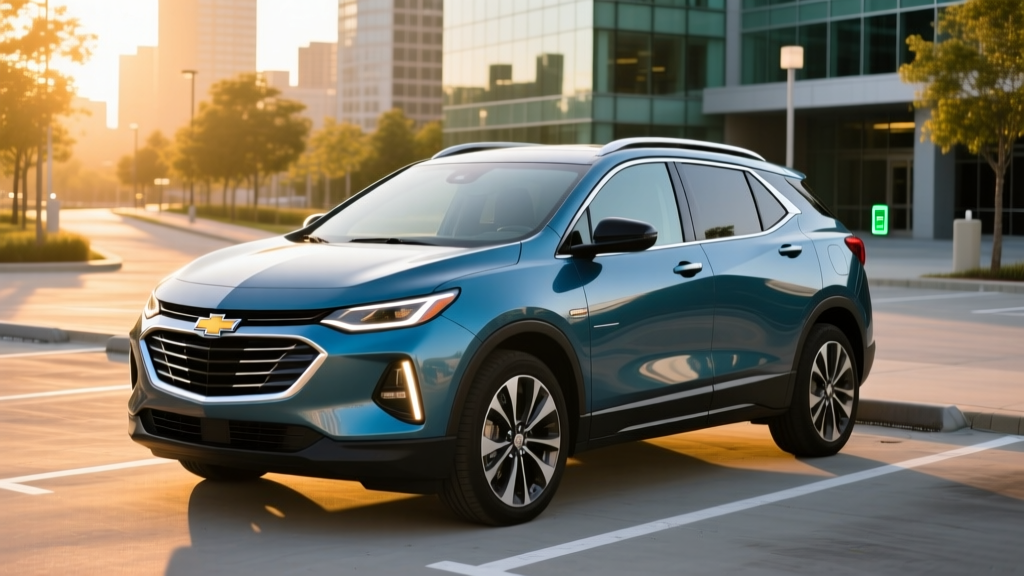
Aggressive Chevy Equinox EV lease specials are dominating dealer ads and EV forums in early 2026, with some offers advertising monthly payments under $300. But before you sign, the math needs scrutiny: a cheap lease only matters if the total cost of ownership — fuel, insurance, maintenance, depreciation, and incentives — actually beats the gas Equinox and rival EVs. We ran the numbers on the 2026 Equinox EV (LT and RS trims, 85 kWh usable NMC battery, up to 319 miles EPA) to show what you'll actually spend over five years.
What the Current Chevy Equinox EV Lease Specials Look Like
Nationally advertised lease offers on the 2026 Equinox EV LT 2 typically hover around $299–$379/month for 36 months with $2,500–$3,999 due at signing, depending on the region and dealer add-ons. GM Financial frequently layers bonus cash on top of federal and state incentives, and some dealers stack loyalty or conquest cash. The catch: these headline numbers usually assume top-tier credit (740+), a 10,000-mile annual cap, and exclusion of tax, title, and destination. Real-world "out the door" first-month costs often land closer to $4,500–$5,500.
Compare that to a purchase at the current MSRP of $33,600 for the LT 2 (before destination) and the lease starts to look less like a bargain and more like a way to defer the depreciation risk — which, for EVs in 2026, is a legitimate concern worth addressing head-on.
5-Year Total Cost of Ownership: Equinox EV vs Gas Equinox
To understand whether those lease specials actually save money, we modeled a 5-year/60,000-mile ownership cycle using EPA efficiency data, AAA electricity and fuel pricing, and industry depreciation curves. The table below assumes home Level 2 charging at $0.16/kWh (national average residential rate) and $3.60/gallon regular unleaded.
| Category | 2026 Equinox EV LT 2 | 2026 Equinox Gas AWD |
|---|---|---|
| Purchase / Lease Outlay | $33,600 MSRP (or ~$18,500 over 60-mo lease) | $30,200 MSRP |
| Federal Tax Credit (§30D) | −$7,500 (if eligible) | $0 |
| Fuel / Electricity | $3,060 (18,000 kWh) | $7,560 (2,100 gal) |
| Maintenance | $1,450 | $3,100 |
| Insurance (5-yr avg) | $11,800 | $9,400 |
| Depreciation (est.) | $16,200 (48%) | $13,100 (43%) |
| Net 5-Year Cost | ~$26,110 | ~$37,160 |
Federal Tax Credit: Do You Actually Qualify?
The Equinox EV is assembled in Ramos Arpe, Mexico, but GM has structured the battery pack and critical-mineral sourcing to qualify for the full $7,500 under current IRS §30D rules. However, "qualifying vehicle" is only half the equation — you must also clear buyer-level hurdles. Use this checklist before counting the credit in your budget:
- MSRP cap: Must be ≤ $55,000 for SUVs (Equinox EV qualifies at ~$33,600–$43,400 depending on trim).
- Buyer AGI limits: ≤ $150,000 single / $225,000 head of household / $300,000 married filing jointly.
- Battery sourcing: At least 80% of critical minerals and 100% of battery components must meet North American or FTA-partner thresholds for 2026 model year — verify via the VIN lookup tool at fueleconomy.gov.
- Point-of-sale transfer: You can apply the credit as a down-payment reduction at the dealer instead of waiting for tax-day. Requires IRS seller registration and a signed election form.
- Lease loophole: If you exceed the income cap, leasing routes the credit through the lessor (GM Financial), which may pass savings through as "lease cash" — but it's not guaranteed.
Rules under §30D have shifted multiple times since 2023 and are scheduled for further tightening in 2027. Confirm eligibility the week you buy, not the month you research — confirm with a tax professional or the IRS clean vehicle credits page.
Charging vs Gas: The Per-Mile Math
The Equinox EV averages about 3.0 miles per kWh (EPA combined). At $0.16/kWh residential, that's roughly $0.053 per mile. The gas Equinox AWD at 26 MPG combined costs $0.138 per mile at $3.60/gallon — 2.6× more per mile. Here's how those numbers translate across common scenarios:
| Scenario | Equinox EV $/mi | Gas Equinox $/mi |
|---|---|---|
| Home Level 2 ($0.16/kWh) | $0.053 | $0.138 |
| Public DCFC ($0.45/kWh) | $0.150 | $0.138 |
| Time-of-use off-peak ($0.09/kWh) | $0.030 | $0.138 |
The takeaway: Home charging is where the EV wins decisively. If you rely exclusively on public DC fast chargers (peak at 150 kW on the Equinox EV, 10–80% in about 34 minutes), the cost advantage evaporates. Install a Level 2 home charger — budget $600–$1,800 for equipment and electrician work — to lock in the savings.
Maintenance Savings: Where EVs Quietly Win
The Equinox EV eliminates oil changes, transmission fluid, spark plugs, timing belts, and exhaust system service. Regenerative braking extends pad life dramatically — many owners report 60%+ pad material remaining at 60,000 miles. Here's a realistic 5-year maintenance comparison:
| Service Item | Equinox EV | Gas Equinox |
|---|---|---|
| Oil & filter (6×) | $0 | $420 |
| Transmission fluid | $0 | $180 |
| Brake pads (1 set vs 2+) | $280 | $560 |
| Cabin air filter | $120 | $120 |
| Tire rotation & replacement | $850 | $780 |
| Coolant & misc. | $200 | $340 |
| Total | $1,450 | $3,100 |
Note the tire line: EVs wear tires ~15–20% faster due to instant torque and higher curb weight (the Equinox EV weighs ~4,700 lbs vs ~3,600 lbs gas). Budget for one extra tire set over five years.
The Insurance Reality Check
This is where the Equinox EV quietly costs more. Average annual premiums run $2,360 for the EV versus $1,880 for the gas model — a 25% premium. Insurers price EVs higher because battery packs are expensive to replace after collisions, repair networks are smaller, and parts availability lags ICE vehicles. GEICO, Progressive, and State Farm all quote EV-specific rates, and bundling home+auto can shave 10–15%. Always run a VIN-specific quote before signing — don't rely on national averages.
Depreciation: The Lease-vs-Buy Wildcard
EV depreciation has been volatile since 2022's price-war reset. The Equinox EV is projected to retain roughly 52% of MSRP after 5 years / 60,000 miles — slightly worse than the gas Equinox at ~57%. Two forces are at play: aggressive new-EV incentives suppress used values, and battery health uncertainty makes private buyers cautious. GM's 8-year/100,000-mile battery warranty (covering loss below 70% capacity) partially offsets this.
This is exactly why the lease specials are attractive: you push depreciation risk onto GM Financial. If residual values fall short of projections, that's their problem, not yours. If battery tech leaps forward and today's Equinox EV feels dated by 2029, you simply return the keys.
Decision Framework: Lease, Buy, or Walk Away?
Lease the Equinox EV if: You qualify for the §30D credit via the lease loophole (income cap workaround), you want to avoid depreciation risk, you drive under 12,000 miles/year, and you have reliable home Level 2 charging.
Buy the Equinox EV if: You qualify for the full $7,500 point-of-sale credit, plan to keep the car 7+ years, drive 15,000+ miles/year (lease overage penalties are brutal), and want to capture the full fuel savings.
Consider the gas Equinox or a hybrid if: You lack home charging access, drive in extreme cold climates regularly (15–25% range loss below 20°F), or plan to tow more than the EV's 1,500-lb rating.
Frequently Asked Questions
How much does it really cost to own an Equinox EV over 5 years?
Approximately $26,100 net after the federal credit, versus $37,200 for the gas version — a ~$11,000 advantage, assuming home charging and credit eligibility. Without the credit, the gap narrows to ~$3,500.
Do I qualify for the $7,500 federal tax credit?
Only if your AGI is under $150K (single) / $300K (joint), the VIN confirms compliant battery sourcing, and MSRP is under $55K. Use the fueleconomy.gov VIN tool and confirm with a tax professional.
How much do I save on fuel and maintenance?
Roughly $4,500 in fuel and $1,650 in maintenance over 5 years / 60,000 miles — totaling about $6,150 in operational savings versus the gas Equinox.
Are EVs more expensive to insure?
Yes, typically 15–30% higher than equivalent gas vehicles due to battery replacement costs and specialized repair networks. Expect ~$480/year more for the Equinox EV.
How well do EVs hold their value?
Currently worse than gas counterparts — the Equinox EV is projected at ~48–52% retention after 5 years vs ~57% for the gas model. This makes leasing a compelling hedge against further depreciation volatility.
What's the real-world range vs EPA?
EPA rates the FWD LT at 319 miles. Expect 250–275 miles in mixed real-world driving, and 220–240 miles in sustained highway/cold-weather conditions. The 85 kWh battery and 150 kW peak DC charge rate (10–80% in ~34 min) are adequate for road trips with planning.