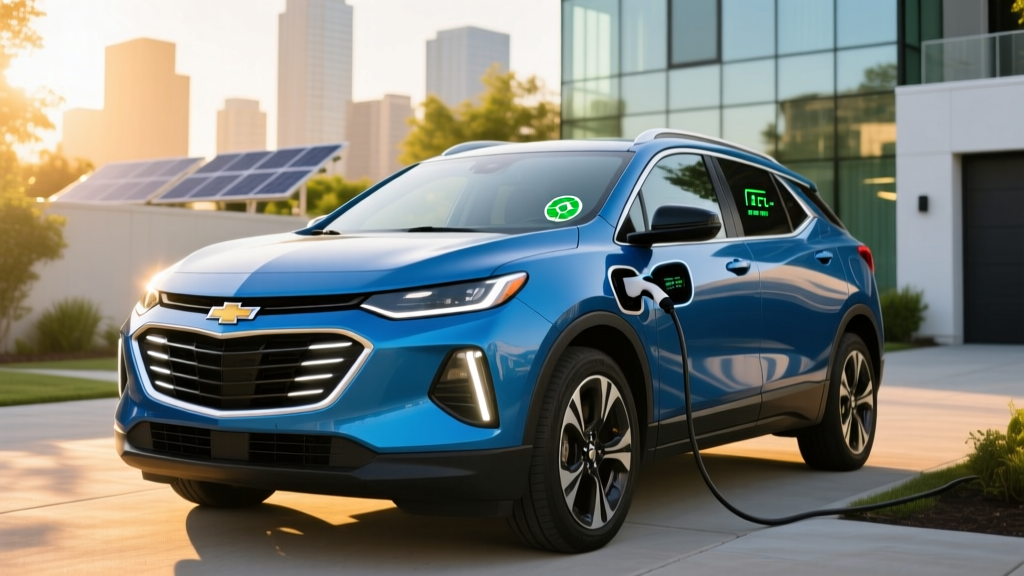
The 2026 Chevrolet Equinox EV remains one of the most affordable long-range electric crossovers on the market, with an EPA-estimated range of up to 319 miles and a starting MSRP that undercuts most rivals. But the sticker price is only half the equation. For buyers researching Chevy Equinox EV incentives, the real question is what this SUV costs to own over five years — after federal tax credits, state rebates, home charging savings, and the realities of EV insurance and depreciation.
We've run the numbers using current 2026 IRS §30D rules, EPA efficiency data, real-world electricity rates, and insurance benchmarks. Here's exactly what to expect.
2026 Chevy Equinox EV: Key Specs at a Glance
Before calculating ownership costs, here are the figures that drive them. The Equinox EV is built on GM's Ultium platform with an NMC (nickel manganese cobalt) lithium-ion battery pack.
| Spec | 2LT (FWD) | 3LT (FWD) | RS (AWD) |
|---|---|---|---|
| Base MSRP | $33,600 | $36,300 | $43,400 |
| Usable Battery | 85 kWh (NMC, Ultium) | ||
| EPA Range | 319 mi | 319 mi | 285 mi |
| Real-World Range (highway/cold) | ~255–280 mi | ~255–280 mi | ~230–255 mi |
| Efficiency (MPGe) | 117 MPGe | 117 MPGe | 104 MPGe |
| DC Fast Charge (peak) | 150 kW; 10–80% in ~30 min | ||
| Level 2 Charge Rate | 11.5 kW (~34 mi/hr) | ||
| Horsepower | 213 hp | 213 hp | 288 hp |
| 0–60 mph | ~8.0 sec | ~8.0 sec | ~6.5 sec |
| Battery/Powertrain Warranty | 8 years / 100,000 miles | ||
Federal Tax Credit: Do You Qualify for Up to $7,500?
The federal EV tax credit under IRS §30D remains the single largest incentive for Equinox EV buyers, but eligibility depends on four interlocking requirements. As of 2026, the credit can be transferred to the dealer at point of sale — meaning you can take it as an immediate price reduction rather than waiting to claim it on your tax return.
- Vehicle MSRP Cap: SUVs, vans, and pickups must have an MSRP ≤ $80,000. All Equinox EV trims qualify.
- Buyer Income Cap (Modified AGI): $150,000 single filer / $225,000 head of household / $300,000 joint filers. Income is checked against the year of delivery or the prior year — whichever is lower.
- Battery Component Manufacturing: Battery components must be manufactured or assembled in North America (percentage threshold increases annually through 2029).
- Critical Minerals Sourcing: A required percentage of critical minerals must be sourced from the U.S. or a free-trade-agreement country (threshold rises each year).
- Final Assembly: Vehicle must undergo final assembly in North America. The Equinox EV is built at GM's Spring Hill, Tennessee plant — qualifies.
- Point-of-Sale Transfer: You can transfer the credit to the dealer for an instant price reduction, or claim it on your federal return using IRS Form 8936.
The Equinox EV has consistently qualified for the full $7,500 credit since launch, meeting both battery-component and critical-minerals requirements. However, sourcing thresholds tighten each year under the Inflation Reduction Act. Always verify current eligibility on the DOE/EPA fueleconomy.gov tax credit page before purchasing, as component sourcing can shift model year to model year.
Effective price after credit: A 2026 Equinox EV 2LT at $33,600 MSRP drops to approximately $26,100 with the full $7,500 point-of-sale transfer — before any state incentives or dealer discounts.
State, Local, and Utility Incentives
Federal credits stack with state and utility programs, which vary dramatically by region. Here are representative examples for 2026 — always verify with your local DMV and utility provider, as programs change frequently.
- California: CVRP rebate up to $7,000 for income-eligible buyers; additional $1,500 for low-income households in disadvantaged communities.
- Colorado: State EV tax credit of $5,000 for vehicles under $80,000 MSRP.
- New Jersey: Up to $4,000 point-of-sale rebate via Charge Up NJ (income-tiered).
- Utility Rebates: Many utilities offer $250–$1,500 for EV purchase or Level 2 charger installation. Examples: PG&E ($800), ConEdison ($1,000 in select areas), Xcel Energy ($550).
- HOV Lane Access: Several states (CA, CO, FL, GA, MD, NJ, NY, VA) grant solo HOV lane access for EVs — a significant non-cash incentive in congested metro areas.
Note: State incentive amounts and availability vary by jurisdiction, funding availability, and applicant income. Consult your state energy office or official program website for current details.
5-Year Total Cost of Ownership: Equinox EV vs. Gas Equinox
To understand real savings, we compared the 2026 Equinox EV 2LT against the gas-powered 2026 Chevy Equinox LT (1.5L turbo, FWD, EPA 26/31/28 MPG combined) over five years and 75,000 miles of driving (15,000 miles/year).
| Cost Category (5 Years) | Equinox EV 2LT | Gas Equinox LT (1.5T FWD) |
|---|---|---|
| Purchase Price (MSRP) | $33,600 | $30,100 |
| Federal Tax Credit | −$7,500 | $0 |
| Effective Purchase Price | $26,100 | $30,100 |
| Fuel / Charging Cost | $3,940 | $9,430 |
| Maintenance | $1,800 | $4,200 |
| Insurance (est. average) | $9,750 | $7,500 |
| Estimated Depreciation | $11,200 | $12,800 |
| 5-Year Total Cost | $52,790 | $64,030 |
Assumptions: 15,000 mi/yr; electricity at $0.16/kWh national average (80% home L2, 20% DCFC at $0.40/kWh); gasoline at $3.40/gal; insurance based on national EV average premium differential; maintenance includes tire rotation, cabin filter, fluid top-offs (EV) vs. oil changes, filters, brake service (gas). Depreciation estimated at 50% residual for EV, 42% for gas over 5 years based on recent market trends. Actual costs vary by region, driving habits, and market conditions.
Charging vs. Gasoline: The Per-Mile Math
This is where the Equinox EV delivers its most consistent savings. The FWD model's efficiency of 117 MPGe translates to roughly 29 kWh per 100 miles of driving (or 3.45 mi/kWh).
| Scenario | Cost Per Mile | Annual Cost (15k mi) |
|---|---|---|
| Home Level 2 ($0.16/kWh) | $0.046 | $694 |
| DC Fast Charging ($0.40/kWh) | $0.116 | $1,738 |
| Blended (80% home / 20% DCFC) | $0.060 | $900 |
| Gas Equinox (28 MPG, $3.40/gal) | $0.121 | $1,821 |
With predominantly home charging, the Equinox EV costs roughly half per mile compared to the gas Equinox. Even relying entirely on public DC fast charging — the most expensive option — the EV's fuel cost is comparable to or slightly below gasoline at current prices.
The savings widen further if your utility offers time-of-use (TOU) rates. Charging overnight at off-peak rates of $0.08–$0.10/kWh drops the cost per mile to $0.029–$0.035, or roughly $430–$520 annually for 15,000 miles.
Maintenance Savings: Fewer Parts, Less Wear
The Ultium-based Equinox EV eliminates the maintenance items that dominate gas-car service schedules:
| Maintenance Item | Gas Equinox (5-yr cost) | Equinox EV (5-yr cost) |
|---|---|---|
| Oil Changes (synthetic, ~2x/yr) | $750 | $0 |
| Engine Air Filter | $200 | $0 |
| Transmission Fluid | $250 | $0 |
| Brake Pads/Rotors | $800 | $150 (regen extends life 2–3x) |
| Spark Plugs | $300 | $0 |
| Tire Rotation & Replacement | $1,900 | $2,100 (EVs are heavier, torque-heavy) |
| Cabin Air Filter, Wipers, Fluid | $400 | $400 |
| Total | $4,600 | $2,650 |
Regenerative braking is the unsung maintenance saver. Because the electric motor recaptures kinetic energy during deceleration, the friction brakes see dramatically less use. Many EV owners report original brake pads lasting 100,000+ miles. The main maintenance cost that's slightly higher for EVs: tires. The Equinox EV's additional weight (~4,500 lbs vs. ~3,400 lbs for the gas model) and instant torque accelerate tire wear by roughly 15–20%.
Insurance: The Cost EV Owners Don't Anticipate
Here's the honest downside. EV insurance premiums are typically 15–30% higher than equivalent gas vehicles. For the Equinox EV, expect annual premiums in the $1,800–$2,100 range nationally, compared to $1,400–$1,600 for the gas Equinox.
The reasons are structural:
- Higher repair costs: Battery pack damage in a collision can total a vehicle that would otherwise be repairable. High-voltage system repairs require specialized training and equipment.
- Parts cost: Ultium battery modules, power electronics, and EV-specific components carry higher replacement costs than a 1.5L turbo engine and 6-speed automatic.
- Total-loss frequency: Insurers are more likely to declare an EV a total loss after undercarriage or battery-adjacent damage due to safety protocols.
Shop quotes from multiple carriers — some insurers (GEICO, Progressive, State Farm) have narrowed the EV premium gap, while others still price EVs at a significant markup. Bundling home and auto often helps.
Depreciation and Resale Value Trends
EV depreciation has been volatile. From 2022–2024, used EV values dropped sharply due to Tesla price cuts, rising new-EV inventory, and consumer hesitation over battery longevity. By 2025–2026, the market has stabilized somewhat, but EVs still depreciate faster on average than their gas counterparts in the first three years.
For the Equinox EV specifically:
- 5-year projected residual value: ~45–55% of MSRP, depending on trim, mileage, and market conditions.
- Key depreciation risk: If GM introduces a significantly cheaper or longer-range successor, current models will lose value faster. Battery technology improvements (solid-state, LFP cost reductions) can accelerate obsolescence.
- Depreciation mitigation: The 8-year/100,000-mile battery and powertrain warranty provides residual-value support. Transferable warranties help used-EV resale.
- Compared to gas Equinox: The gas model depreciates from a lower purchase price, so absolute dollar depreciation is comparable — but the EV's higher initial MSRP means more capital at risk.
The federal tax credit effectively reduces your cost basis. If you buy at $33,600 and take the $7,500 credit, your effective purchase is $26,100. Even if the vehicle depreciates to $15,000 after five years (56% of original MSRP), your actual loss is $11,100 against your $26,100 effective cost — a 42.5% loss on cash invested, which is competitive with the gas model's depreciation.
Putting It All Together: Who Saves and Who Doesn't
- You qualify for the full $7,500 federal credit (income and sourcing requirements met).
- You can charge at home (Level 2) for the majority of your driving.
- You drive 12,000+ miles per year (higher mileage = greater fuel savings).
- You live in a state with additional rebates or HOV lane access.
- You plan to keep the vehicle 5+ years (amortizing the higher insurance cost).
- You exceed the §30D income caps and don't qualify for the federal credit.
- You lack access to home or workplace charging and must rely on expensive public DCFC.
- You drive fewer than 8,000 miles per year (fuel savings don't offset the premium).
- You live in a state with no additional EV incentives and high electricity rates ($0.25+/kWh).
Frequently Asked Questions
How much does it really cost to own a Chevy Equinox EV over 5 years?
With the $7,500 federal tax credit, predominantly home charging, and 15,000 miles per year, the 2026 Equinox EV 2LT costs approximately $52,000–$55,000 over five years including purchase, charging, insurance, maintenance, and depreciation. That's roughly $10,000–$12,000 less than the comparable gas Equinox over the same period, though individual results depend heavily on electricity rates, insurance premiums, and state incentives.
Do I qualify for the $7,500 federal tax credit on the Equinox EV?
You likely qualify if your modified adjusted gross income is under $150,000 (single) or $300,000 (joint), the vehicle MSRP is under $80,000 (all trims qualify), and the battery meets current-year sourcing requirements. The Equinox EV has consistently met battery-component and critical-mineral thresholds. Verify on fueleconomy.gov and consult a tax professional for your specific situation. The credit can be applied at point of sale as an immediate price reduction.
How much do I save on fuel and maintenance vs. a gas Equinox?
Combined fuel and maintenance savings typically run $5,000–$7,000 over five years at 15,000 miles/year. Charging at home at $0.16/kWh saves roughly $900/year vs. gasoline at $3.40/gallon. Maintenance savings add another $400–$500/year from eliminated oil changes, reduced brake wear, and fewer fluid services.
Are EVs more expensive to insure than gas cars?
Yes, typically 15–30% more. For the Equinox EV, expect roughly $300–$500 more per year in insurance premiums compared to the gas Equinox. This is driven by higher repair costs, battery replacement expenses, and specialized labor requirements. Over five years, the insurance premium adds approximately $2,000–$2,500 to your total cost — a real offset against fuel and maintenance savings.
How well does the Equinox EV hold its value?
Current projections estimate 45–55% residual value after five years / 75,000 miles. EV depreciation has been steeper than gas vehicles in recent years due to rapid technology advancement and price competition. However, the Equinox EV's accessible price point, 319-mile range, and 8-year/100,000-mile battery warranty provide some depreciation support. The federal tax credit also effectively reduces your cost basis, making your net depreciation loss more competitive.
Can I stack the federal credit with state and utility incentives?
Yes — federal, state, and utility incentives stack independently. A buyer in Colorado, for example, could combine the $7,500 federal credit with a $5,000 state credit and a $550 utility charger rebate, reducing a $33,600 MSRP to roughly $20,550 out of pocket. Always verify current program availability and eligibility, as state programs can exhaust funding or change terms.