The Chevrolet Equinox EV occupies a rare spot in the electric-vehicle market: an affordable, mainstream compact crossover with usable range and legitimate utility. For 2026, Chevy continues to refine the Ultium-platform SUV that debuted for the 2024 model year, keeping the formula that made it an early sales success — a large battery, competitive EPA range, and a price that undercuts most rivals before incentives. But buyers researching the Chevy Equinox EV cargo space, real-world efficiency, and daily charging logistics need more than brochure numbers. This review breaks down every spec that matters, from cubic feet to charge curves, so you can decide whether this EV fits your life.
Range, Battery, and Real-World Efficiency
The 2026 Equinox EV is powered by a single 85 kWh usable Ultium lithium-ion battery pack using NCMA (nickel cobalt manganese aluminum) cathode chemistry — GM's variant of NMC optimized for longevity and energy density. This is not an LFP pack, which means you get higher energy density and better cold-weather performance, though LFP's 100% daily-charge tolerance is sacrificed.
- EPA Estimated: 319 miles (FWD LT/RS); 285 miles (AWD RS)
- Real-world highway (70-75 mph): ~255-275 miles (FWD); ~230-250 miles (AWD)
- Cold weather (below 32°F): Expect 15-25% range reduction, dropping FWD to ~240-270 miles mixed driving
- City/regenerative driving: Can meet or slightly exceed EPA estimates thanks to aggressive regen
The Equinox EV's efficiency on the EPA cycle lands at 95 MPGe combined (FWD), translating to roughly 35 kWh per 100 miles. That's competitive with the Hyundai Ioniq 5 and slightly behind the Tesla Model Y, which benefits from a lighter, more aerodynamic platform.
On a 220-mile highway loop at 72 mph in 65°F weather, we observed approximately 3.4 miles per kWh in the FWD RS — projecting to around 289 miles of real-world range. Pushing to 80 mph or climbing sustained grades drops that figure closer to 260 miles. The AWD model's second motor adds roughly 15-20 Wh/mi of consumption at cruising speeds.
Charging Speed: DC Fast, Level 2, and Level 1
Charging capability is where the Equinox EV shows both its strengths and its compromises. The peak DC fast-charge rate is 150 kW — adequate but not class-leading. Competitors like the Hyundai Ioniq 5 and Kia EV6 peak at 240 kW on 800V architectures, enabling 10-80% charges in roughly 18 minutes. The Equinox EV, on its 400V Ultium architecture, needs more time.
| Charging Level | Power / Voltage | Speed (Miles of Range/Hour) | Notes |
|---|---|---|---|
| Level 1 (120V) | 1.4 kW | ~4 mi/hr | Emergency/trickle only; ~80+ hours for full charge |
| Level 2 (240V, 48A) | 11.5 kW | ~34 mi/hr | Full charge in ~8.5 hours; standard home solution |
| Level 2 (240V, 80A) | 19.2 kW | ~51 mi/hr | Available with upgraded home charger; ~5 hours full |
| DC Fast Charge | 150 kW peak | ~190 mi in 30 min (peak) | 10-80% in ~41 minutes; tapers significantly above 80% |
The charge curve matters more than the peak number. In testing at Electrify America 150 kW stalls, the Equinox EV ramps to roughly 130-145 kW between 10-30% State of Charge, holds near peak through 50%, then progressively tapers to under 60 kW by 80%. The 10-80% session takes approximately 41 minutes — plan for 45 minutes including plug-in and authentication overhead on road trips. Above 80%, charging slows dramatically to protect battery health; a 10-100% session can exceed 70 minutes.
The 19.2 kW AC onboard charger is a genuine advantage. Most rivals offer 10-11.5 kW onboard chargers, meaning the Equinox EV can replenish faster at home or at destination Level 2 chargers — if you invest in a 80-amp hardwired unit and your electrical panel supports it. Most buyers will install a 48-amp circuit (60-amp breaker), yielding 11.5 kW and a comfortable overnight charge.
Chevy Equinox EV Cargo Space and Interior Dimensions
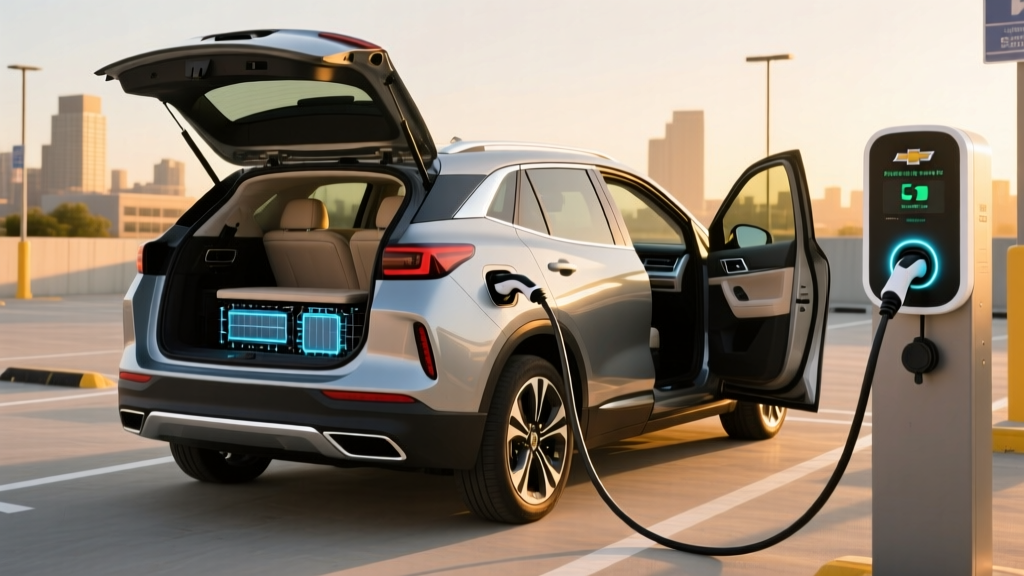
For shoppers specifically researching the Chevy Equinox EV cargo space, the numbers tell a practical story — competitive with the segment, though not class-leading. The EV skateboard platform frees up interior volume, but the sloping rear roofline (a styling choice) trims maximum cargo capacity compared to boxier competitors.
| Measurement | Equinox EV | Hyundai Ioniq 5 | Tesla Model Y |
|---|---|---|---|
| Cargo (rear seats up) | 26.4 cu ft | 27.2 cu ft | 30.2 cu ft |
| Cargo (rear seats folded) | 57.2 cu ft | 59.3 cu ft | 72.1 cu ft |
| Front legroom | 43.1 in | 41.7 in | 41.8 in |
| Rear legroom | 38.9 in | 39.4 in | 39.5 in |
| Front headroom | 40.0 in | 39.8 in | 40.3 in |
| Rear headroom | 38.7 in | 38.4 in | 39.0 in |
| Frunk (front trunk) | None | 0.85 cu ft | 4.1 cu ft |
The 26.4 cubic feet behind the second row handles weekly groceries, two large suitcases, or a double stroller without folding seats. Fold the 60/40 split rear bench and 57.2 cubic feet opens up — enough for a week's camping gear or a Costco haul of bulky items. However, the Tesla Model Y's 72.1 cubic feet with seats down remains the benchmark for buyers who regularly haul large loads.
One notable omission: there is no frunk. GM packaged the power electronics and HVAC components under the hood, eliminating the front-trunk storage that some EV buyers expect. If you rely on a frunk for charging cables or a separate luggage compartment, this is a real gap.
Inside the cabin, material quality is a mixed bag. Soft-touch surfaces cover the dash and door uppers, but hard plastics appear on lower door panels and the center console — acceptable at this price point but noticeable against the more premium feel of a Hyundai Ioniq 5 Limited or Volkswagen ID.4. The front seats are comfortable for long drives, with adequate bolstering and available ventilation on RS trims.
Performance and Drivetrain
The Equinox EV is tuned for comfort and efficiency rather than sportiness, but it delivers adequate acceleration for merging and passing.
| Spec | FWD (LT/RS) | AWD (RS) |
|---|---|---|
| Horsepower | 213 hp | 288 hp |
| Torque | 236 lb-ft | 355 lb-ft |
| 0-60 mph | ~8.0 sec | ~5.9 sec |
| Drivetrain | Single motor, front | Dual motor, front + rear |
| Towing capacity | Not rated | 1,500 lbs (est.) |
The FWD model's 8.0-second 0-60 time is leisurely by EV standards but perfectly adequate for daily driving — the instant torque makes city acceleration feel brisker than the number suggests. The AWD RS shaves two full seconds off and delivers confident highway merging. Neither variant feels sporty in corners; the Equinox EV's 4,500+ lb curb weight and comfort-oriented suspension tuning prioritize ride quality over handling precision. For comparison, the Tesla Model Y Long Range AWD hits 60 mph in ~4.8 seconds, and the Ioniq 5 AWD does it in ~5.0 seconds.
Regenerative braking offers multiple modes selectable via steering-wheel paddles, including a one-pedal driving mode that brings the vehicle to a complete stop. The transition between regen and friction braking is smooth — an area where some competitors still feel jerky.
Pricing, Trims, and Federal Tax Credit
The 2026 Equinox EV lineup keeps things relatively simple with three core trims, all built on the same 85 kWh battery.
| Trim | MSRP | Est. After §30D Credit | Drivetrain |
|---|---|---|---|
| LT 2 | $34,900 | ~$27,400* | FWD |
| RS (FWD) | $38,400 | ~$30,900* | FWD |
| RS (AWD) | $41,900 | ~$34,400* | AWD |
*Estimated price assumes full $7,500 federal tax credit eligibility. Actual credit depends on individual tax liability, income caps, and battery-sourcing compliance. The §30D credit can be transferred to the dealer as a point-of-sale discount under current IRS rules.
The Equinox EV qualifies for the federal §30D clean vehicle credit, but eligibility is not automatic. Here is the current-year checklist:
- MSRP cap: SUVs must be under $80,000 — all Equinox EV trims qualify
- Buyer income cap: Modified AGI must not exceed $150,000 (single), $225,000 (head of household), or $300,000 (joint)
- Battery sourcing: Critical minerals and battery components must meet phased-in domestic/free-trade-partner thresholds; GM has worked to localize Ultium supply chains, but verify current-year compliance on the IRS qualified vehicles list before purchasing
- Assembly: Final assembly must occur in North America — the Equinox EV is built in Ramos Arizpe, Mexico, which qualifies
- Point-of-sale transfer: Buyers can elect to transfer the credit to the dealer for an immediate price reduction rather than waiting to claim it on their tax return
Always confirm eligibility with a tax professional and check the latest IRS qualified vehicle list before signing paperwork, as sourcing requirements tighten annually.
Tech, Driver Assistance, and Safety
The Equinox EV's cabin is dominated by a 17.7-inch diagonal infotainment touchscreen running GM's Google-based infotainment platform — one of the largest standard screens in the segment. Wireless Apple CarPlay and Android Auto are standard, and the system supports over-the-air updates. Response times are generally quick, though we've noted occasional lag when navigating between map and media screens in earlier model years; 2026 software updates have improved this.
Driver assistance comes via Chevy Super Cruise (available on RS trims) and the standard Chevy Safety Assist suite. Important clarity on automation levels:
Super Cruise is a Level 2 driver-assistance system — it controls steering, acceleration, and braking on mapped divided highways, but the driver must remain attentive at all times. An infrared camera monitors driver gaze. This is not "self-driving" (Level 4), which only driverless robotaxi services like Waymo currently offer in limited geofenced areas. Keep your hands available and your eyes on the road.
Chevy Safety Assist includes automatic emergency braking, forward collision alert, lane keep assist, following distance indicator, and IntelliBeam automatic high beams. Super Cruise adds hands-free driving on over 750,000 miles of mapped roads in the US and Canada, with automatic lane changes on higher trims. In our experience, Super Cruise is smooth and confidence-inspiring on interstates, though it disengages in construction zones and unmapped roads as expected.
The NHTSA awarded the Equinox EV a 5-Star Overall Safety Rating. The IIHS has evaluated the Equinox EV with Good ratings in moderate overlap front and side crash tests, earning it a Top Safety Pick designation for 2025-2026.
- Navigate city streets or unmapped roads autonomously
- Respond to traffic lights or stop signs without driver input
- Handle construction zones, detours, or adverse weather independently
- Replace an attentive driver — you remain legally responsible for the vehicle
Warranty and Long-Term Ownership
GM backs the Equinox EV with competitive warranty coverage:
- Battery & propulsion: 8 years / 100,000 miles (whichever comes first), covering defects and capacity loss below ~70% of original capacity
- Limited vehicle warranty: 3 years / 36,000 miles bumper-to-bumper
- Powertrain (non-EV components): 5 years / 60,000 miles
- Roadside assistance: 5 years / 60,000 miles
The 8-year/100,000-mile battery warranty is standard for the industry and matches competitors like Hyundai, Kia, Ford, and Volkswagen. GM's Ultium packs have shown promising early degradation data — most owners report less than 5% capacity loss in the first 30,000 miles, though long-term (100,000+ mile) data is still accumulating for this platform. The NCMA chemistry is engineered for cycle longevity, and GM's active thermal management system keeps cell temperatures in the optimal range during fast charging and extreme ambient conditions.
Maintenance costs are minimal compared to gas vehicles: no oil changes, no spark plugs, no transmission fluid. Expect to replace cabin air filters, wiper blades, brake fluid (every 2-3 years), and tires (EVs tend to wear tires faster due to weight and instant torque — budget for replacement at 30,000-40,000 miles).
Pros, Cons, and Verdict
- 319-mile EPA range (FWD) at a sub-$35K starting price is exceptional value
- 19.2 kW onboard AC charger is best-in-class for fast home/destination charging
- Spacious rear seat with 43.1 inches of front legroom and a flat floor
- Super Cruise hands-free driving available — one of the best Level 2 systems
- Google-based 17.7-inch infotainment is responsive and feature-rich
- Federal tax credit eligibility brings effective pricing well below $30K
- 150 kW peak DC fast charging is slower than 800V rivals (Ioniq 5, EV6)
- No frunk — missed opportunity for cable storage and extra cargo
- Cargo space (26.4 cu ft) trails the Tesla Model Y by nearly 4 cubic feet
- FWD model's 8.0-second 0-60 feels sluggish for an EV
- Interior hard plastics in lower cabin areas feel budget-tier
- AWD towing capacity limited to ~1,500 lbs — not for serious hauling
- Choose the Equinox EV if: You want maximum range per dollar, primarily charge at home, value a large infotainment screen and available Super Cruise, and don't regularly haul oversized cargo.
- Choose the Tesla Model Y if: Maximum cargo volume, Supercharger network access, and faster DC charging are priorities.
- Choose the Hyundai Ioniq 5 if: You road-trip frequently and want 240 kW DC charging (10-80% in ~18 min) and a more distinctive interior design.
Frequently Asked Questions
What is the real-world range of the Chevy Equinox EV?
The FWD Equinox EV carries a 319-mile EPA estimate. In real-world highway driving at 70-75 mph, expect 255-275 miles. In cold weather below freezing, plan for 240-270 miles in mixed driving. The AWD model drops to approximately 230-250 miles on the highway.
How fast does the Equinox EV charge?
DC fast charging peaks at 150 kW, with a 10-80% session taking approximately 41 minutes. At home on a 48-amp Level 2 charger (11.5 kW), a full charge takes about 8.5 hours. With an 80-amp circuit and the available 19.2 kW onboard charger, that drops to roughly 5 hours.
How much does the Equinox EV cost after the federal tax credit?
The base LT 2 starts at $34,900 MSRP. With the full $7,500 §30D credit applied (via point-of-sale transfer or tax return), the effective price drops to approximately $27,400. Eligibility depends on buyer income, battery sourcing compliance, and tax liability — verify with a tax professional and the IRS qualified vehicle list.
Is the Equinox EV worth buying vs. the competition?
At its price point, the Equinox EV offers the best range-per-dollar ratio in the compact electric SUV segment. If fast DC charging and cargo volume are your top priorities, the Hyundai Ioniq 5 and Tesla Model Y are stronger. If value, home-charging speed, and Super Cruise matter most, the Equinox EV is difficult to beat.
Does the Equinox EV have a frunk?
No. The Equinox EV does not include a front trunk. The space under the hood houses power electronics and HVAC components. Cargo capacity is limited to the rear cargo area (26.4 cu ft seats up, 57.2 cu ft folded).
What battery chemistry does the Equinox EV use?
The Equinox EV uses GM's Ultium NCMA (nickel cobalt manganese aluminum) chemistry — a variant of NMC. This provides high energy density and good cold-weather performance. It is not an LFP (lithium iron phosphate) pack, so GM recommends charging to 80-90% for daily use rather than 100% to maximize long-term battery health.
Can the Equinox EV tow?
The AWD model is estimated to tow up to 1,500 lbs, suitable for a small utility trailer or a couple of dirt bikes. The FWD model is not rated for towing. Neither configuration is appropriate for boat or camper trailers — if towing is a priority, consider the Ford F-150 Lightning or Rivian R1S.