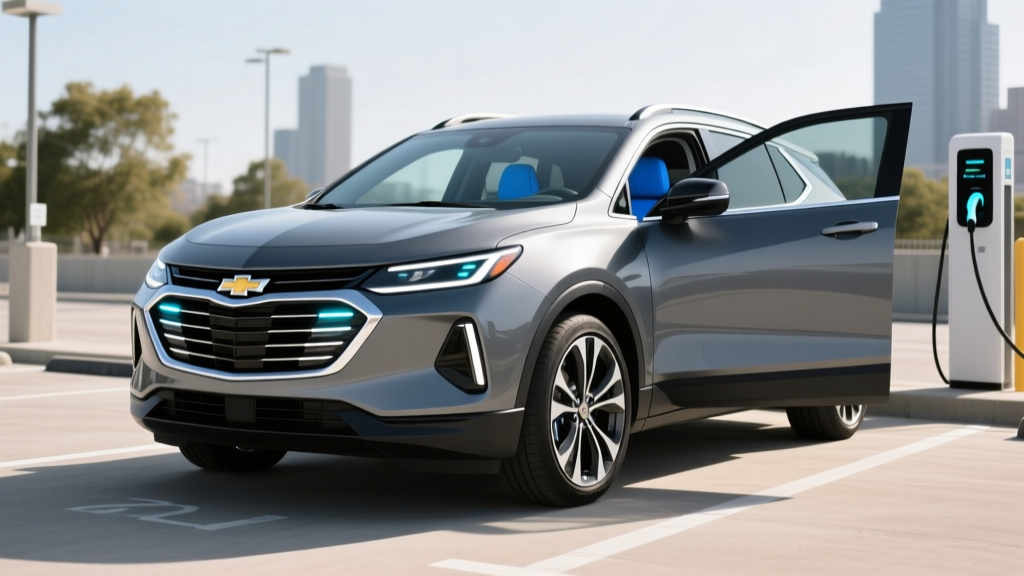
Quick Answer: The 2026 Chevrolet Equinox EV is a compact electric SUV with up to 319 miles of EPA-estimated range, starting at $33,600 MSRP. It qualifies for the full $7,500 federal tax credit (point-of-sale) for eligible buyers, dropping the effective starting price to approximately $26,100. With a usable battery of ~85 kWh and peak DC fast charging at 150 kW (10–80% in ~30 minutes), it targets mainstream buyers who want long range without a luxury price tag.
Real-World Range and Efficiency: Beyond the EPA Sticker
The Equinox EV rides on GM's Ultium platform and is available with front-wheel drive (FWD) or all-wheel drive (eAWD). The FWD models equipped with the larger battery pack achieve an EPA-estimated 319 miles, while eAWD trims are rated at approximately 285 miles. According to fueleconomy.gov, the FWD Equinox EV returns a combined 95 MPGe (35 kWh/100 miles).
EPA vs. Real-World Range: Expect approximately 270–290 miles on a mixed highway commute in moderate temperatures (65–75°F). At sustained 75+ mph highway speeds, range drops to roughly 240–260 miles due to aerodynamic drag. In freezing temperatures (20–30°F) without preconditioning, expect a 20–30% reduction, bringing effective range to 220–255 miles for the 319-mile FWD variant. Always precondition the battery while plugged in to mitigate cold-weather losses.
| Spec | FWD (Large Battery) | eAWD (Large Battery) |
|---|---|---|
| EPA Range | 319 miles | ~285 miles |
| Battery (usable) | ~85 kWh (NMC) | ~85 kWh (NMC) |
| Horsepower | 213 hp | 288 hp |
| 0–60 mph | ~8.0 sec | ~5.9 sec |
| Efficiency (combined) | 95 MPGe / 35 kWh/100mi | ~89 MPGe / 38 kWh/100mi |
| Max DC Charge Rate | 150 kW | 150 kW |
| 10–80% DC Charge | ~30 min | ~30 min |
| Level 2 (240V) Rate | 11.5 kW | 11.5 kW |
Charging Speeds and the Curve Reality
The Equinox EV accepts a peak DC fast-charging rate of 150 kW via its CCS connector (NACS adapter available for Tesla Supercharger access). However, peak rate is not sustained rate. The charge curve tapers significantly above 55% state of charge (SoC). From 10–55%, you'll see rates near 130–150 kW. From 55–80%, that drops to 60–90 kW. Above 80%, charging slows to under 30 kW to protect battery longevity.
This means a 10–80% session takes approximately 30 minutes at a capable 150+ kW station, but if you need to charge past 80% on a road trip, budget an additional 20–25 minutes for that final 20%. Practical road-trip strategy: charge to 80%, drive 180–200 miles, then top up again.
At home on a Level 2 (240V, 48-amp) charger delivering 11.5 kW, a full 0–100% charge takes roughly 9.5 hours. Most owners who plug in overnight will wake up to a full battery every morning. On a standard 120V Level 1 outlet (~1.4 kW), you'll recover about 4 miles of range per hour — adequate only for emergency top-ups or very low daily mileage.
Equinox EV vs. Gas Equinox: The Cost Breakdown
The core question for first-time EV buyers is whether the higher sticker price offsets fuel and maintenance savings. Here's a data-driven comparison using the 2026 Equinox EV LT FWD ($33,600) versus a comparably equipped 2026 gas-powered Equinox LT (~$30,000).
| Cost Factor (5-Year / 75,000 mi) | Equinox EV (FWD) | Gas Equinox (FWD, 28 MPG) |
|---|---|---|
| Purchase Price (MSRP) | $33,600 | $30,000 |
| Federal Tax Credit (§30D) | −$7,500 | $0 |
| Effective Purchase | $26,100 | $30,000 |
| Fuel / Electricity (75k mi) | $3,375 (at $0.15/kWh) | $9,375 (at $3.50/gal) |
| Maintenance (5 yr) | ~$1,200 | ~$3,500 |
| Insurance (est. avg/yr × 5) | $9,500 ($1,900/yr) | $7,500 ($1,500/yr) |
| 5-Year Total Cost | $40,175 | $50,375 |
| Cost Per Mile | $0.54 | $0.67 |
The EV wins decisively on operating costs, saving roughly $10,200 over five years. However, EV insurance premiums run 15–25% higher on average due to repair costs and battery replacement risk. Home charging at residential rates ($0.12–$0.18/kWh depending on your utility) is critical to achieving these savings — frequent DC fast charging at $0.35–$0.48/kWh erodes the fuel-cost advantage substantially.
Charging at Home: What First-Time Buyers Need to Know
Home charging access is the single biggest determinant of EV ownership satisfaction. The Equinox EV's 11.5 kW onboard charger requires a 240V, 60-amp dedicated circuit with a 48-amp Level 2 EVSE (electric vehicle supply equipment) to achieve maximum speed.
| Item | Typical Cost Range |
|---|---|
| Level 2 Charger (hardware) | $300–$700 |
| Electrician (240V/60A circuit run) | $800–$2,500 |
| Permit & inspection | $100–$400 |
| Electrical panel upgrade (if needed, 200A) | $1,500–$3,500 |
| Total (no panel upgrade) | $1,200–$3,600 |
| Total (with panel upgrade) | $2,700–$7,100 |
If your home has a 100-amp electrical panel and you already run central A/C, an electric dryer, and an electric stove, you will likely need a panel upgrade to 200 amps before adding a 60-amp EV circuit. Budget for this possibility. Consult a licensed electrician for a load calculation before purchasing equipment. The residential clean energy credit may cover 30% of charger installation costs (up to $1,000) — confirm eligibility with a tax professional.
Federal Tax Credit Eligibility for the Equinox EV
The Equinox EV is assembled in Ramos Arizpe, Mexico, but GM has structured battery sourcing to qualify for the full $7,500 under IRS §30D rules for 2026. The credit is available as a point-of-sale transfer, meaning the dealer applies it as a down-payment reduction at purchase rather than waiting for a tax refund.
§30D Requirements You Must Meet:
- Income caps: Modified AGI ≤ $150,000 (single), ≤ $300,000 (married filing jointly), ≤ $225,000 (head of household)
- MSRP cap: SUVs/vans/pickups ≤ $80,000; sedans ≤ $55,000 (Equinox EV qualifies)
- Battery sourcing: Critical minerals and battery components must meet phased-in domestic/free-trade sourcing thresholds (GM has confirmed compliance for 2026 model year)
- Vehicle must be new and purchased for personal use in the United States
- One credit per VIN; cannot be stacked with the used-EV credit (§25E)
Verify current eligibility on the IRS qualified vehicles list before signing a purchase agreement, as sourcing rules and eligible VINs can change mid-year.
Common Misconceptions About the Equinox EV
| Myth | Fact |
|---|---|
| "319 miles means I'll always get 319 miles." | Highway driving at 75 mph yields ~240–260 miles; cold weather drops it to ~220–255 miles. Plan trips around 200–220 miles between stops for comfort. |
| "DC fast charging takes 30 minutes for a full battery." | The 30-minute figure is 10–80%. Charging from 80–100% takes an additional 25+ minutes due to taper. Road-trip on 10–80% cycles. |
| "The battery will need expensive replacement in 5 years." | GM warrants the Ultium battery for 8 years/100,000 miles against defects and capacity loss below 60%. NMC degradation averages 2–3% per year under normal use; expect ~85–90% capacity at 100,000 miles. |
| "I can use any public charger." | The Equinox EV uses CCS1 natively. Tesla Supercharger access requires GM's approved NACS adapter (included or ~$225). Verify adapter compatibility before relying on Superchargers. |
| "EVs are always cheaper to own." | If you lack home charging and rely entirely on DC fast charging at $0.40+/kWh, your fuel costs rise to ~$0.06–$0.08/mile — still below gas, but the 5-year savings shrink by $3,000–$4,000. |
Decision Framework: Is the Equinox EV Right for You?
Choose the Equinox EV if:
- You have (or can install) Level 2 home charging and drive under 250 miles daily
- You qualify for the $7,500 federal credit (income and sourcing requirements met)
- You want a mainstream-compact SUV with class-leading range at a sub-$35,000 starting price
- You value low running costs and are willing to pay slightly higher insurance premiums
- You primarily drive in moderate climates or can precondition in cold weather
Consider a gas Equinox or a PHEV alternative if:
- You live in an apartment or street-park with no realistic home-charging option
- You regularly tow (Equinox EV is not rated for towing; gas Equinox tows up to 1,500 lbs)
- You frequently drive 400+ mile one-way trips through charging-sparse regions
- Your household income exceeds §30D caps, eliminating the $7,500 price advantage
- You need a sub-$25,000 purchase price today and cannot absorb the EV premium pre-credit
Frequently Asked Questions
How long does the Equinox EV battery last?
GM covers the Ultium battery with an 8-year/100,000-mile warranty that guarantees the battery will retain at least 60% of its original capacity. Real-world NMC degradation data from similar Ultium-based vehicles suggests 85–90% state of health at 100,000 miles with normal charging habits (avoiding frequent 100% charges and deep discharges).
Can the Equinox EV use Tesla Superchargers?
Yes, but only with GM's approved NACS adapter. The Equinox EV ships with a CCS1 port. GM has offered NACS adapters to eligible owners, and they are available for purchase (~$225) for use at V3 and V4 Supercharger stalls. Confirm adapter availability with your dealer before purchase.
What does it cost to charge the Equinox EV at home?
Charging the ~85 kWh battery from 10% to 100% at a national average residential rate of $0.16/kWh costs approximately $12.24. That delivers roughly 287 real-world miles, equating to about $0.043 per mile — compared to $0.125 per mile for a 28 MPG gas SUV at $3.50/gallon.
Does the Equinox EV qualify for state incentives too?
Possibly, depending on your state. States like Colorado, California, and Massachusetts offer additional rebates or tax credits that can stack with the federal §30D credit. Check your state energy office or the AFDC state incentive database for current programs, as these change frequently.
Is the Equinox EV a good road-trip vehicle?
It's capable, with a caveat. The 319-mile EPA range means comfortable 200-mile legs between DC fast-charge stops on interstates with robust charging infrastructure (I-5, I-95, I-70 corridors). In charging-sparse regions (rural Great Plains, parts of the Southwest), the 150 kW peak charge rate and 30-minute 10–80% time add more downtime than vehicles with 250+ kW charging like the Hyundai Ioniq 5 or Tesla Model Y. Plan routes using A Better Routeplanner or PlugShare before long trips.