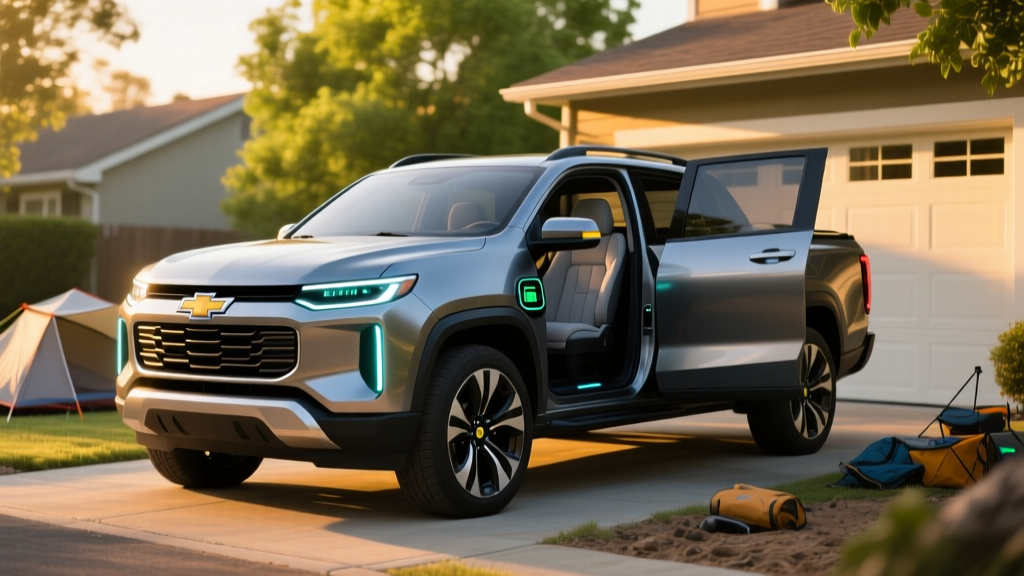
If you've been searching for a Chevy Colorado EV, here's the direct answer: as of early 2026, Chevrolet has not officially announced or released an all-electric Colorado. GM's midsize truck lineup remains powered by the turbocharged 2.7L four-cylinder gasoline engine across all Colorado trims. However, with the Chevrolet Silverado EV already in production and GM committing to an all-electric future by 2035, an electrified Colorado is widely anticipated — though timing, specs, and pricing remain unconfirmed.
Quick Answer: Chevy Colorado EV Status (2026)
Availability: Not announced. No official release date, pricing, or specs from Chevrolet.
Closest current option: Gas-powered 2026 Chevy Colorado (2.7L Turbo, EPA 20-22 MPG combined) or the full-size Chevy Silverado EV (EPA range up to ~380 mi, starting ~$39,600 for fleet trims).
What to watch: GM's next-generation Ultium platform announcements and midsize truck segment moves from Ford and Toyota.
Where the Chevy Colorado EV Stands in GM's Lineup
General Motors has invested heavily in its Ultium battery platform, which underpins the GMC Hummer EV, Cadillac Lyriq, Chevy Blazer EV, Chevy Equinox EV, and the full-size Silverado EV. The current-generation Chevy Colorado, redesigned for the 2023 model year, was engineered exclusively around the 2.7L TurboMax gasoline powertrain — producing up to 310 horsepower and 430 lb-ft of torque on ZR2 and Trail Boss trims.
GM executives have publicly stated that midsize trucks are a priority segment for future electrification, but the company has not committed to a specific Colorado EV timeline. Industry analysts suggest that if a battery-electric Colorado arrives, it would likely share architecture with the Silverado EV's Ultium platform — potentially on a shortened wheelbase to maintain the midsize footprint that distinguishes the Colorado from its full-size sibling.
For truck buyers evaluating their options now, the midsize electric pickup segment remains thin. The Ford Maverick hybrid offers a bridge solution (EPA-estimated 42 MPG city), while the Rivian R1T occupies a premium niche starting above $69,000. The Colorado's traditional competitors — the Toyota Tacoma, Ford Ranger, and Nissan Frontier — also remain gasoline-powered as of 2026, though the Tacoma now offers the i-FORCE MAX hybrid powertrain.
Gas Colorado vs. Electric Trucks: A Cost and Capability Comparison
Understanding whether to wait for a potential Colorado EV or buy the current gas model requires comparing real ownership costs. Below is a side-by-side look at the 2026 Chevy Colorado (gas) against the closest electric truck alternative, the Chevy Silverado EV, across the metrics that matter to truck buyers.
| Attribute | 2026 Chevy Colorado (2.7L Turbo Gas) | 2026 Chevy Silverado EV (3WT / LT) |
|---|---|---|
| Base MSRP | ~$31,900 (WT) | ~$39,600 (3WT fleet) / ~$57,900 (LT) |
| Powertrain | 2.7L Turbo I4, 310 HP, 430 lb-ft | Dual-motor AWD, 510-664 HP (trim-dependent) |
| EPA Fuel Economy / Range | 20-22 MPG combined | ~380 mi EPA (4WT max range battery) |
| Battery / Tank | 21.4-gallon fuel tank | ~200 kWh Ultium (max range), NMC chemistry |
| Refuel / Recharge Time | ~5 minutes at pump | ~350 kW peak DC; 10-80% est. ~20 min |
| Max Towing | 7,700 lbs | 10,000 lbs (WT fleet); 12,500 lbs (future max tow pkg) |
| Payload | 1,640 lbs | ~1,800 lbs (WT) |
| Bed Length | 5'2" (short box) | 5'11" (w/ midgate open: 10'11") |
| Federal Tax Credit (§30D) | Not eligible | Up to $7,500 (subject to MSRP cap, income limits, battery sourcing rules) |
| Drivetrain Warranty | 5 yr / 60,000 mi powertrain | 8 yr / 100,000 mi battery & electric components |
The numbers reveal the core trade-off: the Silverado EV offers substantially more power, a longer effective bed with the midgate, and lower per-mile energy costs — but at a higher entry price and a larger physical footprint that doesn't match the Colorado's midsize maneuverability. A hypothetical Colorado EV would need to thread the needle between the Silverado EV's capability and the gas Colorado's compact dimensions and accessible pricing.
Real-World Ownership Costs: Gas vs. Electric Truck
Whether you're considering the current gas Colorado or waiting for an electric midsize option, the five-year cost picture matters more than the sticker price. Here's a breakdown based on 15,000 miles driven annually, with electricity at $0.14/kWh (national average home rate) and gasoline at $3.40/gallon.
| Cost Category (5 Years / 75,000 mi) | 2026 Colorado Gas (21 MPG avg) | Comparable Electric Midsize Truck (est. 2.0 kWh/mi) |
|---|---|---|
| Purchase Price (est. base) | $31,900 | $45,000 (estimated, if announced) |
| Federal Tax Credit | $0 | Up to $7,500 (if eligible) |
| Net Purchase | $31,900 | $37,500 (est.) |
| Fuel / Energy Cost | ~$12,143 (3,571 gal × $3.40) | ~$4,200 (150,000 kWh × $0.14, est. home charging) |
| Maintenance | ~$3,200 (oil, filters, brakes, fluids) | ~$1,400 (tire rotation, cabin filter, wiper fluid) |
| Insurance (est.) | ~$8,500 | ~$10,200 (EV premiums typically 15-20% higher) |
| 5-Year Total Cost of Ownership | ~$55,743 | ~$53,300 (est.) |
The estimated electric midsize truck breaks even within five years despite a higher starting price, driven primarily by fuel savings of nearly $8,000 and lower maintenance costs. However, this calculation assumes reliable home Level 2 charging and does not factor in potential battery degradation beyond the 8-year/100,000-mile warranty period. For buyers who tow frequently, the energy cost gap narrows — electric trucks can consume 2.5-3.0+ kWh/mi under heavy trailer loads, roughly equivalent to the gas truck's fuel cost per mile.
What a Colorado EV Buyer Should Know Before Waiting
If you're considering holding off on a purchase in anticipation of an electric Colorado, several practical factors should shape your decision.
Home Charging Is Non-Negotiable for Most EV Truck Owners
Electric trucks have large batteries — likely 100-150 kWh for a midsize model — which means Level 1 (120V) charging would add only 2-4 miles of range per hour. A Level 2 home charger (240V, 48A) delivering roughly 11.5 kW is essential for overnight replenishment, adding approximately 30-40 miles per hour of charging. Installation costs typically range from $800 to $2,500 for a straightforward setup, but can exceed $4,000 if your electrical panel needs an upgrade from 100A to 200A service.
Roughly 30% of US households lack access to dedicated home charging (apartments, street parking, rented garages). If you fall into this category, relying on public DC fast charging for a large-battery truck becomes both expensive ($0.35-$0.50/kWh at networks like Electrify America or EVgo) and time-consuming — a 10-80% session on a 150 kWh battery at 200 kW still takes 30-40 minutes, and peak rates are rarely sustained across the full charge curve.
Cold Weather Hits Truck Batteries Harder
Electric trucks lose 20-35% of their EPA-estimated range in sustained freezing temperatures, based on real-world testing of the Silverado EV, F-150 Lightning, and Rivian R1T by outlets including fueleconomy.gov and independent EV reviewers. A Colorado EV with a hypothetical 300-mile EPA rating could realistically deliver 195-240 miles in sub-30°F conditions — a meaningful reduction for buyers in northern states who use their trucks for work commutes or job-site travel. Heat pumps mitigate this loss but don't eliminate it.
Towing Collapses Electric Range
This is the most underappreciated limitation of electric trucks. Towing a 5,000-lb trailer can cut range by 40-50%. The gas Colorado's 7,700-lb max tow rating with a 21.4-gallon tank still delivers roughly 250-300 miles of towing range. An electric Colorado would likely need a 150+ kWh battery to match that under load — adding significant weight and cost.
Federal Tax Credit Rules: What Applies to a Future Colorado EV
If and when a Chevy Colorado EV reaches dealerships, its eligibility for the §30D Clean Vehicle Credit will depend on several factors that have tightened significantly since the Inflation Reduction Act:
§30D Eligibility Requirements (2026 Rules)
- MSRP Cap: Vans, SUVs, and pickups must have an MSRP at or below $80,000 to qualify.
- Buyer Income Limits: Adjusted gross income must not exceed $150,000 (single), $225,000 (head of household), or $300,000 (joint filers).
- Battery Component Sourcing: Increasing percentages of battery components must be manufactured or assembled in North America (escalating annually through 2029).
- Critical Minerals: A growing percentage of critical minerals must be sourced from the US or free-trade-agreement partners.
- Foreign Entity of Concern (FEOC): Vehicles with battery components or critical minerals from designated FEOCs (primarily China) are disqualified.
- Point-of-Sale Transfer: Eligible buyers can transfer the credit to the dealer at purchase, reducing the upfront price rather than waiting for a tax refund.
Note: These rules are subject to legislative and regulatory changes. Consult a tax professional and verify current eligibility at irs.gov before purchasing.
A midsize Colorado EV would likely price between $40,000 and $55,000 across trims, keeping it well under the $80,000 MSRP cap. However, GM's battery sourcing compliance — particularly regarding critical minerals like lithium, cobalt, and graphite — will determine whether the full $7,500 credit applies, a partial credit, or none at all. The Silverado EV's credit eligibility has varied by model year and trim, so buyers should not assume a future Colorado EV will automatically qualify.
Decision Framework: Should You Buy Now or Wait?
Buy the Gas Colorado Now If:
- You need a midsize truck within the next 6 months for work or personal use.
- You regularly tow 4,000+ lbs and can't afford range uncertainty on job sites.
- You lack reliable home charging access (no garage, apartment living, street parking).
- You live in a region with extreme winters and need consistent range year-round.
- Your budget tops out around $35,000-$42,000 and you can't absorb a higher monthly payment.
- You drive more than 25,000 miles/year and need the flexibility of 5-minute refueling anywhere.
Wait for a Potential Colorado EV (or Consider Alternatives) If:
- You have home Level 2 charging and drive under 200 miles/day (including commutes and errands).
- You want lower per-mile operating costs and are willing to pay more upfront to save over 5+ years.
- You're interested in V2L (vehicle-to-load) capability for powering tools or camping equipment — a feature the Silverado EV offers via its ProPower-style outlets.
- Your current vehicle is functional and you can comfortably wait 1-3 years for more midsize EV truck options.
- You qualify for the §30D tax credit and can reduce the effective purchase price by $7,500.
- You prioritize instant torque, quiet operation, and zero tailpipe emissions for daily driving.
Common Misconceptions About Electric Trucks
| Myth | Fact |
|---|---|
| "Electric trucks can't tow anything useful." | The Silverado EV tows up to 10,000 lbs (WT), and the F-150 Lightning tows 10,000 lbs with the extended-range battery. Towing capacity is competitive — but towing range drops 40-50%. |
| "EV batteries need replacing every few years." | GM's Ultium batteries carry an 8-year/100,000-mile warranty guaranteeing at least 70% capacity retention. Real-world data from older EVs shows most batteries retain 85-90% capacity after 100,000 miles with proper charging habits. |
| "Charging takes forever." | At a 350 kW DC fast charger, the Silverado EV can add ~100 miles of range in approximately 10 minutes. Home Level 2 charging happens overnight while you sleep — 8-10 hours typically replenishes a full battery. |
| "EVs are worse in the cold." | EVs start reliably in any temperature (no cold-cranking issues). Range does drop 20-35% in sustained freezing weather, but preconditioning the battery while plugged in recovers much of that loss. AWD electric trucks also have excellent traction with instant torque to all wheels. |
| "The Colorado EV will definitely be announced soon." | GM has signaled midsize electrification interest, but no official announcement exists as of 2026. Competing priorities (Silverado EV production ramp, Equinox EV, next-gen Bolt) may push a Colorado EV to 2028 or later. |
Alternatives to Consider While You Wait
If you need a truck now and want some level of electrification, these options exist in the current market:
- Ford Maverick Hybrid (2026): Starting ~$28,000, EPA-estimated 42 MPG city, 2.0L hybrid powertrain, 1,500-lb payload, 2,000-lb towing. Not a midsize truck, but the most fuel-efficient new pickup available.
- Toyota Tacoma i-FORCE MAX (2026): Hybrid midsize, ~24 MPG combined, up to 6,500-lb towing, starting ~$40,000. The closest direct competitor to a hypothetical Colorado hybrid or EV.
- Chevy Silverado EV (2026): Full-size electric, ~380 mi max range, 10,000-lb towing, starting ~$39,600 (fleet) to ~$57,900 (LT). Larger than a Colorado, but the most accessible electric GM truck today.
- Rivian R1T (2026): Premium electric midsize, EPA range up to ~352 mi (Dual-Motor Max), 11,000-lb towing, starting ~$69,900. Excellent capability but significantly more expensive.
Frequently Asked Questions
Is Chevrolet making an electric Colorado?
As of 2026, Chevrolet has not officially announced an electric Colorado. GM has confirmed that midsize truck electrification is under consideration, and the Ultium platform could support a midsize application, but no release date, pricing, or specifications have been published.
How much would a Chevy Colorado EV cost?
No official pricing exists. Based on the gas Colorado's $31,900-$46,000 range and the Silverado EV's pricing structure, industry estimates place a potential Colorado EV between $40,000 and $55,000 depending on battery size and trim — before any federal tax credits.
Would a Colorado EV qualify for the $7,500 tax credit?
It would need to meet §30D requirements including the $80,000 MSRP cap, buyer income limits, North American battery component manufacturing, and critical-mineral sourcing rules. Eligibility cannot be assumed — it depends on GM's supply chain compliance at the time of sale. Always verify at irs.gov.
What electric truck can I buy right now?
Available electric trucks in 2026 include the Chevy Silverado EV, Ford F-150 Lightning, Rivian R1T, GMC Sierra EV, and Tesla Cybertruck. The Silverado EV and F-150 Lightning are the most accessible in terms of pricing and dealer availability. No midsize electric truck from a legacy automaker is currently on sale.
Should I buy a gas Colorado now or wait for an EV version?
If you need a truck now, tow frequently, lack home charging, or live in extreme cold, the gas Colorado is the practical choice. If you can wait 1-3 years, have home charging, and want lower operating costs, waiting is reasonable — but there is no guarantee a Colorado EV will arrive by 2028.