The Quick Answer: What Replaces the Camaro in 2026?
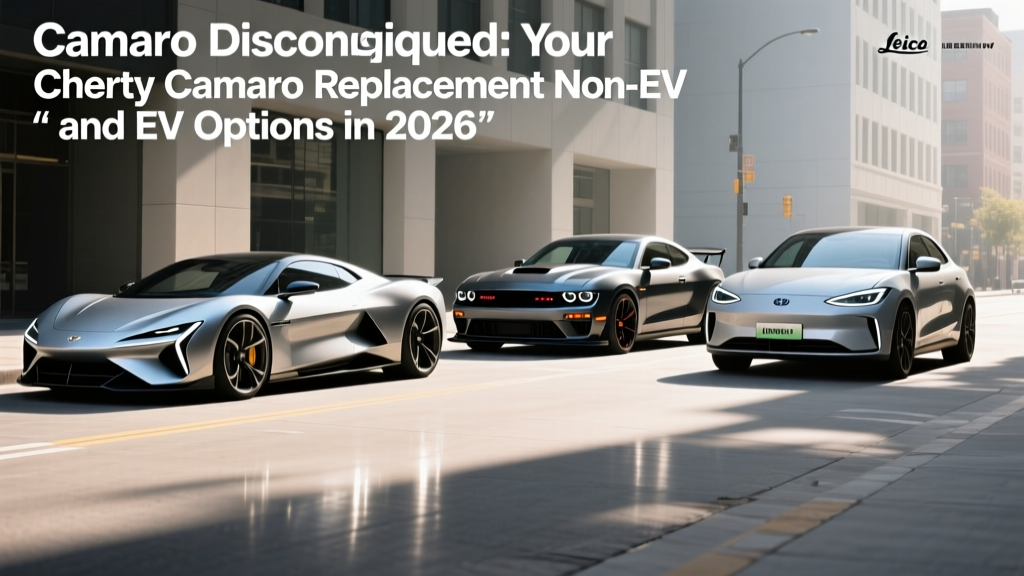
Chevrolet discontinued the Camaro after the 2024 model year, leaving muscle-car buyers scrambling. Your best Chevy Camaro replacement non EV options in 2026 are the Dodge Challenger (final-year inventory, 717 hp Hellcat, ~$55,000+), the Ford Mustang GT (480 hp V8, 0-60 in 4.3s, starting at $44,090), and the Chevrolet SS sedan (used market only). If you're open to electric, the Dodge Charger Daytona EV (496-670 hp, 0-60 in 3.3s, 317-mile range, from $59,990) and Ford Mustang Mach-E GT (480 hp, 0-60 in 3.5s, 290-mile range, from $54,995) deliver comparable or superior straight-line performance. The right choice depends on whether you prioritize exhaust note and track use (gas) or instant torque and lower running costs (EV).
Why the Camaro Is Gone and What That Means for Buyers
General Motors ended Camaro production in January 2024 after six generations and declining sales. The sixth-generation Camaro peaked at 80,000+ units annually in 2016 but fell below 30,000 by 2023. GM has not announced a direct successor, focusing instead on its Ultium EV platform. This leaves loyal Camaro buyers — particularly SS and ZL1 owners who valued V8 rumble, sharp handling, and aggressive styling — searching for alternatives that match the car's emotional and performance appeal.
The muscle-car segment is contracting but not dead. Ford continues the Mustang (now in its seventh generation), Dodge is transitioning the Charger to electric, and the used market for late-model Camaros remains active. Your decision hinges on three factors: performance priorities (track capability vs. straight-line speed), ownership economics (fuel, maintenance, insurance), and lifestyle fit (daily driving vs. weekend toy).
Top Chevy Camaro Replacement Non EV Options
2026 Ford Mustang GT — The Direct Rival
The seventh-generation Mustang GT is the closest spiritual successor to the Camaro SS. The 5.0-liter Coyote V8 produces 480 horsepower (486 hp with the active-valve exhaust option) and 415 lb-ft of torque. With the 10-speed automatic, 0-60 mph takes 4.3 seconds; the six-speed manual adds about 0.2 seconds. EPA fuel economy is 17 city / 24 highway / 20 combined mpg. Base MSRP is $44,090; a well-equipped GT Premium with the Performance Package lands around $52,000.
Real-world ownership: The Mustang GT's rear-seat space (33.2 inches of legroom) is tighter than the Camaro's already-cruel 29.9 inches, but trunk volume (13.5 cu ft) beats the Camaro's 9.1 cu ft. Insurance averages $2,100-$2,600 annually for a 35-year-old driver with clean record, per IIHS data. Maintenance runs $500-$800 yearly for oil changes, brake fluid, and tire rotation — higher if you track the car.
Dodge Challenger — Final-Year Inventory
Stellantis ended Challenger production in December 2023, but dealer lots still hold new inventory in early 2026. The R/T (375 hp, 5.7L Hemi V8) starts around $45,000; the Hellcat (717 hp, supercharged 6.2L) commands $70,000-$90,000 depending on trim and markup. The Challenger is heavier (4,200-4,500 lbs) and less agile than the Camaro, but its 16.2 cu ft trunk and usable rear seat make it more practical for daily use. EPA fuel economy: 16/25/19 mpg for the R/T.
Availability is spotty. Expect to negotiate hard or travel to find specific trims. Once inventory clears, the Challenger becomes a used-market-only proposition.
Used Chevrolet Camaro (2016-2024)
Sixth-generation Camaros hold value well. A 2023 Camaro SS (455 hp, 6.2L V8) with 15,000-25,000 miles sells for $38,000-$48,000 in early 2026. The ZL1 (650 hp, supercharged LT4) commands $65,000-$85,000. Pros: You know exactly what you're getting, and depreciation has already hit. Cons: No warranty remaining on most examples, higher mileage means wear items (brakes, suspension bushings, clutch) may need attention within 20,000 miles.
EV Alternatives: When Electric Beats the V8
2026 Dodge Charger Daytona EV
The Charger Daytona is Dodge's electric muscle car, built on the STLA Large platform. The R/T trim (496 hp, 404 lb-ft) hits 0-60 in 4.7 seconds; the Scat Pack (670 hp, 627 lb-ft) does it in 3.3 seconds — faster than a Hellcat Redeye. The 100.5 kWh NMC battery delivers an EPA-estimated 317 miles (R/T) or 260 miles (Scat Pack, due to performance tires and tuning). Peak DC fast charging is 175 kW, with a 10-80% charge in approximately 27 minutes. Base prices: $59,990 (R/T) and $72,990 (Scat Pack), before incentives.
Real-world range caveat: Expect 250-270 miles in mixed driving, 200-220 miles at sustained 80 mph highway speeds, and 180-200 miles in sub-30°F cold weather. The Charger Daytona uses Dodge's "Fratzonic" exhaust simulation — a synthetic V8 sound piped through speakers. It's divisive; some owners love it, others disable it after a week.
Tax credit eligibility: The Charger Daytona qualifies for the full $7,500 §30D federal tax credit if you meet income caps ($150,000 single / $300,000 joint modified adjusted gross income) and the vehicle's MSRP is below $55,000 for sedans. The Scat Pack exceeds the cap; the R/T qualifies. Point-of-sale transfer is available, reducing your purchase price directly at the dealer.
2026 Ford Mustang Mach-E GT
The Mach-E GT pairs 480 hp and 634 lb-ft of torque with a 91 kWh usable NMC battery. EPA range is 290 miles (extended-range AWD). Peak DC charging is 150 kW; 10-80% takes about 32 minutes. 0-60 mph is 3.5 seconds. MSRP starts at $54,995; the GT with Performance Upgrade (which unlocks the 3.5-second time) is $59,995.
The Mach-E is a crossover, not a coupe, so it sacrifices the low-slung muscle-car aesthetic. But cargo volume (29.7 cu ft behind rear seats, 59.7 cu ft folded) dwarfs any Camaro or Mustang. Real-world highway range: 230-250 miles at 75 mph. Cold-weather loss: 20-25%, so expect 190-210 miles in freezing temps.
Cost Comparison: Gas Muscle Car vs. Electric Muscle Car
| Category | Mustang GT (Gas) | Charger Daytona R/T (EV) |
|---|---|---|
| Purchase Price (MSRP) | $44,090 | $59,990 |
| Federal Tax Credit | $0 | -$7,500 |
| Effective Purchase Price | $44,090 | $52,490 |
| Fuel/Energy (5 years) | $12,750 (20 mpg, $3.40/gal) | $4,500 ($0.12/kWh avg, 3.0 mi/kWh) |
| Maintenance (5 years) | $3,500 (oil, brakes, fluids) | $1,200 (cabin filter, wipers, brake fluid) |
| Insurance (5 years) | $12,000 | $13,500 |
| Depreciation (est.) | $18,000 | $22,000 |
| Total 5-Year Cost | $89,840 | $93,690 |
The gas Mustang wins on upfront cost and depreciation (muscle cars hold value better than EVs currently). The EV wins on fuel and maintenance — you'll save $8,250 over five years on energy and $2,300 on maintenance with the Charger Daytona. Insurance is 10-15% higher for EVs due to repair costs and parts pricing. If you drive 20,000+ miles annually, the EV's fuel savings widen the gap. If you drive under 10,000 miles, the gas car's lower purchase price dominates.
Real-World Ownership: What First-Time EV Buyers Must Know
Home Charging Is Non-Negotiable for Most Owners
Over 80% of EV charging happens at home. If you have a garage or driveway with access to a 240V outlet (NEMA 14-50) or can install a Level 2 charger ($500-$1,200 for equipment, $800-$2,500 for electrician labor depending on panel capacity and run distance), an EV is convenient — you wake up with a "full tank" daily. If you rely solely on public charging, expect to spend 25-40 minutes per session at a DC fast charger, 2-4 times per week, at higher per-kWh costs ($0.30-$0.50 vs. $0.12-$0.16 at home).
Apartment dwellers without charging access should stick with gas or consider a plug-in hybrid as a bridge.
Cold Weather Cuts Range — Plan Accordingly
Lithium-ion batteries lose 20-30% of their EPA-estimated range in sub-30°F temperatures. The Charger Daytona's 317-mile EPA rating becomes 220-250 miles in a Minnesota January. Cabin heating is the primary culprit; EVs use resistive or heat-pump systems that draw from the traction battery. Gas cars waste engine heat for cabin warmth, so their range penalty is smaller (5-10%). If you live in a cold climate and regularly drive 200+ miles in winter, the EV's real-world range may feel tight.
Track Use and Enthusiast Driving
EVs deliver instant torque and brutal acceleration, but sustained high-speed lapping drains batteries fast and triggers thermal throttling. The Mustang GT can run 15-20 minutes of hard track use before brake fade; the Charger Daytona will hit battery-temp limits in 3-4 hot laps. If track days are central to your ownership, the gas Mustang or a used Camaro SS/ZL1 remains the better tool.
Decision Framework: Which Camaro Replacement Is Right for You?
Choose the Ford Mustang GT (Gas) If:
- You want a manual transmission (the only V8 coupe still offering one in 2026)
- Track days and autocross are priorities
- Your budget is under $50,000
- You lack home charging access
- Exhaust sound and mechanical engagement matter more than straight-line speed
Choose the Dodge Charger Daytona EV If:
- You want Hellcat-rivaling acceleration (Scat Pack) at a lower price than a used Hellcat
- You have home charging and drive under 250 miles daily
- You want lower running costs and minimal maintenance
- You value a usable rear seat and larger trunk
- You're curious about EV ownership and willing to adapt
Choose a Used Camaro SS/ZL1 If:
- You want the exact car you loved, and nothing else will do
- You're comfortable with out-of-warranty ownership and potential repair costs
- You want a future collector car (sixth-gen values are rising)
Common Misconceptions About Muscle Car EVs
| Myth | Fact |
|---|---|
| "EVs have no soul — they're appliances." | The Charger Daytona's 3.3-second 0-60 time and instant torque delivery are visceral. The synthetic exhaust sound is a stylistic choice, not a performance limiter. Many owners report the acceleration is more thrilling than a V8 because it's silent and immediate. |
| "EVs are slower on track." | EVs are heavier (Charger Daytona: 5,838 lbs vs. Mustang GT: 3,825 lbs), which hurts cornering and braking. But in a quarter-mile drag race, the EV's instant torque and AWD traction typically win. It depends on the track type. |
| "Charging takes too long." | At home, you plug in for 10 seconds and walk away — no gas station stops. On road trips, a 27-minute DC fast charge every 200-250 miles is a coffee/restroom break. If you drive 400+ miles in a day regularly, gas is still faster. |
| "EV batteries need replacement every 5 years." | Modern NMC and LFP batteries retain 85-90% capacity after 150,000 miles. Dodge warranties the Charger Daytona's battery for 8 years / 100,000 miles against defects and capacity loss below 70%. Replacement cost (if needed out of warranty) is $12,000-$18,000, but most batteries outlast the car. |
| "EVs are worse for the environment because of battery mining." | EVs have higher upfront carbon footprints due to battery production, but they break even with gas cars after 15,000-35,000 miles of driving (depending on your local grid mix). Over a 150,000-mile lifetime, an EV produces 50-70% fewer emissions than a comparable gas car, per EPA lifecycle analysis. |
Frequently Asked Questions
Is Chevy making a new Camaro?
No. GM ended Camaro production in January 2024 and has not announced a successor. Rumors of an electric Camaro on the Ultium platform circulate annually, but nothing is confirmed for 2026-2028. If you want a Camaro, the used market is your only option.
Can I get a manual transmission in any 2026 muscle car?
Yes, but only in the Ford Mustang. The EcoBoost (turbo four-cylinder) and GT (V8) both offer a 6-speed manual. The Dodge Charger Daytona EV is single-speed (no traditional gearbox). Manual take rates are under 5% for Mustangs, so inventory is limited — expect to order or search multiple dealers.
Does the Charger Daytona qualify for the $7,500 tax credit?
The R/T trim ($59,990 MSRP) exceeds the $55,000 sedan cap for the §30D credit as of 2026 IRS rules. However, if Dodge reclassifies it as an SUV/truck (which some automakers have done for credit purposes), it may qualify under the $80,000 cap. Check the DOE's fueleconomy.gov tax credit list for the latest eligibility. Your income must also be below $150,000 (single) or $300,000 (joint) MAGI. Consult a tax professional for your specific situation.
What's the cheapest way to replace a Camaro SS?
A 2019-2022 Camaro SS with 30,000-50,000 miles sells for $32,000-$40,000 in early 2026. You'll get the 455 hp 6.2L V8, modern infotainment (Apple CarPlay/Android Auto), and remaining powertrain warranty (5yr/60,000mi from new). Factor in $1,500-$3,000 for a pre-purchase inspection and any immediate maintenance (tires, brakes, differential fluid).
How much does it cost to charge an EV vs. fuel a V8?
At the U.S. average electricity rate of $0.16/kWh and the Charger Daytona's efficiency of 3.0 miles/kWh, you'll spend $0.053 per mile. The Mustang GT at 20 mpg combined and $3.40/gallon costs $0.17 per mile — over three times more. Over 15,000 annual miles, that's $795 (EV) vs. $2,550 (gas). If you have access to free workplace or public charging, the EV's cost drops to near zero.
Will the Charger Daytona hold its value like a gas muscle car?
EVs currently depreciate faster than gas performance cars due to rapid tech obsolescence and battery-health concerns. Expect the Charger Daytona to lose 45-55% of its value over five years, vs. 35-40% for a Mustang GT. However, if Dodge limits production or the car gains a cult following (like the original 1968-1970 Chargers), values could stabilize. It's a riskier long-term hold.
Final Verdict: Your Camaro Replacement Depends on Priorities
The Camaro's discontinuation forces a choice between tradition and evolution. If you need a manual gearbox, track capability, and V8 sound, the Ford Mustang GT is the last true muscle car standing, and it's a worthy successor. If you're open to electric performance and want daily-driver practicality with supercar-rivaling acceleration, the Dodge Charger Daytona redefines what a muscle car can be — at a higher upfront cost offset by years of fuel and maintenance savings.
There's no wrong answer, only the answer that fits your driving habits, budget, and emotional connection to the car. Test-drive both, run your own numbers, and decide whether the future of muscle is worth embracing — or whether the past is where your heart stays.