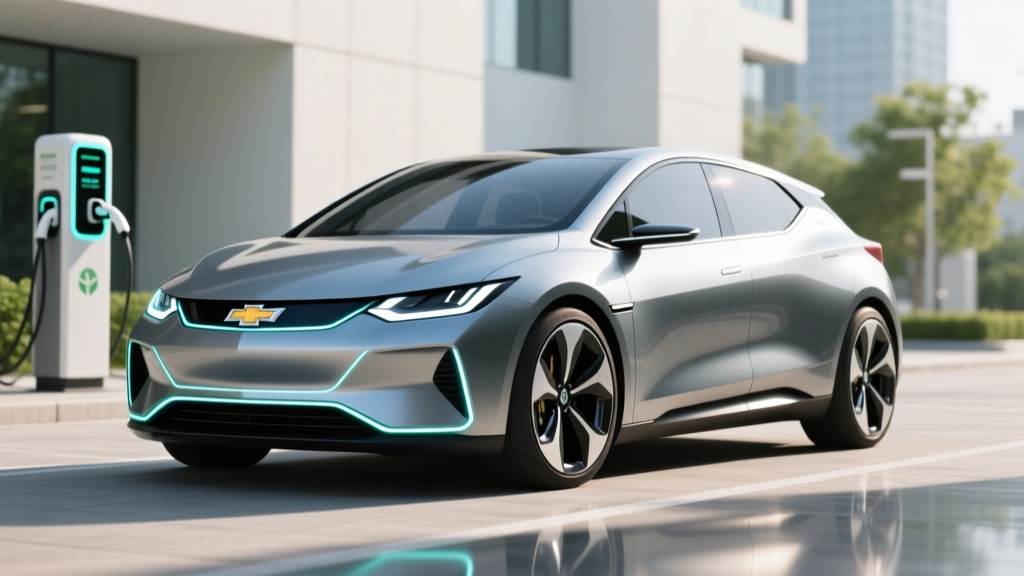
The original Chevrolet Bolt EV and EUV were discontinued after the 2023 model year, leaving a void in the affordable electric vehicle segment. But the Chevy Bolt return is now official: General Motors confirmed a next-generation Bolt built on the Ultium platform, expected to arrive as a 2026 or 2027 model year vehicle. While final EPA-certified specifications remain unreleased, GM has shared enough directional information — combined with the architecture of current Ultium-based models — to build a data-informed preview of what buyers can expect.
This article compiles every confirmed detail, reasonable projection based on Ultium platform benchmarks, and the ownership-critical questions around charging, tax credits, and competitive positioning. Because the vehicle is announced but not yet on sale, all specifications are labeled as preliminary or estimated where applicable.
The next-generation Chevy Bolt has been confirmed by GM CEO Mary Barra but is not currently available for purchase or order. Specifications below are preliminary estimates based on Ultium platform data and GM statements. Final EPA-certified figures will be published closer to launch.
What GM Has Confirmed About the Next-Gen Bolt
In April 2023, GM CEO Mary Barra announced that the Bolt nameplate would return on an all-new Ultium-based platform. The key confirmed points:
- Platform: GM Ultium (the same modular architecture underpinning the Cadillac Lyriq, Chevrolet Equinox EV, and Blazer EV)
- Market position: Entry-level affordable EV, targeting the sub-$30,000 segment before incentives
- Body style: Expected to retain a compact hatchback/crossover form factor similar to the outgoing Bolt EUV
- Charging standard: NACS (North American Charging Standard), giving native access to Tesla Supercharger stations without an adapter
- Production timeline: GM has indicated a 2026 calendar-year production start, likely as a 2027 model year vehicle, though a late-2026 model year launch remains possible
What GM has not yet confirmed: exact battery capacity (kWh), EPA range, motor output, pricing by trim, or specific ADAS feature availability. The projections below are informed by the Equinox EV's published specs and GM's public statements about targeting a lower price point.
Projected Range, Battery, and Efficiency
The outgoing 2023 Bolt EV carried a 65 kWh NMC (nickel manganese cobalt) battery and achieved an EPA-estimated 259 miles of range. The Bolt EUV, with the same battery, was rated at 247 miles due to its larger, heavier body.
For the Ultium-based successor, GM has signaled a target of approximately 250–300 miles of EPA range. Here is how that compares to the current Ultium lineup and what battery chemistry might enable it:
| Spec | Outgoing Bolt EV (2023) | Next-Gen Bolt (Estimated) | Equinox EV 2LT (Reference) |
|---|---|---|---|
| Battery Capacity | 65 kWh (NMC) | ~60–75 kWh (LFP or NMC TBD) | 85 kWh (NMC) |
| EPA Range | 259 mi | ~250–300 mi (target) | 319 mi (FWD) |
| Efficiency | 120 MPGe / 28 kWh/100mi | ~115–130 MPGe (est.) | 114 MPGe / 29 kWh/100mi |
| Drivetrain | FWD, single motor | FWD expected (AWD possible) | FWD or AWD |
Chemistry question — LFP or NMC? GM has been evaluating lithium iron phosphate (LFP) cells for entry-level models to reduce cost. LFP offers superior cycle life (3,000+ cycles vs. ~1,500 for NMC), lower fire risk, and cheaper raw materials. The trade-off: LFP is heavier and less energy-dense, meaning a comparable range requires a physically larger pack. If GM prioritizes the sub-$30K price target, LFP is the likely choice. If they prioritize range in a compact footprint, NMC remains probable. GM has not confirmed the chemistry as of this writing.
If the next-gen Bolt achieves a 280-mile EPA rating, here is what to expect in practice:
• City/suburban driving (moderate climate): ~270–290 miles — EVs are most efficient at lower speeds with regenerative braking
• Highway driving (70 mph sustained): ~220–250 miles — aerodynamic drag increases consumption 15–20%
• Cold weather (below 30°F): ~190–230 miles — battery chemistry and cabin heating reduce usable range 20–30%
• Cold + highway combined: ~170–200 miles — the worst-case scenario for any EV
These projections are based on observed performance of comparable Ultium-based vehicles and the outgoing Bolt. Final real-world data will depend on the production vehicle's thermal management system.
Charging Speed: The Ultium Upgrade That Matters Most
The single biggest criticism of the outgoing Bolt was its glacial DC fast-charging speed — a peak of just 55 kW, requiring over 60 minutes for a 10–80% charge. This made road trips painful and was the Bolt's most significant competitive weakness.
The Ultium platform solves this. Based on the Equinox EV and Blazer EV benchmarks, the next-generation Bolt should deliver dramatically improved charging performance:
| Charging Level | Outgoing Bolt (2023) | Next-Gen Bolt (Projected) | Miles Added per Hour |
|---|---|---|---|
| Level 1 (120V, 12A) | 1.4 kW | ~1.4 kW | ~4–5 mi/hr |
| Level 2 (240V, 48A) | 11.5 kW | ~11.5–19.2 kW | ~35–55 mi/hr |
| DC Fast Charge (peak) | 55 kW | ~150 kW (est.) | N/A |
| 10–80% DC Fast Charge | ~60+ minutes | ~25–30 minutes (est.) | N/A |
Why 150 kW and not 200+? The Equinox EV peaks at approximately 150 kW on DC fast charging, while the Blazer EV and Silverado EV can reach 190–350 kW on larger battery packs. Given the Bolt's likely smaller battery (~60–75 kWh), a 150 kW peak is realistic and would represent a roughly 3x improvement over the outgoing model. The charge curve will taper above 80% state of charge (SoC), as with all lithium-ion batteries — expect the 80–100% top-off to add another 15–20 minutes.
Connector: NACS native. GM has committed to the NACS (Tesla-style) connector across its EV lineup beginning with 2025 model year vehicles. The next-gen Bolt will ship with a NACS port, enabling direct access to over 20,000 Tesla Supercharger stalls nationwide (via GM's agreement with Tesla) without requiring the CCS-to-NACS adapter that current Equinox EV owners use. This is a significant practical advantage for road-trip charging.
Home charging reality check: At Level 2 (240V), a full overnight charge from 10% to 100% should take approximately 5–7 hours depending on the amperage of your home charger and the final battery capacity. Most owners charging nightly from ~30% back to 80–90% will need only 3–4 hours. Installation of a Level 2 home charger typically costs $500–$2,000 depending on whether your electrical panel needs an upgrade — budget for a licensed electrician assessment before purchase.
Performance and Drivetrain Expectations
The outgoing Bolt EV produced 200 horsepower and 266 lb-ft of torque from a single front-mounted motor, delivering a 0–60 mph time of approximately 6.5 seconds. It was front-wheel drive only.
For the Ultium-based successor, reasonable projections based on the platform's modularity:
- Horsepower: ~200–220 hp (single motor FWD); ~280–300 hp if an AWD dual-motor variant is offered
- 0–60 mph: ~6.0–6.5 seconds (FWD); ~5.0–5.5 seconds (AWD, if available)
- Torque: ~236–325 lb-ft depending on motor configuration
- Drivetrain: FWD standard; AWD possible but not confirmed — GM has offered AWD on the Equinox EV, so the architecture supports it
The Ultium platform uses a lower, flatter battery pack placement compared to the outgoing Bolt's stacked battery, which should improve the center of gravity and handling dynamics. The outgoing Bolt was already praised for its peppy acceleration and nimble city driving; expect the successor to retain that character while potentially improving ride quality with a longer wheelbase.
Towing: The outgoing Bolt was not rated for towing. Given the compact EV segment's focus on efficiency over utility, the next-gen Bolt is unlikely to offer significant towing capacity. Buyers needing to tow should look at the Blazer EV (up to 1,500 lbs) or Silverado EV.
Interior, Cargo, and Technology
GM has not released interior dimensions or cargo volume for the next-gen Bolt. However, based on the Equinox EV's packaging and the outgoing Bolt's benchmarks, here is what to expect:
| Dimension | Outgoing Bolt EUV (2023) | Next-Gen Bolt (Projected) | Equinox EV (Reference) |
|---|---|---|---|
| Cargo (behind rear seats) | 16.3 cu ft | ~17–20 cu ft (est.) | 26.4 cu ft |
| Cargo (seats folded) | 56.9 cu ft | ~55–65 cu ft (est.) | 57.2 cu ft |
| Rear Legroom | 39.1 in | ~37–40 in (est.) | 38.1 in |
| Front Frunk | None | Possible (Ultium supports it) | None (small compartment) |
Infotainment and tech: Expect GM's latest Ultifi software platform with an 11.3-inch (or larger) touchscreen, wireless Apple CarPlay and Android Auto, Google Built-in (Google Maps, Google Assistant, Play Store), and over-the-air update capability. The outgoing Bolt's 10.2-inch screen was adequate but dated; the Ultium generation brings a meaningful step up in resolution and processing speed.
Driver assistance: Chevrolet's Super Cruise — GM's hands-off, eyes-on Level 2 driver-assistance system — is expected to be available on higher trims. Super Cruise operates on over 750,000 miles of mapped highways in the U.S. and Canada and is widely regarded as one of the most refined Level 2 systems available. Lower trims will likely include Chevy Safety Assist (automatic emergency braking, lane-keep assist, adaptive cruise control, following distance indicator).
Super Cruise is an SAE Level 2 driver-assistance system. Despite being "hands-free" on compatible highways, the driver must remain attentive and ready to take control at any time. A driver-monitoring camera ensures your eyes are on the road. This is not autonomous or self-driving capability (which would be Level 4, like Waymo's robotaxi service). You are the driver at all times.
Pricing, Trims, and Federal Tax Credit Eligibility
GM has stated that the next-gen Bolt will target an entry price that makes it one of the most affordable EVs on the market. Industry analysts project a base MSRP in the $25,000–$30,000 range before incentives, though GM has not published official pricing.
Here is how pricing could break down by estimated trim level, alongside the current IRS §30D federal tax credit rules:
| Trim (Projected) | Est. MSRP | §30D Credit (Max) | Effective Price |
|---|---|---|---|
| Base (1LT) | ~$25,000–$28,000 | Up to $7,500* | ~$17,500–$20,500 |
| Mid (2LT) | ~$29,000–$33,000 | Up to $7,500* | ~$21,500–$25,500 |
| Premier | ~$34,000–$38,000 | Up to $7,500* | ~$26,500–$30,500 |
*The §30D federal tax credit has strict eligibility requirements. It is not a flat $7,500 for every buyer.
- MSRP cap: The vehicle must have an MSRP at or below $55,000 for SUVs/pickups or $25,000 for sedans/hatchbacks (the Bolt's classification will matter here — if classified as a hatchback, the $25K cap could limit credit eligibility on higher trims)
- Buyer income cap: Modified adjusted gross income must not exceed $150,000 (single), $225,000 (head of household), or $300,000 (married filing jointly)
- Battery sourcing: The credit is split into two halves — $3,750 for critical minerals and $3,750 for battery component manufacturing. Both have escalating domestic/FTE-partner sourcing requirements that tighten annually through 2032
- Point-of-sale transfer: As of 2024, eligible buyers can transfer the credit to the dealer at purchase, reducing the upfront cost rather than waiting for a tax refund
- Assembly: The vehicle must undergo final assembly in North America (the Bolt will be built at GM's Orion Assembly plant in Michigan, satisfying this requirement)
Critical uncertainty: If GM uses LFP battery cells sourced from China (where the majority of LFP production currently resides), the Bolt could lose part or all of the $3,750 critical-minerals half of the credit, depending on the model year's sourcing thresholds. GM's battery joint venture with LG Energy Solution (Ultium Cells LLC) produces NMC cells in Ohio and Tennessee, which would more easily satisfy domestic-content rules. The battery sourcing strategy will directly impact the Bolt's effective price — watch for GM's announcement on cell supplier and chemistry.
Warranty and Long-Term Ownership
Based on GM's current EV warranty structure and the outgoing Bolt's coverage, expect the following for the next-generation model:
- Battery and propulsion warranty: 8 years / 100,000 miles (whichever comes first), covering defects and capacity loss below a specified threshold (typically 60–70% of original capacity)
- Limited vehicle warranty: 3 years / 36,000 miles bumper-to-bumper
- Powertrain warranty: 5 years / 60,000 miles (may be superseded by the 8-year battery/propulsion coverage for EV-specific components)
- Corrosion protection: 6 years / 100,000 miles
The outgoing Bolt's battery recall (due to manufacturing defects that caused fire risk in certain 2017–2019 cells) was a painful chapter for owners and GM alike. The recall resulted in full battery replacements at no cost and a redesigned battery module. The Ultium platform uses an entirely different cell format and manufacturing process, and GM has stated that the lessons from the Bolt recall directly informed Ultium's quality controls. Still, buyers should monitor early reliability data once the vehicle reaches customers.
Competitive Landscape: Bolt vs. the Affordable EV Field
- You want the lowest possible entry price into a new EV (sub-$20K after credits is plausible)
- You prioritize NACS native charging and Tesla Supercharger access without an adapter
- You want a compact hatchback form factor with strong city maneuverability
- Super Cruise availability on an affordable EV appeals to you for highway commuting
- You can wait — the Bolt is not yet available for purchase
- You need an EV now — the Equinox EV, Hyundai Kona Electric, and Nissan Leaf are currently on sale
- You need AWD for snow-belt winters (unconfirmed for the Bolt)
- You need towing capacity (look at Blazer EV, Ioniq 5, or Model Y)
- You want maximum range — the Equinox EV offers 319 miles EPA today
The next-gen Bolt will enter a segment that has evolved significantly since its predecessor's departure. Key competitors include:
- Chevrolet Equinox EV: Already on sale, 319-mile range, starts ~$33,000 before credits. Larger, more capable, but more expensive. The Bolt's role is to undercut it on price.
- Hyundai Kona Electric (2024+): 261-mile EPA range, ~100 kW DC fast charging, starts ~$32,975. Strong competitor with CCS charging and solid tech.
- Nissan Leaf: Aging platform, CHAdeMO connector (a growing liability), 212-mile range on the Plus model. Likely to be redesigned or discontinued.
- Tesla Model 3: Starts ~$38,990 before credits, 272–363 mile range, best-in-class Supercharger network. More expensive but the benchmark for efficiency and charging infrastructure.
- Volvo EX30: Starting ~$34,950, 265-mile range, compact crossover. Premium positioning but in a similar size class.
- Sub-$30K base price; potentially under $20K after credits
- NACS connector = native Tesla Supercharger access
- Dramatically faster DC charging vs. outgoing Bolt (~150 kW vs. 55 kW)
- Super Cruise availability (best-in-class Level 2 system)
- Proven Ultium platform with existing service/parts network
- Compact size ideal for urban parking and commuting
- Not yet available — 2026/2027 timeline means a long wait
- FWD-only likely; AWD unconfirmed
- Compact cargo area vs. crossover competitors
- LFP battery (if used) could mean heavier weight and reduced cold-weather range
- No towing capacity expected
- Tax credit eligibility depends on unresolved battery sourcing decisions
Who the Next-Gen Bolt Is For
The next-generation Bolt's ideal buyer profile is clear:
- Daily commuters with round trips under 100 miles who can charge at home overnight and want the lowest-cost entry into EV ownership
- Urban and suburban drivers who value compact dimensions, easy parking, and nimble handling over cargo capacity
- Second-car households that already have a larger vehicle for road trips and need an efficient, affordable daily driver
- Budget-conscious EV shoppers who have been priced out of the $35K–$50K EV market and are waiting for a genuinely affordable option
- Super Cruise enthusiasts who want hands-free highway driving without paying Cadillac or Tesla premiums
The Bolt is not the right choice for frequent long-distance road trippers (the compact battery and projected ~250–300 mile range will require more charging stops than a 350+ mile EV), large families needing three-row seating, or anyone who needs to tow.
Frequently Asked Questions
When will the next-gen Chevy Bolt be available to buy?
GM has confirmed the Bolt's return on the Ultium platform but has not announced an exact on-sale date. Production is expected to begin in late 2026, with the vehicle likely arriving at dealerships as a 2027 model year. Pre-orders may open in mid-to-late 2026. The vehicle is not currently available for purchase.
What is the expected real-world range of the new Bolt?
GM is targeting approximately 250–300 miles of EPA-estimated range. In real-world conditions, expect ~220–250 miles on the highway, ~270–290 miles in city driving, and a 20–30% reduction in cold weather (below 30°F). Final figures will depend on battery capacity, chemistry, and the production vehicle's thermal management system.
How fast will the new Bolt charge?
Projected DC fast-charging speed is approximately 150 kW peak, enabling a 10–80% charge in roughly 25–30 minutes — a massive improvement over the outgoing Bolt's 55 kW / 60+ minute charge time. Home Level 2 charging (240V) should deliver 35–55 miles of range per hour of charging, depending on the onboard charger specification.
Will the new Chevy Bolt qualify for the $7,500 federal tax credit?
It is likely but not guaranteed. The Bolt will be assembled in Michigan (satisfying the North American assembly requirement) and should fall under the MSRP cap. However, eligibility depends on battery component and critical mineral sourcing rules that tighten annually. If GM sources LFP cells from China, the credit could be reduced. Buyers should verify eligibility on fueleconomy.gov and consult a tax professional closer to the vehicle's launch.
Will the new Bolt have all-wheel drive?
GM has not confirmed AWD for the next-gen Bolt. The Ultium platform supports dual-motor AWD configurations (as seen on the Equinox EV and Blazer EV), but given the Bolt's focus on affordability and efficiency, FWD is the most likely standard configuration. An AWD variant is possible on higher trims but remains unconfirmed.
Does the new Bolt have a front trunk (frunk)?
Not confirmed. The Ultium platform's flat battery architecture can accommodate a frunk, but GM has not published details on whether the Bolt will include one. The outgoing Bolt had no frunk. The Equinox EV has a small front compartment rather than a full frunk.
How does the Bolt compare to the Chevy Equinox EV?
The Equinox EV is larger (compact SUV vs. subcompact hatchback), offers more cargo space (26.4 vs. an estimated ~17–20 cu ft), has a confirmed 319-mile EPA range, and starts at ~$33,000. The Bolt will be smaller, lighter, less expensive (targeting sub-$30K), and potentially slightly less range. Think of the Bolt as the budget-friendly urban commuter and the Equinox EV as the more versatile family crossover — both on the same Ultium platform.
Is the Chevy Bolt return worth waiting for?
If your priority is the lowest possible new-EV price and you can wait until late 2026 or 2027, the Bolt is worth monitoring closely. If you need an EV now, the Equinox EV (~$33K, 319-mile range, available today with §30D credit eligibility) is the most direct in-house alternative. The Hyundai Kona Electric and base Tesla Model 3 are also strong current options in the affordable EV space.
Note: This article reflects information available as of early 2026. Final specifications, pricing, and tax credit eligibility for the next-generation Chevy Bolt will be confirmed by GM and the IRS closer to the vehicle's on-sale date. Always verify current incentive rules at irs.gov and range/efficiency data at fueleconomy.gov before making a purchase decision.