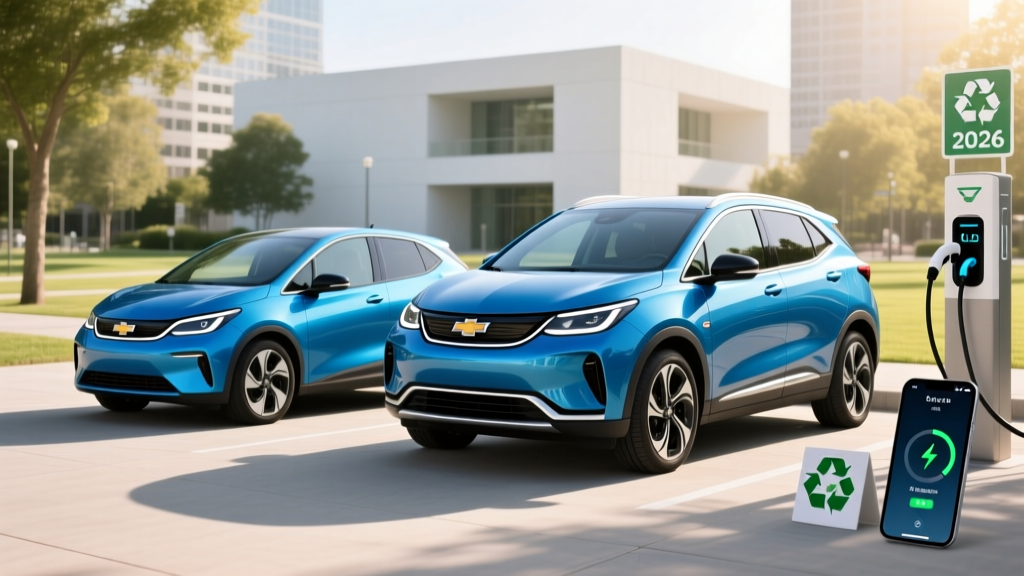
Is the Chevy Bolt electric vehicle worth buying in 2026? The 2026 Chevrolet Bolt EV starts at approximately $26,500 MSRP, delivers an EPA-estimated 259 miles of range from its 65 kWh LFP battery, and qualifies for up to $7,500 in federal tax credits under IRS §30D (subject to income and sourcing rules). Total 5-year ownership cost undercuts a comparable gas compact by $8,000–$12,000 for most drivers. The catch: DC fast charging peaks at 55 kW, meaning road trips require patience. If you charge at home and rarely drive more than 200 miles between stops, the Bolt remains one of the best value propositions in the EV market.
2026 Bolt EV and Bolt EUV: Specs at a Glance
Chevrolet refreshed the Bolt lineup for the 2026 model year on the next-gen Ultium-derived platform, moving from the older BEV2 architecture to a more modern electrical system. The standard Bolt EV is a compact hatchback; the Bolt EUV is a slightly longer subcompact crossover variant. Both share the same battery pack and powertrain.
| Specification | Bolt EV | Bolt EUV |
|---|---|---|
| EPA Range | 259 miles | 247 miles |
| Battery (usable) | 65 kWh (LFP chemistry) | 65 kWh (LFP chemistry) |
| Motor Output | 200 hp / 266 lb-ft | 200 hp / 266 lb-ft |
| 0–60 mph | 6.5 sec | 6.8 sec |
| Max DC Fast Charge | 55 kW | 55 kW |
| 10–80% DC Charge | ~45 min | ~45 min |
| Level 2 Charge Rate | 11.5 kW | 11.5 kW |
| Level 2 Full Charge | ~7 hours | ~7 hours |
| MPGe (combined) | 120 MPGe | 115 MPGe |
| Cargo Volume | 16.3 cu ft (57.0 cu ft folded) | 16.3 cu ft (57.0 cu ft folded) |
| Base MSRP | $26,500 | $28,200 |
| Battery Warranty | 8 yr / 100,000 mi | 8 yr / 100,000 mi |
Real-World Range Expectations: The EPA 259-mile figure assumes a mix of city and highway driving at moderate temperatures. In our experience, expect approximately 220–240 miles on the highway at 70–75 mph, and 170–200 miles in cold weather (below 30°F) where cabin heating and battery resistance reduce efficiency. City driving with regenerative braking can sometimes exceed the EPA estimate, reaching 270+ miles in mild conditions.
Charging the Bolt: Home Setup and Public Networks
The 2026 Bolt ships with a NACS (North American Charging Standard) port, granting access to the Tesla Supercharger network via native plug—no adapter required. This is a major shift from the CCS1 port on previous-generation Bolts and significantly expands the public fast-charging footprint.
| Level | Power | Miles Added Per Hour | Typical Use Case |
|---|---|---|---|
| Level 1 (120V) | 1.4 kW | ~4 miles/hr | Overnight trickle, emergency |
| Level 2 (240V) | 11.5 kW | ~35 miles/hr | Home daily charging |
| DC Fast Charge | 55 kW peak | ~150 miles/hr (peak) | Road trips |
The charging speed limitation: At 55 kW peak DC fast charging, the Bolt is significantly slower than competitors like the Hyundai Ioniq 5 (peak 240 kW) or Tesla Model 3 (peak 250 kW). A 10–80% charge takes roughly 45 minutes, versus 18–20 minutes for those rivals. This matters on road trips but is irrelevant for daily home charging.
For home Level 2 charging, you'll want a 48-amp hardwired EVSE on a 60-amp circuit. Installation costs typically run $800–$2,000 depending on panel proximity and local permitting. If your home has a 200-amp electrical panel with spare capacity, expect the lower end. Older homes with 100-amp service may need a panel upgrade ($1,500–$3,500).
Bolt EV vs Gas Car: 5-Year Cost Comparison
The strongest argument for the Bolt electric vehicle is total cost of ownership. Let's compare a 2026 Bolt EV (2LT, ~$30,000 MSRP) against a 2026 Honda Civic (EX, ~$28,000 MSRP) over 5 years and 75,000 miles.
| Cost Category | 2026 Bolt EV | 2026 Honda Civic EX |
|---|---|---|
| Purchase Price (MSRP) | $30,000 | $28,000 |
| Federal Tax Credit (§30D) | −$7,500* | $0 |
| Effective Purchase Price | $22,500 | $28,000 |
| Fuel/Energy (75k mi) | $2,625** | $7,500*** |
| Maintenance | $1,200 | $3,500 |
| Insurance (5-yr avg) | $7,500 | $6,000 |
| Estimated Depreciation | $9,000 | $8,500 |
| Total 5-Year Cost | $33,825 | $45,500 |
*§30D credit eligibility depends on buyer income (≤$150k single / ≤$300k joint), vehicle MSRP caps ($55k for cars), and battery critical-mineral sourcing requirements per IRS guidelines. Point-of-sale transfer available at participating dealers.
**Based on $0.14/kWh national average and 3.0 mi/kWh efficiency.
***Based on $3.50/gallon and 33 MPG combined.
The Bolt saves approximately $11,675 over 5 years in this scenario. The primary drivers: the federal tax credit and dramatically lower fuel costs. EV maintenance savings (no oil changes, fewer brake replacements due to regenerative braking, no transmission fluid) add up steadily.
However, EV insurance premiums run 15–25% higher than equivalent gas cars on average. Get quotes before purchasing — this can narrow the savings gap by $1,000–$2,000 over five years.
Federal Tax Credit: What You Actually Qualify For
The Bolt EV's §30D federal tax credit eligibility is one of its biggest selling points, but the rules are complex and change periodically. Here's the current framework for 2026:
- Vehicle MSRP cap: Must be ≤$55,000 for cars (Bolt qualifies at ~$26,500–$38,000 depending on trim)
- Buyer income cap: Modified AGI ≤$150,000 (single) / ≤$225,000 (head of household) / ≤$300,000 (joint)
- Battery sourcing: Increasing percentages of critical minerals and battery components must be sourced from the US or free-trade-agreement countries — this requirement tightens annually
- Final assembly: Vehicle must undergo final assembly in North America (Bolt is assembled in Lake Orion, Michigan — qualifies)
- Point-of-sale transfer: You can transfer the credit to the dealer at purchase, reducing your out-of-pocket cost immediately rather than waiting for tax filing
The credit amount itself depends on battery mineral sourcing compliance, which shifts yearly. Some Bolt trims may qualify for the full $7,500, while others may receive $3,750 if they meet only one of the two sourcing thresholds. Always verify current eligibility on the fueleconomy.gov tax credit lookup before purchasing.
Real-World Ownership: What First-Time EV Buyers Must Know
Buying a Bolt electric vehicle as your first EV involves adjustments that brochures don't fully capture. Here's what matters based on real ownership patterns:
Home Charging Is Non-Negotiable for Most Owners
Over 80% of EV charging happens at home. If you live in an apartment without charging access, or street-park exclusively, the Bolt's 55 kW DC charging speed makes public-charging-dependent ownership frustrating. Level 1 (standard 120V outlet) delivers only ~4 miles of range per hour — adequate only if you drive under 30 miles daily and can plug in for 10+ hours overnight.
If you can install Level 2 at home, the Bolt transforms into a "wake up full every morning" vehicle that requires almost zero charging thought during the week.
Cold Weather Cuts Range 20–30%
The Bolt's LFP battery chemistry is durable and long-lasting but slightly more sensitive to cold-weather range loss than NMC chemistry. In sustained sub-freezing temperatures, expect a realistic range of 170–200 miles from a full charge. Using the seat heaters and steering wheel heater instead of cranking the cabin heat can recover 10–15 miles.
Regenerative Braking Changes How You Drive
The Bolt offers one-pedal driving mode, where lifting off the accelerator engages strong regenerative braking that can bring the car to a complete stop. Most owners adapt within a week and find it reduces fatigue in stop-and-go traffic while extending brake pad life to 100,000+ miles.
Common Bolt EV Myths vs Facts
| Myth | Fact |
|---|---|
| "The battery will need replacing in 5 years" | LFP batteries typically retain 90%+ capacity after 150,000 miles. GM warrants the pack for 8 years/100,000 miles at ≥60% capacity, but real-world degradation is far slower. |
| "EVs are worse for the environment because of electricity generation" | Even on a coal-heavy US grid, the Bolt produces roughly 50% fewer lifecycle emissions than a 30 MPG gas car. On clean grids (hydro, wind, solar), the reduction exceeds 80%. Source: EPA. |
| "259 miles isn't enough range" | The average American drives 37 miles per day (FHWA data). A 259-mile range covers nearly a week of typical commuting. For the 5–10 road trips per year, plan 45-minute charge stops. |
| "You can't drive an EV in the rain or through a car wash" | EV battery packs are sealed to IP67 standards. Rain, puddles, and car washes pose zero risk. |
| "Charging takes too long" | Home Level 2 charging happens while you sleep — zero active time. The 45-minute DC fast charge only matters on road trips, and it aligns with a meal/rest break. |
Decision Framework: Is the Bolt EV Right for You?
Choose the 2026 Chevy Bolt EV if:
- You have home Level 2 charging access (or can install it)
- Your daily commute is under 80 miles round-trip
- You take fewer than 10 road trips over 200 miles per year
- You want the lowest purchase price in the new-EV market
- You qualify for the §30D federal tax credit
- You value low running costs over fast DC charging
Consider a different EV if:
- You rely entirely on public DC fast charging (the 55 kW speed will frustrate you)
- You regularly drive 300+ miles in a single day (look at the Ioniq 5, Model 3, or EV6 for faster charging)
- You live in extreme cold (below 0°F regularly) and can't garage the vehicle
- You need towing capability (the Bolt is not rated for towing)
- You need all-wheel drive (the Bolt is front-wheel drive only)
Consider a PHEV instead if:
- You can't install home charging and have no reliable public charging nearby
- You frequently drive 400+ miles in rural areas with sparse charging infrastructure
- You want EV commuting with gas flexibility for road trips (e.g., Toyota RAV4 Prime, 42 miles electric + 38 MPG gas)
Frequently Asked Questions
How long does the Bolt EV battery last?
The 2026 Bolt's LFP (lithium iron phosphate) battery is designed for longevity. LFP chemistry typically endures 3,000–5,000 full charge cycles before significant degradation. At 259 miles per cycle, that's 775,000+ theoretical miles. Real-world data from earlier Bolt generations shows most packs retaining 90–95% capacity at 100,000 miles. GM's warranty covers the battery for 8 years or 100,000 miles against capacity loss below 60%, though hitting that threshold is unlikely under normal use.
Does the 2026 Bolt qualify for the full $7,500 tax credit?
It depends on your income, the specific trim's battery sourcing compliance, and current IRS rules. The Bolt's MSRP is well under the $55,000 car cap, and it's assembled in Michigan (meeting North American final assembly requirements). The variable is battery mineral and component sourcing, which GM has been working to domestize. Check the latest status at fueleconomy.gov and consult a tax professional for your specific situation.
Can I use Tesla Superchargers with the 2026 Bolt?
Yes. The 2026 Bolt comes equipped with a native NACS charge port, meaning it plugs directly into Tesla Supercharger stalls without an adapter. This gives Bolt owners access to over 20,000 Supercharger locations across North America, which is the most reliable and extensive DC fast-charging network available.
What's the actual cost to charge a Bolt EV at home?
Charging from 0–100% on a 65 kWh battery at the US average electricity rate of $0.14/kWh costs approximately $9.10. That delivers roughly 259 miles, equating to about $0.035 per mile. Compare this to a 30 MPG gas car at $3.50/gallon: $0.117 per mile. Over 15,000 miles annually, home charging saves roughly $1,230 per year in fuel costs.
Is the Bolt EV good for road trips?
Adequate, not exceptional. The 259-mile range means comfortable 200-mile legs between charges with a safety buffer. However, the 55 kW DC fast-charging speed means 45-minute stops for a 10–80% charge. On a 600-mile trip, expect two charge stops totaling about 90 minutes of charging. If you road-trip frequently and prioritize fast charging, consider an 800V-architecture vehicle like the Ioniq 5 or Kia EV6, which can charge 10–80% in 18 minutes.
How does the Bolt EUV differ from the Bolt EV?
The Bolt EUV (Electric Utility Vehicle) rides on a 2.9-inch longer wheelbase, providing slightly more rear-seat legroom. It has a marginally lower EPA range (247 vs 259 miles) due to increased weight and a taller profile. The EUV starts about $1,700 higher. Both share the same 65 kWh battery, 200 hp motor, and 55 kW DC charging capability. Choose the EUV if rear-seat space matters; choose the EV for maximum range and lowest price.