Quick Verdict: The Bolt EUV's 2026 Value Proposition
The Chevrolet Bolt EUV occupies a specific niche that few competitors can match: a compact electric crossover priced below $30,000 before incentives, with enough range for daily commuting and weekend errands. After the Bolt lineup's brief hiatus and subsequent revival with updated battery architecture, the 2026 EUV returns with a refreshed 65 kWh NMC pack, a NACS charge port from the factory, and a starting MSRP that undercuts nearly every crossover in the EV market. But low price means trade-offs — most notably in DC fast-charging speed and interior material quality. These Chevy Bolt EUV reviews break down exactly what you get, what you give up, and whether it's the right electrified vehicle for your garage.
| Spec | Value |
|---|---|
| EPA Range | 247 miles (2LT FWD) |
| Battery Capacity | 65 kWh usable (NMC chemistry) |
| Max DC Fast Charge | 55 kW peak (CCS via adapter / NACS native) |
| 10–80% DC Charge Time | ~52 minutes |
| Level 2 Home Charging | 11.5 kW (~37 miles per hour) |
| Motor Output | 200 hp / 266 lb-ft torque |
| 0–60 mph | 7.0 seconds |
| Drivetrain | FWD (single motor, front axle) |
| EPA Efficiency | 115 MPGe combined / 29 kWh/100 mi |
| Cargo Volume | 27.5 cu ft (rear seats up) / 56.2 cu ft (folded) |
| Rear Legroom | 39.1 inches |
| Battery Warranty | 8 years / 100,000 miles |
| Base MSRP | $28,995 (LT) / $32,495 (2LT) |
Range and Efficiency: EPA Numbers vs. Real-World Driving
Real-World Expectation: 210–230 miles on mixed highway driving at 70 mph; 170–195 miles in sub-freezing winter conditions (20°F and below). City/regenerative driving can push closer to or slightly above the EPA sticker.
The 2026 Bolt EUV's 247-mile EPA rating is competitive within the sub-$35,000 EV segment, though it trails the Hyundai Kona Electric's 261 miles and falls well short of Tesla's Model 3 Standard Range at ~272 miles. Where the Bolt EUV earns its keep is efficiency: at 29 kWh per 100 miles (combined), it sips electrons frugally around town, thanks to its modest 3,600-lb curb weight and aggressive regenerative braking calibration.
On a 200-mile highway loop at sustained 70–75 mph speeds in 65°F weather, expect to consume roughly 33–35 kWh/100 mi, translating to about 190–210 miles of practical range before you'd want to locate a charger. Cold weather is the Bolt EUV's Achilles' heel — GM's battery thermal management system in this platform relies on passive cooling and limited active heating, meaning range loss of 25–35% is common in deep winter. If you commute in Minnesota or Maine, plan for roughly 170 usable miles in January. Owners in temperate coastal climates will find the 247-mile sticker far more achievable.
One-pedal driving mode is standard and well-calibrated, allowing most commuters to avoid the friction brake pedal entirely in stop-and-go traffic. The friction brakes themselves feel slightly grabby at low speeds — a common complaint carried over from the prior-generation Bolt platform.
Charging Speed: The Bolt EUV's Most Honest Limitation
| Charge Level | Power (kW) | Miles Added per Hour | Notes |
|---|---|---|---|
| Level 1 (120V household) | ~1.2 kW | ~4 miles/hr | Emergency/trickle only; 60+ hrs for full charge |
| Level 2 (240V home/public) | 11.5 kW | ~37 miles/hr | Full charge in ~6.5 hours; ideal daily use |
| DC Fast Charge | 55 kW peak | ~170 miles/hr (peak) | 10–80% in ~52 min; tapers significantly above 60% |
Let's address the Bolt EUV's most significant compromise head-on: DC fast-charging speed. At 55 kW peak, the Bolt EUV charges at roughly one-quarter the rate of a Hyundai Ioniq 5 (240 kW) or Tesla Model Y (250 kW). A 10–80% session takes approximately 52 minutes under ideal thermal conditions — and that's only if you precondition the battery by navigating to a charger via the infotainment system.
The charge curve is the real story. The Bolt EUV holds near-peak 55 kW from roughly 10% to 45% State of Charge (SoC), then tapers progressively: dropping to ~40 kW by 60%, ~30 kW by 70%, and crawling at ~15–20 kW above 80%. This means a 20–80% session in practice takes closer to 55–60 minutes. For road-trippers accustomed to 18-minute Tesla Supercharger stops, this is a meaningful inconvenience.
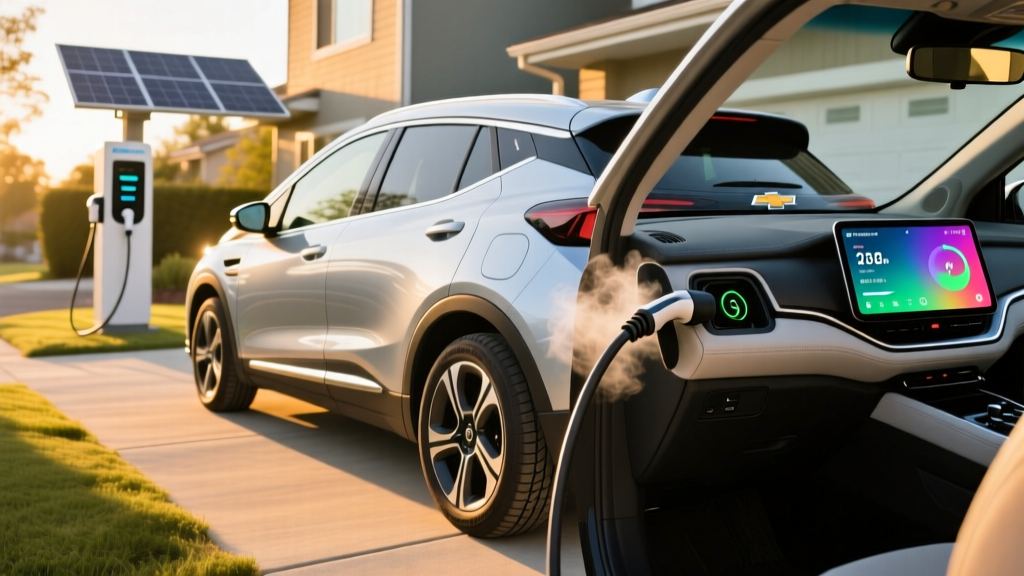
For the 2026 model year, GM has equipped the Bolt EUV with a native NACS (North American Charging Standard) port, granting access to Tesla's Supercharger network via the built-in connector — no adapter required. This dramatically expands reliable fast-charging options, though the vehicle's 55 kW ceiling remains the bottleneck, not the station's capability. At home, the 11.5 kW onboard charger is excellent for this price point, adding roughly 37 miles of range per hour on a Level 2 circuit. A full overnight charge from 10% takes about 6–7 hours on a 48-amp home charger.
Home installation of a Level 2 charger typically runs $800–$2,000 depending on electrical panel proximity and whether a 240V/50A circuit already exists. Budget for a licensed electrician to assess your panel capacity — the Bolt EUV's 11.5 kW draw requires a dedicated 60A breaker.
Performance and Driving Dynamics
The Bolt EUV's single front-mounted motor produces 200 horsepower and 266 lb-ft of torque, routing all power to the front wheels. The 0–60 mph sprint clocks in at 7.0 seconds — perfectly adequate for highway merging and city acceleration, though it won't win any drag races against dual-motor competitors. Instant electric torque makes the Bolt EUV feel quicker than its numbers suggest in urban driving, where 0–30 mph response is immediate and linear.
Ride quality is the surprise highlight. GM tuned the suspension for comfort over sportiness, and the result is a compliant, quiet ride that absorbs potholes and expansion joints better than some luxury EVs costing twice as much. The steering is light and numb — clearly tuned for parking-lot ease rather than canyon carving — but for the target buyer (commuters, small families, urban dwellers), this is the right call.
Notable absence: all-wheel drive is not available on the Bolt EUV. If you live in a region with heavy snow and need AWD traction, you'll need to look at the Hyundai Kona Electric AWD, Subaru Solterra, or step up to a Tesla Model Y Long Range. Snow tires on the FWD Bolt EUV are a viable budget alternative for moderate winter climates.
Interior, Tech, and Cargo Practicality
Step inside the 2026 Bolt EUV and you'll find a cabin that's functional but firmly budget-tier. Hard plastics dominate the lower dash and door panels, though the upper surfaces and seats (leatherette on 2LT) feel acceptable for the price. The 10.2-inch infotainment touchscreen runs GM's latest Ultifi-based software with wireless Apple CarPlay and Android Auto, a responsive interface, and native Google Built-in on upper trims. The 8-inch digital driver cluster is clear and customizable, showing real-time energy flow, range estimation, and regen levels.
Passenger space is genuinely generous for a compact crossover. Rear-seat legroom measures 39.1 inches — enough for adults on longer trips without knee complaints. Headroom is ample thanks to the EUV's slightly taller roofline compared to the standard Bolt hatchback. Cargo volume behind the rear seats is 27.5 cubic feet, expanding to 56.2 cu ft with the 60/40 split rear bench folded. That's competitive with a Honda HR-V or Mazda CX-30 and sufficient for strollers, weekly groceries, or camping gear for two.
Driver-assistance technology includes Chevy Safety Assist as standard: automatic emergency braking, forward collision alert, lane keep assist, following distance indicator, and IntelliBeam auto high beams. The available Super Cruise system (2LT with optional package, ~$2,200) enables hands-free driving on over 400,000 miles of mapped highways — a GM SAE Level 2 system that still requires driver attention and eye monitoring. This is not autonomous driving; it's an advanced lane-centering and adaptive cruise system that excels on long highway stretches but disengages on unmapped roads, construction zones, and inclement weather.
Pricing, Trims, and Federal Tax Credit Eligibility
| Trim | Base MSRP | Destination | Total Before Credit |
|---|---|---|---|
| LT | $28,995 | $1,395 | $30,390 |
| 2LT | $32,495 | $1,395 | $33,890 |
| 2LT + Super Cruise Pkg | $34,695 | $1,395 | $36,090 |
The Bolt EUV's headline number — under $29,000 to start — is what makes these Chevy Bolt EUV reviews worth writing. Very few EVs at any price point deliver 247 miles of range and a usable crossover body for this kind of money. The LT trim includes the 10.2-inch screen, wireless phone mirroring, Chevy Safety Assist suite, and heated front seats. The 2LT adds leatherette upholstery, panoramic sunroof, adaptive cruise control, 360-degree camera, and heated steering wheel.
Does the 2026 Bolt EUV Qualify for the §30D Federal Tax Credit?
Under current IRS §30D rules, the Bolt EUV's credit eligibility depends on several buyer-specific and vehicle-specific factors:
- MSRP Cap: The Bolt EUV must have an MSRP at or below $80,000 for SUVs/CUVs — it clears this easily at all trim levels.
- Buyer Income Cap: Modified adjusted gross income (MAGI) must not exceed $150,000 (single), $225,000 (head of household), or $300,000 (married filing jointly).
- Battery Sourcing Requirements: A percentage of critical minerals and battery components must be sourced from the US or free-trade-agreement countries. GM has worked to localize Bolt battery supply, but exact qualification for the full $7,500 vs. partial $3,750 varies by model year and production batch. Verify current status on fueleconomy.gov.
- Point-of-Sale Transfer: Eligible buyers can transfer the credit to the dealer at purchase, reducing the sale price directly rather than waiting for a tax refund.
Note: Tax credit rules are subject to legislative change. Consult a tax professional and verify on IRS.gov before purchase.
If you qualify for the full $7,500 credit, the effective price of a Bolt EUV LT drops to approximately $22,890 — a figure that competes with well-equipped gasoline compact crossovers on total cost of ownership, especially when factoring in zero fuel costs and minimal maintenance (no oil changes, fewer brake replacements due to regen).
Who Should Buy the Bolt EUV — And Who Shouldn't
- Lowest entry price for a 240+ mile EV crossover in 2026
- Spacious rear seat and practical cargo area
- Strong Level 2 home charging speed (11.5 kW)
- Native NACS port = Tesla Supercharger network access
- Comfortable, compliant ride quality
- Available Super Cruise hands-free highway driving
- Competitive 8-year/100,000-mile battery warranty
- Slow DC fast charging (55 kW peak; 52-min 10–80%)
- FWD only — no AWD option
- Budget-grade interior materials
- Significant cold-weather range loss (25–35%)
- No frunk (front trunk) — space occupied by motor/electronics
- Towing capacity limited to 0 lbs (not rated for towing)
Choose the Chevy Bolt EUV if: You're a commuter or small household seeking maximum EV range per dollar, you charge primarily at home overnight, your road trips are under 200 miles or you don't mind longer charge stops, and you want crossover practicality without crossing $35,000.
Look elsewhere if: You take frequent 400+ mile road trips and need 20-minute fast-charge stops (consider Hyundai Ioniq 5 or Tesla Model Y), you need AWD for harsh winters (Subaru Solterra, Kona Electric AWD), you need to tow anything (Ford F-150 Lightning, Rivian R1S), or you prioritize premium interior materials (BMW iX, Genesis GV60).
How the Bolt EUV Stacks Up Against Key Competitors
The Bolt EUV's most direct rivals in 2026 include the Hyundai Kona Electric, the Nissan LEAF (discontinued after 2025 but still available used), and lower-trim versions of the Tesla Model 3 and Model Y. Against the Kona Electric (261 mi EPA, ~$34,000), the Bolt EUV gives up 14 miles of range and significantly faster DC charging (the Kona peaks at 100+ kW) but wins on price by roughly $5,000. Against a base Tesla Model 3 RWD (~$39,990, 272 mi), the Bolt EUV is vastly cheaper but slower to charge, less tech-forward, and without access to Tesla's native software ecosystem (though NACS access partially closes the gap).
The Bolt EUV's total cost of ownership over 5 years is remarkably low when the federal credit applies. With electricity averaging $0.14/kWh nationally, a full charge costs roughly $9.10 — versus $45–$55 for a tank of gas in a comparably sized gasoline crossover. Insurance premiums for the Bolt EUV run slightly higher than its gas counterparts (typically 10–15% more) due to EV repair cost structures, but the gap has narrowed as the Bolt platform has matured.
Warranty and Long-Term Battery Outlook
GM covers the Bolt EUV's battery pack and electric powertrain for 8 years or 100,000 miles, whichever comes first. The warranty guarantees the battery will retain at least 60% of its original capacity during that period — though real-world GM data and third-party fleet monitoring suggest NMC packs in the Bolt platform typically retain 85–90% capacity at 100,000 miles under normal use.
To maximize battery longevity, GM recommends keeping State of Charge between 20% and 80% for daily driving and reserving 100% charges for road trips. The Bolt EUV's Hill Top Reserve mode (charge limit setting) makes this easy to manage from the infotainment screen. Out-of-warranty battery replacement, should it ever be needed, currently runs approximately $14,000–$16,000 including labor — a figure that has declined steadily as NMC cell prices have fallen, but still a significant potential expense for high-mileage owners.
Frequently Asked Questions
What is the real-world range of the 2026 Chevy Bolt EUV?
The EPA rates the Bolt EUV 2LT at 247 miles. In real-world mixed highway driving at 70 mph, expect 210–230 miles. In cold weather below 20°F, plan for 170–195 miles. City driving with regenerative braking can match or slightly exceed the EPA sticker.
How fast does the Bolt EUV charge at home and on the road?
At home on a Level 2 (240V) charger, the Bolt EUV charges at 11.5 kW, adding about 37 miles per hour — a full charge in roughly 6.5 hours. On DC fast chargers, it peaks at 55 kW, with a 10–80% session taking approximately 52 minutes. This is the vehicle's most notable limitation for road-trippers.
How much does the 2026 Bolt EUV cost after the federal tax credit?
The LT trim starts at $30,390 (including destination). If you qualify for the full $7,500 §30D federal credit via point-of-sale transfer, the effective price drops to approximately $22,890. Eligibility depends on income caps, battery sourcing requirements, and MSRP limits — verify on fueleconomy.gov and with a tax professional.
Is the Bolt EUV worth buying compared to the Hyundai Kona Electric or Tesla Model Y?
If price is your primary driver and you charge at home, the Bolt EUV offers unbeatable value under $30,000. If fast-charging speed and road-trip convenience matter more, the Kona Electric (faster DC charging) or Model Y (Supercharger speeds, longer range) are worth the premium. The Bolt EUV wins on cost-per-mile-of-range; its rivals win on charging infrastructure speed.
Does the 2026 Bolt EUV have all-wheel drive?
No. The Bolt EUV is front-wheel drive only, with a single 200 hp motor. If you need AWD for snow or off-pavement traction, consider the Hyundai Kona Electric AWD, Subaru Solterra, or Tesla Model Y Dual Motor.
Is Super Cruise on the Bolt EUV actually self-driving?
No. Super Cruise is an SAE Level 2 driver-assistance system — it handles steering, acceleration, and braking on mapped highways but requires the driver to remain attentive and ready to take over. An in-cabin camera monitors your eyes. It is not autonomous driving (Level 4/5). Think of it as an excellent adaptive cruise + lane-centering system, not a replacement for an engaged driver.
Can I tow with the Bolt EUV?
The 2026 Bolt EUV is not rated for towing. If towing capacity is a requirement, look at the Ford F-150 Lightning (up to 10,000 lbs), Rivian R1S (7,700 lbs), or Hyundai Ioniq 5 (2,300 lbs with tow package).