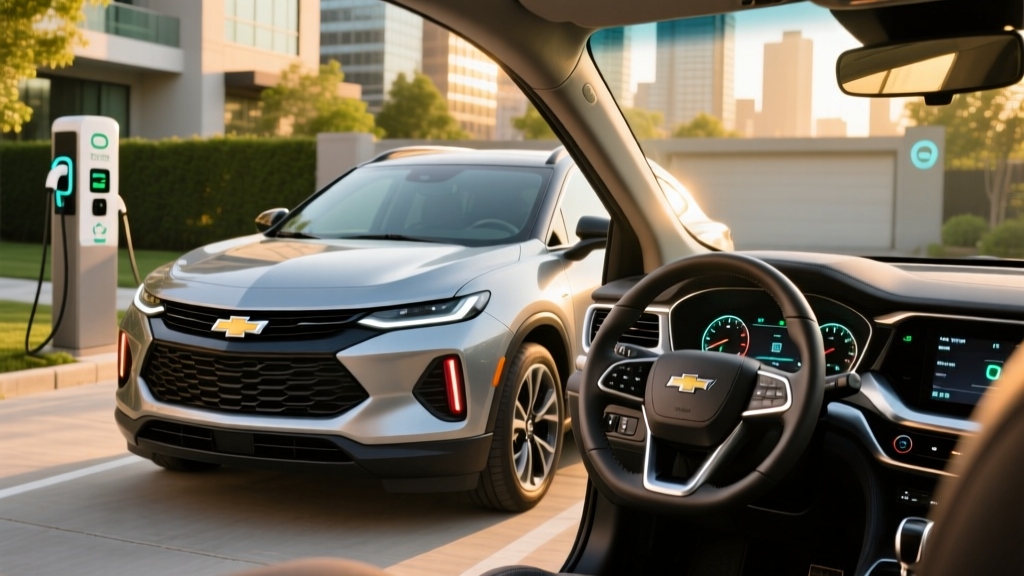
The Chevy Blazer EV RS occupies a specific lane in the midsize electric SUV segment: it's the sporty, design-forward option for buyers who want a recognizable nameplate with genuine daily-driver range. After spending time with the 2026 model year — which carries forward the Ultium platform refinements introduced in 2024 — the Blazer EV RS delivers a compelling mix of 324 miles of EPA-estimated range, aggressive styling, and a well-appointed cabin. But it also carries a premium price, a few frustrating software quirks, and charging speeds that trail the class leaders.
Here's what the data actually shows after real-world driving, charging, and ownership analysis.
Range and Efficiency: EPA Sticker vs. Reality
Real-World Expectation: 270–295 miles in mixed driving; 240–260 miles sustained highway at 70+ mph; 200–230 miles in sub-freezing winter conditions
The RS trim pairs dual-motor all-wheel drive with a 102 kWh usable battery (NMC lithium-ion chemistry on GM's Ultium platform). The EPA combined efficiency rating lands at 89 MPGe, which translates to roughly 34 kWh per 100 miles — competitive with the Ford Mustang Mach-E Extended Range AWD but slightly behind the Hyundai Ioniq 5's efficiency.
In mixed suburban and city driving with moderate climate control use, consistently achieving 290+ miles before hitting a 10% state of charge is realistic. However, sustained highway driving at 75 mph pushes consumption closer to 38–40 kWh/100mi, dropping effective range to around 250 miles. Cold weather (below 32°F) without preconditioning can reduce range by 25–35%, a physics reality for all NMC batteries without a heat pump — and the Blazer EV does not include a heat pump as of the 2026 model year, relying instead on resistive cabin heating.
For context, fueleconomy.gov lists the Blazer EV RS AWD at 324 miles combined, but your results will vary meaningfully based on driving style, terrain, and temperature.
Charging Speed: DC Fast Charge and Home Level 2
| Charging Level | Power / Rate | Speed | Notes |
|---|---|---|---|
| Level 1 (120V) | 1.4 kW | ~4 miles/hour | Emergency/trickle only |
| Level 2 (240V, 48A) | 11.5 kW | ~34 miles/hour | Full charge in ~9.5 hours |
| DC Fast Charge | 190 kW peak | 10–80% in ~30 min | Tapers significantly above 80% |
The Blazer EV RS peaks at 190 kW on DC fast chargers using its CCS connector (a NACS adapter is available for Tesla Supercharger access as of 2025). On a 350 kW Electrify America or EVgo station, the charge curve holds near peak power from roughly 10% to 45% state of charge, then tapers progressively. The 10–80% session takes approximately 30 minutes in ideal battery-temperature conditions — slower than the Hyundai Ioniq 5's ~18 minutes on its 800V architecture, but comparable to the Ford Mustang Mach-E.
Home Level 2 charging via the onboard 11.5 kW charger is the ownership sweet spot. A 48-amp hardwired Level 2 station on a 60-amp circuit will add roughly 34 miles per hour of charging, meaning an overnight session (8–10 hours) easily replenishes a full day's driving. GM includes a portable dual-level charge cord with the vehicle, though dedicated wall units from ChargePoint or Emporia deliver better long-term reliability.
Preconditioning note: The Blazer EV supports battery preconditioning when a DC fast charger is set as your navigation destination. Always use this — arriving at a charger with a cold battery can double your charging time.
Performance and Drivetrain
| Specification | 2026 Blazer EV RS AWD |
|---|---|
| Powertrain | Dual-motor AWD |
| Horsepower | 288 hp (combined) |
| Torque | 343 lb-ft |
| 0–60 mph | ~5.8 seconds |
| Top Speed | 118 mph (electronically limited) |
| Towing Capacity | 1,500 lbs |
| Battery (usable) | 102 kWh, NMC (Ultium) |
| EPA Range | 324 miles |
| Efficiency | 89 MPGe / 34 kWh/100mi |
The RS trim's dual-motor setup produces 288 horsepower — adequate for confident highway merging and passing but not thrilling by EV standards. The 5.8-second 0–60 time trails the Mach-E GT and Ioniq 5 dual-motor variants. Where the Blazer EV RS distinguishes itself is ride quality: the suspension tuning is compliant and quiet, with well-damped responses over rough pavement. The steering is weighted appropriately for a comfort-oriented SUV, though it lacks the precision of sportier competitors.
Regenerative braking offers multiple modes via steering-wheel paddles, including a one-pedal driving mode that brings the vehicle to a complete stop. The transition between regen and friction braking is smooth — one of GM's stronger calibration efforts on the Ultium platform.
Interior Space, Tech, and Daily Livability
The Blazer EV rides on GM's dedicated BEV3 platform, which frees up interior volume compared to converted ICE architectures. Passenger and cargo dimensions are competitive:
- Front legroom: 42.4 inches
- Rear legroom: 38.9 inches
- Cargo (rear seats up): 25.8 cu ft
- Cargo (rear seats folded): 55.1 cu ft
- Frunk: None (no front trunk on Blazer EV)
The cabin materials in the RS trim are a step above the 2LT, with perforated leather-appointed seats, a flat-bottom steering wheel, and red contrast stitching. The centerpiece is a 17.7-inch diagonal infotainment touchscreen running GM's Google Built-in platform — navigation, Google Assistant, and Play Store apps are native. A 11.0-inch digital driver display sits behind the wheel.
Tech highlights: Super Cruise (GM's Level 2 hands-free driver assistance) is available on the RS trim for mapped divided highways. It requires a subscription after the initial trial period. Wireless Apple CarPlay and Android Auto, a Wi-Fi hotspot, and a 7-speaker Bose audio system are included.
Notable drawbacks: The lack of a frunk is a missed opportunity for the segment. The 1,500-pound towing capacity is low for buyers considering light trailer duty. Early 2024 models experienced significant software reliability issues; GM issued multiple OTA updates through 2025 to address infotainment freezes and charging communication errors, but the platform's software reputation still lags behind Tesla and Hyundai/Kia.
Pricing, Trims, and Federal Tax Credit
| Trim | MSRP | After Max §30D Credit | Key Features |
|---|---|---|---|
| Blazer EV 2LT (AWD) | $49,700 | ~$42,200 | Standard AWD, 2LT equipment |
| Blazer EV RS (AWD) | $56,200 | ~$48,700 | RS styling, Super Cruise eligible, premium audio |
| Blazer EV SS (AWD) | $62,400 | ~$54,900 | 557 hp, performance tuning |
The RS trim starts at $56,200 before destination charges and options. As-tested with the available Super Cruise package and premium paint, expect $58,000–$60,000 out the door.
- Maximum credit: $7,500 if all requirements are met
- MSRP cap: $80,000 for SUVs — Blazer EV qualifies
- Buyer income cap: $150,000 single / $300,000 joint (MAGI)
- Battery sourcing: Critical minerals and battery component requirements apply — verify current-year compliance at irs.gov
- Point-of-sale transfer: Eligible buyers can transfer the credit to the dealer at purchase for an upfront price reduction
- VIN verification: Required at point of sale
The Blazer EV RS falls under the $80,000 SUV MSRP cap, making it eligible for the full $7,500 credit if your income qualifies and the battery sourcing requirements are satisfied for the specific model year. GM has worked to localize battery component and critical mineral sourcing through its Ultium Cells joint venture with LG Energy Solution, but the exact credit amount can vary by production batch. Always verify the VIN-specific eligibility through the IRS portal or your dealer before committing to a purchase. Consult a tax professional for your specific situation.
Warranty and Long-Term Ownership
GM backs the Blazer EV with competitive warranty coverage:
- Battery & Powertrain: 8 years / 100,000 miles (whichever comes first)
- Battery capacity retention: Warranty covers degradation below 60% of original capacity during the warranty period
- Bumper-to-bumper: 3 years / 36,000 miles
- Corrosion: 6 years / 100,000 miles
- Roadside assistance: 5 years / 100,000 miles
The 60% capacity retention threshold is standard for the industry but less generous than Tesla's 70% threshold. For a 102 kWh battery, 60% retention at 100,000 miles would mean roughly 61 kWh usable — still enough for ~195 miles of range. Real-world Ultium degradation data from 2024–2025 model-year vehicles suggests most owners will retain 90%+ capacity at 50,000 miles with normal charging habits, though long-term data is still accumulating.
Pros, Cons, and Who Should Buy
- 324-mile EPA range is among the best in the midsize EV SUV class
- Comfortable, quiet ride quality on the BEV3 platform
- Super Cruise hands-free driving on mapped highways
- Spacious rear seat with nearly 39 inches of legroom
- Eligible for up to $7,500 federal tax credit (verify sourcing)
- Google Built-in infotainment with native apps
- 190 kW peak DC charging trails Ioniq 5 and Mach-E competitors
- No heat pump — cold-weather range loss is significant
- No frunk (front trunk) despite dedicated EV platform
- 1,500-lb towing capacity is low for the segment
- Software reliability reputation still recovering from 2024 launch issues
- RS price near $60K as-tested is steep before incentives
Who the Blazer EV RS suits best: Daily commuters and two-row families who prioritize range, ride comfort, and hands-free highway driving over sporty performance or maximum charging speed. If your routine involves 40–80 miles of daily driving with home Level 2 charging, the 324-mile range provides ample buffer for errands, detours, and occasional road trips. It's less ideal for frequent long-distance highway travelers who need rapid DC charging, buyers in consistently cold climates who would benefit from a heat pump, or those who need to tow more than 1,500 pounds.
How It Stacks Up Against Competitors
The Blazer EV RS competes directly with the Ford Mustang Mach-E Extended Range AWD, Hyundai Ioniq 5 Long Range AWD, and Tesla Model Y Long Range. Here's the essential comparison:
- Range advantage: Blazer EV RS (324 mi) edges the Mach-E ER AWD (~312 mi) and Ioniq 5 AWD (~290 mi), but trails the Model Y Long Range (~330 mi).
- Charging speed deficit: At 190 kW peak, the Blazer is notably slower than the Ioniq 5 (240 kW on 800V) and comparable to the Mach-E (150 kW). The Model Y peaks around 250 kW on V3 Superchargers.
- Price positioning: The RS at $56,200 is more expensive than a comparably equipped Mach-E Premium (~$48,000) and Ioniq 5 SEL (~$52,000), though the Blazer includes more standard equipment.
- Software & ADAS: Super Cruise is arguably the best Level 2 highway assist in the segment outside Tesla's FSD Supervised, but GM's general infotainment software polish still trails Tesla and Hyundai.
For a detailed side-by-side analysis, see the NHTSA vehicle listing for safety ratings as they're published.
Frequently Asked Questions
What is the real-world range of the Chevy Blazer EV RS?
The EPA rates the Blazer EV RS AWD at 324 miles. In real-world mixed driving, expect 270–295 miles. Sustained highway driving at 70+ mph drops that to roughly 240–260 miles, and cold weather (below 32°F) can reduce range to 200–230 miles without preconditioning.
How fast does the Blazer EV RS charge?
On DC fast chargers, it peaks at 190 kW, reaching 10–80% in approximately 30 minutes under ideal conditions. At home on a Level 2 (240V, 48A) charger, the 11.5 kW onboard charger adds about 34 miles per hour, fully replenishing the battery overnight.
Does the Chevy Blazer EV RS qualify for the federal EV tax credit?
Yes, the Blazer EV RS is eligible for up to $7,500 under IRS §30D, provided the buyer's income is under $150K single / $300K joint, the MSRP is under $80K (it is), and the battery sourcing requirements are met for the specific VIN. The credit can be transferred at point of sale. Always verify at irs.gov and consult a tax professional.
Is the Blazer EV RS worth buying over the Mustang Mach-E or Ioniq 5?
It depends on priorities. Choose the Blazer EV RS if you value maximum range, a comfortable ride, and Super Cruise highway assist. Choose the Ioniq 5 if fast DC charging (18-min 10–80%) and value pricing matter more. Choose the Mach-E for a sportier driving experience at a lower entry price.
What are the biggest drawbacks of the Blazer EV RS?
The main weaknesses are 190 kW charging (slower than key rivals), no heat pump (amplifying cold-weather range loss), no front trunk, a 1,500-lb towing limit, and a software reliability reputation still recovering from the 2024 launch.
Does the Blazer EV have a heat pump?
No. As of the 2026 model year, the Blazer EV uses resistive cabin heating, which draws more energy from the traction battery in cold weather and contributes to the 25–35% range loss observed in sub-freezing temperatures.