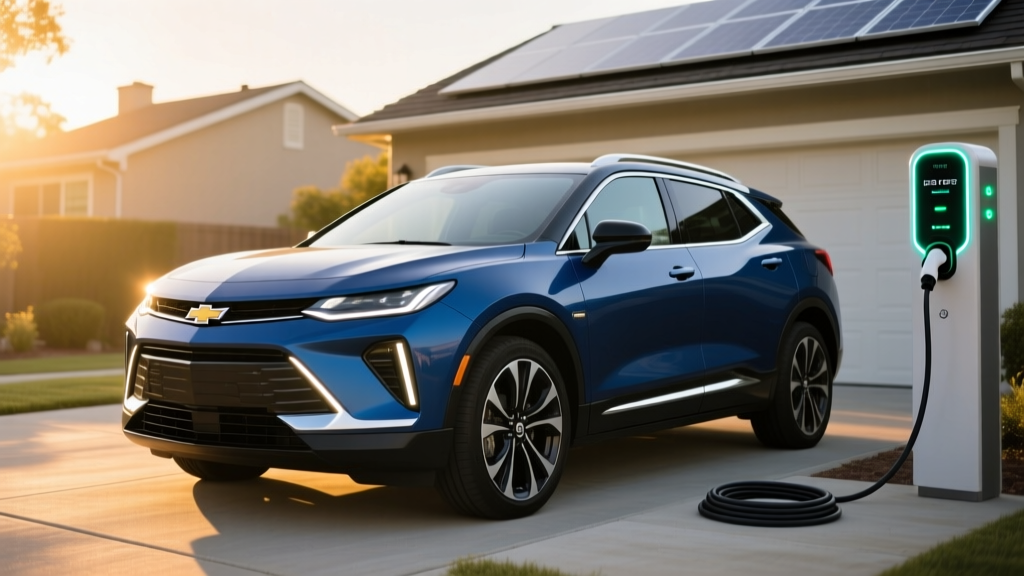
Leasing a 2026 Chevrolet Blazer EV looks attractive on paper: a midsize electric crossover with up to 314 miles of EPA range, a spacious cabin, and monthly payments that can undercut buying. But a lease is only as smart as the total cost behind it. Between shifting federal tax credit rules, higher-than-average EV insurance premiums, and depreciation trends that have battered early-adopter electrics, the math requires a closer look.
This guide runs the real numbers on a Blazer EV lease in 2026 — from the IRS §30D credit eligibility (and how the point-of-sale lease loophole works) to charging costs, maintenance savings, insurance reality, and what happens at lease-end. We use the 2LT AWD trim as our baseline, as it represents the volume configuration most shoppers consider.
2026 Blazer EV: The Specs That Drive Ownership Cost
Before calculating cost, you need the hardware baseline. The 2026 Blazer EV rides on GM's Ultium platform with an NMC (nickel-manganese-cobalt) lithium-ion battery pack. Here are the numbers that directly affect your wallet:
| Specification | Value |
|---|---|
| MSRP (2LT AWD) | $48,800 (before destination) |
| Usable Battery Capacity | 102 kWh (NMC chemistry) |
| EPA Range | 279 miles (2LT AWD); 314 mi (RS RWD) |
| Real-World Range Expectation | ~230–255 mi highway; ~200–220 mi in cold weather (below 32°F) |
| EPA Efficiency | 89 MPGe combined (2.9 mi/kWh) |
| Peak DC Fast Charge Rate | 190 kW (10–80% in ~32 minutes) |
| Level 2 AC Charge Rate | 11.5 kW (~34 mi/hr) |
| Horsepower / Torque | 288 hp / 343 lb-ft (2LT AWD) |
| 0–60 mph | ~7.5 seconds |
| Battery Warranty | 8 years / 100,000 miles (60% capacity retention) |
| Bumper-to-Bumper Warranty | 3 years / 36,000 miles |
Federal Tax Credit: How the Lease Loophole Works in 2026
This is where leasing gets interesting — and where most shoppers get confused. Under the current IRS §30D rules, the Blazer EV's eligibility for the full $7,500 federal tax credit when purchased is uncertain due to battery-sourcing and critical-mineral requirements that have tightened significantly since the Inflation Reduction Act. Chevrolet's North American battery production and mineral sourcing have been evolving, and the exact credit amount for a purchase can change month to month.
However, leasing operates under a different section of the tax code — IRC §45W (the commercial clean vehicle credit). Here's the critical distinction:
For comparison, here's what the purchase-path §30D credit requires in 2026:
- MSRP Cap: SUVs must have an MSRP at or below $80,000 (Blazer EV qualifies)
- Buyer Income Cap: Modified AGI ≤ $150,000 (single) / $225,000 (head of household) / $300,000 (joint)
- Battery Sourcing: Increasing percentages of critical minerals and battery components must be sourced from the U.S. or FTA partners — thresholds that tighten annually
- Point-of-Sale Transfer: Eligible buyers can transfer the credit to the dealer at purchase for an immediate price reduction
- Filing Requirement: Must file IRS Form 8936 with your tax return; credit is non-refundable (you must owe at least $7,500 in federal tax to claim the full amount)
For the latest eligibility details, always check IRS.gov's clean vehicle credit page and confirm with your tax professional before signing.
5-Year Total Cost of Ownership: Blazer EV Lease vs. Gas Equivalent
Let's model a realistic 5-year scenario. We'll compare a Blazer EV 2LT AWD lease against a comparable gas-powered midsize SUV (25 MPG combined) to show where money is saved and where it isn't.
Lease assumptions: 36-month lease at ~$399/month (with $7,500 lease credit applied as cap-cost reduction), followed by a second 24-month lease or purchase at residual. For simplicity, we model 60 months of equivalent payments. We assume 12,000 miles/year (60,000 miles total).
| Cost Category | Blazer EV (Lease) | Gas SUV (25 MPG) |
|---|---|---|
| Vehicle Payments (60 mo) | $23,940 ($399/mo) | $25,200 ($420/mo est.) |
| Fuel / Charging | $4,320 (home + public DC) | $8,400 (gas at $3.50/gal) |
| Insurance (5 years) | $12,000 (~$200/mo) | $9,600 (~$160/mo) |
| Maintenance | $1,200 | $3,500 |
| Federal Tax Credit | –$7,500 (lease pass-through) | $0 |
| Depreciation (lease residual risk) | Borne by lessor | ~$12,000 (if purchased) |
| Net 5-Year Cost | ~$33,960 | ~$46,700 |
Charging Costs vs. Gas: The Per-Mile Math
The Blazer EV's efficiency of 2.9 miles per kWh means your cost per mile depends heavily on where you charge:
| Charging Scenario | Rate | Cost/Mile | Annual Cost (12k mi) |
|---|---|---|---|
| Home Level 2 (national avg) | $0.16/kWh | $0.055 | $660 |
| Home with EV time-of-use rate | $0.09/kWh (off-peak) | $0.031 | $372 |
| Public DC Fast Charging | $0.48/kWh (avg) | $0.166 | $1,992 |
| Gas SUV (25 MPG) | $3.50/gallon | $0.140 | $1,680 |
The numbers make the case clear: home charging is where EV economics win. At the national residential average of $0.16/kWh, the Blazer EV costs roughly $0.055 per mile — less than half the cost of a 25 MPG gas SUV. With an off-peak utility rate, it drops to just $0.031/mile.
But if you rely exclusively on public DC fast chargers at $0.48/kWh (typical for Electrify America or EVgo standard rates), your per-mile cost actually exceeds the gas SUV. This is why home Level 2 charging access is the single most important variable in EV ownership economics.
For a realistic mixed scenario — 80% home charging, 20% public DC — expect an annual fuel cost of roughly $925, saving about $755 per year versus gas. Over 5 years: ~$3,775 in fuel savings.
Maintenance Savings: What You Won't Pay For
EVs eliminate the most common recurring maintenance items of internal-combustion vehicles. Here's the side-by-side over 60,000 miles:
| Service Item | Blazer EV | Gas SUV |
|---|---|---|
| Oil Changes (every 7,500 mi) | $0 | $480 (8 changes × $60) |
| Brake Pad Replacement | $0 (regen braking preserves pads; 100k+ mi life typical) | $600 (2 axle sets) |
| Transmission Fluid | $0 (single-speed reduction gear) | $250 |
| Engine Air Filter | $0 | $120 |
| Cabin Air Filter | $150 | $150 |
| Tire Rotation / Replacement | $900 (EVs wear tires ~15–20% faster due to weight/torque) | $750 |
| Coolant / Misc. Fluids | $150 | $350 |
| Software Updates | $0 (OTA) | $0 |
| Total Maintenance | ~$1,200 | ~$2,700+ |
Net maintenance savings: approximately $1,500 over 5 years. The biggest caveat is tire wear — the Blazer EV's 4,600+ lb curb weight and instant torque accelerate tire wear. Budget for a set of EV-rated touring tires (like the Michelin CrossClimate 2 or Hankook iON) around 35,000–40,000 miles.
Insurance Reality: The Cost EV Owners Often Overlook
EV insurance premiums run 15–25% higher than equivalent gas vehicles. For the Blazer EV, expect average annual premiums of $1,800–$2,400 depending on your state, driving record, and coverage levels — compared to $1,400–$1,800 for a gas midsize SUV.
Why EV insurance costs more:
- Higher repair costs: Battery pack damage, even minor, often triggers total-loss declarations due to safety protocols around high-voltage components
- Specialized labor: Fewer certified EV repair technicians mean higher labor rates at body shops
- Parts cost: Ultium battery modules and EV-specific components carry premium pricing
- Vehicle value: Higher MSRP translates to higher comprehensive/collision premiums
According to IIHS, some insurers have begun offering EV-specific policies with battery coverage riders. Shop quotes from at least three carriers — GEICO, Progressive, and State Farm all have distinct EV rating models — and ask specifically about EV battery coverage terms.
Depreciation & Lease-End: Who Bears the Risk?
EV depreciation has been one of the most volatile segments of the used car market. Between 2023 and 2025, several mainstream EVs lost 40–55% of their value within two years, driven by Tesla's aggressive price cuts, rapid battery tech improvements, and shifting consumer sentiment. The Blazer EV, launched for the 2024 model year, has limited resale history.
Why leasing insulates you:
- The residual value is set at lease signing — if the Blazer EV depreciates faster than expected, GM Financial absorbs the loss, not you
- No surprise trade-in value negotiations
- You walk away at month 36 (or pay the residual if you want to keep it)
Lease-end considerations:
- Mileage overage: Typically $0.20–$0.25/mile over the limit. At 12,000 mi/year, exceeding by 3,000 miles/year means ~$1,800–$2,250 at turn-in
- Wear and tear: GM Financial follows standard guidelines — minor scuffs are acceptable, but cracked wheels or significant body damage will be billed
- Purchase option: Your lease will specify a residual purchase price. If used EV values have dropped below that residual, simply return the vehicle
For current market depreciation trends, Kelley Blue Book and Edmunds publish quarterly EV resale value reports worth checking before committing.
State, Local & Utility Incentives: The Stacked Savings
Beyond the federal lease credit, many states and utilities offer additional incentives that can stack:
- California: Up to $2,000 via the Clean Fuel Reward (point-of-sale) plus potential CVRP rebate for income-qualified buyers
- Colorado: State EV tax credit of up to $5,000 (varies by vehicle price and year)
- New York: Drive Clean Rebate up to $2,000 (point-of-sale)
- Utility rebates: Many utilities (PG&E, ConEdison, Xcel Energy, others) offer $500–$1,500 rebates for home Level 2 charger installation, plus time-of-use rate plans that slash charging costs
- HOV lane access: Several states grant solo-carpool-lane access to EVs — a non-monetary but time-valuable benefit
When stacked with the federal lease credit, total incentives in favorable states can reach $10,000–$14,000 — dramatically altering the lease economics.
Is a Blazer EV Lease Right for You? Decision Framework
Choose the Blazer EV Lease If:
- You have reliable home Level 2 charging access (garage or driveway with 240V outlet)
- Your income exceeds the §30D purchase credit caps but you want to access the $7,500 via the lease pathway
- You drive 10,000–14,000 miles/year (within standard lease limits)
- You want to avoid EV depreciation risk during a period of rapid technology change
- You value a spacious, quiet, tech-forward midsize crossover with 279+ miles of range
Consider Alternatives If:
- You lack home charging access and would rely on public DC fast charging (your per-mile cost may exceed gas)
- You drive more than 15,000 miles/year (lease overage penalties erode savings)
- You live in a state with no additional incentives and high electricity rates (above $0.25/kWh residential)
- You want to keep vehicles 8–10+ years (buying becomes more economical long-term)
- Your insurance quotes come in above $250/month (get quotes before signing)
Frequently Asked Questions
How much does a 2026 Blazer EV lease cost per month?
With the $7,500 commercial credit applied as a cap-cost reduction, expect advertised lease offers in the $350–$450/month range for a 2LT AWD on a 36-month term with $3,000–$4,000 due at signing. Actual terms vary by dealer, credit score, and region.
Do I qualify for the federal tax credit if I lease?
The lease pathway (§45W commercial credit) has no income cap, no MSRP cap, and no battery-sourcing restrictions. The credit goes to the leasing company, which typically passes it through as a lower monthly payment. Confirm with the dealer that the full $7,500 is being applied as a cap-cost reduction before signing.
How much will I save on fuel charging a Blazer EV vs. buying gas?
At the national average residential electricity rate of $0.16/kWh and the Blazer EV's 2.9 mi/kWh efficiency, you'll pay about $0.055/mile — versus $0.14/mile for a 25 MPG gas SUV at $3.50/gallon. Over 12,000 miles, that's roughly $660 in electricity vs. $1,680 in gas, saving ~$1,000/year with primarily home charging.
Are EVs more expensive to insure than gas cars?
Yes, typically 15–25% more. For the Blazer EV, expect $1,800–$2,400/year vs. $1,400–$1,800 for a gas equivalent. Higher repair costs, specialized labor, battery replacement risk, and higher vehicle values all contribute. Always get a binding quote before committing to a lease.
How well do EVs hold their value?
EV depreciation has been volatile, with some models losing 40–55% in the first two years during 2023–2025. The Blazer EV's long-term resale value is still establishing itself. Leasing transfers this risk to the lessor — you're protected regardless of what the used EV market does.
What happens if the Blazer EV's battery degrades during my lease?
The battery is warranted for 8 years/100,000 miles against degradation below 60% capacity. A typical 36-month lease covering 36,000 miles will see minimal degradation (likely 3–5% loss based on Ultium platform data). You won't face battery replacement costs during a standard lease term.
Can I charge a Blazer EV on a regular 120V outlet?
Yes, but Level 1 (120V) charging adds only about 3–4 miles of range per hour at ~1.4 kW. For the 102 kWh battery, a full charge would take over 70 hours. Level 1 is viable only for emergency top-ups or very low daily mileage. A 240V Level 2 home charger (adding ~34 miles/hour) is strongly recommended for practical daily use.