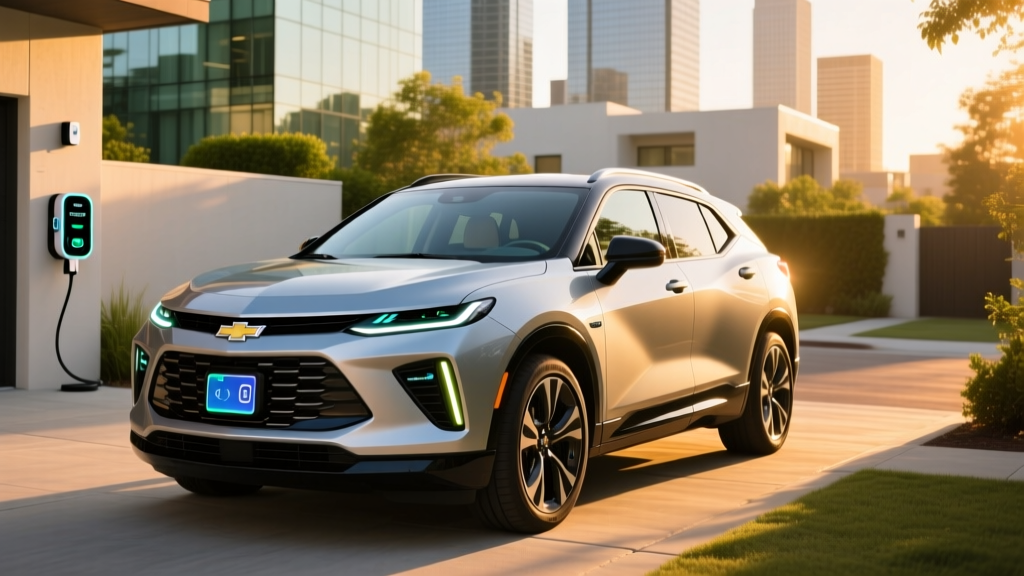
The 2026 Chevrolet Blazer EV slots into one of the most competitive segments in the electric-vehicle market: the midsize two-row crossover. With an EPA-estimated range of up to 324 miles (2LT AWD with the larger battery), a starting MSRP that undercuts several rivals, and eligibility for the full $7,500 federal tax credit under current IRS §30D rules, the Blazer EV is a strong candidate for lease shoppers. But a low monthly payment only tells part of the story. To understand whether a Chevy Blazer EV lease makes financial sense, you need to see the full picture: five-year total cost of ownership, real-world charging economics, insurance premiums, maintenance savings, and the depreciation curve that EVs are still working to flatten.
This guide walks through every cost variable you will face as a Blazer EV lessee or buyer in 2026, using exact figures from the EPA, GM, and the IRS. Whether you are comparing it against a Tesla Model Y, Ford Mustang Mach-E, or Hyundai Ioniq 5, the math below gives you the data to decide.
2026 Chevy Blazer EV: Key Specs at a Glance
| Specification | 2LT (Standard Range) | 2LT (Extended Range) | RS AWD | SS |
|---|---|---|---|---|
| Base MSRP | $44,600 | $47,400 | $51,200 | $62,800 |
| Battery Capacity (usable) | 85 kWh (est.) | 102 kWh | 102 kWh | 102 kWh |
| Battery Chemistry | NMC | NMC | NMC | NMC |
| EPA Range | ~279 mi | 324 mi | 293 mi | 293 mi |
| Real-World Range (highway/cold) | ~230–250 mi | ~260–285 mi | ~240–260 mi | ~240–260 mi |
| Motor Power | 288 hp (FWD) | 288 hp (FWD) | 515 hp (AWD) | 557 hp (eAWD) |
| 0–60 mph | ~7.0 sec | ~7.0 sec | ~4.8 sec | ~3.4 sec (Wide Open Watts) |
| Peak DC Fast Charge | 190 kW | 190 kW | 190 kW | 190 kW |
| 10–80% DC Charge Time | ~32 min | ~34 min | ~34 min | ~34 min |
| Level 2 (240V) Charge Rate | 11.5 kW | 11.5 kW | 11.5 kW | 11.5 kW |
| MPGe (combined) | 95 MPGe | 89 MPGe | 84 MPGe | 79 MPGe |
| Efficiency (kWh/100 mi) | 35 | 38 | 40 | 43 |
| Battery/Powertrain Warranty | 8 years / 100,000 miles | |||
Federal Tax Credit: Does the Blazer EV Qualify?
For 2026, the Blazer EV continues to qualify for the full $7,500 federal tax credit under IRS §30D, provided you meet all eligibility requirements. General Motors manufactures the Blazer EV at its Ramos Arizpe plant in Mexico, but the battery components and critical-mineral sourcing have been structured to satisfy current IRS rules. The credit can now be transferred to the dealer at the point of sale, effectively reducing your purchase price or capitalized cost on a lease by $7,500 upfront — a significant advantage for lease shoppers.
- Vehicle MSRP Cap: SUVs/crossovers must have an MSRP at or below $80,000. All Blazer EV trims qualify (top SS trim at $62,800).
- Buyer Income Cap (Modified AGI): $300,000 (married filing jointly), $225,000 (head of household), $150,000 (single). Exceed these and you lose the credit entirely.
- Battery Component Sourcing: Battery components must be manufactured or assembled in North America (percentage thresholds increase annually). GM has confirmed 2026 Blazer EV compliance.
- Critical Minerals: A required percentage of critical minerals must be sourced from the U.S. or a free-trade-agreement country. GM has confirmed 2026 compliance.
- Point-of-Sale Transfer: You may transfer the credit to the dealer for an immediate price reduction. The dealer registers the sale through the IRS Energy Credits Online portal.
- Lease Loophole (Commercial Credit §45W): If you lease rather than buy, the leasing company (lessor) technically claims the credit. Most major lessors pass this through as a capitalized-cost reduction, effectively giving you the $7,500 discount regardless of your personal income. Confirm this with your dealer before signing.
Source: IRS.gov — Clean Vehicle Credits. Rules are subject to change; verify current-year requirements with a tax professional.
Five-Year Total Cost of Ownership: Blazer EV vs. Gas Midsize SUV
To put the Chevy Blazer EV lease in context, let's compare it against a typical gas-powered midsize SUV in the same price bracket — the 2026 Chevrolet Blazer 2LT (gas, AWD, ~$42,000 MSRP). We assume 15,000 miles driven annually, a 36-month/45,000-mile lease term for the EV, and ownership through year five.
| Cost Category | Blazer EV 2LT (Ext. Range) | Gas Blazer 2LT (AWD) | Difference |
|---|---|---|---|
| Purchase/Lease Cost (net of credit) | $39,900 (after $7,500 credit) | $42,000 | EV saves $2,100 |
| Fuel / Electricity (5 yr, 75k mi) | $3,420 (home charging at $0.14/kWh) | $10,350 ($3.45/gal, 22 MPG avg) | EV saves $6,930 |
| Maintenance (5 yr) | $1,200 | $3,800 | EV saves $2,600 |
| Insurance (5 yr) | $11,400 ($2,280/yr avg) | $9,000 ($1,800/yr avg) | Gas saves $2,400 |
| Depreciation (5 yr) | $18,000 (~45%) | $15,750 (~37.5%) | Gas saves $2,250 |
| Total 5-Year Cost | $73,920 | $80,900 | EV saves ~$6,980 |
Key takeaway: The Blazer EV's advantage comes primarily from fuel and maintenance savings, which more than offset higher insurance and steeper depreciation. The $7,500 tax credit is the single biggest swing factor — without it, the five-year costs are nearly identical.
Charging Cost vs. Gas: The Per-Mile Math
The Blazer EV 2LT Extended Range consumes approximately 38 kWh per 100 miles (per fueleconomy.gov). Your actual cost per mile depends entirely on where and how you charge.
| Charging Scenario | Cost per kWh | Cost per 100 Miles | Cost per Mile |
|---|---|---|---|
| Home Level 2 (national avg residential) | $0.14 | $5.32 | $0.053 |
| Home Level 2 (high-cost state, e.g., CA) | $0.28 | $10.64 | $0.106 |
| Home with solar (net cost) | $0.06 | $2.28 | $0.023 |
| Public DC fast charging (avg network rate) | $0.38 | $14.44 | $0.144 |
| Public DC (peak/urban rates) | $0.55 | $20.90 | $0.209 |
| Gas Comparison: Gas Blazer AWD at 22 MPG combined, $3.45/gal = $15.68 per 100 miles ($0.157/mile) | |||
At the national average residential electricity rate, the Blazer EV costs roughly one-third as much per mile as its gas counterpart. Even at California's higher rates, home charging still beats gas. However, if you rely exclusively on public DC fast charging at peak rates, you may actually exceed gas costs per mile. This is why home Level 2 charging access is the single most important variable in EV economics.
Maintenance Savings: Where EVs Win Decisively
Electric vehicles eliminate the most frequent maintenance items that plague internal-combustion vehicles. The Blazer EV has no engine oil, no transmission fluid, no spark plugs, no exhaust system, and no timing belt. Its single-speed reduction gear requires minimal service. Regenerative braking dramatically extends brake-pad life — many EV owners report original brake pads lasting 80,000+ miles.
| Maintenance Item | Gas Blazer (5-yr cost) | Blazer EV (5-yr cost) |
|---|---|---|
| Oil changes (6 over 75k mi) | $480 | $0 |
| Transmission fluid | $250 | $0 |
| Air filter / cabin filter | $200 | $120 (cabin only) |
| Spark plugs | $400 | $0 |
| Brake pads (front) | $350 | $0 (regen extends life) |
| Coolant flush | $150 | $150 |
| Tire rotation / replacement | $1,200 | $1,200 (EV tires wear similarly) |
| Miscellaneous (wipers, bulbs) | $150 | $120 |
| Software updates / diagnostics | $100 | $100 |
| Total Estimated (5 yr) | $3,280 | $1,690 |
Over five years, the Blazer EV saves approximately $1,600 in maintenance. That figure grows substantially over eight to ten years as gas-vehicle maintenance accelerates (timing chains, water pumps, catalytic converters).
Insurance Costs: The Uncomfortable Truth
EV insurance premiums are typically 15–25% higher than equivalent gas vehicles. The Blazer EV is no exception. Several factors drive this:
- Higher repair costs: EV battery packs and power electronics are expensive to replace after collision damage. Even minor structural damage near the battery enclosure can trigger a total-loss declaration.
- Specialized labor: Fewer body shops are certified for high-voltage EV repair, increasing labor rates and claim cycle times.
- Vehicle value: The Blazer EV's MSRP (post-credit) is competitive, but pre-credit values set the insurer's replacement-cost baseline.
- Parts availability: GM's Ultium-platform parts supply chain is still maturing, which can delay repairs and increase rental-car costs for insurers.
Expect to pay approximately $2,100–$2,500 annually for full coverage on a Blazer EV 2LT, compared to roughly $1,700–$1,900 for the gas Blazer. That's an additional $1,500–$3,000 over five years. Shop quotes from multiple carriers — some insurers (notably those with dedicated EV programs) offer competitive rates that narrow this gap significantly.
Depreciation and Resale Value: EVs Are Improving
Historically, EVs depreciated faster than gas vehicles due to rapid technology advancement, battery-degradation concerns, and uncertain long-term demand. The 2023–2024 price wars (led by Tesla) further compressed used-EV values. However, the market has stabilized considerably heading into 2026.
Current data from automotive valuation sources suggests the Blazer EV retains approximately 50–55% of its post-credit value after five years, compared to roughly 58–63% for the gas Blazer. On a $39,900 net purchase, that translates to roughly $18,000–$20,000 in depreciation over five years.
For lease shoppers, depreciation matters less directly — your lease payment already factors in the lessor's residual-value estimate. A lower residual means higher monthly payments, so GM Financial's projected residual percentage is a key variable. As of early 2026, Blazer EV lease residuals are set at approximately 48–52% for a 36-month term, which is competitive within the EV segment.
Beyond the federal credit, many states and utilities offer additional incentives that can reduce your effective cost by $500–$5,000+:
- California: Up to $2,000 via the Clean Fuel Rebate (income-dependent); additional CVRP rebates for lower-income buyers.
- Colorado: Up to $5,000 state tax credit for new EVs (income-capped).
- New York: Drive Clean Rebate up to $2,000 (point-of-sale).
- Utility rebates: Many utilities offer $250–$1,000 for home Level 2 charger installation or discounted off-peak charging rates. Check with your local provider.
- HOV lane access: Several states grant single-occupant HOV access for EVs — a significant time savings in congested metros.
Incentive amounts and eligibility vary by jurisdiction and change frequently. Consult your state's energy office or AFDC's incentive database for current programs.
Is a Chevy Blazer EV Lease the Right Financial Move?
- You have access to home Level 2 charging (or can install a 240V outlet).
- You drive 10,000–15,000 miles annually (within typical lease limits).
- You want to lock in current technology without long-term battery-degradation risk.
- Your household income exceeds the §30D cap but the lease §45W commercial-credit passthrough still applies.
- You value a quiet, smooth, torque-heavy driving experience and low running costs.
- You cannot charge at home and public charging infrastructure in your area is sparse or expensive.
- You regularly tow (the Blazer EV is rated for only 1,500 lbs vs. the gas model's 4,500 lbs).
- You drive more than 15,000 miles per year (lease overage penalties are typically $0.20–$0.30/mile).
- You live in an extreme-cold climate where 25–30% winter range loss would make the 279-mile base range uncomfortably tight.
Frequently Asked Questions
How much does a 2026 Chevy Blazer EV lease cost per month?
Lease payments vary widely based on trim, down payment, term, money factor, and residual value. For a 2026 Blazer EV 2LT Extended Range (MSRP $47,400) on a 36-month/36,000-mile lease with $3,500 due at signing and the $7,500 credit applied as a cap-cost reduction, expect monthly payments in the range of $399–$499, depending on your credit tier and regional incentives. Always confirm the money factor and residual percentage before signing.
Can I get the $7,500 tax credit on a lease?
Technically, the lessee does not claim the §30D credit on a lease — the leasing company (lessor) claims the equivalent commercial clean-vehicle credit (§45W). However, most major lessors pass this benefit through as a capitalized-cost reduction, effectively lowering your lease payment by the equivalent of $7,500. Importantly, the §45W commercial credit does not have the same buyer-income or MSRP caps as §30D, which can make leasing more advantageous for high-income buyers. Confirm the cap-cost reduction with your dealer before signing.
How much do I save on fuel with the Blazer EV vs. gas?
At the national average residential electricity rate of $0.14/kWh and the Blazer EV's efficiency of 38 kWh/100 mi, you pay approximately $0.053 per mile for electricity. The gas Blazer at 22 MPG combined and $3.45/gallon costs $0.157 per mile. Over 15,000 miles per year, that's a fuel savings of roughly $1,560 annually, or $7,800 over five years. Your actual savings depend on local electricity rates, how much you charge at home vs. public chargers, and local gas prices.
Are EVs more expensive to insure than gas cars?
Yes, typically 15–25% more. For the Blazer EV, expect annual premiums of $2,100–$2,500 compared to $1,700–$1,900 for the gas Blazer. Higher repair costs, specialized labor requirements, and battery-replacement expenses drive the difference. Get quotes from at least three insurers — some offer EV-specific programs with competitive rates.
How well does the Blazer EV hold its value?
As of 2026, the Blazer EV retains approximately 50–55% of its post-credit purchase value after five years. This is slightly below the gas Blazer's 58–63% retention but represents a meaningful improvement over earlier EV generations. For lease shoppers, residual values are baked into your payment — GM Financial sets 36-month residuals at roughly 48–52% of MSRP. As battery-durability data accumulates and the used-EV market matures, residuals are expected to improve.
What is the real-world range of the Blazer EV?
The EPA rates the 2LT Extended Range at 324 miles. In real-world mixed driving, expect 270–290 miles. On sustained highway trips at 75 mph, plan for 260–280 miles. In freezing weather, budget for 230–260 miles. The standard-range 2LT's 279-mile EPA rating drops to roughly 220–250 miles in cold-weather highway driving.
Does the Blazer EV support NACS (Tesla Supercharger) charging?
Yes. GM transitioned its EVs to the NACS connector starting with the 2025 model year. The 2026 Blazer EV comes with a native NACS charge port, giving you direct access to Tesla's Supercharger network (now open to non-Tesla vehicles via the NACS standard) without an adapter. It also supports CCS1 via adapter for legacy Electrify America and other CCS stations.
What is the Blazer EV battery warranty?
Chevrolet covers the Blazer EV's battery and electric-drive components for 8 years or 100,000 miles, whichever comes first. The warranty guarantees the battery will retain a minimum level of capacity (typically 60–70% of original, as specified in the warranty booklet). If degradation exceeds the threshold within the warranty period, GM will repair or replace the battery at no cost.
Sources: EPA fueleconomy.gov, IRS §30D Clean Vehicle Credits, Chevrolet official specifications. Pricing and incentive data reflect 2026 model year and are subject to change. Consult a tax professional for credit eligibility. Always verify current specs and pricing with your local dealer.