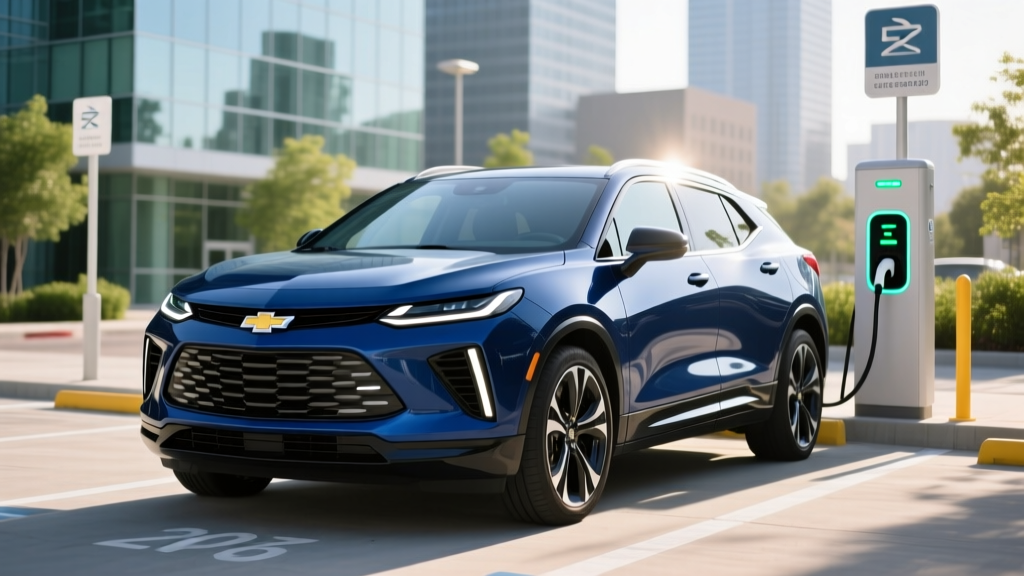
Quick Verdict: Is the 2026 Chevy Blazer EV a Smart Buy?
The 2026 Chevrolet Blazer EV is a midsize electric crossover that competes directly with the Hyundai Ioniq 5, Ford Mustang Mach-E, and Tesla Model Y. With an EPA-estimated range of up to 324 miles (LT RWD trim), a usable battery capacity of approximately 102 kWh (Ultium NMC chemistry), and DC fast charging that peaks around 190 kW (10–80% in roughly 28 minutes), it offers a compelling package for families transitioning from gas SUVs.
But the sticker price — starting at $44,600 for the LT eAWD and climbing to $56,500+ for the RS and SS trims — demands scrutiny. The real question buyers are asking: do Chevy Blazer EV deals actually save you money over five years? The answer depends on your tax-credit eligibility, home charging access, annual mileage, and insurance market. Let's break it down with hard numbers.
2026 Chevy Blazer EV Key Specifications
| Spec | LT eAWD | RS (RWD) | SS (eAWD) |
|---|---|---|---|
| Base MSRP | $44,600 | $51,900 | $56,500 |
| EPA Range | 283 mi | 324 mi | 293 mi |
| Battery (Usable) | ~85 kWh (NMC) | ~102 kWh (NMC) | ~102 kWh (NMC) |
| DC Fast Charge (Peak) | 190 kW | 190 kW | 190 kW |
| 10–80% Charge Time | ~28 min | ~31 min | ~31 min |
| Level 2 Charge Rate | 11.5 kW | 11.5 kW | 11.5 kW |
| Horsepower | 288 hp | 343 hp | 557 hp |
| 0–60 mph | ~6.2 sec | ~5.4 sec | ~3.4 sec |
| MPGe (Combined) | 98 MPGe | 100 MPGe | 89 MPGe |
| Battery/Powertrain Warranty | 8 yr / 100,000 mi | 8 yr / 100,000 mi | 8 yr / 100,000 mi |
Real-World Range Expectations
The EPA rates the RS RWD at 324 miles. In real-world highway driving at 70+ mph, expect 260–285 miles. In cold weather (below 32°F), range can drop an additional 15–25%, bringing effective range down to roughly 210–245 miles. The Blazer EV's Ultium platform includes a heat pump on most trims, which helps mitigate cold-weather losses compared to EVs without active thermal management. Always precondition the battery while plugged in to maximize range and charging speed.
5-Year Total Cost of Ownership: The Full Math
To evaluate whether Chevy Blazer EV deals make financial sense, we need to model the total cost of ownership (TCO) over five years and 75,000 miles (15,000 miles/year — the U.S. average). We'll compare the Blazer EV RS RWD ($51,900 MSRP) against a similarly equipped gas midsize SUV averaging 24 MPG combined.
5-Year / 75,000-Mile TCO: Blazer EV RS vs. Gas Midsize SUV
| Category | Blazer EV RS (RWD) | Gas Midsize SUV (24 MPG) |
|---|---|---|
| Purchase Price (MSRP) | $51,900 | $42,000 |
| Federal Tax Credit (§30D) | −$7,500 (if eligible) | $0 |
| Effective Purchase Price | $44,400 | $42,000 |
| Fuel/Energy Cost (75k mi) | $5,625 (home charging avg) | $10,938 ($3.50/gal avg) |
| Maintenance (5 years) | $1,800 | $4,200 |
| Insurance (5 years) | $11,500 | $8,750 |
| Depreciation (est. 5-yr) | $22,200 (50%) | $16,800 (40%) |
| Total 5-Year Cost | $85,525 | $82,688 |
| Cost per Mile | $1.14/mi | $1.10/mi |
Assumptions: electricity at $0.15/kWh (home avg), Blazer efficiency 34 kWh/100mi, gas at $3.50/gal, 24 MPG combined. Insurance estimates based on national EV averages. Depreciation based on current EV resale trends from Kelley Blue Book and Edmunds data. Individual results vary significantly by state, utility rate, driving pattern, and credit eligibility.
The Blazer EV costs roughly $2,837 more over five years in this scenario, primarily due to higher depreciation and insurance. However, if you qualify for the full $7,500 federal credit and pair it with a state rebate (more below), the math can flip in the EV's favor. Buyers who charge primarily at home on off-peak utility rates and drive above 15,000 miles per year will see fuel savings compound faster.
Federal Tax Credit: Do You Qualify for $7,500?
The IRS §30D Clean Vehicle Credit can reduce your federal tax liability by up to $7,500 — and as of current rules, it can be transferred to the dealer at the point of sale, effectively reducing your purchase price on day one. But eligibility is not universal. The rules have tightened significantly, and many EVs that previously qualified no longer do due to battery-sourcing requirements.
§30D Federal Tax Credit Eligibility Checklist (2026 Rules)
- MSRP Cap: SUVs, pickups, and vans must have an MSRP of $80,000 or less. The Blazer EV qualifies — all trims are under this cap.
- Buyer Income Limits (Modified AGI): $300,000 for joint filers, $225,000 for head of household, $150,000 for single filers. Exceed these thresholds and you are ineligible.
- Battery Component Sourcing: A percentage of battery components must be manufactured or assembled in North America. This threshold increases annually.
- Critical Minerals Sourcing: A percentage of critical minerals must be sourced from the U.S. or a free-trade-agreement country. This threshold also increases annually and has disqualified several models.
- Vehicle Assembly: Final assembly must occur in North America. The Blazer EV is assembled at GM's Ramos Arizpe plant in Mexico — verify current eligibility, as this has been a point of contention for some GM models.
- Point-of-Sale Transfer: You can elect to transfer the credit to the dealer, reducing your out-of-pocket cost at purchase rather than waiting to claim it on your tax return.
- One Credit Per Vehicle: The vehicle must be new, purchased for personal use, and not previously claimed.
Source: IRS.gov — Credits for New Clean Vehicles. Rules are subject to change. Consult a tax professional before making a purchase decision based on credit eligibility.
Critical caveat for the Blazer EV: Because the Blazer EV is assembled in Mexico, it has faced scrutiny under the North American final assembly requirement. GM has worked to ensure compliance for specific model years and trims, but buyers should verify the VIN on fueleconomy.gov before signing paperwork. A VIN that doesn't appear on the IRS qualifying list will not receive the credit, regardless of dealer assurances.
Charging Cost vs. Gas: The Per-Mile Math
This is where the Blazer EV starts to claw back its higher purchase price. Electricity costs vary enormously by region and charging method, but the per-mile advantage of home charging is substantial.
Cost per Mile: Blazer EV vs. Gas SUV
| Charging/Fuel Method | Cost per kWh / Gallon | Cost per Mile (Blazer EV) | Cost per Mile (24 MPG SUV) |
|---|---|---|---|
| Home Level 2 (national avg) | $0.15/kWh | $0.051 | — |
| Home Level 2 (off-peak utility rate) | $0.09/kWh | $0.031 | — |
| Public DC Fast Charging (avg) | $0.40/kWh | $0.136 | — |
| Gasoline (national avg) | $3.50/gal | — | $0.146 |
Blazer EV efficiency: ~34 kWh/100 miles (based on EPA 100 MPGe combined). Gas SUV: 24 MPG combined.
At the national average home electricity rate of $0.15/kWh, the Blazer EV costs roughly 5.1 cents per mile to fuel — about a third of what a 24 MPG gas SUV costs at $3.50/gallon. Over 75,000 miles, that's a $5,313 savings on energy alone when charging primarily at home.
However, if you rely heavily on public DC fast charging at $0.35–$0.48/kWh (common on Electrify America, EVgo, and Tesla Supercharger networks for non-Tesla vehicles), your per-mile cost can approach or even exceed the gas SUV. This is why home Level 2 charging access is the single biggest variable in EV ownership economics. If you cannot install a Level 2 charger at home (a 240V circuit, typically 32–48 amps), the financial case for the Blazer EV weakens considerably.
Home Level 2 charger installation typically costs $800–$2,500 including equipment and electrician labor, depending on panel capacity and run length. Some utilities offer rebates of $200–$500 for charger installation — check with your local provider.
Maintenance Savings: Where EVs Quietly Win
EVs have far fewer moving parts than internal combustion vehicles. There's no engine oil, no transmission fluid, no spark plugs, no timing belt, no exhaust system, and no catalytic converter. The Blazer EV's Ultium platform uses a single-speed reduction gear with minimal service requirements.
Typical 5-Year / 75,000-Mile Maintenance Costs
| Service Item | Blazer EV | Gas Midsize SUV |
|---|---|---|
| Oil Changes | $0 (none required) | $1,250 (10 changes @ $125 avg) |
| Brake Pads/Rotors | $300 (regen braking reduces wear by ~50–70%) | $900 |
| Transmission Fluid | $0 | $250 |
| Coolant / Misc. Fluids | $200 | $300 |
| Cabin Air Filter | $150 | $150 |
| Tire Rotation / Replacement | $1,000 (EVs can wear tires faster due to weight/torque) | $800 |
| Wiper Blades, Bulbs, Misc. | $150 | $250 |
| Total Estimated | $1,800 | $3,900 |
The Blazer EV saves an estimated $2,100 in maintenance over five years. Regenerative braking is the biggest contributor to savings — by using the electric motor to decelerate, friction brakes are used far less frequently. Many EV owners report original brake pads lasting well past 80,000 miles.
One area where EVs can cost more: tires. The Blazer EV weighs approximately 5,400–5,700 lbs depending on trim, and instant electric torque accelerates tread wear. Budget for a tire replacement around 35,000–45,000 miles rather than the 50,000–60,000 miles typical for lighter gas SUVs.
Insurance: The Uncomfortable Truth
EV insurance premiums are typically 15–30% higher than equivalent gas vehicles. According to national data, the average annual premium for a midsize electric SUV is approximately $2,200–$2,500, compared to $1,700–$1,900 for a gas counterpart.
Why the premium?
- Higher repair costs: EV battery packs are expensive to replace after collision damage. Even minor structural damage near the battery enclosure can trigger a total-loss determination.
- Specialized labor: High-voltage system repairs require certified EV technicians, which are still less common than traditional mechanics.
- Parts cost: EV-specific components (inverters, onboard chargers, thermal management systems) carry higher replacement costs.
- Vehicle value: Higher MSRP means higher comprehensive and collision coverage costs.
Over five years, expect to pay roughly $2,500–$3,000 more in insurance premiums for the Blazer EV compared to a gas midsize SUV. Shop quotes from multiple carriers — some insurers (like State Farm, Progressive, and Tesla Insurance in select states) now offer EV-specific policies with more competitive rates. Bundling home and auto, maintaining a clean driving record, and choosing a higher deductible can reduce premiums by 10–20%.
Depreciation and Resale Value: What to Expect
Depreciation is the single largest cost of vehicle ownership, and it's an area where EVs have historically struggled. According to data from Kelley Blue Book and iSeeCars, EVs depreciate an average of 45–55% over five years, compared to 35–45% for gas vehicles.
Several factors drive faster EV depreciation:
- Rapid technology advancement: Newer EVs with better range, faster charging, and updated software make older models feel dated more quickly.
- Battery degradation concerns: While the Blazer EV's Ultium NMC battery is warrantied for 8 years/100,000 miles (with a capacity retention threshold of 70%), some buyers discount used EVs due to uncertainty about long-term battery health.
- Tax credit compression: When a new buyer can get $7,500 off a new Blazer EV, the used market must price accordingly — used EV values effectively drop by the credit amount.
- Price wars: Aggressive new-vehicle pricing from Tesla, Hyundai, and others has compressed used EV values across the segment since 2023.
For the Blazer EV RS at $51,900 MSRP, expect a resale value of approximately $23,000–$28,000 after five years — representing 46–56% depreciation. GM's strong brand recognition and the Blazer nameplate may help it hold value slightly better than lesser-known EVs, but the structural headwinds remain.
State, Local, and Utility Incentives
Beyond the federal §30D credit, many states and utilities offer additional incentives that can significantly improve the Blazer EV's value proposition:
- California: Clean Fuel Rebate of up to $1,000 (income-dependent); some air districts offer additional rebates up to $4,000 for low-income buyers.
- Colorado: State tax credit of up to $5,000 for EVs with MSRP under $80,000.
- New York: Drive Clean Rebate of up to $2,000 (point-of-sale).
- Utility rebates: Many utilities (e.g., PG&E, ConEdison, Xcel Energy) offer $200–$1,000 rebates for home charger installation and off-peak charging rate plans that can cut per-mile energy costs to under 3 cents.
Incentive availability, amounts, and eligibility vary by jurisdiction and change frequently. Check your state energy office and local utility for current programs. The Alternative Fuels Data Center maintains a searchable database of state and local incentives.
The Bottom Line: Who Should Buy the Blazer EV?
Buy the Blazer EV If:
- You qualify for the full $7,500 federal tax credit and potentially a state rebate
- You can install a Level 2 home charger and will charge at home 80%+ of the time
- You drive 15,000+ miles per year (fuel savings compound faster)
- You value quiet, smooth electric driving and instant torque
- You want a 300+ mile EPA range without paying Tesla or luxury-brand premiums
Consider a Gas or Hybrid SUV If:
- You cannot install home charging (apartment, street parking, no 240V access)
- You exceed the income caps for the §30D credit
- You drive fewer than 10,000 miles per year (fuel savings won't offset higher insurance and depreciation)
- You plan to sell within 3 years (depreciation hit is steeper on EVs)
- You regularly tow heavy loads (the Blazer EV's 1,500 lb tow rating is limited)
The 2026 Chevy Blazer EV is a capable, comfortable electric crossover with competitive range and reasonable charging speeds. But Chevy Blazer EV deals only make financial sense when the full incentive stack is available and home charging is accessible. Run your own numbers using your local electricity rate, insurance quotes, and expected mileage before committing — the difference between a smart buy and an expensive lesson often comes down to these variables.
Frequently Asked Questions
How much does it really cost to own a Chevy Blazer EV over 5 years?
Based on our analysis of the RS RWD trim at $51,900 MSRP, the estimated 5-year / 75,000-mile total cost of ownership is approximately $85,525 — or about $1.14 per mile — when factoring in purchase price (minus the $7,500 federal credit if eligible), home charging costs, maintenance, insurance, and depreciation. This is roughly $2,800 more than a comparable gas SUV over the same period, though individual results vary widely based on your electricity rate, mileage, state incentives, and insurance market.
Do I qualify for the $7,500 federal tax credit on the Blazer EV?
Eligibility depends on three main factors: (1) your modified adjusted gross income must be under $300,000 (joint), $225,000 (head of household), or $150,000 (single); (2) the vehicle MSRP must be under $80,000 (all Blazer EV trims qualify); and (3) the vehicle must meet battery component and critical mineral sourcing requirements, which change annually. Because the Blazer EV is assembled in Mexico, verify your specific VIN on fueleconomy.gov before purchasing. The credit can be transferred to the dealer at point of sale, reducing your out-of-pocket cost immediately.
How much do I save on fuel and maintenance with the Blazer EV?
At the national average electricity rate of $0.15/kWh and 15,000 miles per year, you'll spend approximately $1,125/year on electricity vs. $2,188/year on gasoline for a 24 MPG SUV — saving about $1,063 per year or $5,313 over five years. Maintenance savings add another ~$2,100 over five years thanks to eliminated oil changes, reduced brake wear from regenerative braking, and fewer mechanical components. Combined, fuel and maintenance savings total approximately $7,400 over five years.
Are EVs more expensive to insure?
Yes — typically 15–30% more expensive. For the Blazer EV, expect annual premiums of approximately $2,200–$2,500 compared to $1,700–$1,900 for a gas midsize SUV. Higher repair costs (especially for battery-related collision damage), specialized technician requirements, and higher vehicle values all contribute. Over five years, budget an extra $2,500–$3,000 in insurance costs. Shopping multiple carriers and bundling policies can help reduce this gap.
How well does the Chevy Blazer EV hold its value?
Like most EVs, the Blazer EV depreciates faster than comparable gas vehicles. Expect approximately 46–56% depreciation over five years, translating to a resale value of roughly $23,000–$28,000 for the RS RWD trim. This is driven by rapid EV technology advancement, tax credit compression (new buyers getting $7,500 off pushes used prices down), and buyer concerns about long-term battery health. The 8-year/100,000-mile battery warranty provides some protection, but EV resale values remain a structural disadvantage compared to gas vehicles.
What's the real-world range of the Blazer EV?
The EPA rates the RS RWD at 324 miles and the LT eAWD at 283 miles. In real-world highway driving (70+ mph), expect approximately 260–285 miles from the RS and 230–255 miles from the LT. In cold weather (below 32°F), reduce those figures by 15–25%. Preconditioning the battery while plugged in and using the heat pump (standard on most trims) can help mitigate cold-weather range loss.
Can I use the Blazer EV's tax credit as a point-of-sale discount?
Yes. Under current §30D rules, you can elect to transfer the credit to the dealer at the time of purchase. This reduces your out-of-pocket cost (or down payment) by up to $7,500 rather than waiting to claim the credit on your federal tax return. The dealer must be registered with the IRS Energy Credits Online portal. Confirm with your Chevy dealer that they participate in the point-of-sale transfer program before finalizing your purchase.