Quick Verdict: A Spacious Electric Crossover With Real Trade-Offs
The 2026 Chevrolet Blazer EV occupies a specific niche in the midsize electric SUV segment: it prioritizes interior volume and comfort over outright range or charging speed. With up to 321 miles of EPA-estimated range in the right configuration and a cabin that genuinely accommodates four adults on long trips, it's a practical family hauler. But its cargo dimensions, DC fast-charging peak, and pricing relative to rivals like the Hyundai Ioniq 5 and Ford Mustang Mach-E deserve a close, numbers-driven look before you sign anything.
This review breaks down every spec that matters — from the Blazer EV's cargo space measurements in cubic feet to its real-world highway efficiency, battery chemistry, and federal tax credit eligibility under current IRS §30D rules.
Cargo Space & Interior Dimensions: The Numbers
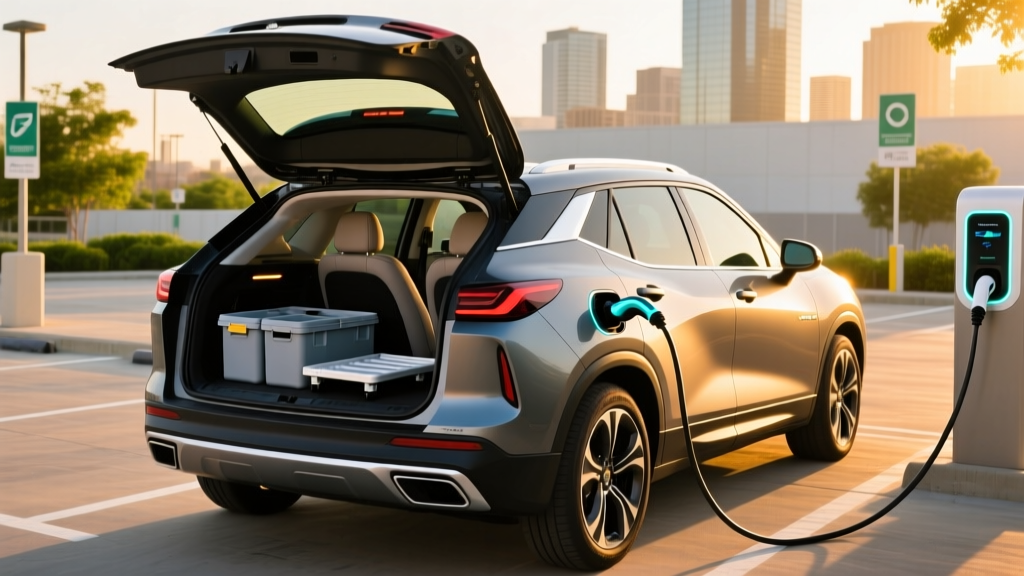
The keyword that brought you here — chevy blazer ev cargo space — deserves exact figures, not marketing language. Here's how the Blazer EV measures up behind each row, based on Chevrolet's published specifications for the 2026 model year:
| Measurement | Specification |
|---|---|
| Cargo volume (behind 2nd row) | 25.5 cu ft |
| Cargo volume (2nd row folded) | 55.1 cu ft |
| Front headroom | 40.1 in |
| Rear headroom | 38.6 in |
| Front legroom | 43.0 in |
| Rear legroom | 39.1 in |
| Front shoulder room | 59.1 in |
| Rear shoulder room | 57.6 in |
| Frunk (front trunk) | Not available |
What this means in practice: 25.5 cubic feet behind the second row is adequate for a week's groceries or two large suitcases, but it trails the Ford Mustang Mach-E (29.9 cu ft) and falls well short of the Hyundai Ioniq 5 (27.2 cu ft behind the rear seats, expandable to 59.3 cu ft with seats folded). The Blazer EV's 55.1 cu ft maximum is similarly mid-pack. The absence of a frunk is a notable omission — that space typically holds charging cables, a tire-inflation kit, or a small bag, and competitors like the Rivian R1S and Ioniq 5 offer one.
Where the Blazer EV genuinely excels is passenger space. The 43.0 inches of front legroom and 39.1 inches of rear legroom are generous for this segment, and the flat floor (a benefit of GM's Ultium platform) makes the rear middle seat more usable than in many crossovers with a transmission tunnel hump.
Range, Battery & Efficiency: EPA vs. Reality
The 2026 Blazer EV is offered with two battery sizes across its trim lineup. Here's the breakdown:
| Trim | Battery (usable kWh) | Chemistry | Drivetrain | EPA Range | MPGe (combined) |
|---|---|---|---|---|---|
| LT (RWD) | 85 kWh | NMC | RWD | 293 mi | 108 MPGe |
| RS (RWD) | 102 kWh | NMC | RWD | 321 mi | 102 MPGe |
| RS (AWD) | 102 kWh | NMC | Dual-motor AWD | 283 mi | 97 MPGe |
| SS (AWD) | 102 kWh | NMC | Dual-motor AWD | 279 mi | 95 MPGe |
The EPA sticker is a starting point, not a guarantee. In mixed highway/city driving at 70 mph with climate control on, expect the RS RWD (321 mi EPA) to deliver approximately 265–285 miles before needing a charge. In cold weather (below 32°F), plan for a 20–30% reduction — that same RS AWD could drop to 200–225 miles of usable range on a winter road trip. City driving with regenerative braking engaged can push real-world numbers closer to or even slightly above the EPA estimate.
The Blazer EV uses NMC (nickel manganese cobalt) lithium-ion chemistry across all trims, housed in GM's Ultium platform modules. NMC offers higher energy density than LFP (lithium iron phosphate), which is why GM can pack up to 102 kWh usable into this footprint. The trade-off: NMC batteries are more sensitive to sustained high states of charge, so daily charging to 80% is recommended unless you need the full capacity for a road trip. Chevrolet's battery management system includes a buffer to protect longevity, but you should still avoid routinely sitting at 100% for days.
Efficiency ranges from 95 to 108 MPGe combined depending on trim and drivetrain. The RWD LT is the efficiency champion of the lineup, translating to roughly 31 kWh per 100 miles. The heavier AWD SS consumes closer to 35 kWh/100 mi. For context, the Hyundai Ioniq 5 RWD achieves 114 MPGe combined — the Blazer EV's heavier curb weight (approximately 5,600–5,900 lbs depending on trim) works against it here.
Charging Speed: DC Fast Charge & Home Level 2
Charging is where buyers need exact numbers, not adjectives. Here's what the 2026 Blazer EV delivers at each level:
| Charging Level | Specification | Time / Rate |
|---|---|---|
| Level 1 (120V household) | 1.4 kW | ~3–4 mi/hr of range |
| Level 2 (240V home/public) | 11.5 kW (48A) | ~25–27 mi/hr; full charge in ~9–10 hrs |
| DC Fast Charge (peak) | 190 kW max | 10–80% in ~30 min (est.) |
| Charge port | NACS (native Tesla Supercharger compatible) | CCS adapter not needed at NACS stations |
Understanding the charge curve: The Blazer EV's peak 190 kW DC fast-charge rate is not sustained across the entire session. Like all EVs, the battery management system tapers charge speed as the battery fills. You'll see close to 190 kW between roughly 10–40% state of charge, then a step-down to approximately 120–130 kW through 60%, and further tapering above 80%. A realistic 10–80% session at a functioning 200+ kW charger takes about 30 minutes. A 10–90% session — what you'd actually need on a road trip to feel comfortable reaching the next stop — will take closer to 42–45 minutes.
For comparison, the Hyundai Ioniq 5 peaks at 240 kW (with its 800V architecture) and achieves 10–80% in roughly 18 minutes. The Blazer EV's 400V architecture and 190 kW peak put it a clear tier below the fastest-charging competitors, though still adequate for most road-trip scenarios if you plan stops around meal or restroom breaks.
Home charging at 11.5 kW (48 amps on a 60-amp circuit) is competitive. A full overnight charge from near-empty takes about 9–10 hours, meaning a typical daily top-up from 50% to 80% requires only 2–3 hours. You'll need a NEMA 14-50 outlet or a hardwired Level 2 wall connector installed by a licensed electrician — budget $800–$2,000 for installation depending on your panel's proximity to the garage and whether a panel upgrade is needed.
Performance: 0–60, Horsepower & Drivetrain
| Trim | Horsepower | Torque (lb-ft) | 0–60 mph | Drivetrain |
|---|---|---|---|---|
| LT (RWD) | 340 hp | 325 | ~6.5 sec | Rear-wheel drive |
| RS (RWD) | 340 hp | 325 | ~6.3 sec | Rear-wheel drive |
| RS (AWD) | 288 hp | 343 | ~6.8 sec | Dual-motor AWD |
| SS (AWD) | 557 hp | 648 | ~3.9 sec | Dual-motor AWD |
The SS trim's 557 hp and sub-4-second 0–60 time are headline numbers, but most buyers will land in the LT or RS trims, where 340 hp (RWD) or 288 hp (AWD) provides confident highway merging and passing. The RWD models feel lighter on their feet thanks to less drivetrain mass, while the AWD RS trades a bit of acceleration for all-weather traction.
The Blazer SS's WOW (Wide Open Watts) mode unlocks its full power output and holds the suspension in its firmest setting — entertaining on a back road, but the SS's ~5,900-lb curb weight is noticeable through corners. This is a straight-line performer, not a canyon carver.
Towing capacity is rated at 1,500 lbs across all trims — adequate for a small utility trailer or a pair of dirt bikes, but not competitive with the Rivian R1S (up to 7,700 lbs) or even the Ford Mach-E (rated at 1,500–2,000 lbs depending on configuration). If towing is a priority, the Blazer EV isn't your best option.
Pricing, Trims & Federal Tax Credit Eligibility
| Trim | Base MSRP | Est. As-Tested | §30D Credit Eligible? |
|---|---|---|---|
| 2LT (RWD) | $44,600 | $47,000–$49,500 | Yes (if sourcing & income rules met) |
| RS (RWD) | $49,400 | $52,000–$55,000 | Yes (if sourcing & income rules met) |
| RS (AWD) | $52,400 | $55,000–$58,000 | Yes (if sourcing & income rules met) |
| SS (AWD) | $60,400 | $63,000–$66,000 | Yes (below $80K SUV cap) |
- MSRP cap: Vehicle must be below $80,000 (SUV classification). All Blazer EV trims qualify.
- Buyer income cap: Modified AGI must not exceed $150,000 (single), $225,000 (head of household), or $300,000 (joint filers).
- Battery sourcing: Critical minerals and battery components must meet escalating domestic-content thresholds per the Inflation Reduction Act. Verify the specific VIN's compliance on the DOE/EPA fueleconomy.gov tax credit page before purchasing.
- Point-of-sale transfer: Eligible buyers can transfer the up-to-$7,500 credit to the dealer at purchase, reducing the purchase price directly rather than waiting for a tax refund.
- Final assembly: Must occur in North America. The Blazer EV is assembled in Ramos Arizpe, Mexico — which meets the USMCA/North America requirement.
Always confirm eligibility with your tax professional and check IRS.gov §30D guidance before relying on the credit in your purchase math. Rules and eligible VIN lists are updated periodically.
After the maximum $7,500 federal credit (if eligible), a 2LT Blazer EV effectively starts around $37,100 — competitive with the base Hyundai Ioniq 5 SE ($42,400 MSRP minus credit) and undercutting the Ford Mach-E Select. However, the credit is not guaranteed for every buyer or every VIN, so model your purchase decision on the full MSRP and treat the credit as a bonus.
Tech, Driver Assistance & Notable Drawbacks
The Blazer EV's cabin is anchored by a 17.7-inch diagonal infotainment touchscreen running GM's latest software, paired with an 11.0-inch digital instrument cluster. Wireless Apple CarPlay and Android Auto are standard. The interface is responsive, though the sheer screen size means some climate and vehicle settings require more taps than physical controls would.
Driver assistance is where the Blazer EV offers a genuinely compelling feature: Super Cruise (available on RS and SS trims, standard on SS). This is a Level 2 hands-free driving system on over 750,000 miles of mapped highways in North America. You can take your hands off the wheel on compatible roads, but your eyes must remain on the road — a driver-monitoring camera enforces this. Super Cruise is one of the most polished Level 2 systems available, with smooth lane changes and natural speed management, but it is not autonomous driving.
Super Cruise is an SAE Level 2 driver-assistance system. The driver must remain attentive, keep eyes on the road, and be prepared to take over immediately. It does not function on unmapped roads, in heavy construction zones, or in severe weather. It is not equivalent to a Level 4 robotaxi service like Waymo. See the NHTSA guidance on automated vehicles for the full framework.
Notable drawbacks worth flagging:
- No frunk: The space under the hood is sealed and not accessible for storage. Charging cables ride in the cargo area.
- Software history: The Blazer EV's launch was marred by early software issues that led to a stop-sale in early 2024. GM has issued multiple OTA (over-the-air) updates since, and 2026 models ship with significantly improved software stability. But early adopter reputation lingers in owner forums.
- 190 kW peak charge rate: Adequate but not class-leading. Road-trippers who regularly drive 300+ mile stretches will spend 10–12 more minutes at chargers than Ioniq 5 owners.
- No third row: If you need seating for more than five, you'll need to look at the Kia EV9 or Rivian R1S.
- Rear visibility: The sloping roofline and thick C-pillars create blind spots that make the surround-view camera (standard on RS, optional on LT) practically essential.
Who Should Buy the 2026 Chevy Blazer EV?
Best Fit: The Two-Row Family Commuter
The Blazer EV is ideal for a household of two to four people who prioritize cabin comfort and passenger space over maximum cargo volume or the fastest charging speeds. If your typical week involves school runs, grocery trips, and a 40–60 mile round-trip commute — with occasional 200-mile weekend drives — the RS RWD's 321-mile range and generous rear legroom make it a comfortable daily companion. Super Cruise availability is a genuine quality-of-life upgrade for highway-heavy commuters.
Look Elsewhere If:
- You regularly need more than 25.5 cu ft of cargo space with passengers aboard (consider the Ioniq 5 or a three-row EV9).
- You road-trip frequently and want the fastest possible charging (the Ioniq 5's 240 kW / 18-min 10–80% is meaningfully faster).
- You need a third row or serious towing capacity.
- You want a frunk for organized cable and accessory storage.
Pros, Cons & Competitive Position
Pros
- Class-leading rear legroom (39.1 in) and comfortable seating for four adults
- Up to 321 miles EPA range (RS RWD)
- Super Cruise hands-free driving on 750K+ miles of highway
- NACS charge port — native Tesla Supercharger access
- All trims below $80K SUV MSRP cap for §30D credit eligibility
- SS trim delivers sports-sedan acceleration (3.9 sec 0–60)
Cons
- 25.5 cu ft cargo space trails key rivals (Mach-E: 29.9, Ioniq 5: 27.2)
- No frunk
- 190 kW peak DC charging is 20–25% slower than best-in-class
- AWD RS loses 38 miles of range vs. RWD RS
- Early-model-year software reliability reputation
- 1,500-lb towing capacity is low for the segment
Frequently Asked Questions
What is the real-world range of the Chevy Blazer EV?
The EPA rates the Blazer EV RS RWD at 321 miles and the AWD RS at 283 miles. In real-world highway driving at 70 mph, expect approximately 265–285 miles from the RWD and 240–260 miles from the AWD. In sub-freezing temperatures, subtract 20–30% from those figures. City driving with regenerative braking can yield results at or slightly above the EPA sticker.
How fast does the Blazer EV charge?
On a DC fast charger, the Blazer EV peaks at 190 kW and charges from 10–80% in approximately 30 minutes at a capable station. On a home Level 2 charger (11.5 kW / 48 amps), it adds about 25–27 miles of range per hour, fully charging in roughly 9–10 hours. Level 1 (120V) trickle charging adds 3–4 miles per hour and is only practical for overnight top-ups on low-mileage days.
How much does the Blazer EV cost after tax credits?
If you qualify for the full $7,500 federal §30D credit (based on income, battery sourcing, and VIN eligibility), the Blazer EV 2LT effectively starts at approximately $37,100. The RS RWD drops to about $41,900. However, credit eligibility depends on your modified AGI, the specific VIN's battery sourcing compliance, and current IRS rules. Many buyers also qualify for state or utility incentives — check AFDC's state incentive database for local programs.
Does the Blazer EV qualify for the federal EV tax credit?
All 2026 Blazer EV trims fall below the $80,000 MSRP cap for SUVs, and final assembly in Mexico meets the North America requirement. However, eligibility also depends on battery critical-mineral and component sourcing thresholds (which tighten annually) and buyer income limits ($150K single / $300K joint). Confirm the specific VIN's eligibility on fueleconomy.gov and consult a tax professional before counting the credit into your budget.
Is the Blazer EV worth buying vs. the Ioniq 5 or Mustang Mach-E?
It depends on your priorities. Choose the Blazer EV if rear passenger comfort, Super Cruise highway driving, and native NACS/Supercharger access matter most. Choose the Hyundai Ioniq 5 if you want faster 240 kW charging, more cargo space (27.2 cu ft), and a frunk. Choose the Ford Mustang Mach-E if you prioritize driving dynamics and a slightly larger cargo area (29.9 cu ft). Cross-shop all three with a test drive — seat comfort and visibility are personal preferences that specs alone can't settle.
How much cargo space does the Chevy Blazer EV actually have?
The 2026 Blazer EV provides 25.5 cubic feet of cargo space behind the second row and 55.1 cubic feet with the rear seats folded flat. There is no front trunk (frunk). For comparison, that's about 4 cu ft less than the Mach-E behind the rear seats, and roughly 2 cu ft less than the Ioniq 5. If maximum cargo volume is your top criterion, the Blazer EV is mid-pack in this segment.