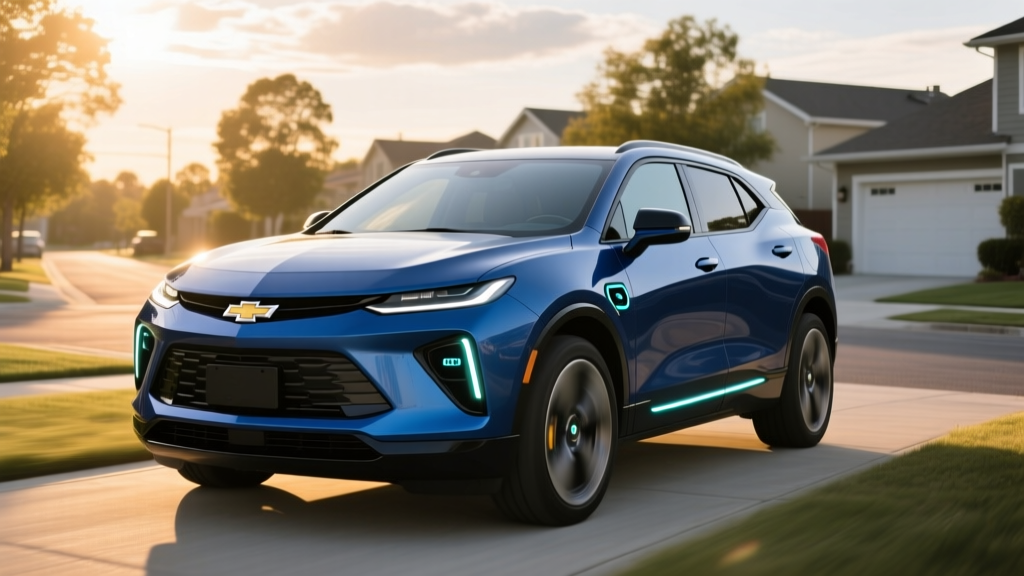
Quick Answer: The 2025 Chevy Blazer EV is a two-row midsize electric SUV with up to 324 miles of EPA-estimated range (2LT AWD), starting at $44,600 before incentives. Real-world highway range lands closer to 260–285 miles; cold weather drops that further to roughly 220–240 miles. It charges at up to 190 kW on DC fast chargers (10–80% in approximately 30 minutes) and qualifies for the $7,500 federal tax credit under current §30D rules for eligible buyers. It's best suited for daily commuters with home Level 2 charging access who want a comfortable, tech-forward EV without the third-row bulk of the Equinox EV or the price of a Cadillac Lyriq.
Range and Efficiency: EPA vs. the Real World
The 2025 Blazer EV rides on GM's Ultium platform with a 102 kWh (usable) battery pack across all trims. EPA range varies significantly by configuration:
| Trim | Drivetrain | EPA Range | MPGe (Combined) | 0–60 mph |
|---|---|---|---|---|
| 2LT (RWD) | Rear-Wheel Drive | 324 mi | 87 MPGe | ~7.8 sec |
| 2LT (AWD) | All-Wheel Drive | 293 mi | 84 MPGe | ~6.5 sec |
| RS (AWD) | All-Wheel Drive | 293 mi | 84 MPGe | ~6.5 sec |
| SS (AWD) | All-Wheel Drive | 293 mi | 82 MPGe | ~4.0 sec |
Real-World Range Reality: EPA figures assume a mix of city and highway driving at moderate temperatures. On sustained 70–75 mph highway trips in 65–75°F weather, expect roughly 260–285 miles from the 2LT RWD and 240–260 miles from AWD trims. In freezing conditions (below 32°F), lithium-ion batteries lose efficiency due to increased internal resistance and cabin-heating demands — plan for 210–240 miles from the RWD and 195–220 from AWD models. GM's heat pump (standard on all trims) helps mitigate this compared to resistive heaters, but physics still wins in deep cold.
The Blazer EV's efficiency of roughly 2.8–3.0 miles per kWh is competitive for its class. For context, the Ford Mustang Mach-E (extended-range RWD) achieves 320 miles EPA with a smaller 91 kWh battery at 3.5 mi/kWh, while the Hyundai Ioniq 5 (long-range RWD) hits 303 miles with a 77.4 kWh pack at a more efficient 3.9 mi/kWh. The Blazer trades some efficiency for a larger battery buffer and a more traditional SUV ride.
Charging Speeds and What You'll Actually Experience
The Blazer EV supports NACS (Tesla-style) connectors natively — a major advantage in 2025, giving access to Tesla Superchargers without an adapter alongside Electrify America, EVgo, and other networks.
| Charging Level | Power (kW) | Connector | Rate | Time (10–80%) |
|---|---|---|---|---|
| Level 1 (120V) | ~1.4 kW | Standard outlet | ~4 mi/hr | ~60+ hours |
| Level 2 (240V, 48A) | 11.5 kW | NACS / J1772 | ~32 mi/hr | ~9 hours (full) |
| DC Fast Charge | Peak 190 kW | NACS | Varies by SoC | ~30 min (10–80%) |
Charging curve reality: The 190 kW peak only holds between roughly 10–40% state of charge. From 40–60%, it tapers to around 130–150 kW, and above 80%, it drops sharply to protect battery longevity (to roughly 40–60 kW). This is standard behavior for NMC lithium-ion chemistry, but it means a "30-minute" 10–80% session can stretch to 45+ minutes if you charge to 90% or higher. For road trips, plan stops around 180–200 miles apart to stay in the fast-charging sweet spot.
At home, a Level 2 wall connector on a 60-amp circuit (delivering 48 amps continuously) will fully replenish the 102 kWh pack overnight. Installation typically runs $800–$2,500 depending on panel proximity and whether your electrical panel needs an upgrade to 200 amps. (Source: Chevrolet Charging Guide)
Pricing, Trims, and the Federal Tax Credit
Here's the 2025 Blazer EV lineup at a glance:
| Trim | Starting MSRP | Key Features |
|---|---|---|
| 2LT (RWD or AWD) | $44,600 (RWD) / $47,600 (AWD) | 17.7" infotainment, Super Cruise avail., heated seats |
| RS (AWD) | $51,200 | Sport styling, 21" wheels, blacked-out trim |
| SS (AWD) | $56,200 | 557 HP, WOW mode, performance-tuned suspension |
Federal §30D Tax Credit — $7,500 Potential:
- MSRP cap: Blazer EV qualifies (SUV cap is $80,000 — all trims clear this)
- Buyer income cap: AGI must not exceed $150,000 (single), $225,000 (head of household), or $300,000 (joint)
- Battery sourcing: As of 2025, critical-minerals and battery-component thresholds apply — GM sources Ultium cells domestically at Ultium Cells LLC (Tennessee/Ohio), and the Blazer EV currently qualifies for the full $7,500
- Point-of-sale transfer: You can apply the credit as a down-payment reduction at the dealer rather than waiting until tax filing
- Verify before buying: Rules change annually. Check IRS §30D guidance and confirm with your dealer at time of purchase
With the full $7,500 credit, a 2LT RWD drops to an effective $37,100 — competitive with a mid-trim Honda CR-V Hybrid or Toyota RAV4 Hybrid, but with dramatically lower running costs.
Blazer EV vs. Gas SUV: The 5-Year Cost Breakdown
Numbers matter more than marketing. Here's how the 2LT AWD Blazer EV stacks up against a comparably equipped 2025 Chevy Blazer (gas, 2.0T AWD, ~$42,000 MSRP) over five years and 75,000 miles:
| Cost Category | 2025 Blazer EV 2LT AWD | 2025 Blazer Gas 2.0T AWD |
|---|---|---|
| Purchase Price (after credit) | $40,100 ($47,600 − $7,500) | $42,000 |
| Fuel / Electricity (75k mi) | $2,800 (home L2, $0.14/kWh avg) | $8,400 (24 MPG, $3.50/gal avg) |
| Maintenance (5 yr) | $800 (cabin filter, tire rotation, wipers) | $3,200 (oil changes, brakes, transmission fluid) |
| Insurance (5 yr est.) | $9,500 | $7,800 |
| Estimated Depreciation | $18,000 | $16,500 |
| Total 5-Year Cost | $71,200 | $77,900 |
Net 5-year savings with the EV: ~$6,700. This assumes home charging at average residential electricity rates. If you rely primarily on DC fast charging at $0.40–$0.55/kWh, your electricity cost jumps to roughly $5,500–$7,000 over 75,000 miles, narrowing the savings significantly. Home charging access is the single biggest financial variable in EV ownership.
The EV also wins on maintenance. No oil changes, no transmission fluid, no spark plugs, and regenerative braking extends pad life to 80,000+ miles in typical driving. The main maintenance items are cabin air filters ($30–50 every 20k miles), tire rotations, and wiper blades.
Insurance is the EV's Achilles heel. Expect premiums 15–25% higher than the gas Blazer, driven by higher repair costs for battery-adjacent damage and specialized collision repair training. Get quotes before committing — your ZIP code and driving record matter enormously here.
Battery Longevity and Warranty
The Blazer EV uses GM's Ultium NMC (nickel-manganese-cobalt) pouch cells, manufactured by Ultium Cells LLC. The battery warranty covers 8 years or 100,000 miles against defects and capacity loss below 60% of original capacity — per GM's Ultium warranty terms.
In practice, NMC chemistry typically degrades 8–15% over the first 100,000 miles under normal use. You can minimize degradation by:
- Charging to 80% daily rather than 100% (use 100% only for road trips)
- Avoiding repeated DC fast charging above 150 kW when Level 2 is available
- Preconditioning the battery before fast charging (the Blazer does this automatically when you navigate to a charger)
- Avoiding letting the pack sit below 10% or above 90% for extended periods in extreme heat
Full battery replacement out of warranty currently runs $15,000–$22,000 depending on labor, though individual module replacement is possible and significantly cheaper. Battery costs continue declining, and by the time a 2025 model exits warranty in 2033, replacement pricing should be substantially lower.
Common Misconceptions — Myth vs. Fact
| Myth | Fact |
|---|---|
| "The Blazer EV gets 324 miles no matter how you drive it." | 324 miles is the EPA combined estimate for the 2LT RWD. Highway driving at 75 mph yields ~270 miles; cold weather drops it further. AWD trims get 293 EPA / ~250 real-world highway. |
| "It charges in 30 minutes, full stop." | 10–80% takes ~30 min at peak rate. Charging to 100% adds another 25–35 minutes due to taper. Plan road trips around 10–80% cycles. |
| "Super Cruise means the car drives itself." | Super Cruise is an SAE Level 2 hands-free driver-assist system. You must remain attentive and eyes-on-road (monitored by a driver-facing camera). It operates only on mapped divided highways (~400,000+ miles in the US/Canada). |
| "EV batteries need replacing every few years." | Modern NMC packs are designed for 200,000+ mile lifespans with 70–85% capacity retention. GM warranties the Blazer EV battery for 8 years/100,000 miles at 60% minimum capacity. |
| "I can't road-trip in an EV." | With the NACS connector, the Blazer EV accesses Tesla Superchargers (17,000+ stalls) plus Electrify America, EVgo, and others. A 600-mile trip requires 2 fast-charge stops of ~30 minutes each. |
Decision Framework: Is the 2025 Blazer EV Right for You?
Buy the Blazer EV if:
- You have Level 2 home charging (or can install it) and drive under 80 miles round-trip daily
- You want a comfortable, quiet midsize SUV without needing a third row
- You qualify for the §30D credit (income under $150k/$300k thresholds) and want the point-of-sale price reduction
- You road-trip 2–4 times a year and are comfortable planning ~30-minute charge stops every 180–200 miles
- You value Super Cruise for long highway commutes on compatible routes
Consider a gas Blazer, a hybrid (like the Hyundai Tucson Hybrid), or a different EV if:
- You lack home or workplace charging and your area has sparse DC fast-charging infrastructure
- You regularly drive in sub-zero temperatures where 30%+ range loss is a real concern
- You need to tow more than 1,500 lbs (Blazer EV is rated for 1,500 lbs max vs. 4,500 lbs for the gas Blazer)
- Your insurance quotes come back $2,500+/year higher than the gas equivalent, eroding fuel savings
- You need a third row — look at the Kia EV9 or gas/hybrid alternatives
Frequently Asked Questions
Does the 2025 Chevy Blazer EV qualify for the full $7,500 federal tax credit?
As of 2025, yes — the Blazer EV is assembled in Mexico but its Ultium battery cells are manufactured domestically, meeting critical-minerals and battery-component thresholds under current IRS §30D rules. However, you must also meet income caps ($150k single / $300k joint) and the vehicle MSRP must be under $80,000 (all Blazer EV trims qualify). Always verify eligibility with your tax professional and dealer before purchase, as sourcing rules tighten annually.
How does the Blazer EV compare to the Chevy Equinox EV?
The Equinox EV is smaller, more affordable (starting ~$33,000 after credit), and offers up to 319 miles EPA. The Blazer EV is larger, more powerful (up to 557 HP in SS trim), offers Super Cruise, and has a more premium interior. If you're budget-conscious and don't need the performance or size, the Equinox EV is the value play. If you want a more refined midsize SUV experience, the Blazer EV is worth the premium.
What happens if I can only charge on a standard 120V outlet?
Level 1 charging adds roughly 4 miles of range per hour — about 48 miles overnight (12 hours). This works if your daily driving is under 40 miles and you can plug in every night. But for anything beyond minimal commuting, a Level 2 (240V) installation is strongly recommended. Budget $800–$2,500 for installation; if your panel needs a 200-amp upgrade, add $1,500–$3,000.
Is the Blazer EV good in snow and cold weather?
AWD trims perform well in snow with instant torque vectoring and a low center of gravity from the floor-mounted battery. Range drops 20–30% in sub-freezing temperatures due to battery chemistry and cabin heating. Preconditioning while plugged in (using the MyChevy app) warms the battery and cabin on grid power, preserving range. The standard heat pump is more efficient than resistive heating but still draws significant energy in extreme cold.
How reliable is the Blazer EV's software and infotainment?
Early 2024 models suffered from significant software bugs that led GM to pause sales temporarily. The 2025 model year ships with substantially improved software after multiple OTA updates. The 17.7-inch infotainment screen runs Google Built-In (Maps, Assistant, Play Store). Apple CarPlay and Android Auto are wireless. Reliability has improved, but check owner forums and IIHS/NHTSA data for the latest service bulletins before purchasing.