The Short Answer on the Chevrolet S10 EV
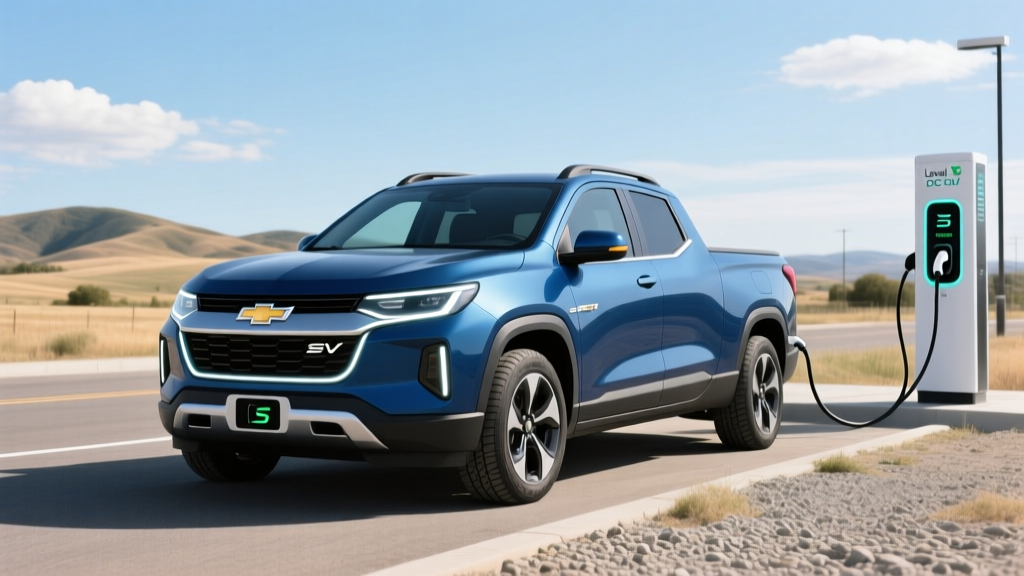
The Chevrolet S10 EV is an announced electric compact pickup that General Motors has signaled for global markets, primarily Latin America and potentially North America. As of early 2026, Chevrolet has not confirmed U.S. retail availability, final EPA range figures, or MSRP. Based on GM's Ultium platform variants and international previews, the S10 EV is expected to target a 250–300 mile EPA range, DC fast charging in the 150–200 kW range, and a starting price in the low-to-mid $30,000s before incentives. U.S. buyers should treat all specs as preliminary until Chevrolet formally announces North American trims and pricing.
Compact pickups are having a moment. The Ford Maverick hybrid proved there's massive demand for a right-sized, fuel-efficient truck, and the Hyundai Santa Cruz carved out a lifestyle niche. An electric entrant like the Chevrolet S10 EV could disrupt the segment further — if it lands with the right combination of range, payload, and price. Here's a data-driven look at what we know, what we can reasonably project, and whether you should wait or look elsewhere.
Projected Specs: What GM's Platform Tells Us
While official U.S. specifications for the Chevrolet S10 EV remain unconfirmed, GM's Ultium battery architecture gives us reliable guardrails. The same modular platform underpins the Chevrolet Equinox EV and Chevrolet Blazer EV, and its flexibility allows for different battery pack sizes and motor configurations. International market previews of the S10 EV (sold in Brazil as the successor to the Montana-based S10 lineup) suggest a single-motor and dual-motor option with a mid-size Ultium pack.
| Specification | Estimated / Projected | Source Basis |
|---|---|---|
| Battery Chemistry | NMC (Ultium pouch cells) | GM Ultium platform standard |
| Battery Capacity (usable) | ~65–85 kWh | Comparable to Equinox EV 85 kWh pack |
| EPA Range (est.) | 250–310 miles | Based on platform efficiency & weight class |
| Peak DC Fast Charge Rate | 150–190 kW | Equinox EV peaks at ~150 kW; Blazer EV at ~190 kW |
| 10–80% DC Charge Time (est.) | ~25–35 minutes | Typical Ultium charge curve taper |
| Level 2 AC Charging | 11.5 kW (standard), 19.2 kW (available) | GM Ultium standard offerings |
| Drivetrain | RWD single motor / AWD dual motor | Platform flexibility |
| Horsepower (est.) | 200–340 hp (trim dependent) | Comparable Ultium outputs |
| 0–60 mph (est.) | ~6.5–8.0 seconds | Weight and power projections |
| Payload Capacity (est.) | ~1,200–1,500 lbs | Compact truck segment norms |
| Towing Capacity (est.) | ~3,500–5,000 lbs | Maverick hybrid tows 2,000; EV torque advantage |
| Battery/Powertrain Warranty | 8 years / 100,000 miles (expected) | GM's standard EV warranty |
Chevrolet S10 EV vs. Gas and Hybrid Compact Trucks
The S10 EV won't exist in a vacuum. Its primary competitors will be the Ford Maverick Hybrid, the gas-only Maverick EcoBoost, the Hyundai Santa Cruz, and potentially the upcoming Toyota compact truck. Here's how the numbers stack up for a buyer cross-shopping these options.
| Metric | Chevy S10 EV (est.) | Ford Maverick Hybrid | Ford Maverick 2.0L EcoBoost (Gas) |
|---|---|---|---|
| Powertrain | Battery Electric (BEV) | 2.5L Hybrid (HEV) | 2.0L Turbo Gas |
| Combined Efficiency | ~95–105 MPGe | 37 MPG combined | 26 MPG combined |
| Range / Tank | ~250–310 mi (EPA) | ~500+ mi | ~400 mi |
| Fuel/Energy Cost per Mile | ~$0.04–$0.06 (home charging) | ~$0.09–$0.11 | ~$0.13–$0.16 |
| Estimated Starting MSRP | $32,000–$38,000 | ~$28,000 | ~$26,000 |
| Federal Tax Credit Eligibility | Potential up to $7,500 (§30D) | Not eligible (HEV) | Not eligible |
| Max Towing | ~3,500–5,000 lbs (est.) | 2,000 lbs | 4,000 lbs |
| Maintenance (5-yr est.) | ~$1,500–$2,000 | ~$3,000–$3,500 | ~$3,500–$4,000 |
The Maverick Hybrid's 500+ mile range and sub-$30,000 starting price make it tough to beat for buyers who regularly take long road trips or live in areas with sparse charging infrastructure. But if most of your driving is within 100 miles of home and you can charge overnight, the S10 EV's per-mile energy cost — roughly half that of the gas Maverick — compounds into meaningful savings over five years.
5-Year Cost Breakdown: EV vs. Gas Compact Truck
Upfront price is only part of the ownership equation. Here's a realistic 5-year / 75,000-mile total cost of ownership (TCO) comparison, assuming national average electricity and gasoline prices and home Level 2 charging access.
| Cost Category | Chevy S10 EV (est.) | Ford Maverick Gas |
|---|---|---|
| Purchase Price (base MSRP) | $35,000 | $27,000 |
| Federal Tax Credit (§30D) | −$3,750 to −$7,500 (if eligible) | $0 |
| Effective Purchase Price | $27,500–$31,250 | $27,000 |
| Fuel / Energy (75k mi) | $3,000–$4,500 | $9,750–$12,000 |
| Maintenance | $1,500–$2,000 | $3,500–$4,000 |
| Insurance (5-yr avg) | $7,500–$9,000 | $6,000–$7,500 |
| Home Charger Install (Level 2) | $800–$2,000 (one-time) | $0 |
| Estimated 5-Year TCO | $40,300–$48,750 | $46,250–$50,500 |
The EV pulls ahead on energy and maintenance — no oil changes, no transmission fluid, fewer moving parts, and regenerative braking extends brake pad life. Insurance tends to run 10–20% higher on EVs due to repair cost data, though this gap has been narrowing. The tax credit is the wild card: under current IRS §30D rules, eligibility depends on MSRP caps (trucks: $80,000), buyer income limits ($150K single / $300K joint AGI), and battery component and critical mineral sourcing requirements. Not every EV qualifies for the full $7,500, and the amount can split into $3,750 for battery components and $3,750 for critical minerals. Always verify current-year eligibility on the IRS website or with a tax professional before counting on the credit in your budget.
Real-World Ownership: What First-Time EV Buyers Should Know
If you've never owned an EV, the Chevrolet S10 EV will change your refueling routine. Here's what actually matters day-to-day:
Home Charging Is Non-Negotiable for Most Buyers
Public DC fast charging works for road trips, but daily EV ownership runs on home Level 2 charging. A Level 2 charger (240V, 32–48 amps) adds roughly 25–37 miles of range per hour — enough to fully replenish the S10 EV overnight. Installation costs range from $800 to $2,000 if your electrical panel has capacity, but can climb to $3,000–$5,000 if you need a panel upgrade from 100A to 200A service. If you rent, live in an apartment, or lack dedicated parking with electrical access, an EV becomes significantly less convenient. Public-only charging is viable but adds time and cost — DC fast charging typically runs $0.30–$0.50 per kWh, roughly doubling your per-mile energy cost versus home charging.
Charging Curves Aren't Linear
When Chevrolet publishes a "peak 190 kW" charge rate, understand that this is a maximum, not an average. Lithium-ion batteries accept charge fastest between roughly 10–50% state of charge (SoC), then taper progressively. A typical Ultium-based pack might sustain 150+ kW up to ~55%, drop to 100 kW by 70%, and slow to 40–50 kW above 85%. This is why manufacturers quote 10–80% charge times rather than 0–100% — the final 20% can take as long as the first 70%. On a road trip, plan to charge from 10–80% and drive on rather than waiting for a full battery.
Cold Weather Cuts Range — Plan For It
Battery chemistry slows in cold temperatures, and resistive cabin heating draws significant energy. Expect 20–30% range reduction in sustained sub-freezing driving. A 300-mile EPA truck becomes a 210–240-mile truck on a January highway trip in Minnesota. Preconditioning the battery while plugged in (warming it before departure) mitigates some of this loss and is a feature GM includes on its Ultium vehicles. If you live in a cold climate and regularly drive 200+ miles in winter, you'll want the largest available battery pack.
Common Misconceptions About the S10 EV — Fact-Checked
| Myth | Fact |
|---|---|
| "Electric trucks can't tow anything." | Electric motors deliver instant torque from 0 RPM. Compact EV trucks are projected to tow 3,500–5,000 lbs — more than the Maverick Hybrid's 2,000 lb limit. However, towing does reduce range significantly (expect 30–50% reduction under heavy loads). |
| "The battery will need replacing in 5 years." | GM's Ultium batteries carry an 8-year / 100,000-mile warranty guaranteeing minimum capacity retention (typically 70% or above). Real-world degradation data from similar packs shows ~10–15% capacity loss at 150,000 miles. Full battery replacement, if ever needed, currently costs $10,000–$18,000 out of warranty. |
| "Every EV gets the full $7,500 tax credit." | Under current §30D rules, the credit is split into two halves ($3,750 battery components + $3,750 critical minerals) with strict sourcing requirements that change annually. Buyer income caps and MSRP limits also apply. Some EVs qualify for $0, $3,750, or the full $7,500 depending on the model year and manufacturing date. Always check IRS.gov before purchasing. |
| "I can charge at any public station." | Connector compatibility matters. GM has adopted the NACS (Tesla-style) connector for new EVs. The S10 EV will likely ship with a NACS charge port, granting native access to Tesla Supercharger stations. CCS stations will require an adapter. Always verify connector type before planning a road trip. |
| "EVs are worse in the rain and snow." | EV battery packs are sealed to IP67 standards — they're fully waterproof for normal driving conditions. AWD dual-motor configurations offer excellent traction. The main winter concern is range loss, not safety or capability. |
Decision Framework: Should You Wait for the S10 EV?
Choose the Chevrolet S10 EV (when available) if:
- You have reliable home Level 2 charging access (garage or driveway with 240V)
- Your daily driving is under 100 miles round-trip, with occasional 200–250 mile trips
- You want the lowest per-mile operating cost in a compact truck
- You qualify for federal (and potentially state) EV incentives, narrowing the price gap with gas trucks
- You value instant torque for light towing and city driving
- You're willing to wait for U.S. availability confirmation and final specs
Choose the Ford Maverick Hybrid (or gas compact truck) instead if:
- You regularly drive 300+ miles between stops and don't want to plan around charging
- You live in a charging desert (rural areas with sparse DC fast infrastructure)
- You rent or lack home charging access
- You need maximum range for frequent long-distance towing (EV range drops sharply under tow load)
- Your budget is strictly under $28,000 and you need a truck now
- You drive in extreme cold frequently and cannot accept 25%+ winter range loss
Frequently Asked Questions
Is the Chevrolet S10 EV available to buy in the United States?
As of early 2026, Chevrolet has not confirmed U.S. retail availability for the S10 EV. The model has been previewed for international markets. U.S. buyers should monitor Chevrolet's official announcements. If you need an electric truck now, the Ford F-150 Lightning, Rivian R1T, and Chevrolet Silverado EV are currently on sale — though all are larger and more expensive than the projected S10 EV segment.
How much will the Chevrolet S10 EV cost?
No official U.S. MSRP has been announced. Based on GM's Ultium platform pricing strategy (the Equinox EV starts around $33,000) and the compact truck segment's price points, a reasonable estimate is $32,000–$38,000 for a base single-motor trim, with AWD and larger battery trims reaching $42,000–$48,000. After the federal tax credit (if eligible), effective pricing could dip into the mid-$20,000s.
Will the S10 EV qualify for the $7,500 federal tax credit?
This cannot be confirmed until Chevrolet publishes battery sourcing and assembly details for U.S.-spec models. Under current IRS §30D requirements, the vehicle must meet critical mineral and battery component sourcing thresholds, be assembled in North America, fall under the $80,000 MSRP cap for trucks, and the buyer must meet income limits. GM's increasing North American battery manufacturing improves the odds, but eligibility should be verified at the point of sale.
How long does it take to charge the S10 EV at home?
On a Level 2 home charger (11.5 kW / 48 amps), expect a full charge from near-empty in approximately 7–9 hours, depending on battery pack size. This means plugging in when you get home and waking up to a full battery every morning — similar to charging a phone overnight. A standard 120V household outlet (Level 1) adds only 3–5 miles of range per hour and is best used as a trickle-charge supplement, not a primary strategy.
Can the Chevrolet S10 EV be used for off-roading?
Electric motors offer precise torque control, which is an advantage in technical off-road situations. An AWD dual-motor S10 EV variant would provide strong low-speed crawling capability. However, ground clearance, approach/departure angles, and underbody protection will depend on the specific trim. Dedicated off-road trims (similar to Chevy's Trail Boss or ZR2 packages) have not been confirmed for the S10 EV.
What happens if the S10 EV battery degrades?
GM's Ultium battery warranty covers 8 years or 100,000 miles against excessive capacity loss (typically below 70% state of health). Real-world data from GM's earlier Bolt EV and current Ultium vehicles suggests degradation of approximately 1–2% per year under normal use, meaning you'd retain roughly 85–90% capacity at 100,000 miles. If the battery does fall below the warranty threshold, GM replaces or repairs it at no cost during the warranty period.