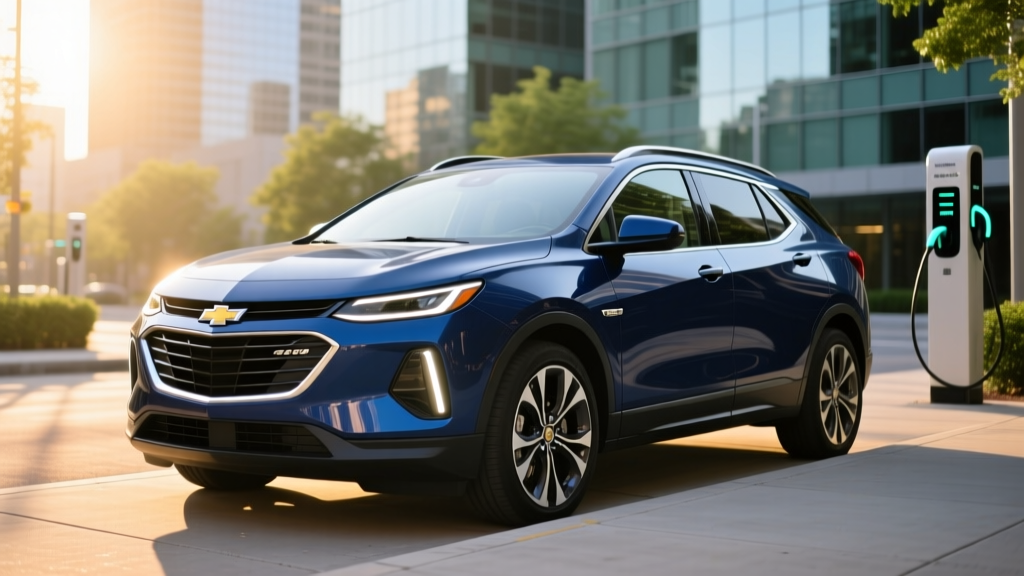
Quick Verdict: Is the Equinox EV an Electric Gem?
The 2026 Chevrolet Equinox EV earns "electric gem" status for one reason: it delivers 319 miles of EPA-estimated range at a base MSRP of $33,600 — making it the most range-per-dollar crossover on the market. After the $7,500 federal tax credit (for eligible buyers), the effective price drops to roughly $26,100. However, real-world highway range lands closer to 255–275 miles, DC fast charging peaks at 150 kW (not class-leading), and the base 2LT trim lacks DC charging hardware entirely. It's a gem for home-charging commuters, less so for frequent road-trippers.
Range, Battery, and Real-World Efficiency
The 2026 Equinox EV rides on GM's Ultium platform with an 85 kWh usable lithium-ion battery pack (NMC chemistry). Chevrolet offers FWD and AWD configurations, and range varies significantly between them.
| Spec | Equinox EV 2LT FWD | Equinox EV 3RS AWD |
|---|---|---|
| EPA Range | 319 mi | 285 mi |
| Battery (usable) | 85 kWh, NMC | 85 kWh, NMC |
| MPGe (combined) | 117 MPGe | 105 MPGe |
| kWh/100 mi | 29 | 32 |
| 0–60 mph | ~8.0 sec | ~6.5 sec |
| Horsepower | 213 hp | 288 hp |
| Max DC Charge Rate | 150 kW | 150 kW |
| 10–80% DC Charge | ~32 min | ~32 min |
| Level 2 Rate | 11.5 kW | 11.5 kW |
| Base MSRP | $33,600 | $43,400 |
Real-World Range Reality Check
EPA sticker: 319 mi (FWD) / 285 mi (AWD)
Expect in practice: 255–275 mi highway at 70 mph; 220–245 mi in sub-30°F cold weather
Why the gap: The Equinox EV's boxy crossover profile generates more drag at highway speeds, and the NMC pack loses roughly 20–30% capacity in freezing temperatures without preconditioning. Always precondition the battery via the MyChevrolet app before DC fast charging in cold weather — it restores charge speed and range recovery.
According to fueleconomy.gov, the FWD Equinox EV achieves 117 MPGe combined, translating to 29 kWh per 100 miles. That's efficient for a 4,500-pound crossover, though the Hyundai Ioniq 5 (34 kWh/100 mi at higher weight) and Tesla Model Y (28 kWh/100 mi) remain the efficiency benchmarks in this segment.
Charging: Home Setup and Public Network Reality
The Equinox EV's charging story has a critical caveat buyers must understand before signing paperwork.
| Level | Power | Miles Added/Hour | Equipment Needed |
|---|---|---|---|
| Level 1 (120V) | 1.4 kW | ~4 mi/hr | Standard outlet (included cord) |
| Level 2 (240V) | 11.5 kW | ~34 mi/hr | Home wall connector or public L2 |
| DC Fast Charge | 150 kW peak | ~175 mi in 30 min | CCS public station (NACS with adapter) |
The base 2LT trim ships without DC fast-charging capability. Chevrolet includes DC charging hardware starting on the 3LT trim and above. If you plan to road-trip or rely on public fast chargers, you must option up or choose a higher trim. This is a dealbreaker we don't see discussed enough in mainstream coverage.
For home charging, the 11.5 kW onboard charger is competitive. A full 0–100% charge takes roughly 9.5 hours on a Level 2 wall connector, meaning overnight replenishment is effortless. Expect to pay between $800 and $2,200 for a professional Level 2 home installation, depending on your electrical panel's capacity and the run distance from panel to garage. Homes with older 100-amp panels may need a $1,500–$3,000 service upgrade to 200 amps — factor this into your budget.
GM has adopted the NACS (Tesla) connector for 2025+ models, and the Equinox EV ships with a NACS charge port. Chevrolet also includes a CCS adapter in the box for compatibility with Electrify America and other legacy CCS networks. Tesla Supercharger access is available via the NACS port with no adapter required.
Cost Breakdown: Equinox EV vs. Gas Equinox vs. Hybrid
The "electric gem" label only holds if the math works. Here's a five-year total cost of ownership comparison using the Equinox EV 2LT FWD against the gas-powered 2026 Equinox LT (1.5L turbo, 28 MPG combined) and a comparable compact hybrid SUV at 38 MPG combined.
| Cost Factor (5 years / 75,000 mi) | Equinox EV 2LT FWD | Gas Equinox LT (28 MPG) | Compact Hybrid SUV (38 MPG) |
|---|---|---|---|
| Purchase Price (MSRP) | $33,600 | $30,100 | $32,500 |
| Federal Tax Credit (§30D) | –$7,500* | $0 | $0 |
| Effective Purchase | $26,100 | $30,100 | $32,500 |
| Fuel/Energy Cost | $3,375 (home L2) | $8,036 ($3.00/gal) | $5,921 ($3.00/gal) |
| Maintenance | $1,200 | $3,500 | $2,800 |
| Insurance (avg.) | $7,500 | $6,250 | $6,500 |
| 5-Year Total | $38,175 | $47,886 | $47,721 |
| Cost per mile | $0.51 | $0.64 | $0.64 |
*Federal §30D tax credit eligibility requires buyer AGI under $150K (single) / $300K (joint), vehicle MSRP under $80,000 (SUVs), and battery critical-mineral/component sourcing compliance per current IRS guidelines. Credit can be transferred to the dealer at point of sale as a purchase-price reduction. Verify eligibility with a tax professional — sourcing rules shift annually.
Energy cost assumes $0.15/kWh national average for home charging and $3.00/gallon regular unleaded. Public DC fast charging at $0.35–$0.50/kWh would raise the EV's energy cost to roughly $4,800–$5,600 over five years if used exclusively — still below gasoline. Maintenance savings on the EV come from eliminating oil changes, transmission fluid, spark plugs, and exhaust system repairs. Brake pad life extends significantly due to regenerative braking.
Insurance costs 15–25% more for the Equinox EV than its gas counterpart, a trend consistent across the EV market. Get quotes before purchasing — in some states, the insurance premium gap partially offsets fuel savings.
Tax Credit Eligibility: What You Actually Need to Know
The Equinox EV currently qualifies for the full $7,500 federal tax credit under IRS §30D, but eligibility is buyer-specific. Here's the checklist:
- Income cap: Modified AGI ≤ $150,000 (single), $225,000 (head of household), $300,000 (married filing jointly)
- MSRP cap: Vehicle base price + options must not exceed $80,000 for SUVs (Equinox EV clears this easily at $33,600–$46,200)
- Battery sourcing: Required percentages of critical minerals and battery components must be sourced from the US or FTA partners — GM's Ultium packs currently meet these thresholds, but the IRS updates qualified-vehicle lists periodically
- Point-of-sale transfer: You can transfer the credit to the dealer at purchase, reducing the sale price by $7,500 on the spot — no need to wait for tax-season filing
- One credit per VIN: The vehicle must be new, purchased for personal use, and not previously credited
State and local incentives stack on top. Colorado, California, and several Northeast states offer additional rebates ranging from $1,000 to $5,000. Check your state energy office or the AFDC state incentive database for current programs.
Common Misconceptions About the Equinox EV
| Myth | Fact |
|---|---|
| "319 miles means I'll always get 319 miles" | Highway driving at 75 mph yields ~255–275 mi. Cold weather drops range 20–30%. Plan trips around 220–250 mi to maintain a buffer. |
| "It charges as fast as a Tesla or Ioniq 5" | The Equinox EV peaks at 150 kW and sustains ~120 kW through 50% SoC, then tapers. A 10–80% session takes ~32 min. The Ioniq 5 peaks at 240 kW and does 10–80% in ~18 min. |
| "All trims have DC fast charging" | The base 2LT does NOT include DC charging hardware. You must choose 3LT or above for road-trip capability. |
| "The battery will need expensive replacement" | GM warrants the Ultium battery for 8 years / 100,000 miles against defects and capacity loss below 70% of original. NMC chemistry typically degrades 10–15% over 150,000 miles based on industry data. Full replacement, if ever needed, is estimated at $8,000–$12,000 out of warranty. |
| "I don't need home charging — public stations are everywhere" | Public DC charging costs 2–3× more than home Level 2 and availability varies drastically by region. Without home charging, EV ownership becomes significantly more expensive and inconvenient. |
Who Should Buy the Equinox EV — and Who Shouldn't
Decision Framework
Choose the Equinox EV if:
- You have access to Level 2 home charging (garage or driveway with 240V circuit)
- Your daily commute is under 80 miles round-trip
- You drive 12,000–15,000 miles/year and want maximum fuel savings
- You qualify for the $7,500 federal credit (bringing effective price below $27K)
- You want a mainstream-brand crossover with dealer service access nationwide
Look elsewhere if:
- You lack home charging access and would rely entirely on public infrastructure
- You road-trip more than 6 times per year and need 200+ kW charging speeds
- You need three rows of seating (the Equinox EV is strictly two-row, five-passenger)
- You tow frequently — the Equinox EV is rated for just 1,500 lbs max towing
- You want the fastest 10–80% charge times — consider the Hyundai Ioniq 5 (800V architecture, 18 min) or Tesla Model Y (250 kW peak, ~20 min)
Ownership Practicalities: What First-Time Buyers Should Know
Home charging is non-negotiable for cost savings. At $0.15/kWh, a full 85 kWh charge costs about $12.75 for 319 miles of range. That's $0.04 per mile. Compare that to the gas Equinox at $0.11 per mile ($3.00/gal at 28 MPG). If you can't charge at home, your per-mile energy cost roughly triples on public DC chargers, erasing much of the economic advantage.
Cold-weather planning matters. The Equinox EV uses a heat pump for cabin heating (standard on all trims), which reduces winter range loss compared to resistive heaters. Still, expect 20–30% range reduction below freezing. Preconditioning the battery and cabin while plugged in at home mitigates this significantly.
Regenerative braking changes how you drive. The Equinox EV offers one-pedal driving mode and a steering-wheel paddle for adjustable regen. New EV owners typically adapt within a week and report preferring it — it extends brake pad life to 100,000+ miles in many cases.
Software updates are ongoing. GM pushes over-the-air updates that can improve range estimation, add features, and refine thermal management. Unlike a gas car, your Equinox EV may actually improve slightly after purchase.
Frequently Asked Questions
Does the 2026 Equinox EV qualify for the full $7,500 federal tax credit?
As of early 2026, yes — the Equinox EV appears on the IRS qualified-vehicle list for the full $7,500 credit, provided the buyer meets income thresholds and the vehicle's battery sourcing continues to comply. Always verify on irs.gov before purchasing, as the list updates periodically.
Can I road-trip in the Equinox EV comfortably?
Yes, with planning. The 319-mile EPA range (FWD) means realistic 250-mile highway legs between 30-minute DC fast-charge stops. Use the MyChevrolet app or A Better Routeplanner to map Supercharger and CCS stations along your route. Just remember: the base 2LT trim lacks DC charging — upgrade to 3LT or above.
How does the Equinox EV compare to the Tesla Model Y?
The Model Y Long Range offers 320 miles EPA, 250 kW peak charging, a more mature Supercharger network experience, and faster acceleration (4.8 sec 0–60). But it starts at ~$44,990 and may not qualify for the full tax credit depending on sourcing updates. The Equinox EV wins on effective purchase price after credit, while the Model Y wins on charging speed, software, and performance.
What happens if the battery degrades?
GM covers the Ultium battery for 8 years/100,000 miles, warranting it against capacity loss below 70%. Industry data on NMC packs shows typical degradation of 10–15% over 150,000 miles. If you drive 15,000 miles/year, you'll likely retain 85–90% of original range at the 10-year mark. Out-of-warranty replacement is estimated at $8,000–$12,000 but is rarely needed within the vehicle's practical lifespan.
Is the Equinox EV a true "electric gem" or just cheap?
It's genuinely compelling because it solves the biggest barrier to EV adoption: price-to-range ratio. At $26,100 effective (after credit), you're getting a 319-mile crossover with modern ADAS, heat-pump climate control, and OTA updates. The trade-offs — 150 kW charging cap, base-trim DC charging omission, and moderate performance — are acceptable for the commuter-focused buyer who prioritizes value over specs.