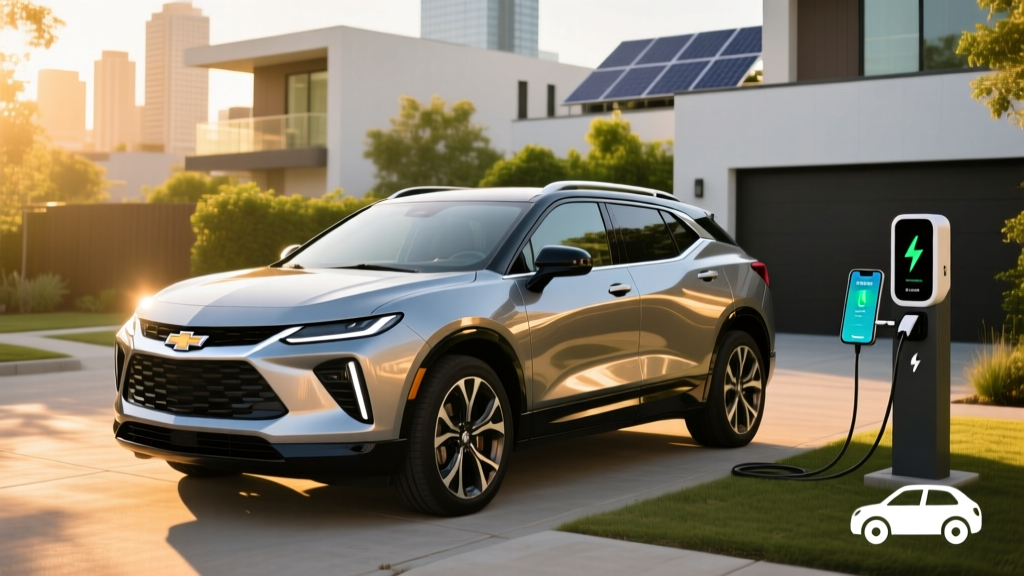
Finding genuine Chevrolet Blazer EV deals in 2026 requires looking past the sticker price and the headline-grabbing federal tax credit. The midsize electric SUV, built on GM's Ultium platform, has settled into a competitive position against the Tesla Model Y, Hyundai Ioniq 5, and Ford Mustang Mach-E — but whether it's actually a bargain depends on your driving habits, home charging access, and tax situation.
We've run the numbers on the 2026 Blazer EV lineup — including the LT, RS, and SS trims — across purchase price, energy costs, insurance, maintenance, depreciation, and incentive eligibility. Here's the data-driven breakdown every buyer needs before signing.
2026 Blazer EV Pricing: Where the Deals Actually Are
The 2026 Chevrolet Blazer EV starts at approximately $44,600 for the LT trim with the standard 85 kWh (usable) Ultium battery pack and rear-wheel drive. The RS trim climbs to roughly $48,200, while the performance-oriented SS AWD pushes past $52,000. These MSRPs matter because they sit right at the edge of the federal tax credit's price cap for SUVs.
| Trim | MSRP | Drivetrain | EPA Range | Battery (usable) | Peak DC Charge | 0-60 mph |
|---|---|---|---|---|---|---|
| LT (RWD) | $44,600 | RWD | ~324 mi | 85 kWh (NMC) | ~190 kW | ~7.0 sec |
| RS (AWD) | $48,200 | AWD | ~293 mi | 85 kWh (NMC) | ~190 kW | ~5.5 sec |
| SS (AWD) | $52,400 | AWD | ~280 mi | 102 kWh (NMC) | ~190 kW | ~4.0 sec |
The §30D Federal Tax Credit: Do You Qualify?
The federal EV tax credit under IRS Section 30D can reduce your effective purchase price by up to $7,500, but it's not automatic. For the 2026 tax year, the Blazer EV's eligibility depends on a stack of requirements that trip up many buyers. Since 2024, the credit can be transferred to the dealer at the point of sale, meaning you can apply it as an immediate discount rather than waiting for a tax refund — but only if every box is checked.
- MSRP Cap: Vehicle must be ≤ $80,000 for SUVs (all Blazer EV trims qualify)
- Income Cap: Buyer AGI must be ≤ $150,000 (single) / $225,000 (head of household) / $300,000 (joint)
- Battery Sourcing: Critical minerals and battery components must meet escalating domestic/free-trade-partner thresholds — verify current-year compliance on the IRS §30D page before purchase
- Assembly: Final assembly must occur in North America (Blazer EV is built in Ramos Arizpe, Mexico — verify current eligibility as sourcing rules tighten annually)
- One-Time Use: The credit applies once per buyer per year, and the vehicle's VIN must be registered with the IRS at sale
- Point-of-Sale Transfer: Optional — you can receive the credit as a dealer discount instead of a tax refund, but the dealer must be IRS-registered
Critical caveat: The Blazer EV's North American assembly status and battery-sourcing compliance have shifted as GM adjusts its supply chain. Always confirm eligibility on fueleconomy.gov for the specific VIN before finalizing a deal. Do not rely on dealer verbal assurances — get the IRS sourcing confirmation in writing.
5-Year Total Cost of Ownership: Blazer EV vs. Gas SUV
To evaluate whether Chevrolet Blazer EV deals represent genuine savings, we compared the Blazer EV LT (RWD) against a comparably priced gas midsize SUV — the 2026 Chevrolet Blazer LT 2.0T AWD (MSRP ~$41,000, 24 MPG combined) — over 5 years and 75,000 miles.
| Cost Category | Blazer EV LT (RWD) | Gas Blazer LT (AWD) | EV Advantage |
|---|---|---|---|
| Purchase Price (after credit) | $37,100* | $41,000 | +$3,900 |
| Energy/Fuel (75k mi) | $5,625 | $9,375 | +$3,750 |
| Insurance (5 years) | $11,250 | $8,750 | -$2,500 |
| Maintenance | $1,800 | $4,200 | +$2,400 |
| Depreciation (est.) | $18,500 | $14,700 | -$3,800 |
| Total 5-Year Cost | $74,275 | $78,025 | +$3,750 |
*Assumes full $7,500 §30D credit applied at point of sale. Actual eligibility varies.
The Blazer EV comes out roughly $3,750 ahead over five years — but only if you qualify for the full tax credit and charge primarily at home. Lose the credit, and the EV trails by ~$3,750. Charge mostly on expensive public DC fast chargers, and the energy savings narrow significantly.
Charging vs. Gas: The Per-Mile Math
The Blazer EV LT's EPA-rated efficiency is approximately 84 MPGe, translating to roughly 33 kWh per 100 miles. Your actual cost per mile depends entirely on where and how you charge.
| Energy Source | Rate | Cost/Mile | Cost per 75,000 mi |
|---|---|---|---|
| Home Level 2 (national avg.) | $0.15/kWh | $0.050 | $3,750 |
| Home Level 2 (high-cost state, e.g., CA) | $0.28/kWh | $0.092 | $6,900 |
| Public DC fast charging (avg.) | $0.40/kWh | $0.132 | $9,900 |
| Gas Blazer (24 MPG, $3.00/gal) | $3.00/gal | $0.125 | $9,375 |
| Gas Blazer (24 MPG, $3.75/gal) | $3.75/gal | $0.156 | $11,700 |
The takeaway: Home charging at average electricity rates delivers roughly 60% savings over gas. But if you rely entirely on public DC fast charging at $0.40/kWh, the Blazer EV actually costs more per mile than the gas version at $3.00/gallon. Home Level 2 charging access is the single biggest variable in whether EV ownership saves you money.
For the Blazer EV's 190 kW peak DC charge rate, expect a 10–80% session to take approximately 28–32 minutes at a compatible 200+ kW station. Note that the charge curve tapers significantly above 80% SoC — a full 10–100% session can take 50+ minutes. For road trips, plan stops around the 10–80% sweet spot.
Maintenance Savings: Where EVs Quietly Win
The Blazer EV eliminates several recurring maintenance items that gas-vehicle owners pay for every year. With no internal combustion engine, there are no oil changes, no spark plugs, no timing belts, no transmission fluid, and no exhaust system repairs. Regenerative braking dramatically extends brake pad life — many EV owners report original brake pads at 80,000+ miles.
| Service Item | Blazer EV | Gas Blazer |
|---|---|---|
| Oil changes | $0 | $600–$900 |
| Brake pads (front) | $0 (regen extends life) | $350–$500 |
| Transmission fluid | $0 | $150–$250 |
| Air filters / spark plugs | $0 | $200–$400 |
| Cabin air filter | $100–$150 | $100–$150 |
| Tire rotation / replacement | $800–$1,200* | $600–$900 |
| Coolant / misc. | $100–$200 | $200–$400 |
| Total (est.) | $1,800 | $4,200 |
*EV tires wear faster due to higher vehicle weight and instant torque. Budget for one extra set of tires over 5 years compared to the gas equivalent.
The net maintenance savings of roughly $2,400 over five years is real, but partially offset by higher tire costs. EV-specific tires (like the Michelin Energy Saver or Continental EcoContact EV) help manage wear and rolling resistance but carry a premium.
Insurance Reality: The Cost Nobody Advertises
EV insurance premiums typically run 15–30% higher than equivalent gas vehicles. For the Blazer EV, expect annual premiums of $2,000–$2,500 depending on your state, driving record, and coverage levels — compared to roughly $1,500–$1,800 for the gas Blazer.
The reasons are structural, not arbitrary:
- Higher repair costs: EV battery packs and power electronics are expensive to replace after collision damage. Insurers factor in total-loss thresholds that trigger more easily.
- Specialized labor: High-voltage system repairs require certified technicians, and fewer shops have the equipment and training.
- Parts pricing: Ultium battery modules, drive units, and EV-specific components carry higher replacement costs than conventional drivetrain parts.
- Vehicle weight: The Blazer EV weighs approximately 5,600–6,000 lbs, increasing collision severity and liability exposure.
Before committing to a Blazer EV purchase, get insurance quotes for the specific VIN. Some insurers (notably GEICO, State Farm, and Progressive) offer EV-specific discounts of 5–10% that partially close the gap. Bundling with homeowners insurance can also help.
Depreciation and Resale Value: The Honest Picture
EV depreciation has been volatile. In 2023–2024, used EV values dropped sharply as Tesla cut new-vehicle prices, leasing flooded the market, and early-adopters traded up. By 2026, the market has stabilized somewhat, but EVs still generally depreciate faster than comparable gas vehicles in the first three years.
For the Blazer EV specifically, expect 45–55% depreciation over 5 years (roughly $20,000–$25,000 on a $44,600 LT), compared to 35–40% for the gas Blazer. Several factors drive this:
- Battery degradation concern: Used buyers discount for perceived battery risk, even though GM's 8-year/100,000-mile battery warranty (covering capacity below 70% of original) transfers to second owners.
- Rapid tech advancement: Newer EVs with faster charging and longer range make 3–5-year-old models feel dated.
- Incentive stacking on new vehicles: When new Blazer EVs can be purchased with $7,500 federal credits plus state rebates, used prices must drop to stay competitive.
- Charging infrastructure growth: As NACS (Tesla Supercharger) access expands — the 2026 Blazer EV ships with a native NACS port — older CCS-equipped EVs face a resale penalty.
The 2026 Blazer EV's native NACS connector is a meaningful resale advantage over 2023–2024 models that required adapters for Supercharger access. When comparing deals, prioritize 2025+ model years with native NACS for better long-term value retention.
State, Local, and Utility Incentives: Stack the Savings
- California (CVRP): Up to $2,000 rebate for income-qualified buyers; additional $1,000–$2,500 through utility clean-fuel rebates (PG&E, SCE, SDG&E)
- Colorado: State tax credit of up to $5,000 for EVs under $80,000 MSRP (stackable with federal credit)
- New York (Charge NY): Point-of-sale rebate up to $2,000 on a sliding income scale
- Utility rebates (national): Many utilities offer $250–$1,000 for Level 2 home charger purchase and installation, plus time-of-use rates that reduce charging costs by 30–50%
- Home charging installation: A Level 2 (240V, 48A) home charger installation typically costs $800–$2,000 including the unit, electrician labor, and permits — potentially more if a panel upgrade to 200A service is needed ($1,500–$3,000 additional)
Combined with the federal credit, these incentives can reduce the Blazer EV's effective purchase price by $8,500–$15,000 in favorable states — dramatically improving the 5-year ownership math. Consult your state's energy office and the AFDC state incentive database for current programs in your area.
Frequently Asked Questions
How much does it really cost to own a Chevrolet Blazer EV over 5 years?
With the full $7,500 federal tax credit and primarily home charging, the 5-year total cost of ownership for a Blazer EV LT comes to approximately $74,000–$78,000 over 75,000 miles — roughly $3,000–$5,000 less than a comparable gas Blazer. Without the tax credit, the EV costs roughly the same or slightly more, depending on electricity rates and insurance in your state.
Do I qualify for the $7,500 federal EV tax credit on the Blazer EV?
You may, but eligibility depends on your adjusted gross income (≤$150K single / $300K joint), the vehicle's MSRP (must be ≤$80K for SUVs — all Blazer EV trims qualify), and whether the battery meets current-year critical-mineral and component sourcing thresholds. The Blazer EV's assembly location and battery sourcing have been subject to change — always verify on the IRS §30D page and fueleconomy.gov before purchase.
How much do I save on fuel and maintenance with the Blazer EV?
With home charging at the national average of $0.15/kWh, expect to save roughly $3,750 on energy over 75,000 miles compared to a gas Blazer at $3.00/gallon. Maintenance savings add another ~$2,400 from eliminated oil changes, reduced brake wear, and fewer fluid services. Combined, that's approximately $6,150 in operating savings over five years.
Are EVs more expensive to insure than gas vehicles?
Yes, typically 15–30% more. For the Blazer EV, budget $2,000–$2,500 annually versus $1,500–$1,800 for the gas equivalent. Higher repair costs for battery and power electronics, specialized labor requirements, and the vehicle's weight all contribute. Get quotes before purchasing — some insurers offer EV-specific discounts.
How well does the Blazer EV hold its value?
Expect approximately 45–55% depreciation over 5 years, which is steeper than the gas Blazer's 35–40%. Battery degradation perception, rapid EV tech advancement, and new-vehicle incentive stacking pressure used values. The 2025+ models with native NACS connectors hold value better than earlier CCS-only models. GM's 8-year/100,000-mile battery warranty (transferrable) provides some used-buyer confidence.
What Blazer EV trim offers the best deal?
The LT RWD at $44,600 offers the best value proposition: longest EPA range (~324 mi), lowest purchase price, and full §30D credit eligibility. The RS AWD adds capability and features for ~$3,600 more but sacrifices ~30 miles of range. The SS is a performance play and is hardest to justify on pure economics. For maximum deal leverage, target end-of-quarter or end-of-year dealer inventory and stack the federal credit with any available state/utility rebates.
Sources: fueleconomy.gov (EPA range/efficiency data), IRS §30D credit rules, Chevrolet manufacturer specifications. All pricing and incentive figures reflect 2026 model-year data and are subject to change. Consult a tax professional for credit eligibility confirmation.