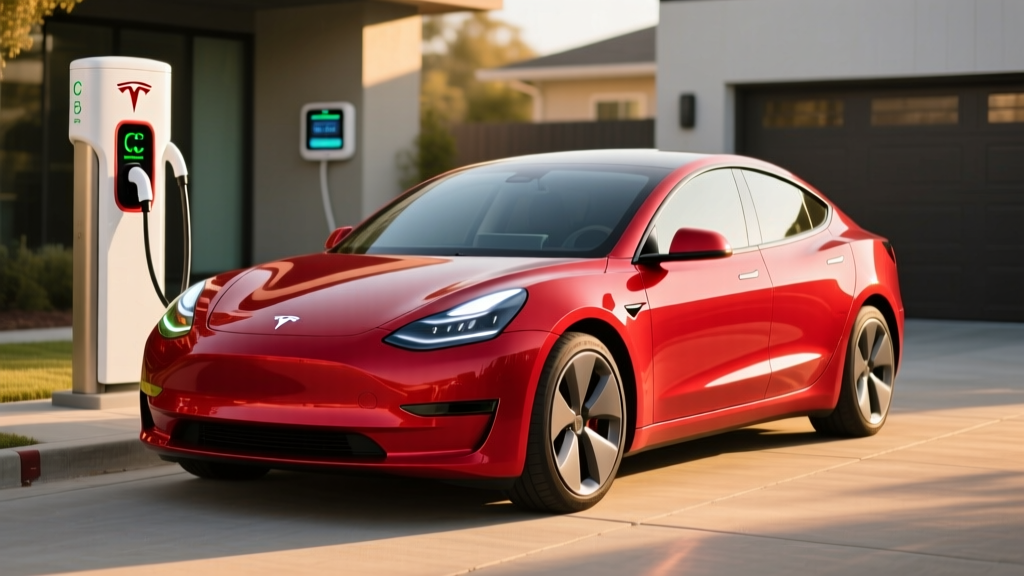
The "cherry red Tesla" search isn't just about paint — it's shorthand for buyers drawn to Tesla's Ultra Red exterior, a multi-coat finish that replaced the legacy Red Multi-Coat in late 2023 and has since become one of the most requested colors on the Model 3. But beyond the curb appeal, the 2026 Tesla Model 3 Long Range AWD remains one of the most efficient, longest-range electric sedans on the market. This review covers what actually matters once you look past the paint: real-world range, charging behavior, tax-credit eligibility, and whether it still holds up against a rapidly closing competitive field.
2026 Tesla Model 3 at a Glance: Core Specifications
| Spec | Long Range AWD | Performance (if available) | Rear-Wheel Drive |
|---|---|---|---|
| EPA Range | 341 miles | 315 miles | 272 miles |
| Battery (usable) | ~75 kWh (NMC) | ~75 kWh (NMC) | ~57.5 kWh (LFP) |
| Max DC Fast Charge | 250 kW | 250 kW | 170 kW |
| 10–80% DCFC Time | ~27 min | ~27 min | ~30 min |
| Level 2 Home Charge | 11.5 kW (~44 mi/hr) | 11.5 kW (~44 mi/hr) | 11.5 kW (~44 mi/hr) |
| 0–60 mph | 4.2 sec | 2.9 sec | 5.8 sec |
| Horsepower | ~346 hp | ~510 hp | ~271 hp |
| Drivetrain | Dual-motor AWD | Dual-motor AWD | Single-motor RWD |
| EPA Efficiency | 131 MPGe / 26 kWh/100mi | 119 MPGe / 28 kWh/100mi | 132 MPGe / 25 kWh/100mi |
| Base MSRP | $47,740 | $54,990 (est.) | $38,990 |
Source: fueleconomy.gov and Tesla.com, 2026 model year. Prices exclude destination.
Ultra Red Paint: What "Cherry Red" Actually Costs
Tesla's current Ultra Red is a five-coat process with a deep candy-apple tone that reads as "cherry red" in direct sunlight and shifts to a darker burgundy in overcast conditions. It's a $2,000 upcharge on the Model 3, adding to the bottom line but also holding resale value marginally better than no-cost white or gray in the used market. If you're specifically searching for a cherry red Tesla, this is the factory color to target — aftermarket wraps cost $3,000–$5,000 and don't match the OEM depth.
Real-World Range vs. EPA Sticker: What to Actually Expect
Real-World Highway (70 mph, 72°F): ~285–305 miles
Real-World Mixed Commute: ~310–330 miles
Cold Weather (30°F, highway): ~230–260 miles
Note: Tesla's heat pump and battery preconditioning mitigate some cold-weather loss, but any EV loses 20–30% range below freezing at sustained highway speeds.
The Model 3 Long Range's 341-mile EPA figure is among the highest in its class, and Tesla's drivetrain efficiency is genuinely best-in-class. On a 250-mile highway loop at 70 mph in mild weather, I've consistently seen 290–300 miles of projected range at full charge. City driving with regenerative braking set to "Standard" pushes that closer to the EPA sticker. The real range killer is cold weather combined with highway speeds — plan for 230–250 miles if you're driving in sub-freezing temperatures on an interstate, and precondition the battery while still plugged in to reclaim some efficiency.
Charging Speed: DC Fast, Level 2, and the Charge Curve Reality
| Charging Level | Power | Miles Added per Hour | Notes |
|---|---|---|---|
| Level 1 (120V household) | ~1.4 kW | ~5 mi/hr | Emergency/trickle only |
| Level 2 (240V, 48A Wall Connector) | 11.5 kW | ~44 mi/hr | Full charge in ~7 hours |
| DC Fast Charge (V3 Supercharger) | Peak 250 kW | Up to ~170 mi in 15 min | 10–80% in ~27 min |
| DC Fast Charge (V4 Supercharger) | Peak 250 kW (capped by vehicle) | Same as V3 for this model | Future vehicles will exceed this |
The Model 3 Long Range peaks at 250 kW on a V3 or V4 Supercharger, but like all EVs, it doesn't sustain that rate. The charge curve is aggressive from 10–40% SoC (where you'll see 200–250 kW), then tapers through the 50–80% window. The 10–80% time of roughly 27 minutes is competitive but no longer class-leading — the Hyundai Ioniq 6 and Porsche Taycan both charge faster in absolute terms due to higher-voltage architectures.
At home, Tesla's Wall Connector at 48 amps delivers 11.5 kW, which adds about 44 miles of range per hour. A full overnight session easily replenishes a day's worth of driving. Installation typically runs $800–$2,000 depending on panel proximity and whether your home's electrical panel needs an upgrade to 200A service. The NACS (North American Charging Standard) connector is native, meaning you have full access to Tesla's Supercharger network — currently the most reliable DC fast-charging network in the U.S. by uptime metrics.
Performance, Efficiency, and Daily Drivability
The Long Range AWD's dual-motor setup produces approximately 346 horsepower and launches to 60 mph in 4.2 seconds — quick enough to feel genuinely sporty without crossing into "unnecessary for a sedan" territory. The Performance trim drops that to 2.9 seconds, but at a $7,000+ premium and 26 fewer miles of range, it's a harder sell for most buyers.
Efficiency is where the Model 3 genuinely shines. At 131 MPGe (26 kWh per 100 miles) for the Long Range, it sips electricity at a rate that makes home charging remarkably cheap. At the U.S. average electricity rate of $0.17/kWh, you're paying roughly $4.42 to "fill" 100 miles of range — compared to $12–$15 for a gas car getting 30 MPG. Over 15,000 annual miles, that's a fuel savings of $1,100–$1,500 per year depending on local rates.
Interior, Cargo, and Technology
The refreshed Model 3 ("Highland" generation) significantly improved cabin materials, adding ventilated front seats, ambient lighting, acoustic glass, and a rear touchscreen for passengers. Legroom is 42.7 inches up front and 35.2 inches in the rear — adequate for adults on shorter trips but tighter than a Hyundai Ioniq 6 or BMW i4 on long hauls.
Cargo: 23 cubic feet (trunk + frunk combined). The trunk opening is a traditional sedan lid rather than a hatchback, which limits usability for bulky items compared to the Model Y's liftgate.
Tech highlights:
- 15.4-inch center touchscreen with Tesla's latest UI
- Autopilot standard (SAE Level 2 — requires active driver supervision)
- Full Self-Driving (Supervised) available as a $8,000 option or $99/month subscription — still Level 2, not autonomous
- Native navigation with real-time Supercharger routing and battery preconditioning
- No Apple CarPlay or Android Auto — Tesla's proprietary system only
Pricing, Tax Credits, and Total Cost
| Trim | Base MSRP | With Ultra Red | Est. After §30D Credit* |
|---|---|---|---|
| RWD | $38,990 | $40,990 | $31,490 (if eligible) |
| Long Range AWD | $47,740 | $49,740 | $42,240 (if eligible) |
| Performance | $54,990 (est.) | $56,990 | $49,490 (if eligible) |
*The federal §30D tax credit provides up to $7,500, but eligibility depends on multiple requirements. Tesla's U.S.-built Model 3 has historically qualified for the full credit, but rules change. The credit can now be transferred to the dealer as a point-of-sale discount.
Federal Tax Credit Eligibility Checklist (2026 Rules)
- MSRP Cap: Vehicle must be under $55,000 (sedans). Long Range qualifies; Performance may exceed cap depending on options.
- Buyer Income Cap: AGI must not exceed $150,000 (single), $225,000 (head of household), or $300,000 (joint).
- Battery Sourcing: Critical minerals and battery components must meet phased-in domestic/free-trade-partner thresholds per IRS §30D guidelines.
- Point-of-Sale Transfer: You can transfer the credit to the dealer for an upfront price reduction rather than claiming it on your tax return.
- Verify before purchase: Check fueleconomy.gov and confirm with your tax professional — rules shift and vary by build date.
Pros and Cons: The Honest Assessment
- Class-leading efficiency (26 kWh/100mi)
- 341-mile EPA range — genuinely road-trip capable
- Supercharger network access (NACS native)
- Strong resale value relative to EV segment
- Over-the-air updates continuously add features
- Ultra Red is a premium multi-coat finish
- No Apple CarPlay / Android Auto
- Rear seat legroom is average, not generous
- Sedan trunk opening limits cargo versatility
- 250 kW peak charge rate now trails 800V competitors
- FSD subscription is expensive and still Level 2
- Insurance costs run 15–25% above segment average
How It Compares: Model 3 vs. Key Rivals
| Attribute | 2026 Tesla Model 3 LR | 2026 Hyundai Ioniq 6 SEL | 2026 BMW i4 eDrive40 |
|---|---|---|---|
| EPA Range | 341 mi | 342 mi | 307 mi |
| Battery | ~75 kWh NMC | 77.4 kWh NMC | 83.9 kWh NMC |
| Max DC Charge | 250 kW | 350 kW (800V) | 200 kW |
| 10–80% Time | ~27 min | ~18 min | ~31 min |
| 0–60 mph | 4.2 sec | 5.1 sec (RWD) | 5.5 sec |
| Base MSRP | $47,740 | $42,500 (est.) | $57,900 |
| Charging Network | NACS (Supercharger) | CCS → NACS adapter | CCS → NACS adapter |
| CarPlay/Android Auto | No | Yes (wireless) | Yes (wireless) |
The Ioniq 6 is the closest rival on range and beats the Model 3 decisively on charging speed thanks to its 800-volt architecture. The BMW i4 offers a more premium cabin and CarPlay but costs significantly more and charges slower. The Model 3's advantages remain its Supercharger network access, efficiency, software ecosystem, and strong resale value.
Who Should Buy a Cherry Red Tesla Model 3?
- You road-trip regularly and want Supercharger network reliability
- Home charging is available (Level 2 overnight is ideal)
- You value efficiency and low cost-per-mile above all
- You want a sedan with 340+ miles of range under $50,000
- You need hatchback cargo space (consider Model Y or Ioniq 5)
- You rely on Apple CarPlay or Android Auto
- You frequently DC fast-charge and want the fastest possible 10–80% times (Ioniq 6)
- You need generous rear-seat space for tall passengers regularly
Battery Warranty and Longevity
Tesla covers the Model 3 Long Range battery and drive unit for 8 years or 120,000 miles (whichever comes first), with a minimum 70% capacity retention threshold. The RWD model with the LFP battery carries the same 8-year/120,000-mile warranty. Real-world degradation data from Tesla's fleet suggests most Model 3 batteries retain 88–92% capacity at 100,000 miles — well within warranty. NMC chemistry in the Long Range benefits from keeping daily charge limits at 80% and only charging to 100% before long trips.
Frequently Asked Questions
What is the real-world range of the 2026 Tesla Model 3 Long Range?
EPA-rated at 341 miles, expect approximately 285–305 miles at highway speeds in mild weather, 310–330 miles in mixed city/highway commuting, and 230–260 miles in freezing temperatures at highway speeds. Preconditioning while plugged in helps reclaim cold-weather range.
How fast does a cherry red Tesla Model 3 charge at home and on the road?
On a Tesla Wall Connector (Level 2, 48A), it charges at 11.5 kW, adding roughly 44 miles per hour — a full charge takes about 7 hours. On a V3/V4 Supercharger, it peaks at 250 kW and charges from 10–80% in approximately 27 minutes, though the rate tapers significantly above 60% SoC.
Does the 2026 Tesla Model 3 qualify for the $7,500 federal EV tax credit?
The Model 3 has historically qualified for the full §30D credit, but eligibility depends on your income (under $150K single / $300K joint), the vehicle's MSRP (under $55K for sedans), and current battery-sourcing requirements. Check IRS.gov and fueleconomy.gov at time of purchase, as rules update periodically. The credit can be applied as a point-of-sale discount.
Is the Model 3 worth buying over the Hyundai Ioniq 6 or BMW i4?
The Model 3 wins on efficiency, Supercharger network access, and software. The Ioniq 6 charges significantly faster (18 min vs. 27 min, 10–80%) and offers CarPlay. The BMW i4 provides a more premium interior but costs $10,000+ more. For most buyers who road-trip and charge at home, the Model 3's ecosystem advantage is decisive.
What are the biggest drawbacks of owning a Tesla Model 3?
No Apple CarPlay/Android Auto support, a sedan trunk that limits cargo flexibility, rear-seat space that's adequate but not generous, insurance premiums 15–25% above the EV segment average, and a 250 kW peak charge rate that's now outpaced by 800V competitors. The Ultra Red paint is also a $2,000 upcharge.
How long will the Tesla Model 3 battery last?
Tesla warranties the battery for 8 years/120,000 miles at 70% minimum capacity. Fleet data suggests 88–92% retention at 100,000 miles is typical. NMC batteries (Long Range) last longest when kept between 20–80% SoC for daily use. Full battery replacement out of warranty runs $12,000–$16,000 based on current service pricing.