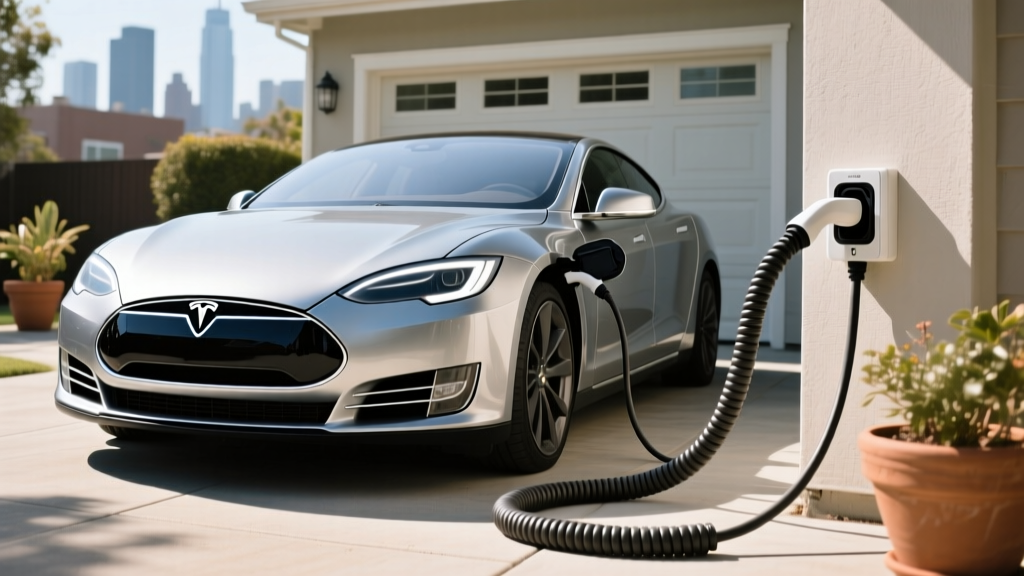
If you've ever parked your Tesla farther from an outlet than the Mobile Connector's 20-foot cable can reach, you've probably wondered: can you charge a Tesla with an extension cord? The short answer is yes — but only under strict conditions, and never the way most people grab one from the garage shelf. A wrong-gauge or damaged cord can overheat, melt, or start a fire long before your car finishes pulling energy from the wall.
This guide breaks down the electrical physics behind why extension cords are risky with EVs, which cords are acceptable in a pinch, what Tesla officially recommends, and how to set up a permanent charging solution that eliminates the problem entirely. We'll use the current-generation 2026 Tesla Model 3 and Model Y as reference points for amperage and charging speeds.
Why Tesla (and Every EV Maker) Warns Against Extension Cords
Tesla's owner's manual states plainly: "Do not use an extension cord with the Mobile Connector." The National Electrical Code (NEC) similarly discourages extension cords as permanent wiring. The reason isn't marketing — it's physics.
EV charging is a sustained high-amperage load, often running 8 to 12 hours straight. That's fundamentally different from plugging in a vacuum cleaner for 20 minutes. When current flows through a wire, resistance generates heat. Thinner wires (higher gauge numbers) have more resistance. Over long durations, that heat accumulates — especially at the plug and receptacle connections, which are the weakest points in any circuit.
Here's what makes extension cords dangerous for EV charging specifically:
- Undersized wire gauge: A typical household 16-gauge extension cord is rated for about 10 amps. Level 1 EV charging on a standard 120V outlet draws up to 12 amps continuously (80% of a 15A circuit). The cord operates above its safe rating for hours.
- Voltage drop over distance: The longer the cord, the greater the voltage drop. At 50 feet of undersized wire, the voltage at the car end can sag enough to reduce charging speed and increase heat in the cord itself.
- Connection points: Every plug-receptacle junction adds resistance. A cord with a worn or loose plug will arc or overheat at the connection before the wire itself fails.
- Outdoor exposure: Cords running across driveways face UV degradation, moisture intrusion, physical damage from being driven over, and temperature extremes — all of which degrade insulation and increase fire risk.
If You Must: The Only Extension Cord Specs That Work
Not all extension cords are created equal. If you're in a temporary situation — visiting family, staying at a rental, or waiting for your electrician — here are the non-negotiable specifications:
| Specification | Minimum Requirement | Why It Matters |
|---|---|---|
| Wire Gauge | 12 AWG or thicker (10 AWG preferred) | Handles 15A continuous draw without overheating |
| Length | 25 feet maximum (50 ft only with 10 AWG) | Minimizes voltage drop and resistive heating |
| Rating | 15A / 125V minimum, outdoor-rated (SJTW or SOOW jacket) | Ensures insulation handles heat and weather |
| Plug Type | Grounded 3-prong (NEMA 5-15P) | Maintains safety ground path |
| Condition | No cuts, kinks, discoloration, or loose plugs | Damaged cords arc and overheat at weak points |
| Configuration | Single cord only — never daisy-chained | Each connection adds resistance and failure points |
What this gets you: Level 1 charging at 120V / 12A delivers roughly 1.4 kW of power to the car. That translates to about 3–5 miles of range per hour of charging in a Model 3 or Model Y. An overnight session (10 hours) adds approximately 30–50 miles of range — adequate for a short daily commute but inadequate for replenishing a depleted battery quickly.
Charging Speed Reality: Extension Cord vs. Proper Setup
Understanding the power (kW) vs. energy (kWh) distinction is essential here. kW is the rate at which electricity flows — like water pressure from a hose. kWh is the total amount stored in your battery — like the size of the bucket. Your extension cord limits the kW rate, which determines how long it takes to fill the bucket.
| Charging Method | Power (kW) | Miles of Range/Hour | 10–80% Time |
|---|---|---|---|
| Level 1 via Extension Cord (120V/12A) | ~1.4 kW | 3–5 mi/hr | ~55–65 hours |
| Level 1 Direct to Outlet (120V/12A) | ~1.4 kW | 3–5 mi/hr | ~55–65 hours |
| Level 2 Home (240V/32A, Mobile Connector) | ~7.7 kW | ~30 mi/hr | ~9–10 hours |
| Level 2 Home (240V/48A, Wall Connector) | ~11.5 kW | ~44 mi/hr | ~6–7 hours |
| DC Fast Charge (Supercharger V4) | Peak ~250 kW | ~1,000+ mi/hr (peak) | ~25–30 min |
The takeaway is stark: a Level 1 extension-cord session that runs overnight adds 30–50 miles. A Wall Connector on a 60A circuit adds that same range in under an hour. If your daily driving exceeds 40 miles, Level 1 charging of any kind — cord or not — will not keep up.
2026 Tesla Model 3 Long Range: Reference Specs
Since most readers asking about extension-cord charging own or are considering a Model 3 or Model Y, here are the current specs to calibrate your expectations:
| Spec | Value |
|---|---|
| EPA Range | 363 miles |
| Battery Capacity | ~79 kWh usable, NMC (nickel manganese cobalt) |
| Max DC Fast Charge | 250 kW peak |
| 10–80% DCFC Time | ~25–30 minutes |
| Level 2 Max Acceptance | 11.5 kW (48A @ 240V) |
| Efficiency | 132 MPGe combined / 25 kWh/100mi |
| 0–60 mph | 4.2 seconds |
| Horsepower | ~346 hp (dual-motor AWD) |
| Cargo Volume | 23 cu ft (rear trunk + frunk combined) |
| Battery Warranty | 8 years / 120,000 miles (70% capacity retention) |
| Base MSRP | $47,740 (before incentives) |
The Right Fix: Installing a 240V Outlet or Wall Connector
If you're reaching for an extension cord regularly, the permanent solution is a dedicated 240V circuit installed near your parking spot. Here's what that involves and what it costs:
| Component | Typical Cost Range | Notes |
|---|---|---|
| Tesla Wall Connector (hardware) | $420–$475 | 48A max, 24-ft cable, Wi-Fi enabled |
| NEMA 14-50 Outlet Install | $500–$1,200 | 50A circuit, works with Mobile Connector |
| Hardwired Wall Connector Install | $600–$1,500 | 60A circuit, no plug — cleaner install |
| Electrical Panel Upgrade (if needed) | $1,500–$3,000 | Required if panel is at or near capacity (older homes with 100A service) |
| Permit & Inspection | $50–$200 | Required in most jurisdictions; ensures code compliance |
Total typical cost: $1,000–$2,000 for a straightforward install (panel has capacity, outlet is within 50 feet of the panel). Homes needing a panel upgrade may spend $2,500–$4,500 total. This is a one-time investment that adds 30–44 miles of range per hour of charging and eliminates the extension-cord problem permanently.
Always hire a licensed electrician for this work. EV charging circuits demand proper wire sizing (6 AWG copper for 50A, 4 AWG for 60A), correct breaker sizing, and GFCI protection per NEC Article 625. The final specifications should be determined by your electrician based on your home's panel capacity and run distance.
2026 Federal Tax Credit and Charging Installation Incentives
Two separate federal incentives can offset your costs:
§30D New Clean Vehicle Credit (for the car): Up to $7,500 for eligible new EVs, subject to MSRP caps ($55,000 for sedans like Model 3; $80,000 for SUVs like Model Y), buyer income limits ($150K single / $300K joint AGI), and critical-mineral/battery-component sourcing requirements. As of 2026, the Model 3 Long Range's eligibility depends on battery sourcing compliance — check the latest IRS qualified vehicle list before purchasing. The credit can now be transferred to the dealer at point of sale, reducing your out-of-pocket cost immediately.
§30C Alternative Fuel Vehicle Refueling Property Credit (for the charger): Up to 30% of the cost of home charging equipment and installation, capped at $1,000, for installations in eligible census tracts. This credit was extended through 2025 and may be available depending on your location and current-year tax law — consult a tax professional to confirm eligibility for your specific situation.
Tesla Mobile Connector Safety Features You Should Know
Tesla's Mobile Connector (included with new vehicles or available separately for ~$200) has built-in protections that provide some safety margin if you must use an extension cord temporarily:
- Temperature sensor at the plug: Monitors the plug-end temperature continuously. If it detects overheating — common with degraded outlets or undersized cords — it automatically reduces charging current or stops charging entirely.
- Adaptive current draw: The connector detects the circuit amperage via the adapter type and limits draw accordingly. A NEMA 5-15 adapter limits draw to 12A; a NEMA 14-50 adapter allows up to 32A.
- Ground fault protection: Built-in GFCI detects ground faults and interrupts the circuit.
- Overcurrent protection: If the car detects current anomalies, it will reduce or halt the charge session.
These protections are a safety net, not a green light. They respond to problems that have already begun — overheating, arcing, or current irregularities. The best practice is to avoid creating those conditions in the first place.
Practical Scenarios: When an Extension Cord Is (and Isn't) Acceptable
✅ Acceptable (Temporary)
- Visiting family for a weekend; charging overnight on a 120V outlet with a 12 AWG, 25-ft cord
- Waiting for your electrician's scheduled install date (1–2 weeks of Level 1)
- Short daily commute under 30 miles where 3–5 mi/hr overnight is sufficient
- Rental property where permanent installation isn't permitted
❌ Unacceptable (Dangerous)
- Using a 16 AWG or 14 AWG household cord — too thin for sustained 12A draw
- Daisy-chaining two or more cords together
- Running a cord under a rug, through a window, or across a high-traffic driveway permanently
- Using a cord with visible damage, discoloration, or loose plugs
- Attempting Level 2 (240V) charging through any extension cord
- Using as your primary daily charging solution for months
Frequently Asked Questions
Can I use an extension cord with a Tesla Wall Connector?
No. The Tesla Wall Connector is hardwired or plugged into a dedicated 240V receptacle (NEMA 14-50 or 14-60). There are no safe, code-compliant extension cords for 240V EV charging at 40–48 amps. The wire gauge required would make the cord impractically heavy and expensive. Install the outlet or hardwire point where you park.
Will using an extension cord void my Tesla warranty?
Tesla's warranty does not cover damage caused by improper charging equipment. If an electrical fire or surge caused by an undersized extension cord damages the vehicle's onboard charger or battery management system, Tesla could deny the warranty claim for that specific damage. The battery and drive unit warranty (8 years/120,000 miles) would remain intact for unrelated issues.
What's the longest extension cord I can safely use for Level 1?
With a 10 AWG (extra-heavy-duty) cord, 50 feet is generally the practical maximum for a 12A Level 1 charge at 120V. Beyond that, voltage drop becomes significant enough to reduce charging efficiency and increase cord heating. At 12 AWG, limit length to 25 feet.
Does a heavy-duty extension cord charge faster than a regular one?
No. Wire gauge affects safety and heat, not charging speed. Both a 10 AWG and a 12 AWG cord will deliver the same ~1.4 kW to the car on a 120V/12A circuit. The thicker cord simply does it without overheating. The speed bottleneck is the 120V outlet and the circuit's 15A breaker — not the cord.
Can I charge my Tesla at 240V using an extension cord from a dryer outlet?
Technically, heavy-duty 240V extension cords exist (6 AWG, rated for 50A, costing $150–$300), and some EV owners use them temporarily for dryer-outlet access. However, this violates NEC guidelines for permanent use, and the connectors (NEMA 10-30 or 14-30) are not designed for frequent plugging/unplugging. The proper solution is having an electrician install a dedicated 14-50 or hardwire point at your parking location.
What's the cheapest safe way to charge a Tesla at home?
The lowest-cost proper setup is a NEMA 14-50 outlet installed by a licensed electrician on a 50A circuit, paired with the Tesla Mobile Connector and its 14-50 adapter ($45). This delivers ~7.7 kW / ~30 miles of range per hour. Total cost is typically $500–$1,200 for the electrical work plus the adapter. Avoid the extension-cord shortcut — the $80–$120 you'd save on a heavy-duty cord isn't worth the fire risk.
Sources: fueleconomy.gov (EPA range and efficiency data), IRS §30D qualified vehicles, Tesla owner's manual and Mobile Connector documentation.