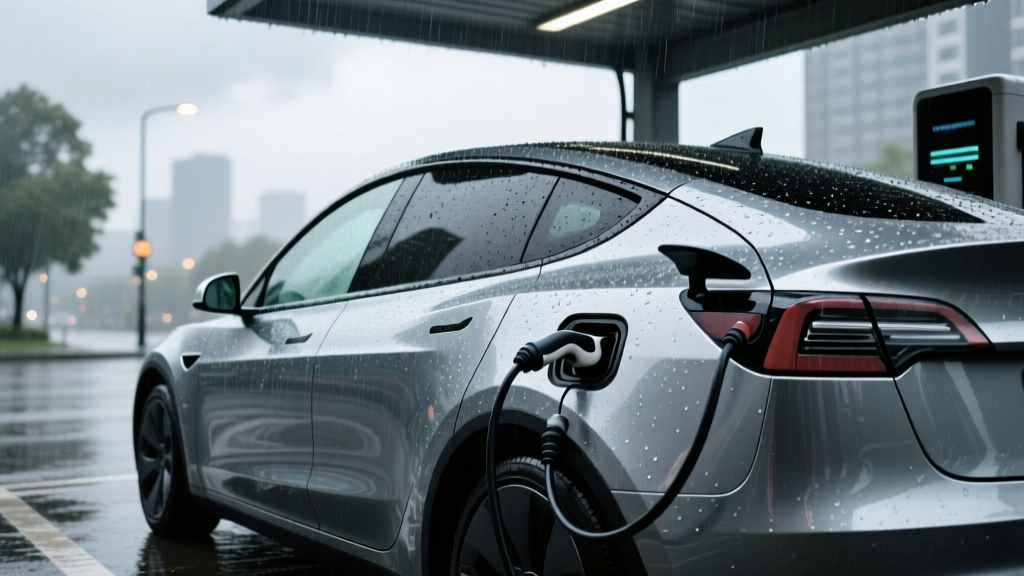
If you're considering an electric vehicle but worry about plugging in during a downpour, here's the direct answer: yes, you can charge an EV in the rain without any safety risk. Every EV charger, cable, and vehicle inlet sold in the United States is engineered and certified to operate safely in wet conditions. The connectors, ports, and charging equipment carry Ingress Protection (IP) ratings — typically IP54 to IP67 — meaning they are sealed against water jets, splashing, and even temporary submersion. There is no electrical shock hazard from plugging or unplugging in rain, snow, or sleet when using properly maintained, undamaged equipment.
This guide goes beyond the simple yes/no. We'll cover the engineering that makes wet-weather charging safe, address persistent myths, compare the cost of EV charging versus gas fueling, and give first-time buyers a practical framework for real-world ownership — rain or shine.
How EV Charging Equipment Handles Water
The concern about water and electricity is rational — water conducts electricity, and EV charging involves serious power levels. A Level 2 home charger delivers 7.2 to 11.5 kW (240V AC), while DC fast chargers push 50 kW to 350+ kW. But the engineering solutions are thorough:
- Sealed connectors: The J1772 (AC), CCS1, and NACS connectors used in North America feature gasketed, weather-sealed mating surfaces. The pins only energize after a secure, sealed connection is confirmed through a digital handshake protocol between the car and charger.
- Ground-fault protection: All UL-listed EV supply equipment (EVSE) includes ground-fault circuit interrupter (GFCI) protection. If any current leakage is detected — even milliamps — the system cuts power in milliseconds.
- Drainage design: Vehicle charge ports are angled to shed water, and drain channels prevent pooling. Tesla's NACS port, the Ford F-150 Lightning's CCS port, and Hyundai's Ioniq 5 inlet all channel water away from contacts.
- IP ratings: Outdoor-rated Level 2 chargers like the ChargePoint Home Flex and Emporia Vue carry NEMA 4 or IP54+ enclosures, certified to withstand directed water jets. DC fast charger cabinets are rated NEMA 3R or higher for full outdoor deployment.
The Society of Automotive Engineers (SAE) standard J1772, which governs all AC EV charging in North America, explicitly requires that connectors function safely in wet conditions. The National Highway Traffic Safety Administration (NHTSA) and independent testing labs like UL Solutions verify compliance before any equipment reaches consumers.
Myths vs. Facts About Charging in Wet Weather
| Myth | Fact |
|---|---|
| "You'll get electrocuted plugging in during rain." | No documented cases of electrocution from EV charging in rain exist. Connectors only energize after a sealed connection is verified. GFCI protection cuts power instantly if any fault occurs. |
| "Water will short-circuit the battery." | EV traction battery packs are sealed to IP67 or IP6K9K — they can survive submersion in 1 meter of water for 30 minutes. The charge port is separate from the battery enclosure. |
| "Charging in a thunderstorm will fry your car." | A direct lightning strike could damage any plugged-in electronics (EV or gas car with a block heater), but the probability is extremely low. Surge protection in modern EVSEs adds a layer of defense. The practical risk is minimal. |
| "You shouldn't charge if the cable is wet." | A wet cable is fine. The cable's insulation is rated for outdoor/wet use. Just ensure the cable jacket isn't cracked or frayed — that's a damage issue, not a moisture issue. |
| "Public chargers in the rain are unsafe." | Public DC fast chargers from Electrify America, EVgo, and ChargePoint are NEMA 3R rated for continuous outdoor use. They undergo the same safety certifications as home equipment. |
Real-World Charging Costs: EV vs. Gas in Any Weather
Whether it's raining or sunny, the economics of EV ownership remain compelling — but the numbers depend on where and how you charge. Here's a concrete cost comparison using a 2026 Tesla Model Y Long Range (EPA 320 miles, 75 kWh usable battery) versus a comparably sized 2026 Toyota RAV4 gas AWD (EPA 30 MPG combined) over 15,000 miles per year.
| Cost Factor | 2026 Tesla Model Y LR (EV) | 2026 Toyota RAV4 AWD (Gas) |
|---|---|---|
| Energy/Fuel Cost Per Mile | $0.04–$0.06/mi (home L2, $0.14/kWh avg) | $0.12/mi (gas at $3.60/gal, 30 MPG) |
| Annual Fuel/Energy (15K mi) | $600–$900 | $1,800 |
| DC Fast Charging (road trips, ~15%) | $0.30–$0.48/kWh (~$170/yr extra) | Included above |
| Maintenance (annual) | $200–$400 (cabin filter, tire rotation, wiper fluid) | $800–$1,200 (oil, filters, brakes, belts) |
| Estimated Insurance (annual) | $1,800–$2,400 (EV premium ~15–25% higher) | $1,400–$1,900 |
| 5-Year Total Operating Cost | $13,850–$19,250 | $20,000–$24,500 |
Source data: EPA efficiency ratings via fueleconomy.gov; electricity rates from EIA averages; insurance estimates from industry aggregators. Actual costs vary by state, utility rate, and driving pattern.
The rain factor: Wet weather has a negligible effect on charging cost or speed. However, cold rain (below 40°F) can reduce battery efficiency by 10–20% due to cabin heating demands and slower electrochemical reactions — not because of moisture. This is a temperature effect, not a water effect. Preconditioning your battery while plugged in mitigates this.
Practical Wet-Weather Charging Tips for Owners
While charging in rain is safe, a few practical habits improve the experience and protect your equipment long-term:
At Home (Level 2)
- Install a weather cover: A simple NEMA 4-rated EVSE cover or carport overhang keeps rain off the connector head, reducing mineral buildup and keeping your hands drier. Cost: $30–$80 for a basic cover.
- Inspect cables annually: Look for cracked insulation, bent pins, or corrosion on the J1772/NACS connector. Replace damaged cables immediately — this applies regardless of weather.
- Use a GFCI-protected circuit: Your Level 2 installation should be on a dedicated GFCI breaker. A licensed electrician will ensure this during your 240V install (typical cost: $600–$1,800 for a standard install; $2,000–$4,500 if a panel upgrade to 200A is needed).
At Public DC Fast Chargers
- Shake off excess water: Before inserting the CCS or NACS connector, give the plug a quick shake to clear pooled water from the socket face. Not a safety requirement — just good practice to keep moisture out of the mating surface.
- Check the holster: If the charger cable was left on the ground in a puddle instead of holstered, inspect the connector for mud or debris before use.
- Precondition on route: Most EVs (Tesla, Hyundai/Kia, Ford, Rivian) automatically precondition the battery when navigating to a DC fast charger. This optimizes the charge curve regardless of weather — expect peak rates of 200–250 kW and a 10–80% session in 18–25 minutes on a 350 kW-capable charger.
During Severe Weather
- Lightning: As with any electronics, unplug during a direct thunderstorm if possible. The risk is extremely low, but a surge from a nearby strike could theoretically damage onboard chargers (replacement: $1,500–$3,000).
- Flooding: Never charge — or drive through — standing floodwater that reaches the vehicle's charge port or rocker panels. While battery packs are IP67 sealed, floodwater can carry conductive contaminants and damage lower-voltage systems. This is a flood hazard, not a rain hazard.
EV vs. Gas vs. Hybrid: Which Fits Your Climate and Driving?
Rain safety isn't a differentiator between EVs and gas cars — both operate fine in wet weather. The real comparison comes down to cost, convenience, and your driving patterns.
| Factor | BEV (e.g., Model Y LR) | PHEV (e.g., RAV4 Prime) | Gas (e.g., RAV4 AWD) |
|---|---|---|---|
| EPA Range / MPG | 320 mi (real-world ~260–280 mi highway) | 42 mi electric + 450 mi gas (94 MPGe / 38 MPG) | 450 mi (30 MPG combined) |
| Wet-Weather Refueling | Plug in safely in any rain; home charging = never visit a station | Same plug-in safety; gas station backup for long trips | Gas station visit required; canopies at most stations |
| Cold-Weather Impact | 15–30% range loss below 30°F (cabin heat + battery chemistry) | Reduced EV range; gas engine compensates seamlessly | Minimal range impact; slight MPG drop in cold |
| Home Charging Access Needed? | Strongly recommended (public-only adds cost + time) | Recommended to maximize EV miles; works without it | Not applicable |
| Federal Tax Credit (§30D, 2026) | Up to $7,500 if MSRP, income, and battery sourcing rules met | Up to $7,500 (same rules; battery kWh must be ≥7 kWh) | Not eligible |
| Base MSRP (2026) | ~$44,990 | ~$44,500 | ~$32,500 |
Federal §30D tax credit eligibility for 2026 requires: vehicle MSRP under $55,000 (sedans) or $80,000 (SUVs/trucks), buyer AGI below $150,000 (single) / $300,000 (joint), and compliance with critical mineral and battery component sourcing rules per IRS guidelines. Credits can be transferred to the dealer at point of sale as an instant rebate. Always verify current-year rules with a tax professional.
First-Time EV Buyer Decision Framework
Choose a BEV (Full Electric) If:
- You have access to home or workplace Level 2 charging (240V)
- Your daily driving is under 200 miles round-trip
- You want the lowest per-mile operating cost ($0.04–$0.06/mi at home)
- You can tolerate 18–25 minute DC fast-charge stops on road trips
- You live in a moderate or warm climate, or accept 15–30% cold-weather range reduction
Choose a PHEV (Plug-In Hybrid) If:
- You want electric commuting (25–45 mi EV range) with gas-engine road-trip flexibility
- You lack reliable home charging but can plug in occasionally
- You frequently drive in extreme cold where BEV range loss is a concern
- You're not ready to depend on public DC fast-charging infrastructure
Stick With Gas/HEV If:
- You have zero access to any charging (no home, no workplace, limited public)
- You regularly tow heavy loads over long distances (EV towing cuts range 40–50%)
- Your budget prioritizes lowest upfront cost over long-term operating savings
Frequently Asked Questions
Can rain damage my EV's charge port over time?
No. Charge ports are designed for decades of outdoor exposure. The port housing uses corrosion-resistant materials (stainless steel contacts, UV-stable plastics), and drainage channels prevent water pooling. Tesla, Ford, Hyundai, and all major OEMs test ports to IP55 or higher — meaning they withstand low-pressure water jets from any direction. The only long-term risk is from physical damage (bent pins, cracked housing from impact), not moisture.
Is it safe to use an extension cord for outdoor EV charging?
For Level 1 (120V) trickle charging, you can use a heavy-duty, outdoor-rated 12-gauge extension cord — but most EVSE manufacturers advise against it due to voltage drop and overheating risk over long runs. For Level 2 (240V), never use an extension cord. Instead, have a licensed electrician install a properly rated outlet (NEMA 14-50 or hardwired) at your parking location. Install costs range from $600 to $1,800 for a standard run; add $1,500–$3,000 if your electrical panel needs upgrading from 100A to 200A service.
Does charging speed change in the rain?
Rain itself does not affect charging speed. However, cold, wet weather (below 40°F) can slow DC fast charging by 10–20% because the battery management system limits charge rates until the pack reaches optimal temperature (typically 68–86°F). Preconditioning — available on most 2026 EVs when navigating to a charger — warms the pack and restores peak charge rates of 200–250 kW. In warm rain (60°F+), expect no change in charge speed.
What about charging during a hurricane or flood warning?
Unplug your EV and move it to elevated ground if flooding is possible. While battery packs are sealed to IP67 (1 meter submersion for 30 minutes), floodwater contains salt, debris, and contaminants that can damage wiring harnesses, 12V systems, and underbody components. No EV is rated for flood operation. After any flood exposure, have the vehicle inspected before plugging in.
Do I need a covered garage to own an EV?
No. Millions of EV owners charge outdoors year-round in rain, snow, and sun. An outdoor-rated Level 2 charger (NEMA 4 enclosure, ~$400–$700 for units like the ChargePoint Home Flex or Emporia Vue) paired with a GFCI-protected 240V circuit is fully sufficient. A simple weather cover or carport is a nice convenience upgrade but not a safety requirement. Battery thermal management systems protect the traction battery regardless of parking location.
The Bottom Line for EV Buyers
Charging an EV in the rain is as safe as using any outdoor-rated electrical appliance — which is to say, completely safe when equipment is undamaged and properly installed. The waterproofing engineering behind EV connectors, charge ports, and battery enclosures exceeds what most consumer electronics offer. Your bigger ownership decisions revolve around home charging access, upfront cost versus long-term savings, cold-weather range expectations, and whether a BEV, PHEV, or gas vehicle best fits your driving patterns.
The rain? That's a non-issue. Plug in with confidence.