Quick Verdict: The $340,000 Electric Ultra-Luxury Statement
The Cadillac Celestiq is not an EV for the masses — it is a hand-built, bespoke electric flagship that exists to prove General Motors can compete with Rolls-Royce, Bentley, and Mercedes-Maybach in the ultra-luxury segment. With a starting price north of $340,000, a 111 kWh Ultium battery, and a production run limited to roughly 400 units per year, the Celestiq is more rolling sculpture than daily driver. But for buyers who want an American-made, fully electric ultra-luxury sedan with genuine performance credentials, it occupies a space no other vehicle fills.
This review breaks down the Celestiq's real-world range expectations, charging behavior, ownership economics, and whether its technology justifies the price. If you're cross-shopping against the Rolls-Royce Spectre, Mercedes-Maybach EQS, or Bentley's upcoming electric lineup, the data below is what matters.
Range, Battery & Efficiency: 303 Miles EPA, But What's the Real Number?
The Celestiq uses a 111 kWh usable Ultium battery pack built on GM's dedicated BEV3 platform. The battery chemistry is NMC (nickel manganese cobalt) — chosen for energy density over the LFP chemistry found in cheaper EVs. At this price point, maximizing range per kilogram matters more than cycle-life longevity, though NMC packs have proven durable well past 150,000 miles with proper thermal management.
Real-world expectations: Expect approximately 260–280 miles in mixed highway driving at 70–75 mph. In cold weather (below 32°F), plan for a 20–30% reduction, bringing effective range to roughly 210–245 miles without preconditioning. The Celestiq's heat pump and active thermal management help mitigate winter losses, but a 5,500-pound sedan with 655 hp will always consume more energy than a lighter EV. City driving with regenerative braking can push range closer to or slightly above the EPA figure.
Efficiency is rated at approximately 89 MPGe combined (about 38 kWh/100 miles), which is unremarkable for a mainstream EV but competitive for a vehicle weighing nearly three tons. For context, the Rolls-Royce Spectre achieves 260 miles EPA with a 102 kWh pack at similar weight, while the Mercedes-Maybach EQS 680 SUV rates 285 MPGe but in a smaller form factor.
| Specification | Value |
|---|---|
| EPA Range | 303 miles |
| Battery Capacity (usable) | 111 kWh, NMC chemistry |
| Efficiency | ~89 MPGe / ~38 kWh/100 mi |
| Drivetrain | Dual-motor AWD |
| Horsepower | 655 hp |
| Torque | 646 lb-ft |
| 0–60 mph | 3.8 seconds |
| Max DC Fast Charge | 200 kW |
| Level 2 Charge Rate | 19.2 kW (AC) |
| Cargo Volume | 17.2 cu ft (trunk) |
| Rear Legroom | ~41.0 inches |
| Curb Weight | ~5,500 lbs |
| Battery/Powertrain Warranty | 8 years / 100,000 miles |
| Base MSRP | ~$340,000 |
Charging Speed: 200 kW Peak, but the Curve Tells the Real Story
The Celestiq supports DC fast charging at up to 200 kW via its CCS1 connector (with a NACS adapter available as GM transitions the Ultium fleet to Tesla's North American Charging Standard). On a 350 kW Electrify America or comparable station, you can expect the battery to charge from 10% to 80% in approximately 28–30 minutes.
However, peak charge rate is not sustained charge rate. Like all large NMC packs, the Celestiq's charge curve tapers significantly above 60% state of charge (SoC). You'll see the full 200 kW only between roughly 10–35% SoC, after which the rate steps down to protect battery health. If you regularly charge to 100% at DC stations, expect the 80–100% top-off to add another 25–35 minutes. For road trips, the practical strategy is charging to 80% and moving on.
| Charging Level | Power | Miles Added per Hour | Notes |
|---|---|---|---|
| Level 1 (120V) | ~1.4 kW | ~3–4 mi/hr | Emergency/trickle only |
| Level 2 (240V, 19.2 kW) | 19.2 kW | ~52–55 mi/hr | Full charge in ~6 hours |
| Level 2 (240V, 11.5 kW) | 11.5 kW | ~31–33 mi/hr | Common public Level 2 |
| DC Fast (peak) | 200 kW | ~500+ mi/hr (peak) | 10–80% in ~28–30 min |
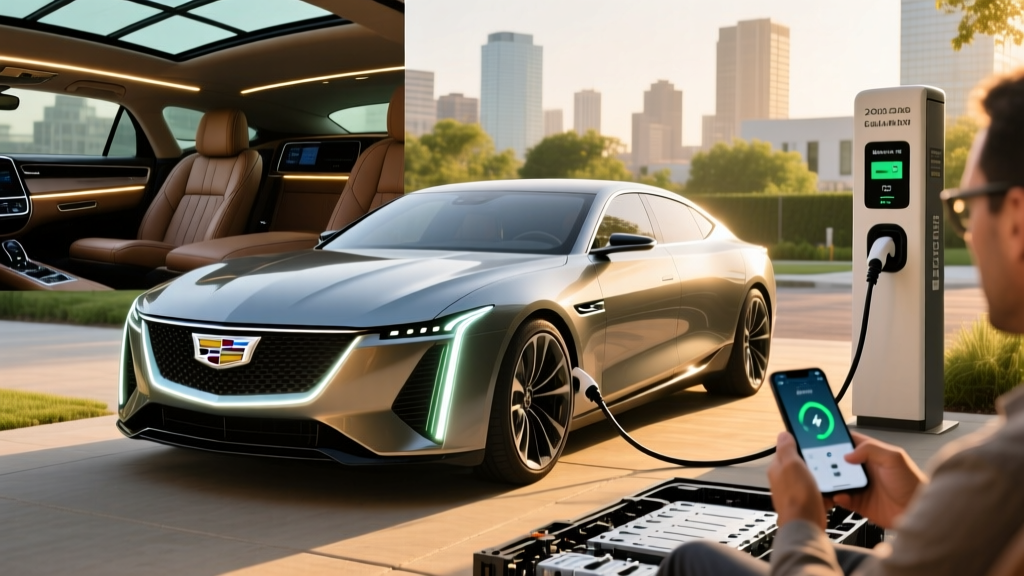
At home on a 19.2 kW Level 2 charger (which requires a 100-amp dedicated circuit), the Celestiq recovers roughly 52–55 miles of range per hour. A full overnight charge from 20% to 100% takes about 6 hours. Most Celestiq owners will install a high-amperage Level 2 station — at this price point, budgeting $2,500–$4,000 for a professional home charging installation (including potential panel upgrades) is a rounding error.
Performance & Driving Dynamics: 655 HP of Silent Authority
The Celestiq's dual-motor all-wheel-drive powertrain produces 655 horsepower and 646 lb-ft of torque. Cadillac quotes a 0–60 mph time of 3.8 seconds — impressive for a vehicle this size, though not supercar-quick. The instantaneous torque delivery that defines EVs makes the Celestiq feel quicker in real-world passing maneuvers than the 0–60 number suggests.
The air suspension with Magnetic Ride Control 4.0 adapts damping in real time, and rear-wheel steering (up to 12 degrees) shrinks the turning radius to something manageable for a car exceeding 180 inches in length. Ride quality is the priority — this is not a sport sedan, and the steering is tuned for isolation rather than feedback. On smooth pavement, the cabin is nearly silent; on rough surfaces, the 22-inch wheels can transmit more impact than expected at this price point.
Regenerative braking offers multiple modes, including a one-pedal driving setting that can bring the Celestiq to a complete stop without touching the brake pedal. The transition between regen and friction braking is smooth — a detail that separates luxury EVs from mainstream models where the handoff can feel abrupt.
Interior, Tech & Standout Features
The Celestiq's cabin is where the $340,000 price tag starts to make sense. Every surface is finished in hand-stitched leather, open-pore wood, or machined aluminum. Each vehicle is built to order at GM's Factory Zero facility in Detroit-Hamtramck, and buyers work directly with Cadillac's bespoke design team to select materials, colors, and finishes — similar to how Rolls-Royce and Bentley handle commissions.
The centerpiece is a 55-inch pillar-to-pillar LED display spanning the entire dashboard, divided into zones for the driver and front passenger. Rear passengers get individual 12.6-inch displays integrated into the front seatbacks. The infotainment runs Google Built-In with native Google Maps, Google Assistant, and access to the Play Store.
Notable tech features:
- Super Cruise (SAE Level 2) hands-free driving on over 400,000 miles of compatible highways — includes automatic lane changes and requires driver attention monitoring via infrared camera
- Power rear executive seats with up to 45 degrees of recline, heating, ventilation, and massage
- Electrochromic glass roof with four individually controllable zones that adjust opacity at the touch of a button
- 38-speaker AKG Studio Reference audio system with headrest-mounted speakers
- Power-closing rear doors with gesture activation
- Active noise cancellation tuned specifically for the electric powertrain's frequency profile
Notable drawbacks:
- Cargo space is limited to 17.2 cu ft — less than a midsize sedan, and the trunk opening is narrow
- No front trunk (frunk) due to front motor and HVAC packaging
- The 55-inch display can produce glare in direct sunlight despite anti-reflective coatings
- At 183+ inches long, parking in urban garages is a genuine challenge
- Rear visibility is compromised by the fastback roofline — the digital rearview mirror helps but takes adjustment
Pricing, Tax Credits & Ownership Cost Reality
The 2026 Cadillac Celestiq starts at approximately $340,000, and because each vehicle is bespoke, as-tested prices regularly exceed $380,000 with custom materials, special paint, and commissioned interior details. There are no traditional "trim levels" — every Celestiq is individually configured.
| Item | Amount |
|---|---|
| Base MSRP | ~$340,000 |
| Typical As-Tested Price | $360,000–$380,000+ |
| Federal §30D Tax Credit | NOT eligible (exceeds $55,000 sedan MSRP cap) |
| Destination Charge | Included |
| Estimated Annual Insurance | $8,000–$12,000+ |
Federal tax credit eligibility: The Celestiq does not qualify for the $7,500 federal EV tax credit under IRS §30D rules. The credit has a strict MSRP cap of $55,000 for sedans (and $80,000 for SUVs, vans, and pickups). At $340,000+, the Celestiq exceeds this cap by a factor of six. Additionally, the buyer income caps ($150,000 single / $300,000 joint modified adjusted gross income) would disqualify most buyers in this price bracket regardless. Do not factor any federal credit into your purchase calculation.
Some states offer their own EV incentives that have no MSRP cap, but these vary widely by jurisdiction. Check your state's energy or DMV website for current programs. A tax professional can advise on any applicable state-level credits or deductions.
Total cost of ownership: Electricity costs for the Celestiq are modest — at the national average of $0.17/kWh, fully charging the 111 kWh battery costs about $18.87, yielding roughly $0.06–$0.07 per mile. Compare that to a comparable V12 luxury sedan at 14 MPG and $3.50/gallon fuel: $0.25/mile. Over 10,000 miles annually, the Celestiq saves roughly $1,800/year in energy costs. However, insurance premiums, tire replacement (22-inch rubber is expensive), and depreciation will dominate ownership costs. Expect insurance alone to run $8,000–$12,000+ annually depending on your profile and state.
Warranty & Long-Term Battery Outlook
Cadillac covers the Celestiq's battery and electric powertrain components for 8 years or 100,000 miles, whichever comes first. The warranty guarantees the battery will retain at least 70% of its original capacity during the coverage period. The bumper-to-bumper limited warranty runs 6 years / 70,000 miles, and Cadillac includes 3 years of complimentary scheduled maintenance and 3 years of OnStar connectivity.
For NMC chemistry at this capacity, industry data from fueleconomy.gov and long-term fleet studies suggest expecting approximately 8–12% degradation over the first 100,000 miles with normal use patterns. The Celestiq's liquid-cooled thermal management system is designed to keep the battery in its optimal temperature window, which is the single most important factor in long-term battery health. Avoiding routine DC fast charging above 80% SoC and minimizing time spent at 100% charge will further extend battery life.
If the battery ever needs replacement outside of warranty, current NMC pack replacement costs for a 111 kWh unit would likely exceed $25,000–$35,000 based on prevailing per-kWh pricing, though costs continue to decline. Given the Celestiq's low production volume and bespoke integration, replacement labor could add significantly to that figure.
Competitor Comparison: Celestiq vs. Rolls-Royce Spectre vs. Maybach EQS
The Celestiq's closest rival is the Rolls-Royce Spectre, which starts around $420,000 with 260 miles of EPA range, a 102 kWh battery, and 577 hp. The Spectre is quieter, more established in the ultra-luxury hierarchy, and holds value better — but offers less range, less power, and no hands-free driving system comparable to Super Cruise.
The Mercedes-Maybach EQS 680 SUV starts at roughly $180,000 (significantly less) with 285 MPGe, 649 hp, and 305 miles of range. It's a more practical vehicle with greater cargo space and a broader service network, but it lacks the bespoke commissioning experience and exclusivity of the Celestiq.
- Choose the Celestiq if: You want a one-of-one American-made electric flagship, value bespoke commissioning, want Super Cruise for highway travel, and exclusivity matters more than practicality or resale value.
- Choose the Rolls-Royce Spectre if: Brand heritage, whisper-quiet ride isolation, and long-term resale value are your top priorities, and you don't mind less range and power.
- Choose the Maybach EQS 680 SUV if: You want electric ultra-luxury with more cargo flexibility, a lower entry price, and a more established dealer network — and you don't need hand-built exclusivity.
Pros, Cons & Final Assessment
- 303 miles EPA range — best in ultra-luxury EV segment
- 655 hp dual-motor AWD with 3.8-second 0–60
- Bespoke, hand-built commissioning process
- Super Cruise hands-free driving on 400K+ miles of highway
- 19.2 kW Level 2 home charging capability
- Unmistakable road presence and exclusivity (~400/year)
- Electrochromic glass roof is a genuine conversation piece
- $340,000+ starting price; no federal tax credit
- Only 17.2 cu ft cargo space; no frunk
- 200 kW max DC charge — slower than 800V rivals
- 22-inch wheels and 5,500-lb weight mean expensive tire wear
- Limited dealer/service network for a vehicle this complex
- Depreciation risk is significant and untested
- Large footprint makes urban parking difficult
The Cadillac Celestiq is not a rational purchase — it's an emotional and aspirational one. For buyers who want the most advanced electric luxury sedan America can build, with genuine performance and range credentials, it delivers. But the ownership economics require acceptance of steep depreciation, high insurance, and a service network that's still scaling for a vehicle this exclusive.
Frequently Asked Questions
What is the real-world range of the Cadillac Celestiq?
The EPA rates the Celestiq at 303 miles. In real-world highway driving at 70–75 mph, expect approximately 260–280 miles. In cold weather (below freezing), effective range drops to roughly 210–245 miles without preconditioning. City driving with regenerative braking can match or slightly exceed the EPA figure.
How fast does the Celestiq charge at home and on the road?
On DC fast charging, the Celestiq peaks at 200 kW, reaching 10–80% in approximately 28–30 minutes (with significant taper above 60% SoC). At home on a 19.2 kW Level 2 charger, it adds about 52–55 miles per hour, fully charging from 20% overnight in roughly 6 hours. A standard 11.5 kW public Level 2 adds about 31–33 miles per hour.
Does the Cadillac Celestiq qualify for the federal EV tax credit?
No. Under current IRS §30D rules, the federal EV tax credit has an MSRP cap of $55,000 for sedans. The Celestiq's $340,000+ price disqualifies it entirely. Buyer income caps would also exclude most purchasers. Some state-level incentives may apply — check your state's energy office for details.
Is the Celestiq worth buying over the Rolls-Royce Spectre?
It depends on priorities. The Celestiq offers more range (303 vs. 260 miles), more power (655 vs. 577 hp), Super Cruise, and American provenance — at a lower starting price ($340K vs. $420K). The Spectre offers stronger brand prestige, likely better resale value, and a more established global service network. If exclusivity and performance matter most, the Celestiq wins. If heritage and long-term value retention matter most, the Spectre holds the edge.
What are the biggest ongoing ownership costs?
Beyond the purchase price, expect annual insurance of $8,000–$12,000+, tire replacement every 20,000–30,000 miles (22-inch tires can cost $400–$600+ each), and significant depreciation — though exact depreciation curves won't be established until more Celestiqs trade on the secondary market. Electricity costs are low: roughly $1,900/year at 10,000 miles driven annually.
How reliable is the Celestiq's battery long-term?
The 111 kWh NMC pack is liquid-cooled and covered by an 8-year/100,000-mile warranty guaranteeing at least 70% capacity retention. Based on industry data for similar Ultium-architecture packs, expect 8–12% degradation over 100,000 miles with normal use. Avoiding frequent charging to 100% and minimizing DC fast charging sessions will help preserve long-term battery health.