The Short Answer: Yes, You Can Safely Charge an EV in the Rain
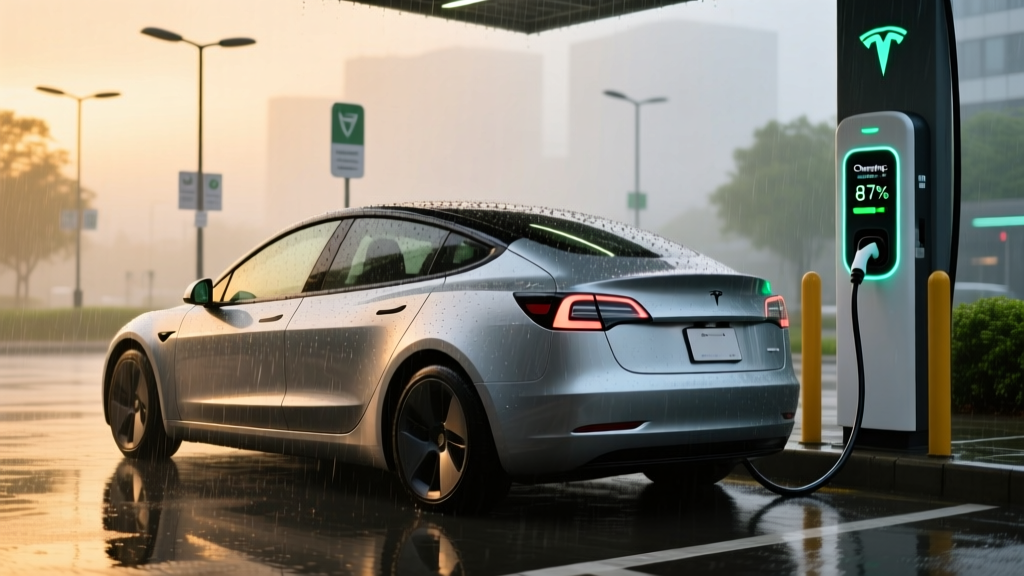
Yes, you can charge your electric car in the rain. Every EV charger and vehicle charging port sold in the U.S. is engineered and certified to withstand rain, snow, and humidity. Connectors meet IP54 or higher ingress-protection ratings, meaning they resist water splashes from any direction. The charging handshake between car and charger only allows current to flow once a sealed, watertight connection is confirmed — so no electricity moves until the plug is fully seated and safe.
If you're considering your first EV or have recently taken delivery, weather-related charging concerns are among the most common. This guide covers the engineering facts, real-world ownership costs, how EV charging compares to gassing up in bad weather, and a practical framework for deciding whether an EV fits your daily life — rain or shine.
How EV Charging Hardware Handles Water
EV charging equipment — from the J1772 connector on Level 2 home chargers to the larger CCS1 or NACS plugs at DC fast-charging stations — is designed for outdoor use in all weather. Here's how the safety chain works:
- Ingress Protection (IP) ratings: Charging connectors are rated at minimum IP54 (splash-proof) and often IP55 or higher. The charging port on your vehicle carries a similar rating. For reference, IP55 protects against low-pressure water jets — far more than a rainstorm delivers.
- Proximity pilot signal: Before any current flows, the charger and car exchange a digital handshake via the pilot pin in the connector. If the plug isn't fully inserted or moisture bridges a pin, the system refuses to energize. This is a hardware-level interlock, not a software suggestion.
- Ground-fault protection: All EV supply equipment (EVSE) includes a ground-fault circuit interrupter (GFCI), typically tripping at 5 mA of leakage — a fraction of what a household bathroom outlet requires. If water were to create a current path, the circuit breaks in milliseconds.
- Drainage design: Charging ports on vehicles are angled or lipped to shed water, and connectors have drainage channels so rain doesn't pool inside the plug.
The National Electrical Code (NEC Article 625) governs EV charging installations in the U.S. and explicitly permits outdoor-rated equipment. Manufacturers like ChargePoint, Tesla, and Electrify America test stations to NEMA enclosure standards (typically NEMA 3R or 4 for outdoor units).
Myth vs. Fact: EV Charging in Wet Weather
| Myth | Fact |
|---|---|
| "Water and electricity mix — charging in rain is dangerous." | EV charging connectors are sealed and interlocked. Current only flows after a confirmed watertight connection. GFCI protection cuts power in milliseconds if leakage is detected. |
| "I need to cover my charger or car port when it rains." | Unnecessary. Equipment is rated for continuous outdoor exposure. Covering ports can actually trap moisture and cause condensation issues. |
| "Lightning makes EV charging extra risky." | Lightning risk to an EV is no different than to a gas car or your home. If lightning strikes your home's electrical system, surge protection matters — but the car itself isn't a lightning magnet. |
| "I can't charge during a thunderstorm." | You can. However, as with any outdoor activity in a severe storm, minimize time outside. Plug in quickly and go indoors — the car and charger manage the session autonomously. |
| "Wet hands make plugging in unsafe." | The connector housing is insulated. While it's good practice to handle any electrical plug with dry hands, the pilot-signal interlock prevents arcing regardless. |
EV Charging vs. Fueling a Gas Car: A Weather Comparison
One underappreciated advantage of EV ownership is that most charging happens at home, under a roof or in a garage. Let's compare the typical wet-weather experience:
| Factor | EV (Home Level 2) | Gas Car | EV (Public DC Fast Charger) |
|---|---|---|---|
| Weather exposure | Minimal — plug in at home, often in garage or under carport | Stand outside at gas station, typically 3-5 minutes | Plug in outdoors, 18-35 minutes depending on session length |
| Time in rain per "refuel" | ~15 seconds to plug in | ~3-5 minutes pumping | ~30-60 seconds to connect; wait inside vehicle |
| Frequency | 2-4 times/week for average driver (plug in overnight) | 1-2 times/week | Only on road trips |
| Slip/fall hazard | Low — short walk from car to charger | Moderate — gas station forecourts get slick with fuel and water | Low — similar to parking lot walking |
| Cost per session (national avg) | ~$4.50-$6.00 (home, at $0.14/kWh avg) | ~$35-$50 (at $3.20-$3.80/gal) | ~$12-$25 (public DC, varies by network) |
For the average driver covering 13,500 miles per year in an EV averaging 3.5 miles/kWh (like the 2026 Hyundai Ioniq 5 or Tesla Model Y), home charging costs roughly $540-$630 annually at typical residential electricity rates. The same mileage in a gas car averaging 28 MPG combined at $3.40/gallon runs about $1,640 per year. That's a fuel savings of roughly $1,000-$1,100 annually — and you spend far less time standing in the rain.
The Real Cost of EV Ownership in 2026
Weather safety aside, the bigger question for first-time EV buyers is total cost of ownership. Here's a realistic 5-year breakdown for a mid-range EV like the 2026 Tesla Model Y Long Range (EPA 320 miles, 75 kWh usable battery, $46,630 MSRP before incentives) compared to a comparable gas crossover averaging 28 MPG combined.
| Cost Category (5 Years) | EV (Tesla Model Y LR) | Gas Crossover (28 MPG) |
|---|---|---|
| Purchase price (base MSRP) | $46,630 | $38,000 |
| Federal tax credit (§30D, if eligible) | -$3,750 to -$7,500 (varies by sourcing/income) | $0 |
| Home Level 2 charger install | $500-$2,000 | $0 |
| Fuel/energy (67,500 miles) | $2,700-$3,150 (home charging) | $8,200 |
| Maintenance (oil, filters, brakes, etc.) | $600-$900 (no oil changes; regen saves brake pads) | $2,500-$3,500 |
| Insurance (avg, 5 years) | $9,500-$11,500 (EVs typically 15-25% higher) | $7,500-$9,000 |
| Estimated 5-year total (before credit) | ~$59,930-$64,180 | ~$56,200-$58,700 |
| Estimated 5-year total (after max credit) | ~$52,430-$60,430 | ~$56,200-$58,700 |
Key takeaways from these numbers:
- Upfront cost is still higher for EVs, but the gap narrows with the federal credit. The IRS §30D credit for 2026 has strict eligibility rules: buyer income caps ($150K single / $300K joint), vehicle MSRP caps ($55K sedans / $80K SUVs and trucks), and battery critical-mineral and component sourcing requirements that change annually. Not every EV qualifies for the full $7,500 — many qualify for $3,750, and some qualify for $0 depending on battery sourcing. Always verify on the IRS website or with a tax professional before relying on a credit amount.
- Fuel savings are real and substantial — roughly $5,000-$5,500 over five years at current prices, and more if gas prices rise.
- Maintenance savings are significant — EVs have no oil changes, no transmission fluid, no spark plugs, and regenerative braking extends pad life to 100,000+ miles in many cases.
- Insurance is the offset — EVs cost 15-25% more to insure on average due to higher repair costs and battery replacement pricing. Get quotes before purchasing.
Real-World Charging Considerations Beyond Rain
Rain is the least of your charging worries. Here are the weather and infrastructure factors that actually affect daily EV ownership:
Cold Weather Range Loss
This is the real concern. In temperatures below 30°F, expect 15-30% range reduction depending on severity, whether you use cabin heat, and whether your EV has a heat pump. A 2026 Model Y with an EPA 320-mile range may deliver 225-270 miles in sustained 20°F weather on the highway. Preconditioning the battery while plugged in recovers some of this loss and is critical for DC fast-charging speed in cold weather — a cold battery may charge at 40-60 kW instead of its 250 kW peak.
Home Charging Access
Not everyone has a garage or dedicated parking spot. If you're in an apartment, condo, or street-parking situation, your options are:
- Workplace charging: Increasingly common; often free or subsidized.
- Public Level 2 networks: ChargePoint, EVgo, and others offer neighborhood chargers at $0.25-$0.49/kWh — more expensive than home but still cheaper than gas per mile.
- DC fast-charging reliance: Feasible but costly ($0.35-$0.69/kWh at networks like Electrify America) and time-consuming if done exclusively. Battery degradation may also accelerate with frequent DC-only charging — though modern thermal management has reduced this concern significantly.
Charging Speed Reality
Marketing materials cite peak kW rates, but charging follows a curve. A vehicle advertising 250 kW DC fast charging (like the Model Y or Ioniq 5) will sustain that rate only between roughly 10-30% state of charge. Above 50%, the rate tapers; above 80%, it drops sharply to protect battery longevity. A realistic 10-80% session on a 250 kW-capable vehicle takes 18-26 minutes, not the "15 minutes" some ads imply. Plan road-trip stops accordingly.
Decision Framework: Is an EV Right for Your Situation?
Choose an EV if:
- You have access to home or workplace charging (Level 2 preferred)
- Your daily commute is under 80 miles round-trip (covers ~90% of U.S. drivers)
- You want to minimize fuel and maintenance costs over 5+ years of ownership
- You live in a moderate or warm climate, or your EV has a heat pump for cold weather
- You qualify for some or all of the §30D federal tax credit, or your state offers additional incentives
Choose a PHEV (plug-in hybrid) if:
- You lack reliable home charging but want some electric-only driving (most PHEVs offer 25-45 miles electric)
- You frequently take road trips exceeding 300+ miles and don't want to plan DC charging stops
- You live in an area with limited public charging infrastructure
Stick with a gas/HEV (conventional hybrid) if:
- You have zero access to any charging (home, work, or public)
- Your budget is tightly constrained and upfront cost is the primary factor
- You regularly tow heavy loads over long distances (though EV towing is improving — the Ford F-150 Lightning and Rivian R1T handle 5,000-11,000 lbs, but range drops 40-50% while towing)
What First-Time EV Buyers Should Know Before Plugging In
Beyond rain safety, here are the practical details that separate a smooth EV ownership experience from a frustrating one:
- Budget for a home Level 2 charger installation. A quality 48-amp Level 2 charger (ChargePoint Home Flex, Tesla Wall Connector, Emporia Vue) costs $400-$700 for the unit. Professional installation by a licensed electrician runs $500-$1,500 for a straightforward setup on an existing 240V circuit. If your electrical panel needs an upgrade to 200A service, add $1,500-$3,000. Total: $900-$2,200 for most homes.
- Understand your electricity rate. Time-of-use (TOU) plans can cut charging costs by 30-50% if you charge during off-peak hours (typically 10 PM - 6 AM). Check with your utility before assuming the national average of $0.14-$0.17/kWh.
- Download the charging network apps before you need them. Electrify America, EVgo, ChargePoint, and Tesla Supercharger all require accounts (though Tesla's NACS connector is opening to other brands, with adapters available). Set up accounts and payment methods at home, not in the rain at a highway rest stop.
- Check battery warranty coverage. Federal law mandates a minimum 8-year/100,000-mile battery warranty for EVs. Most manufacturers warrant the battery to retain 70% of original capacity over that period. Some, like Hyundai, offer 10-year/100,000-mile coverage. Review the specific terms — they vary.
- Don't obsess over battery degradation. Data from fueleconomy.gov and real-world fleet studies show most modern EVs with liquid-cooled batteries lose 5-10% capacity over the first 100,000 miles. LFP (lithium iron phosphate) batteries, used in standard-range Tesla Model 3/Y and some BYD models, often show even less degradation but have lower energy density (less range per kWh of battery weight).
Frequently Asked Questions
Can I use an extension cord to charge my EV in the rain?
No. EV manufacturers and the NEC explicitly prohibit extension cords for EV charging. Standard household extension cords are not rated for the sustained 12-40 amp draw of EV charging and create fire and shock hazards — especially in wet conditions. If your outlet is too far from your parking spot, have an electrician install a dedicated 240V outlet (NEMA 14-50) or hardwire a Level 2 charger at the correct location.
Is it safe to charge during a thunderstorm?
Yes, from a vehicle and charger safety standpoint. However, you should minimize time outdoors during severe weather, as you would with any activity. The main risk isn't the EV — it's the same lightning risk that applies to being outside near any tall object. Plug in quickly and go inside.
Do I need a covered charging station for outdoor home charging?
No, but many owners appreciate a simple overhang or carport to keep the charger and port free of snow accumulation and direct UV exposure over many years. Outdoor-rated EVSE units (NEMA 3R or 4 enclosure) are designed for full weather exposure. A cover is a convenience, not a safety requirement.
Can water get into the charging port while driving in heavy rain?
Charging ports have sealed covers (either manual flaps or powered doors) that close when not in use. When sealed, they meet the same IP ingress ratings as the rest of the vehicle's exterior. Driving through rain, car washes, or even shallow standing water will not compromise the port.
How much does rain affect EV range?
Rain itself has a minor effect — roughly 2-5% range reduction due to increased rolling resistance on wet roads and slightly higher aerodynamic drag from denser air. However, rain often accompanies cooler temperatures and the use of wipers, headlights, and defrosters, which collectively can reduce range by 5-10%. This is far less impactful than cold-weather range loss (15-30%), which is driven primarily by battery chemistry and cabin heating demand.
Are public charging stations safe to use in heavy rain?
Yes. Public DC fast chargers from Electrify America, EVgo, Tesla, and others are built to NEMA 4 or 4X standards, meaning they resist hose-directed water and corrosion. The CCS1, NACS, and CHAdeMO connectors used at these stations have the same pilot-signal interlocks and GFCI protection as home chargers. The main inconvenience is physical — handling a thick, wet DC charging cable and navigating an app on a wet phone screen. Many stations now feature cable management systems and canopy coverage.
Charging an EV in the rain is a solved engineering problem. The real questions for prospective buyers are about access, cost, and daily practicality — not weather safety. With home Level 2 charging, most EV owners spend less time "refueling" in bad weather than gas car drivers, and they spend roughly a third of what they'd spend on fuel. Verify your tax credit eligibility, budget for a proper home installation, and let the rain fall where it may.