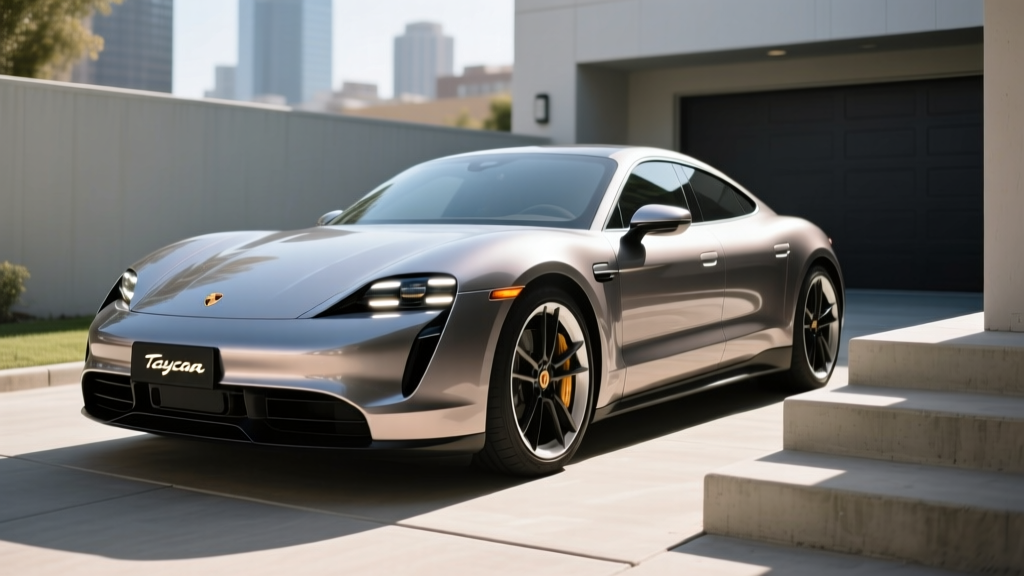
If you have been watching Porsche Taycan prices tumble on the used market, you are not alone. Depreciation has been brutal for early Taycan models, which is precisely why a certified pre-owned Taycan has emerged as one of the most compelling value plays in the luxury EV space for 2026. You get Porsche's engineering benchmark — an 800-volt architecture that still outclasses most rivals at charging speed — at a fraction of its original sticker. But buying a used EV demands scrutiny that a used gas car does not. Battery health, charging history, software updates, and warranty transfer all matter enormously.
This guide covers everything you need to evaluate a CPO Taycan: real-world range versus the EPA sticker, what Porsche's 800V charging system actually delivers at public chargers, battery degradation realities, and whether the federal used-EV tax credit can stack the value further. We focus primarily on the 2020–2024 model years you will encounter in CPO inventory today.
CPO Taycan Quick Specs: What You Are Buying
The Taycan launched in the U.S. for the 2020 model year and received a significant refresh for 2025. Most CPO inventory in 2026 consists of 2021–2024 models built on the original J1 platform with the 93.4 kWh gross (approximately 83.7 kWh usable) Performance Battery Plus. Here is what the most common CPO trims deliver:
| Spec | Taycan 4S | Taycan Turbo | Taycan Turbo S |
|---|---|---|---|
| Battery (gross / usable) | 93.4 kWh / 83.7 kWh (NMC) | 93.4 kWh / 83.7 kWh (NMC) | 93.4 kWh / 83.7 kWh (NMC) |
| EPA Range | 227 mi | 238 mi | 222 mi |
| Drivetrain | Dual-motor AWD | Dual-motor AWD | Dual-motor AWD |
| Horsepower (Launch Control) | 562 hp | 670 hp | 750 hp |
| 0–60 mph | 3.8 sec | 3.0 sec | 2.4 sec |
| Max DC Fast Charge | 270 kW | 270 kW | 270 kW |
| 10–80% DCFC Time | ~22.5 min | ~22.5 min | ~22.5 min |
| Level 2 Home Charge (max) | 9.6 kW (~33 mi/hr) | 9.6 kW (~33 mi/hr) | 9.6 kW (~33 mi/hr) |
| MPGe (combined) | 79 MPGe | 75 MPGe | 73 MPGe |
| EPA Efficiency | 43 kWh/100 mi | 45 kWh/100 mi | 46 kWh/100 mi |
| Cargo (rear + frunk) | 14.3 cu ft + 2.9 cu ft | 14.3 cu ft + 2.9 cu ft | 14.3 cu ft + 2.9 cu ft |
| Rear Legroom | 32.7 in | 32.7 in | 32.7 in |
| Original MSRP (base) | ~$106,000 | ~$153,000 | ~$189,000 |
Sources: fueleconomy.gov, Porsche USA specifications.
Real-World Range: What the EPA Sticker Does Not Tell You
The Taycan's range has always been its most debated spec. Porsche prioritized sustained performance and charging speed over maximum range, and it shows. The 83.7 kWh usable battery is smaller than the Tesla Model S's ~100 kWh pack, and the Taycan's heavier curb weight (around 5,100 lbs for the 4S) plus its two-speed rear transmission and performance-oriented tires all work against efficiency.
For context, on a 300-mile road trip in moderate weather at highway speeds, you will need one DC fast-charge stop in a Taycan 4S — whereas a Model S Long Range might complete the same trip without stopping. This is not a deal-breaker, but it is a reality check if your primary use case involves frequent long-distance travel through areas with sparse charging infrastructure.
The positive side: the Taycan's range estimate on the dashboard is remarkably honest. Unlike some EVs that project overly optimistic range, Porsche's range calculator factors in recent driving style and terrain. If it shows 180 miles remaining, you can trust it.
Charging Performance: The 800V Advantage Still Matters
The Taycan was the first production EV with an 800-volt architecture, and even in 2026, its charging performance remains best-in-class among sedans from the 2020–2024 era. Here is what you can expect at different charging levels:
| Charging Level | Power | Speed | Time (10–80%) |
|---|---|---|---|
| Level 1 (120V standard outlet) | ~1.4 kW | ~5 mi/hr | N/A (overnight adds ~50 mi) |
| Level 2 (240V home, 48A) | 9.6 kW | ~33 mi/hr | ~9 hours (0–100%) |
| DC Fast Charge (350 kW station) | Peak 270 kW | Up to 190 mi in 15 min | ~22.5 minutes |
| DC Fast Charge (150 kW station) | ~130 kW sustained | ~90 mi/hr avg | ~38 minutes |
| DC Fast Charge (50 kW CHAdeMO/CCS) | 50 kW | ~35 mi/hr | ~75 minutes |
A critical detail for CPO buyers: the Taycan uses the CCS1 connector for DC fast charging on 2020–2024 models. With the industry's shift toward the NACS (Tesla) connector, Porsche has committed to providing NACS adapters and expanding Supercharger access. As of 2026, Taycan owners can access Tesla Superchargers via adapter, which dramatically expands the usable charging network for road trips.
The 800V architecture means the Taycan sustains higher charging power deeper into the session than 400V competitors. Where a 400V vehicle might peak at 150 kW and taper sharply after 50% SoC, the Taycan holds above 200 kW well past 60% before tapering. This is why its 10–80% time of roughly 22.5 minutes on a 350 kW charger still competes with newer EVs released years later.
One practical note: preconditioning matters enormously. If you navigate to a DC fast charger using the car's built-in navigation, the Taycan will warm the battery to optimal temperature before you arrive. Skipping preconditioning in cold weather can add 10–15 minutes to your charge session.
Battery Health and Degradation: What CPO Buyers Must Verify
The Taycan uses NMC (nickel manganese cobalt) lithium-ion cells supplied by LG Energy Solution, arranged in a performance-oriented pack with aggressive thermal management. Porsche's battery warranty covers 8 years or 100,000 miles against defects and capacity loss below 70% of original capacity — whichever comes first.
For a 2022 model year Taycan in 2026, you are at the four-year mark with roughly four years of factory battery warranty remaining. Here is what degradation data from high-mileage Taycan owners shows:
- Average degradation at 50,000 miles: 4–7% capacity loss
- Average degradation at 100,000 miles: 8–12% capacity loss
- DC fast charging impact: Taycans with frequent DCFC use show marginally higher degradation (~1–2% more) than those primarily charged at Level 2, but the 800V system's thermal management keeps this well-controlled compared to older 400V platforms
When inspecting a CPO Taycan, request the battery State of Health (SoH) reading from the dealer. Porsche technicians can pull this via PIWIS (Porsche Integrated Workshop Information System). A healthy CPO candidate should show 92% or higher SoH. Anything below 90% warrants a conversation about warranty coverage and potential replacement cost, which runs $20,000–$30,000 out of warranty.
The CPO warranty from Porsche extends the original new-vehicle warranty to 7 years from the original in-service date with no mileage cap, which is among the best CPO programs in the luxury segment. This extension covers the battery and powertrain, giving meaningful peace of mind for a high-voltage system.
Pricing and Tax Credits: The Value Equation in 2026
The Taycan's depreciation curve has been steep, which is your gain. Here is what the CPO market looks like in early 2026:
| Trim | Original MSRP | CPO Price Range | Used EV Credit (IRC §25E) | Effective Price |
|---|---|---|---|---|
| 2022 Taycan (RWD) | ~$84,000 | $48,000–$58,000 | Up to $4,000* | $44,000–$54,000 |
| 2022 Taycan 4S | ~$106,000 | $58,000–$72,000 | Up to $4,000* | $54,000–$68,000 |
| 2023 Taycan Turbo | ~$153,000 | $82,000–$105,000 | Up to $4,000* | $78,000–$101,000 |
| 2023 Taycan Turbo S | ~$189,000 | $100,000–$130,000 | Up to $4,000* | $96,000–$126,000 |
*The IRS §25E used clean vehicle credit provides 30% of the sale price up to $4,000 for qualifying used EVs. Requirements: vehicle must be at least 2 model years old, sale price must be $25,000 or less for the full credit (the Taycan's CPO price typically exceeds this cap, so the credit phases out — consult a tax professional). Income caps apply: $75,000 single / $150,000 married filing jointly. This is the used-EV credit, not the new-vehicle §30D credit.
Who Should Buy a CPO Taycan — And Who Should Not
Buy a CPO Taycan if:
- You want sports-sedan dynamics with EV instant torque — the Taycan's handling benchmark is genuinely class-leading
- Your daily commute is under 150 miles round-trip and you can charge at home
- You value build quality, interior materials, and Porsche's dealer/service network
- You want 800V charging speed for occasional road trips without buying new
- You appreciate that CPO pricing puts a $100K+ car in the $55K–$75K range
Look elsewhere if:
- Maximum range is your top priority — the Lucid Air or Tesla Model S deliver 350–400+ miles EPA
- You need spacious rear seating for adults regularly — the Taycan's 32.7 inches of rear legroom is tight
- You want cutting-edge ADAS — Porsche's InnoDrive is competent but not class-leading versus Tesla Autopilot or GM Super Cruise
- You cannot charge at home and rely entirely on public charging
- Cargo space is critical — 14.3 cu ft rear + 2.9 cu ft frunk is modest for the price class
Taycan vs. the Competition: CPO Value Comparison
At the $55,000–$75,000 CPO price range, the Taycan 4S competes with several compelling alternatives. Here is how it stacks up on the metrics that matter:
| Metric | Porsche Taycan 4S | Tesla Model S LR | Lucid Air Pure | BMW i5 M60 |
|---|---|---|---|---|
| CPO Price (approx.) | $60,000–$72,000 | $55,000–$68,000 | $60,000–$72,000 | $58,000–$70,000 |
| EPA Range | 227 mi | 405 mi | 419 mi | 295 mi |
| 0–60 mph | 3.8 sec | 3.1 sec | 3.5 sec | 3.7 sec |
| Max DCFC Rate | 270 kW | 250 kW | 220 kW | 205 kW |
| 10–80% DCFC | ~22.5 min | ~30 min | ~28 min | ~30 min |
| Handling/Dynamics | Best-in-class | Good | Very good | Very good |
| Interior Quality | Excellent | Good (minimalist) | Excellent | Excellent |
| ADAS Quality | Competent | Best (Autopilot/FSD) | Competent | Very good |
The Taycan wins on driving dynamics, charging speed, and build quality. It loses decisively on range and interior space. If your priority is a driver's car that happens to be electric, nothing in this price range matches it. If range or rear-seat practicality leads your checklist, the Model S or Lucid Air offer substantially more miles per charge.
CPO Inspection Checklist: What to Verify Before You Buy
Not all CPO programs are equal, and even Porsche's excellent CPO process should be supplemented with your own due diligence:
- Battery SoH Report: Demand a PIWIS battery health printout. Accept 92%+ SoH; negotiate or walk away below 90%.
- Charging History: Ask how the previous owner charged. Exclusive Level 2 home charging is ideal; heavy DCFC-only use (fleet or rideshare vehicles) accelerates wear modestly.
- Software Version: Confirm the car has received Porsche's latest software updates, including any battery management system (BMS) revisions that improve range estimation and charging curves.
- Recall Status: Check NHTSA's recall database using the VIN. Early Taycans had recalls related to the 12V battery and certain high-voltage system software — confirm all recalls were performed.
- 12V Battery Condition: The Taycan's 12V auxiliary battery has been a known weak point. A CPO unit should have a fresh 12V battery or confirmation it was replaced under warranty.
- Tire Condition: Performance EVs chew through tires. The Taycan's N-rated Porsche-spec tires cost $300–$500 each. Check tread depth and factor replacement into your budget.
- CPO Warranty Documentation: Get the exact warranty end date in writing. Porsche CPO extends coverage to 7 years from original in-service date with unlimited mileage — verify this applies to the specific VIN.
Frequently Asked Questions
What is the real-world range of a certified pre-owned Taycan?
For the most common CPO model (Taycan 4S with Performance Battery Plus), expect 210–230 miles in mixed driving, 180–200 miles highway-only at 75 mph, and 140–170 miles in freezing winter conditions. The EPA sticker says 227 miles, and Porsche's range estimator is generally accurate — but the car's 43 kWh/100 mi efficiency means you will visit chargers more often than Model S or Lucid Air owners on road trips.
How fast does a CPO Taycan charge?
On a 350 kW DC fast charger, the Taycan peaks at 270 kW and charges from 10–80% in approximately 22.5 minutes — still one of the fastest production EVs on the road. On a home Level 2 charger (240V, 48A), it adds roughly 33 miles of range per hour, requiring about 9 hours for a full charge. The 800V architecture means sustained charging power stays high through most of the session, unlike 400V competitors that taper earlier.
Does a CPO Taycan qualify for any federal tax credit?
The applicable credit is the IRS §25E used clean vehicle credit, not the new-vehicle §30D credit. However, the §25E credit requires a sale price of $25,000 or less to receive the full $4,000 credit (30% of sale price up to $4,000). Most CPO Taycans sell for $50,000+, which exceeds the cap — meaning you will likely receive little or no federal credit. Buyer income caps also apply ($75K single / $150K married). Consult a tax professional to confirm your eligibility.
Is a CPO Taycan worth buying versus a new Tesla Model S or Lucid Air?
It depends on your priorities. The CPO Taycan delivers unmatched driving dynamics, top-tier build quality, and excellent 270 kW charging at $55K–$75K. A new Model S Long Range starts around $75,000 and offers 405 miles of range plus superior Autopilot capability. A new Lucid Air Pure starts around $70,000 with 419 miles of range. If range and tech lead your needs, buy new. If driving feel, build quality, and depreciation value lead, the CPO Taycan is the stronger pick.
What are the biggest risks of buying a CPO Taycan?
The three main risks are: (1) battery replacement cost of $20,000–$30,000 out of warranty if degradation accelerates beyond the 70% capacity threshold, (2) expensive consumables — performance tires ($1,200–$2,000 for a set), brake service, and Porsche-spec parts carry premium pricing, and (3) limited rear-seat and cargo space compared to rivals. The CPO warranty mitigates battery risk significantly through year 7 from original in-service date.
What is the Taycan's 12V battery issue?
Early Taycans (2020–2022) had a known problem with the 12V auxiliary battery dying prematurely, which could prevent the car from starting even though the high-voltage traction battery was charged. Porsche issued software updates and, in some cases, hardware replacements under warranty. Confirm any CPO candidate has had this addressed — it is a minor issue if resolved but a frustrating one if not.