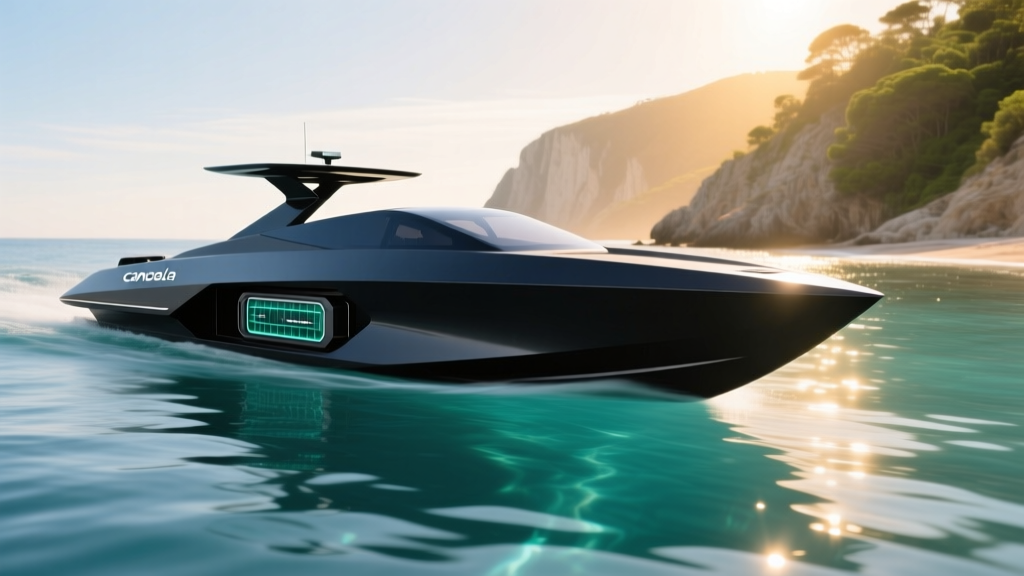
If you've been searching for a mini electric jet boat for sale, you've likely discovered that the market is small, expensive, and full of compromises. Most electric watercraft sacrifice range for speed or vice versa. The Candela C-8, now in its second production year for 2026, attempts to solve this with hydrofoiling technology borrowed from aerospace — lifting the hull above the water to slash energy consumption by up to 80% compared to a planing hull. At roughly 28 feet long, it qualifies as "mini" in the boating world, and its fully electric powertrain with a submerged pod drive (functionally similar to a jet drive in its lack of exposed propeller hazards) makes it one of the most compelling electric watercraft currently available for purchase.
This review covers the Candela C-8's real-world range, charging logistics, performance, pricing, and whether it makes sense for your dock — or if you should wait for competitors like the X Shore Eelex 8000 or the upcoming Arc One to reach broader markets.
| Spec | Value |
|---|---|
| EPA-equivalent range | ~57 nautical miles (at 22 knots cruise) |
| Battery capacity | 44 kWh usable (69 kWh gross, NMC lithium-ion) |
| Motor output | 75 kW continuous (approx. 100 hp) |
| Top speed | 30 knots (34.5 mph) |
| Cruise speed (foiling) | 22–24 knots (25–28 mph) |
| 0–30 mph | ~5.0 seconds (estimated) |
| Length overall | 28 ft 3 in (8.6 m) |
| Beam | 8 ft 2 in (2.5 m) |
| Weight (dry) | ~4,080 lbs (1,850 kg) |
| Passenger capacity | 8 adults (day cruiser) / 6 (overnighter cabin) |
| Base MSRP | ~$390,000 USD (2026) |
| Federal tax credit | Not eligible (§30D applies to highway vehicles only) |
| Warranty | 3 years hull/systems; 5 years battery (80% capacity retention) |
Range and Efficiency: What 57 Nautical Miles Really Means on the Water
The Candela C-8 uses a 69 kWh gross (44 kWh usable) NMC lithium-ion battery pack. Candela quotes a range of approximately 57 nautical miles at a 22-knot cruise speed while foiling. That translates to roughly 65 statute miles — enough for a full day of lake cruising, a harbor hop, or a coastal run from Marina del Rey to Catalina and back (with margin).
Real-World Range Reality Check: The 57 NM figure assumes calm water, moderate temperatures, and sustained foiling cruise. In choppy conditions where the flight controller works harder to maintain altitude, expect a 10–15% reduction (~48–51 NM). Cold water and air temperatures (below 50°F) can reduce usable capacity by 5–8%, similar to EV range loss on land. Aggressive throttle use at 27+ knots drops range to approximately 40 NM. Always plan with a 20% reserve — treat your practical range as ~45 nautical miles for safe trip planning.
Efficiency is where foiling changes the math. A conventional 28-foot gas powerboat at 22 knots burns roughly 15–20 gallons per hour. The C-8 at the same speed consumes approximately 0.8 kWh per nautical mile — an energy equivalent of roughly 800 Wh/mi, which would translate to an absurd 2,500+ MPGe if applied to a car. The physics are simple: a planing hull pushes water out of its way; a foiling hull flies over it. Drag drops by ~80%, and so does energy consumption.
For context, the competing X Shore Eelex 8000 (a conventional planing-hull electric boat with a 125 kWh battery) achieves roughly 40–50 NM at similar speeds despite having nearly triple the battery capacity. That's the foiling advantage in raw numbers.
Charging: How Long Does It Take to Recharge an Electric Boat?
Charging infrastructure for electric boats is far less mature than for EVs, and this remains the C-8's biggest practical limitation. Here's what you need to know:
| Charging Method | Power (kW) | 0–100% Time | Range Added per Hour |
|---|---|---|---|
| Standard AC (dock outlet, 240V/32A) | ~7 kW | ~9–10 hours | ~6 NM/hr |
| AC fast (shore power, 240V/63A) | ~11 kW | ~6 hours | ~9 NM/hr |
| DC fast charge (CCS, marina-equipped) | ~50 kW (peak) | ~1.2 hours (10–80%) | ~40 NM/hr |
The C-8 supports CCS-compatible DC fast charging, which is increasingly available at modern marinas in markets like Sweden, the Netherlands, and parts of coastal California and Florida. At 50 kW peak, you can recover 10–80% in roughly 70 minutes. However, the charging curve tapers significantly above 80% SoC — the final 20% can take an additional 40+ minutes, which is typical of NMC chemistry managed for longevity.
For most owners, overnight charging at the dock on a 7 kW or 11 kW AC connection is the standard workflow. You plug in when you return, and the boat is fully charged by morning — identical to home EV charging. The critical constraint: your marina must support the amperage. Many older docks max out at 30A/240V (~7 kW), which is adequate but slow. Upgrading your slip's electrical service to 63A can cost $2,000–$5,000 depending on marina infrastructure — factor this into your total cost.
DC fast charging on the water is still rare. Companies like Aqua SuperPower are building marina-specific DC networks, but coverage in the US remains limited to select locations in Miami, San Diego, and the Pacific Northwest. If your home marina lacks DC charging, plan trips around the AC overnight charge cycle.
Performance and Ride: Hydrofoiling Is the Real Story
The C-8 is powered by Candela's proprietary C-POD — a permanently submerged, direct-drive electric motor pod that produces 75 kW continuous (approximately 100 hp). Unlike a traditional jet drive or sterndrive, the C-POD has no gears, no cooling water intake, and minimal moving parts. Candela claims it requires essentially zero mechanical maintenance beyond periodic inspection.
Performance figures:
- 0–30 mph: approximately 5.0 seconds (planing before foil-lift engages at ~16 knots)
- Top speed: 30 knots (34.5 mph) — electronically limited
- Cruise speed: 22–24 knots on foils, where the ride is eerily smooth
The ride quality is where the C-8 separates from every other electric boat on the market. The flight controller — a suite of sensors and actuators adjusting the foils 100 times per second — keeps the hull above wave height in conditions up to approximately 4-foot chop. Passengers describe it as "flying over water." Seasickness, a common issue in planing hulls that slam into waves, is virtually eliminated.
The trade-off: the foil system adds complexity. If a sensor fails or a foil actuator malfunctions, the boat defaults to a safe "surface mode" where it planes conventionally — but at drastically reduced range (roughly 20–25 NM on the same battery). Candela's over-the-air update system and modular foil design aim to minimize downtime, but owners in remote areas may face longer service waits.
Pricing, Tax Credits, and Total Cost of Ownership
The Candela C-8 starts at approximately $390,000 for the Daycruiser configuration (open cockpit, 8-passenger). The Hardtop and Cabin variants add $30,000–$50,000 respectively. As-tested, with the premium sonar package, upgraded upholstery, and a custom trailer, expect to land between $420,000 and $445,000.
| Item | Cost |
|---|---|
| Base MSRP (Daycruiser) | $390,000 |
| Hardtop variant | $420,000 |
| Cabin (overnighter) variant | $440,000 |
| Premium electronics package | +$12,000 |
| Custom trailer | +$15,000 |
| Federal EV tax credit (§30D) | $0 — not eligible (watercraft excluded) |
| State/local clean energy incentives | Varies — check DSIRE database |
| Marina electrical upgrade (if needed) | $2,000–$5,000 |
Federal tax credit note: The IRS §30D Clean Vehicle Credit applies exclusively to on-highway motor vehicles with four wheels. Boats, including electric watercraft, do not qualify. Some states offer separate clean-energy or electrification rebates that may cover marine equipment — check the DSIRE incentive database for your jurisdiction. Consult a tax professional for specifics.
Operating cost comparison: Electricity at the marina (averaging $0.18/kWh in the US) means a full 69 kWh charge costs approximately $12.40. A comparable gas boat burning 18 gallons per hour at 22 knots, with fuel at $5.50/gallon, costs $99/hour. Over a 200-hour season, the C-8's energy cost is roughly $2,500 vs. $19,800 for gas — a savings of over $17,000 annually. Maintenance savings (no oil, no impeller, no exhaust manifold corrosion) add another $2,000–$4,000 per year. The payback period against a $250,000 gas equivalent is roughly 6–8 years on fuel and maintenance alone.
Tech, Interior, and Livability
The C-8's cockpit centers on a 15.6-inch touchscreen running Candela's proprietary operating system, which integrates navigation, foil-system telemetry, battery management, and entertainment. The interface is closer to a Tesla's than a traditional marine chartplotter — clean, responsive, and updated over-the-air. Apple CarPlay integration was added in the 2025 software update and continues in 2026.
Notable tech features:
- Candela Flight Controller: real-time foil adjustment with visual readout showing altitude, pitch, and roll
- Auto-foiling mode: engage foils with one button once above 16 knots
- Shallow-water retraction: foils retract for operation in less than 3 feet of water (conventional planing mode)
- Over-the-air updates: performance, UI, and flight-controller improvements delivered remotely
- 360° sonar integration: optional forward-looking sonar for reef and obstacle avoidance
The Daycruiser seats 8 with a U-shaped stern lounge and forward sun pad. The Cabin variant adds a below-deck V-berth and small head (marine toilet) — adequate for overnight trips for two. Storage is limited: approximately 12 cubic feet of enclosed locker space in the Daycruiser, plus under-seat compartments. This is a day boat, not a cruiser — if you need serious cargo volume for dive gear or fishing equipment, the C-8's foiling hardware and battery placement limit options.
Drawbacks worth noting: the C-POD's fixed position means no trim adjustment like a sterndrive, which can feel limiting in heavy following seas. The touchscreen, while excellent, is the sole interface for many functions — there are minimal physical backup switches. And the foil system, while robust, is proprietary — third-party marine mechanics cannot service it, locking you into Candela's service network.
Competitor Comparison: C-8 vs. X Shore Eelex 8000 vs. Arc One
If you're shopping for a mini electric jet boat or electric day cruiser, three names dominate the conversation:
| Spec | Candela C-8 | X Shore Eelex 8000 | Arc One (announced) |
|---|---|---|---|
| Price | $390,000 | ~$350,000 | ~$300,000 (est.) |
| Battery | 69 kWh (NMC) | 125 kWh (NMC) | 226 kWh (est.) |
| Range at cruise | ~57 NM (foiling) | ~45 NM (planing) | ~60 NM (est., planing) |
| Top speed | 30 knots | 35 knots | 35+ knots (est.) |
| Hull type | Hydrofoiling | Planing | Planing |
| Length | 28 ft | 26 ft | 24 ft |
| DC fast charge | Yes (CCS, ~50 kW) | Yes (CCS, ~40 kW) | TBD |
| Availability | In production | In production | Announced, limited delivery |
The Eelex 8000 is the C-8's closest competitor — a beautifully built Swedish planing-hull electric boat with a larger battery but shorter range (because it's dragging water instead of flying above it). It's slightly cheaper and simpler, with no foiling system to maintain, but you sacrifice the smooth ride and efficiency advantage.
The Arc One, from the LA-based startup Arc Boats, is larger-battery and higher-speed but remains in limited early delivery as of early 2026. If you need a boat today, the C-8 and Eelex are your realistic options.
Who Should Buy the Candela C-8?
Choose the Candela C-8 if:
- You boat primarily on lakes, harbors, or calm coastal waters where foiling shine
- You value ride comfort and silence over raw speed
- You have reliable dock charging access (7 kW minimum)
- You want the lowest per-hour operating cost in the 28-foot electric segment
- You're willing to pay a premium for novel technology and accept proprietary service dependency
Look elsewhere if:
- You need shallow-water operation (flats, rivers) — the foils require ~3 ft minimum even when retracted
- You want a fishing platform — the C-8's stern layout and foil hardware aren't angler-friendly
- You boat in areas with no Candela service presence
- You need 60+ NM range without mid-day charging — consider the X Shore or wait for Arc's larger battery
Pros and Cons
Pros
- Unmatched efficiency — 57 NM from a 69 kWh pack beats boats with twice the battery
- Ride quality on foils is extraordinary; eliminates wave-slam and seasickness
- Near-silent operation — conversation at 22 knots requires no raised voices
- Operating cost ~$12.40 per full charge vs. $99+/hr for gas equivalent
- OTA updates continuously improve flight controller and UI
- Zero direct emissions; no fuel spills, no exhaust fumes at the dock
Cons
- $390,000+ entry price — no federal tax credit offsets the cost
- Proprietary foil system means Candela-only service; no independent mechanic option
- DC fast charging on the water is still scarce in most US markets
- Shallow-water limitation (~3 ft minimum) rules out flats and some river use
- Limited cargo/storage — this is a day cruiser, not a utility platform
- Real-world range drops 10–15% in rough conditions; plan conservatively
Frequently Asked Questions
What is the real-world range of the Candela C-8?
Candela quotes ~57 nautical miles at 22-knot cruise on foils. In real-world conditions — moderate chop, mixed speeds, and typical passenger loads — plan for approximately 45–50 NM of usable range with a safety reserve. Cold weather and aggressive throttle use reduce this further.
How fast does the C-8 charge?
On a standard 7 kW dock outlet, a full charge takes 9–10 hours (overnight). On DC fast charge at 50 kW, 10–80% takes approximately 70 minutes. Most owners charge overnight at the slip.
Does the Candela C-8 qualify for any tax credits?
No. The federal §30D Clean Vehicle Credit applies only to on-highway motor vehicles. Electric boats are excluded. Some state or local clean-energy programs may offer rebates — check the DSIRE database and consult a tax professional.
Is the Candela C-8 worth it vs. a gas boat?
On operating cost alone, the C-8 saves $17,000+ per year vs. a comparable gas day cruiser. The payback period on the price premium is 6–8 years. If you boat 150+ hours per year and have dock charging, the economics work. If you boat 30 hours a year, the premium is harder to justify purely financially — the value proposition shifts to ride quality, silence, and environmental impact.
Can I trailer the C-8?
Yes. Candela offers a custom trailer ($15,000 option), and the boat's 8'2" beam is within standard US trailer limits. However, the foils must be manually retracted and secured for transport, and the total trailer weight exceeds 6,000 lbs — you'll need a capable tow vehicle (full-size SUV or truck rated for 8,000+ lbs towing).
What happens if the foil system fails on the water?
The C-8 defaults to "surface mode" — it operates as a conventional planing hull. You lose the efficiency and ride-quality benefits, and range drops to approximately 20–25 NM, but the boat remains fully operational and safe. Redundant sensors and a fail-safe design mean a single-point failure won't strand you.
Sources: Candela official specifications (candela.com/c-8); IRS §30D Clean Vehicle Credit guidelines (irs.gov); DSIRE incentive database (dsireusa.org).