Quick Answer: The Candela C-8 is a 28-foot electric hydrofoil boat that flies above the water on carbon-fiber foils, achieving up to 57 nautical miles of range at 22 knots using a 129 kWh NMC lithium-ion battery and dual electric pod motors. Priced from approximately $390,000 (2026), it eliminates fuel and most engine maintenance but requires access to shore-power charging infrastructure and is best suited for calm-to-moderate coastal and lake conditions. It is not a car and does not qualify for the IRS §30D federal EV tax credit.
What the Candela C-8 Actually Is (and Isn't)
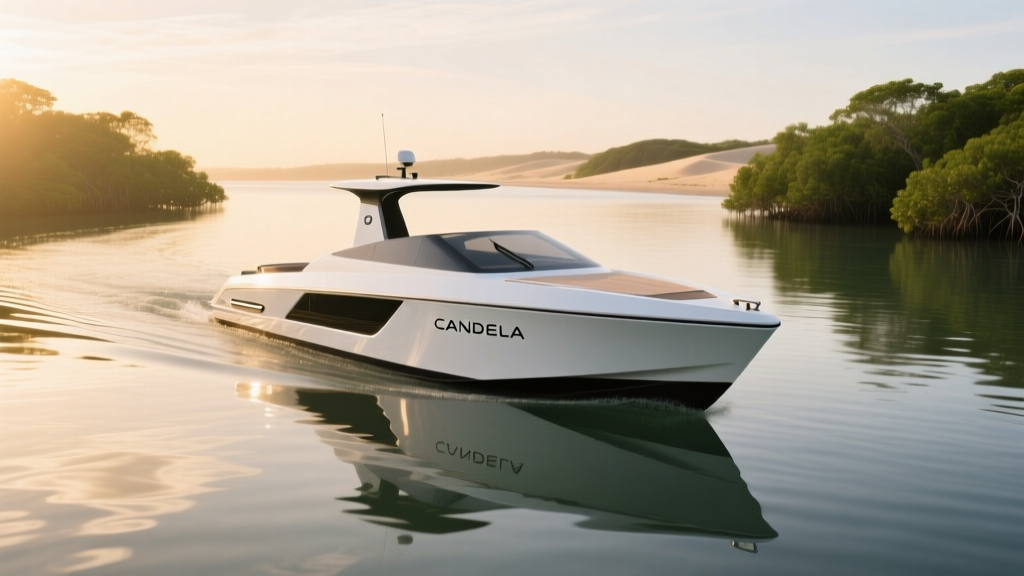
The Candela C-8 is not a conventional boat with an electric motor bolted in. It is a fully hydrofoiling vessel — the hull lifts entirely out of the water at speed, supported by computer-controlled carbon-fiber foils. This eliminates wave drag, which is the single largest energy consumer in marine propulsion, and is why the C-8 achieves efficiency figures that make electric boating viable for the first time at meaningful range.
For EV shoppers exploring electric mobility beyond cars, the C-8 represents the most production-ready electric boat on the market. But it is critical to understand its boundaries: this is a premium day-cruiser for lakes, archipelagos, and protected coastal waters — not an offshore vessel, and not a direct replacement for a 40-foot diesel sportfisherman.
Candela, the Swedish manufacturer, has been iterating on hydrofoil technology since 2017, and the C-8 (first delivered in 2022, with ongoing refinements through 2026) is their first volume-production model. Over 150 units have been delivered globally as of early 2026, making it the best-selling electric boat in its class.
Specs: Battery, Motors, Range, and Performance
Here are the key numbers that define the C-8 ownership experience:
| Specification | Value |
|---|---|
| Battery capacity | 129 kWh (NMC lithium-ion) |
| Motor configuration | Dual Candela C-Pod electric motors |
| Total power output | ~175 kW continuous (combined) |
| Top speed | 30 knots (34.5 mph) |
| Cruising speed (optimal efficiency) | 22 knots (25.3 mph) |
| Range at 22 knots | 57 nautical miles (65.6 statute miles) |
| Range at 27 knots | ~40 nautical miles (46 statute miles) |
| Foiling threshold | ~16 knots |
| Hull length | 28 ft (8.5 m) |
| Weight | ~4,300 lbs (1,950 kg) |
| Passenger capacity | 8 adults |
| Flight controller | Real-time foil adjustment at 100 Hz |
| Starting price (2026) | ~$390,000 USD |
kW vs kWh reminder: The C-8's motors draw roughly 35–45 kW of power (the rate of energy use) while cruising at 22 knots. Its battery stores 129 kWh of energy (the total fuel tank, in car terms). At 40 kW average draw, you get about 3.2 hours of cruising — hence the ~57 nmi range. This distinction matters when sizing your charging infrastructure.
Real-World Range Reality: The 57 nmi figure assumes calm water, 22-knot cruise, and moderate payload. Expect 15–25% range reduction in choppy conditions (the foils work harder to stabilize), 10–15% reduction with a full passenger load, and roughly 10% loss in cold water/air temperatures below 40°F due to increased battery internal resistance. Plan realistic trips around 40–45 nmi of usable range to preserve a safety margin.
Charging the C-8: Infrastructure and Times
Charging a 129 kWh battery is the single biggest ownership planning challenge. Here are the realistic scenarios:
| Charging Method | Power (kW) | 0–100% Time | Infrastructure Needed |
|---|---|---|---|
| Standard shore power (Level 2 equivalent) | 11 kW (3-phase 16A) | ~12 hours | Marina pedestal with 3-phase outlet |
| Fast shore power | 22 kW (3-phase 32A) | ~6 hours | Upgraded marina electrical service |
| DC fast charging (marine-rated) | 50–80 kW | ~2–2.5 hours (10–80%) | Commercial DC marine charger (rare) |
| Trailer + home charging | 11–22 kW | 6–12 hours | Heavy-duty trailer, residential 3-phase power |
The infrastructure gap is real. Unlike EV charging networks on highways, marine DC fast charging barely exists as of 2026. Most C-8 owners charge overnight at their marina slip or private dock. If your marina only offers standard 120V/30A shore power (3.6 kW), a full charge takes over 35 hours — effectively unusable for daily boating.
Before purchasing, confirm your marina can provide at least 11 kW 3-phase power at your slip. Many older marinas in the US lack this, and upgrading can cost $5,000–$15,000 depending on distance from the transformer and local utility requirements. Work with a licensed marine electrician — residential EV electricians may not be familiar with marine-grade connectors and ABYC (American Boat & Yacht Council) standards.
Cost Breakdown: C-8 vs. Comparable Gas-Powered Boat
The C-8's $390,000 price tag is steep. To understand whether it makes financial sense, compare it against a similarly sized premium gas-powered day boat — for example, a 28-foot center console with twin 200 HP outboards (e.g., a well-equipped Boston Whaler or similar), priced around $160,000–$200,000.
| Cost Category (Annual, 100 hrs/yr use) | Candela C-8 | 28-ft Gas Boat (Twin 200 HP) |
|---|---|---|
| Purchase price | ~$390,000 | ~$180,000 |
| Fuel / electricity cost | ~$1,200–$1,800/yr | ~$4,500–$6,000/yr |
| Engine maintenance (oil, filters, impellers, winterization) | $0 (no ICE) | $1,500–$3,000/yr |
| Foil system maintenance | $500–$1,500/yr | N/A |
| Insurance | $4,000–$7,000/yr | $2,500–$4,500/yr |
| Dockage / storage (same for both) | $5,000–$12,000/yr | $5,000–$12,000/yr |
| Estimated 5-year total cost of ownership | ~$470,000–$510,000 | ~$310,000–$370,000 |
The honest math: The C-8 saves roughly $3,000–$5,000 annually on fuel and engine maintenance compared to a gas boat. Over 10 years, that's $30,000–$50,000 in operational savings — significant, but not enough to close the ~$200,000 purchase-price gap. The C-8 is not an economic decision; it's a technology and experience decision. You're paying for near-silent operation, zero exhaust fumes, instant torque, a smooth hydrofoil ride, and the novelty of flying above the water.
Tax credit note: The federal §30D Clean Vehicle Credit applies to on-road electric vehicles meeting specific MSRP, income, and battery-sourcing requirements (see IRS guidelines). Marine vessels do not qualify. Some states offer clean-energy equipment rebates that may partially apply — check your state energy office. Commercial buyers may explore §179 depreciation deductions; consult a tax professional.
Common Misconceptions About Electric Boats
| Myth | Fact |
|---|---|
| "Electric boats can't go fast." | The C-8 hits 30 knots (34.5 mph) — comparable to many gas day boats. The hydrofoil design means it maintains speed with far less energy. |
| "The battery will need replacing in a few years." | NMC marine batteries at this capacity are rated for 2,000+ full charge cycles before 80% capacity retention. At 100 outings/year with partial discharges, that's 15+ years of usable life. Candela offers a battery warranty — confirm current terms with your dealer. |
| "You can charge from any marina outlet." | Standard 120V/30A marine shore power delivers only ~3.6 kW — a full charge takes 35+ hours. You need 3-phase power for practical overnight charging. |
| "It's self-driving on the water." | The C-8's flight controller automatically adjusts foils for stability, but the helmsman is fully responsible for navigation, collision avoidance, and speed control. There is no autonomous marine piloting feature. |
| "Electric boats are zero-emission." | Tailpipe emissions are zero. Upstream emissions depend on your local grid mix — a coal-heavy grid still generates significant CO₂ per kWh. That said, the C-8's efficiency (~2.3 kWh/nmi at cruise) means its carbon footprint is substantially lower than a gas boat even on a dirty grid. |
Real-World Ownership: Who the C-8 Is For
After evaluating the C-8's capabilities and limitations, here's a practical decision framework:
Choose the Candela C-8 if:
- You boat primarily on lakes, protected bays, or archipelagos with calm-to-moderate conditions
- Your typical outing is 30–50 nautical miles round-trip
- Your marina or dock has (or can install) 3-phase 11+ kW power
- You value silent, fume-free operation and ride comfort over raw speed and range
- You're comfortable spending ~$390,000+ on a premium recreational vessel
- You want to be an early adopter of marine electric technology
Stick with a gas or diesel boat if:
- You regularly boat in open ocean or rough-water conditions
- Your trips exceed 60 nautical miles without charging access
- Your marina cannot provide adequate shore power and upgrades are impractical
- You need to trailer long distances frequently (the C-8 is trailerable but requires a heavy-duty rig and careful foil handling)
- Budget is a primary concern — the price premium over gas is substantial
- You need the flexibility of quick fuel dock stops for extended range
First-Time Electric Boat Buyer Checklist
If the C-8 is your introduction to electric marine propulsion, prepare for these ownership realities:
- Survey your charging infrastructure first. Before placing a deposit, get a written assessment from your marina or a marine electrician confirming available power at your slip. This is the #1 deal-breaker.
- Understand the foil system. The hydrofoils are the C-8's defining technology and its most maintenance-sensitive component. Carbon-fiber foils are durable but can be damaged by grounding, debris strikes, or improper trailering. Budget for annual foil inspection and occasional replacement of wear components.
- Plan for weather limitations. The C-8 can foil in waves up to approximately 4–5 feet, but ride quality and efficiency degrade significantly in rougher conditions. In heavy chop, the boat may drop to hull-borne mode, which dramatically increases energy consumption and reduces range to roughly 25–30 nmi.
- Factor in insurance complexity. Insuring a $390,000 electric hydrofoil is not like insuring a pontoon boat. Expect premiums in the $4,000–$7,000/year range and limited carrier options. Get quotes before committing.
- Resale value is uncertain. The C-8 is a new product category. Depreciation curves for electric boats are not yet established the way they are for EVs. Early adopters should expect higher depreciation risk than proven gas-boat platforms.
- Join the owner community. Candela owners' groups (online forums, regional meetups) are invaluable for troubleshooting charging issues, sharing marina power intel, and learning foil-system best practices. The community is small but active.
How the C-8 Compares to Gas Boats: The Experience Gap
Beyond cost, the ownership experience differs fundamentally:
| Experience Factor | Candela C-8 | Gas-Powered 28-ft Boat |
|---|---|---|
| Noise at cruise | Near-silent (wind and water only) | 75–85 dB engine noise |
| Exhaust fumes | None | CO, hydrocarbons at dock and low speed |
| Acceleration feel | Instant torque, smooth | Ramp-up with engine revs |
| Ride quality in chop | Foils absorb waves; minimal pitching | Hull slams through waves |
| Wake produced | Minimal (hull is out of water) | Significant wake, especially at planing speed |
| Refueling / recharging time | 6–12 hours (shore power) | 5–10 minutes at fuel dock |
| Range flexibility | Limited to battery + charging access | 200+ nmi with fuel-dock stops |
| Winterization | Simplified (no engine coolant, fuel stabilizer) | Full engine winterization required |
The C-8's minimal wake is a practical advantage in no-wake zones and environmentally sensitive areas — several European municipalities have begun incentivizing hydrofoil vessels for this reason. In the US, wake-restricted lakes may become early strongholds for electric hydrofoil adoption.
Frequently Asked Questions
Does the Candela C-8 qualify for any EV tax credits?
No. The IRS §30D Clean Vehicle Credit applies only to qualified on-road motor vehicles. Boats are excluded. However, commercial operators should consult a tax professional about potential §179 equipment deductions and any state-level clean-energy incentives that may apply to marine electrification.
How long does the C-8 battery last before replacement?
NMC marine batteries are typically rated for 2,000+ full charge cycles to 80% capacity. With typical recreational use (50–100 partial cycles per year), you can expect 15–20 years before significant degradation. Full battery replacement cost is estimated at $30,000–$50,000 based on current NMC cell pricing, though this figure should decrease as battery costs continue to decline.
Can I trailer the Candela C-8?
Yes, the C-8 is trailerable, but it requires a specialized heavy-duty trailer (the boat weighs ~4,300 lbs) and careful handling of the foil system. The foils can be retracted or partially disassembled for transport. Allow extra time for launch and retrieval compared to a conventional hull.
What happens if I run out of battery on the water?
The C-8 includes a reserve buffer (typically ~5–8 kWh held in reserve) and will issue progressive low-battery warnings. If fully depleted, the boat will float and can be towed like any other vessel. Candela's software provides real-time range estimation based on current conditions, similar to an EV's range estimator. Responsible trip planning — as with any electric vehicle — is essential.
How does cold weather affect the C-8?
Cold water and air temperatures increase battery internal resistance, reducing usable capacity by roughly 10% in temperatures below 40°F. The C-8 includes battery thermal management to mitigate this, but pre-heating the battery before departure (if shore power is available) improves both range and charging speed. In northern climates, the boating season may effectively be May through October.
Where can I buy or test-drive a Candela C-8 in the US?
Candela has been expanding its dealer and demo network in the US, with presence in coastal markets including Florida, California, and the Northeast. Visit Candela's official site for current dealer locations and demo availability. Lead times for new orders have historically been 6–12 months.
Sources: Candela official specifications, IRS §30D Clean Vehicle Credit guidelines. Range and performance figures based on manufacturer data; real-world results vary with conditions.