The Short Answer
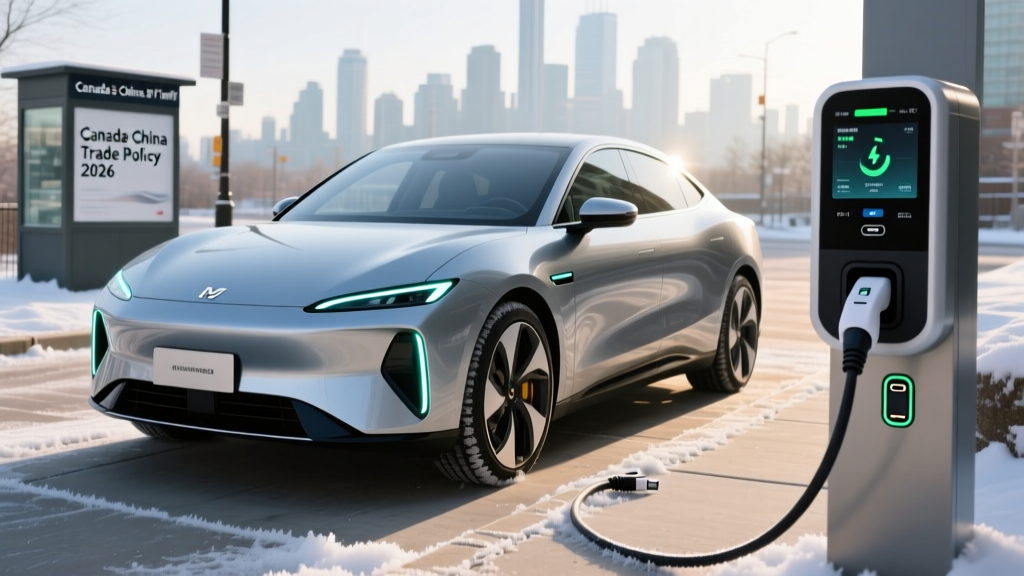
As of late 2024, Canada imposed a 100% surtax on all electric vehicles manufactured in China, effectively doubling the import price of affected models. This tariff, modeled after similar U.S. and EU actions, targets brands like BYD, NIO, Xpeng, and Zeekr — plus any China-built vehicles from Western automakers (such as Tesla's Shanghai-exported Model 3 and Model Y, Volvo's EX30, and Polestar's China-assembled models). For Canadian EV shoppers in 2026, this means Chinese-made EVs are priced out of the affordable segment entirely, and the market has shifted heavily toward Korean, Japanese, European, and North American-built alternatives.
Why Canada Imposed the 100% Chinese EV Tariff
Canada's tariff, announced in August 2024 and enforced starting October 1, 2024, was a response to a flood of heavily subsidized Chinese EVs entering Western markets at prices domestic automakers couldn't match. The Canadian government cited concerns about:
- Unfair state subsidies: China's government-backed EV industry benefits from an estimated $230+ billion in cumulative state support, according to the Center for Strategic and International Studies (CSIS), allowing Chinese OEMs to price vehicles 20-40% below production cost in export markets.
- Supply chain security: Over 75% of global battery cell production and 90%+ of critical mineral refining (lithium, cobalt, graphite) is controlled by Chinese firms, per the International Energy Agency.
- Alignment with trade partners: The U.S. raised its tariff on Chinese EVs to 100% in August 2024 under Section 301. The EU imposed countervailing duties of up to 35.3% in October 2024. Canada's move was designed to prevent trade diversion — Chinese EVs being rerouted through Canada into the U.S. market.
The tariff applies to battery electric vehicles (BEVs) classified under specific HS codes. Plug-in hybrids and conventional hybrids built in China are subject to a separate 25% tariff on steel and aluminum components, but not the full 100% surtax.
Which Vehicles Are Actually Affected?
The tariff's impact varies by brand and assembly location. Here's a breakdown of key models and their tariff status as of early 2026:
| Brand / Model | Assembly Location | Tariff Status | Estimated Price Impact |
|---|---|---|---|
| BYD Atto 3 / Dolphin / Seal | China (Shenzhen, Xi'an) | 100% surtax applied | Effectively doubled; BYD paused Canadian entry |
| Tesla Model 3 (Standard Range) | Shanghai Gigafactory, China | 100% surtax applied | Tesla shifted Canadian supply to Fremont/Austin plants |
| Tesla Model Y | Fremont, CA / Austin, TX | Not affected | No change; remains Canada's top-selling EV |
| Volvo EX30 | Luqiao, China | 100% surtax applied | Volvo delayed Canadian launch; exploring EU-built supply |
| Polestar 2 | Luqiao, China | 100% surtax applied | Polestar shifted some production to South Korea (Renault plant) |
| Polestar 4 | Hangzhou Bay, China | 100% surtax applied | Canadian availability uncertain |
| NIO ET7 / EL6 | Hefei, China | 100% surtax applied | NIO deferred Canadian market entry |
| Xpeng G6 / G9 | Guangzhou / Zhaoqing, China | 100% surtax applied | Xpeng has no Canadian presence |
| MG4 EV | Ningde, China | 100% surtax applied | MG (SAIC) paused Canadian plans |
| Hyundai Ioniq 5 | Ellabell, GA (Metaplant) | Not affected | Now built in the U.S.; qualifies under CUSMA |
| Kia EV6 | West Point, GA | Not affected | U.S.-built; no tariff |
The critical detail: the tariff targets where the vehicle is assembled, not the brand's headquarters. A Tesla Model 3 built in Shanghai faces the tariff; one built in Fremont does not. This has forced automakers to restructure their North American supply chains.
What This Means for EV Pricing in Canada
Before the tariff, several Chinese-made EVs were expected to enter Canada at aggressive price points. BYD's Dolphin, for instance, starts at roughly €30,000 (~C$44,000) in Europe. With the 100% surtax, that same vehicle would land at approximately C$88,000+ before delivery fees — placing it in competition with the BMW i4 and Mercedes EQB rather than the Hyundai Kona Electric.
Estimated Canadian Pricing: With vs. Without Tariff
| Model (Pre-Tariff Est.) | Pre-Tariff Price (C$) | Post-Tariff Price (C$) | Comparable Non-Tariff Alternative | Alt. Price (C$) |
|---|---|---|---|---|
| BYD Dolphin | ~$44,000 | ~$88,000+ | Hyundai Kona Electric | $44,999 |
| BYD Atto 3 | ~$52,000 | ~$104,000+ | Volkswagen ID.4 | $48,995 |
| MG4 EV | ~$38,000 | ~$76,000+ | Chevrolet Equinox EV | $43,900 |
| Volvo EX30 | ~$49,900 | ~$99,800+ | Hyundai Ioniq 5 (Preferred) | $57,999 |
| Tesla Model 3 RWD (Shanghai) | ~$52,990 | ~$105,980+ | Tesla Model 3 RWD (Fremont) | $52,990 |
The practical result: the sub-C$45,000 EV segment in Canada — which Chinese brands were poised to dominate — remains served primarily by the Chevrolet Equinox EV, Nissan Leaf, Hyundai Kona Electric, and the base Tesla Model 3 (now sourced from U.S. plants).
EV vs. Gas vs. Hybrid: The Canadian Cost Reality in 2026
With Chinese EVs priced out, Canadian buyers are choosing between the remaining EVs, traditional hybrids, and gas vehicles. Here's a five-year total cost comparison for a typical Canadian driver covering 20,000 km/year in Ontario (electricity at $0.087/kWh off-peak, gas at $1.55/L):
5-Year Total Cost of Ownership: Ontario, 20,000 km/yr
| Category | Hyundai Kona Electric ($44,999) | Toyota RAV4 Hybrid ($38,550) | Toyota RAV4 Gas ($34,990) |
|---|---|---|---|
| Purchase Price | $44,999 | $38,550 | $34,990 |
| Federal iZEV Rebate | −$5,000 | $0 | $0 |
| Provincial Rebate (QC/BC) | Varies ($0–$7,000) | $0 | $0 |
| Net Purchase (ON, fed only) | $39,999 | $38,550 | $34,990 |
| Annual Fuel/Energy (100,000 km total) | $1,305 (15 kWh/100km) | $5,967 (6.0 L/100km) | $8,525 (8.5 L/100km) |
| 5-Year Maintenance (est.) | $1,800 | $3,500 | $4,200 |
| 5-Year Insurance (est.) | $10,500 | $8,750 | $8,250 |
| 5-Year Total | ~$53,604 | ~$56,767 | ~$55,965 |
Source: Natural Resources Canada fuel consumption data; insurance estimates from Ontario averages. Actual costs vary by province, driving pattern, and electricity rate.
The Kona Electric breaks even with the RAV4 Hybrid around year four in Ontario, thanks to dramatically lower fuel and maintenance costs. In Quebec or British Columbia — where electricity is cheaper and provincial rebates stack — the EV pulls ahead faster. In Alberta, where electricity is pricier and gas is cheaper, the hybrid may retain a cost advantage over five years.
Real-World Ownership: What Canadian Buyers Must Consider
The tariff narrows your choices, but the fundamentals of Canadian EV ownership haven't changed. Here's what matters:
Cold-Weather Range Loss
Every EV loses range in Canadian winters. Testing by the Canadian Automobile Association and independent reviewers shows:
- Mild cold (−5°C to 0°C): Expect 15–25% range reduction from the EPA/NRCan sticker figure.
- Deep cold (−20°C to −30°C): Expect 30–45% range reduction, especially without a heat pump.
- Heat pump equipped models (Hyundai Ioniq 5, Tesla Model Y, Kia EV6) lose 15–30% in deep cold — a meaningful advantage over resistive-heater EVs like the base Nissan Leaf.
A Kona Electric with a 415 km NRCan range may deliver only 250–290 km on a −25°C January day in Winnipeg. Plan accordingly.
Home Charging Access
Over 60% of Canadians live in single-family homes where Level 2 (240V, 7–11 kW) home charging installation is feasible. Typical installation costs:
- Level 2 charger hardware: C$500–$900 (e.g., ChargePoint Home Flex, Grizzl-E Smart)
- Electrician + permit: C$800–$2,500 depending on panel capacity and run distance
- Panel upgrade (if needed, 100A → 200A): C$2,000–$4,000
Condo and apartment dwellers — roughly 33% of Canadian households — face significant barriers. Right-to-charge legislation exists in British Columbia and Ontario, but installation costs and strata/board approval remain hurdles.
Charging Infrastructure
Canada had approximately 3,500 public DC fast-charging stations as of late 2025, concentrated along the Windsor-Quebec City corridor, the Calgary-Edmonton axis, and the Lower Mainland. Northern and rural regions remain underserved. For a Toronto-Montreal run (540 km), you'll find multiple 150–350 kW stations. For a Winnipeg-Thunder Bay run (700 km), plan carefully — some stretches have 100+ km gaps.
Common Misconceptions About the Tariff
| Myth | Fact |
|---|---|
| "All Chinese-brand EVs are banned in Canada." | They're not banned — they're subject to a 100% surtax that makes them economically unviable. No import prohibition exists. |
| "Tesla is unaffected because it's an American company." | Tesla's Shanghai Gigafactory exports globally. Model 3 units built in Shanghai and shipped to Canada face the tariff. Tesla has rerouted Canadian-bound vehicles to U.S.-built inventory. |
| "The tariff will make EVs unaffordable for Canadians." | The tariff eliminates one potential low-cost supply source, but existing affordable EVs (Equinox EV at C$43,900, Kona Electric at C$44,999, Leaf at C$39,998) are assembled in South Korea, the U.S., or Japan and are unaffected. |
| "Chinese EVs will enter through loopholes or CKD kits." | Canada Border Services Agency (CBSA) classifies vehicles by final assembly origin. Partially assembled kits (CKD/SKD) shipped from China are scrutinized under anti-circumvention provisions. |
| "The tariff will be repealed soon." | As of early 2026, there is no indication of repeal. The policy aligns with U.S. and EU positions and is embedded in Canada's broader critical-minerals and industrial strategy. |
Decision Framework: What Should You Buy?
If / Then Guide for Canadian EV Buyers in 2026
- If you want the most affordable new EV under C$40,000: The Nissan Leaf S (C$39,998, 240 km range, CHAdeMO connector) remains the entry point — but its limited range and aging platform make it best as a second car or city commuter.
- If you need 400+ km of real-world range for highway trips: The Hyundai Ioniq 5 Long Range (C$57,999, 488 km NRCan, 84 kWh NMC battery, peak 240 kW DC charging, 10–80% in ~18 minutes) or the Tesla Model Y Long Range (C$63,990, 511 km NRCan) are the top picks.
- If you live in a condo without home charging: A hybrid (Toyota RAV4 Hybrid, 6.0 L/100 km combined) or PHEV (Toyota RAV4 Prime, 68 km electric-only range) may be more practical until public charging access improves in your area.
- If you tow or need AWD in heavy snow: The Ford F-150 Lightning (C$73,995+, 515 km range, 10,000 lb towing) or Rivian R1T Dual-Motor are capable — but verify your daily range needs against cold-weather losses.
- If you were waiting for a BYD or NIO to enter Canada at a budget price: That's not happening in the near term. Redirect your search to the Chevrolet Equinox EV, Hyundai Kona Electric, or certified pre-owned Tesla Model 3.
- If you want a luxury EV: The tariff affects the Polestar 4 and Volvo EX30 (China-built), but the BMW i4 (Germany), Mercedes EQB (Hungary), and Genesis Electrified GV70 (South Korea) are unaffected.
Federal and Provincial Incentives That Still Apply
The Canadian federal iZEV program (Incentives for Zero-Emission Vehicles) provides up to C$5,000 for eligible BEVs and long-range PHEVs with a base MSRP under C$55,000 (or C$60,000 for SUVs/pickups with higher trims up to C$70,000). This program remains active as of early 2026, though funding has been under pressure.
Provincial programs stack on top:
- Quebec: Up to C$7,000 for BEVs (income-tested; reduced for buyers with household income above C$175,000).
- British Columbia: Up to C$4,000 for BEVs (income-tested; SCRAP-IT program provides additional C$6,000 when scrapping a gas car).
- Prince Edward Island: C$5,000 universal rebate.
- Yukon: C$5,000 rebate.
- Ontario, Alberta, Saskatchewan, Manitoba, Nova Scotia, New Brunswick, Newfoundland: No provincial EV purchase rebate as of early 2026 (though some offer reduced registration fees or HOV lane access).
Provincial incentive amounts and eligibility change frequently. Always verify with your province's official transportation or energy ministry before purchasing.
Frequently Asked Questions
Does the tariff apply to used Chinese EVs imported into Canada?
Yes. The 100% surtax applies to all EVs classified under the affected HS tariff codes, regardless of whether the vehicle is new or used. Importing a used BYD from Europe, for example, would still trigger the surtax if the vehicle was originally manufactured in China.
Will BYD, NIO, or Xpeng build factories in Canada to avoid the tariff?
As of early 2026, no Chinese EV automaker has announced a Canadian manufacturing facility. BYD is building a plant in Hungary and has explored a Mexican facility. A Canadian plant is unlikely given the relatively small market size (~1.7 million new vehicles/year) and the high cost of establishing production in Canada. However, BYD has expressed interest in entering Canada with commercial vehicles (buses, trucks) which may fall under different tariff classifications.
Does the tariff affect EV batteries or parts?
The 100% surtax applies specifically to finished battery electric vehicles. Individual battery cells, modules, and components imported from China for use in vehicles assembled in Canada or the U.S. are subject to different tariff schedules. Canada's 2023 Critical Minerals Strategy actually encourages battery supply chain investment, and companies like Volkswagen (PowerCo in St. Thomas, ON) and Stellantis-LG (Windsor, ON) are building Canadian battery plants with federal and provincial subsidies.
How does Canada's tariff compare to the U.S. and EU?
The U.S. raised its tariff on Chinese EVs to 100% in August 2024 under Section 301 of the Trade Act. The EU imposed countervailing duties ranging from 7.8% (for cooperating companies like Tesla Shanghai) to 35.3% (for non-cooperating companies like SAIC/MG) on top of the standard 10% auto import duty. Canada's flat 100% surtax is the most aggressive of the three, matching the U.S. rate but exceeding the EU's tiered approach.
Will the tariff make EVs more expensive overall in Canada?
In the short term, the tariff eliminates a potential source of low-cost EVs, which reduces downward pricing pressure on existing models. However, competition among non-Chinese automakers is intensifying: Hyundai, Kia, GM, Ford, and Tesla are all expanding Canadian-market EV lineups. The Chevrolet Equinox EV (starting at C$43,900) and the redesigned Nissan Leaf (expected 2026–2027) represent the affordable segment that Chinese brands would have targeted. Overall EV pricing in Canada is stabilizing rather than rising, but the ultra-budget sub-C$35,000 EV remains unavailable.
Can I still buy a Tesla Model 3 in Canada?
Yes. Tesla continues to sell the Model 3 in Canada, but inventory is now sourced from the Fremont, California and Austin, Texas factories rather than Shanghai. The U.S.-built Model 3 Rear-Wheel Drive starts at C$52,990 and is not subject to the Chinese EV tariff. Delivery times may vary depending on U.S. production allocation to Canada.
Sources: Government of Canada tariff notice (Global Affairs Canada, August 2024); International Energy Agency Global EV Outlook 2024; Natural Resources Canada fuel consumption ratings; Canadian Automobile Association EV resources. Pricing reflects manufacturer-quoted MSRPs as of early 2026 and is subject to change.