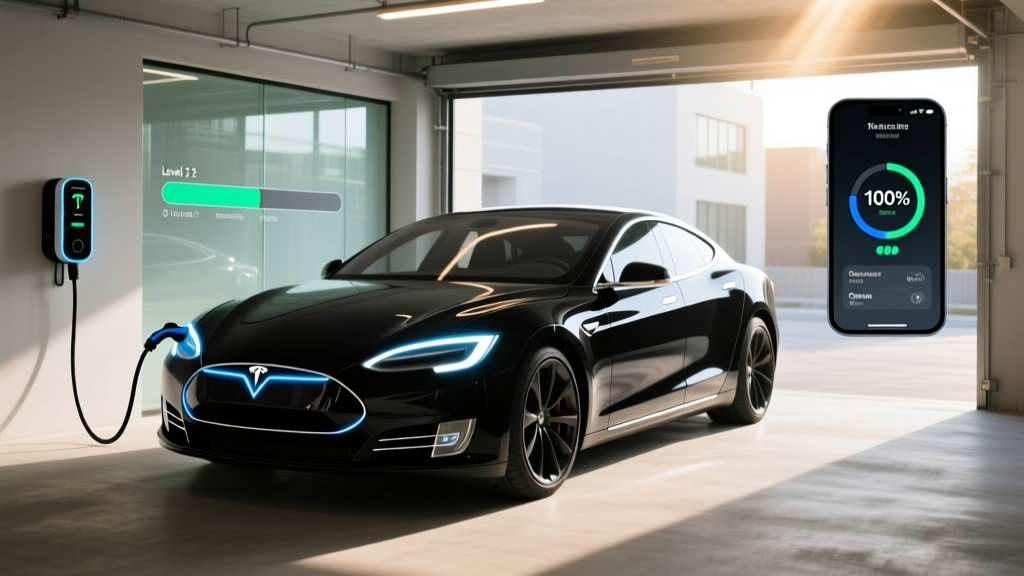
One of the most common questions new Tesla owners ask is deceptively simple: can you charge a Tesla to 100%? The answer depends entirely on which battery chemistry your car uses — and getting it wrong can accelerate long-term degradation or leave miles on the table. This guide breaks down the chemistry, the real-world range you'll actually see, and the charging habits that maximize both daily usability and battery lifespan across the current 2026 Tesla lineup.
The Short Answer: LFP vs NMC Charging Rules
Tesla currently sells vehicles with two distinct battery chemistries, and each has a different recommended daily charge limit:
- LFP (Lithium Iron Phosphate) — found in the Model 3 RWD and Model Y RWD. Tesla recommends charging to 100% at least once per week. These cells tolerate full charges well and actually benefit from periodic 100% sessions to keep the battery management system (BMS) calibrated.
- NMC (Nickel Manganese Cobalt) — found in Long Range and Performance variants of the Model 3, Model Y, Model S, and Model X. Tesla recommends a daily charge limit of 80%, reserving 100% for road trips or days when you need maximum range.
Real-World Range: What the EPA Sticker Doesn't Tell You
EPA range estimates are measured under controlled conditions that rarely match highway driving at 75 mph in winter. Here's what you'll actually see across the 2026 lineup:
| Model / Trim | Battery (kWh usable) | Chemistry | EPA Range | Real-World Hwy (75 mph) | MPGe (combined) |
|---|---|---|---|---|---|
| Model 3 RWD | ~57 kWh | LFP | 272 mi | ~230–245 mi | 132 MPGe |
| Model 3 Long Range AWD | ~75 kWh | NMC | 363 mi | ~290–310 mi | 134 MPGe |
| Model 3 Performance | ~75 kWh | NMC | 315 mi | ~255–275 mi | 121 MPGe |
| Model Y RWD | ~57 kWh | LFP | 277 mi | ~235–250 mi | 127 MPGe |
| Model Y Long Range AWD | ~75 kWh | NMC | 330 mi | ~270–290 mi | 122 MPGe |
| Model S Long Range | ~95 kWh | NMC | 402 mi | ~330–355 mi | 120 MPGe |
| Model X Long Range | ~95 kWh | NMC | 348 mi | ~285–310 mi | 109 MPGe |
Charging Speeds: DC Fast Charge, Level 2, and the 100% Question
Charging to 100% isn't just a battery-care question — it's also a time question. DC fast charging follows a charge curve: the battery pulls peak power at low states of charge, then tapers significantly above ~60–70% SoC to protect the cells. Charging from 80% to 100% on a DC fast charger can take nearly as long as charging from 10% to 80%.
| Model / Trim | Max DC Fast Charge | 10–80% Time | Level 2 (11.5 kW) | Connector |
|---|---|---|---|---|
| Model 3 RWD (LFP) | 170 kW peak | ~25 min | ~30 mi/hr | NACS |
| Model 3 LR / Perf | 250 kW peak | ~18 min | ~44 mi/hr | NACS |
| Model Y RWD (LFP) | 170 kW peak | ~25 min | ~30 mi/hr | NACS |
| Model Y LR AWD | 250 kW peak | ~20 min | ~44 mi/hr | NACS |
| Model S / X | 250 kW peak | ~22–25 min | ~44 mi/hr | NACS |
Practical takeaway for road trips: On a Supercharger, plan your stops around 10–80% charges. The time penalty for pushing to 100% at a DC fast charger is severe — you'll often gain more total trip speed by stopping 10 minutes earlier and charging again sooner. Save 100% charges for overnight Level 2 sessions at home or at your destination.
kW vs kWh reminder: kW (kilowatts) measures power — how fast energy flows into the battery. kWh (kilowatt-hours) measures energy — the total capacity of the battery. A 250 kW charger delivers energy fast, but the battery's kWh capacity determines how far that energy takes you.
Performance, Drivetrain, and What It Feels Like to Drive
Tesla's instant torque delivery remains a benchmark. Here are the 2026 performance figures:
- Model 3 RWD: 283 hp, single-motor RWD, 0–60 mph in 5.8 seconds
- Model 3 Long Range AWD: 346 hp, dual-motor AWD, 0–60 in 4.2 seconds
- Model 3 Performance: 510 hp, dual-motor AWD, 0–60 in 2.9 seconds
- Model Y RWD: 295 hp, single-motor RWD, 0–60 in 6.5 seconds
- Model Y Long Range AWD: 384 hp, dual-motor AWD, 0–60 in 4.8 seconds
- Model S Long Range: 670 hp, dual-motor AWD, 0–60 in 3.1 seconds
- Model X Long Range: 670 hp, dual-motor AWD, 0–60 in 3.8 seconds
All 2026 Teslas feature regenerative braking with one-pedal driving capability, a low center of gravity from the under-floor battery pack, and Tesla's adaptive damping on Performance and Long Range trims. The RWD models are lighter and more efficient; the AWD models trade a small range penalty for all-weather traction and significantly quicker acceleration.
Interior, Cargo, and Technology
The Tesla cabin philosophy is minimalist — a single 15.4-inch touchscreen (17-inch in Model S/X) handles navigation, media, climate, and vehicle settings. There is no traditional instrument cluster; speed and range info appear on the left edge of the main display.
Cargo capacity:
- Model 3: 23 cu ft trunk + 3.1 cu ft frunk
- Model Y: 30 cu ft behind rear seats, 72 cu ft with seats folded + 4.1 cu ft frunk
- Model S: 28 cu ft trunk + front trunk, with a hatchback opening for easier loading
- Model X: Up to 88 cu ft with second-row seats folded, plus a front trunk; available 6-seat config with second-row captain's chairs
Rear-seat legroom: Model 3 offers 35.2 inches; Model Y provides 40.5 inches (a meaningful advantage for families with rear-facing car seats); Model S/X deliver full-size sedan/SUV space with over 41 inches.
Driver assistance: All Teslas ship with Basic Autopilot (lane centering + adaptive cruise). Full Self-Driving (Supervised) is an optional upgrade — but it is a SAE Level 2 system, meaning the driver must remain fully attentive with hands on the wheel and eyes on the road at all times. It is not self-driving.
Pricing, Trims, and Federal Tax Credit Eligibility
Tesla pricing has stabilized in 2026 after several years of aggressive cuts. Here's the current lineup with tax credit context:
| Model / Trim | Base MSRP | Est. §30D Credit | Effective Price | Under MSRP Cap? |
|---|---|---|---|---|
| Model 3 RWD | $38,990 | Up to $7,500 | ~$31,490 | Yes (sedan cap: $55K) |
| Model 3 Long Range | $45,740 | Up to $7,500 | ~$38,240 | Yes |
| Model 3 Performance | $54,990 | Up to $7,500 | ~$47,490 | Yes |
| Model Y RWD | $39,990 | Up to $7,500 | ~$32,490 | Yes (SUV cap: $80K) |
| Model Y Long Range | $46,630 | Up to $7,500 | ~$39,130 | Yes |
| Model S LR | $79,990 | $0 | $79,990 | No — exceeds $55K sedan cap |
| Model X LR | $84,990 | $0 | $84,990 | No — exceeds $80K SUV cap |
- MSRP cap: Sedans/wagons ≤ $55,000; SUVs/pickups/vans ≤ $80,000
- Buyer income cap: AGI ≤ $150K (single), $225K (head of household), $300K (joint)
- Battery sourcing: Must meet critical mineral + battery component requirements (phased thresholds increase annually)
- Point-of-sale transfer: Eligible buyers can transfer the credit to the dealer at purchase, reducing the out-of-pocket price immediately
- FEOC restriction: Vehicles with battery components from a "foreign entity of concern" are disqualified
Warranty, Battery Longevity, and Degradation
Tesla's warranty coverage is competitive but not class-leading:
- Basic vehicle warranty: 4 years / 50,000 miles
- Battery & drive unit warranty (Model 3 RWD): 8 years / 100,000 miles
- Battery & drive unit warranty (Model 3 LR/Perf, Model Y LR, Model S/X): 8 years / 120,000 miles (Model S/X: 150,000 miles)
- Capacity retention threshold: Tesla warrants that the battery will retain at least 70% of its original capacity during the warranty period
Real-world degradation data: Independent fleet data and owner surveys suggest NMC Tesla batteries lose approximately 5–8% capacity in the first 50,000 miles, then degradation flattens to roughly 1–2% per 50,000 miles thereafter. LFP batteries tend to degrade more slowly overall, with many owners reporting 95%+ capacity retention at 50,000 miles. The key longevity factors:
- Avoid holding NMC batteries at 100% for days — charge to 100% only when you'll drive soon after
- Minimize repeated DC fast charging to 100% — the combination of high power and high SoC stresses cells
- LFP owners should charge to 100% at least weekly for BMS calibration
- Precondition the battery before fast charging (Tesla's navigation does this automatically when a Supercharger is set as the destination)
Pros, Cons, and Who Should Buy a Tesla in 2026
Pros
- Supercharger network — still the most reliable DC fast-charging ecosystem in North America
- LFP option on base trims allows guilt-free 100% daily charging
- Over-the-air updates continuously add features
- Strong efficiency (low kWh/100mi) means lower charging costs
- Class-leading cargo space in Model Y for its footprint
- Point-of-sale tax credit transfer reduces upfront cost
Cons
- Minimalist interior isn't for everyone — no physical buttons, no HUD
- Model S/X no longer qualify for the federal tax credit
- Insurance premiums run 15–30% higher than comparable ICE vehicles
- FSD (Supervised) remains a Level 2 system despite the name
- Service center wait times can stretch weeks in some metro areas
- Ride quality on base 18/19-inch wheels is firm over rough pavement
Decision Framework: Who Is This For?
- Choose Model 3 RWD (LFP) if: You commute under 40 miles daily, want the lowest purchase price, and value the simplicity of charging to 100% every night without battery-care anxiety.
- Choose Model 3/Y Long Range if: You take regular road trips over 250 miles, live in a cold climate where range loss matters, or need AWD for snow.
- Choose Model Y (any trim) if: You have a family — the rear seat space, cargo volume, and available 7-seat option make it the most practical Tesla for households.
- Choose Model S/X if: You need premium sedan/SUV space, want the longest range available, and the lack of a tax credit doesn't affect your budget.
- Look at competitors (Hyundai Ioniq 5, Chevrolet Equinox EV) if: You prefer physical buttons, want a more traditional interior, or need a lower price point than Tesla currently offers.
Frequently Asked Questions
Can you charge a Tesla to 100% every day?
If your Tesla has an LFP battery (Model 3 RWD, Model Y RWD), yes — Tesla actually recommends charging to 100% at least once per week for BMS calibration. If your Tesla has an NMC battery (Long Range, Performance, Model S, Model X), daily 100% charging is not recommended. Set your charge limit to 80% for daily use and reserve 100% for road trips.
Does charging to 100% damage the battery?
For NMC cells, routinely sitting at 100% accelerates calendar degradation — not catastrophically, but measurably over years. For LFP cells, 100% is within normal operating parameters. The bigger risk for NMC is holding 100% for extended periods (e.g., charging to 100% on Friday night and not driving until Monday).
How long does it take to charge a Tesla from 80% to 100%?
On a Level 2 home charger (11.5 kW / 48A), the final 20% takes roughly 1.5–2 hours depending on the model. On a DC Supercharger, the taper is even more pronounced — the 80–100% segment can take 15–25 minutes, which is why road-trip strategy focuses on 10–80% charges.
Should I charge to 100% before a road trip?
Yes. For NMC vehicles, charge to 100% the morning of departure (or overnight before) and start driving promptly. For LFP vehicles, 100% is always fine. Use Tesla's Scheduled Departure feature to time the charge completion and battery preconditioning.
How do I know if my Tesla has LFP or NMC?
Check your Tesla app or vehicle settings under Software → Additional Vehicle Information. If it says "LFP" or "Lithium Iron Phosphate," you have an LFP pack. You can also check by model: as of 2026, only the RWD base trims of Model 3 and Model Y use LFP. All Long Range, Performance, Model S, and Model X variants use NMC.
Does the Tesla Model 3 or Model Y qualify for the $7,500 tax credit?
As of 2026, the Model 3 RWD, Model 3 Long Range, Model 3 Performance, Model Y RWD, and Model Y Long Range all fall under the IRS §30D MSRP caps and may qualify for up to $7,500 — provided the buyer meets income limits and the vehicle meets battery-sourcing requirements. The Model S and Model X exceed the MSRP caps and do not qualify. Verify current rules at irs.gov.