The Short Answer: Yes — But It Depends on Your Situation
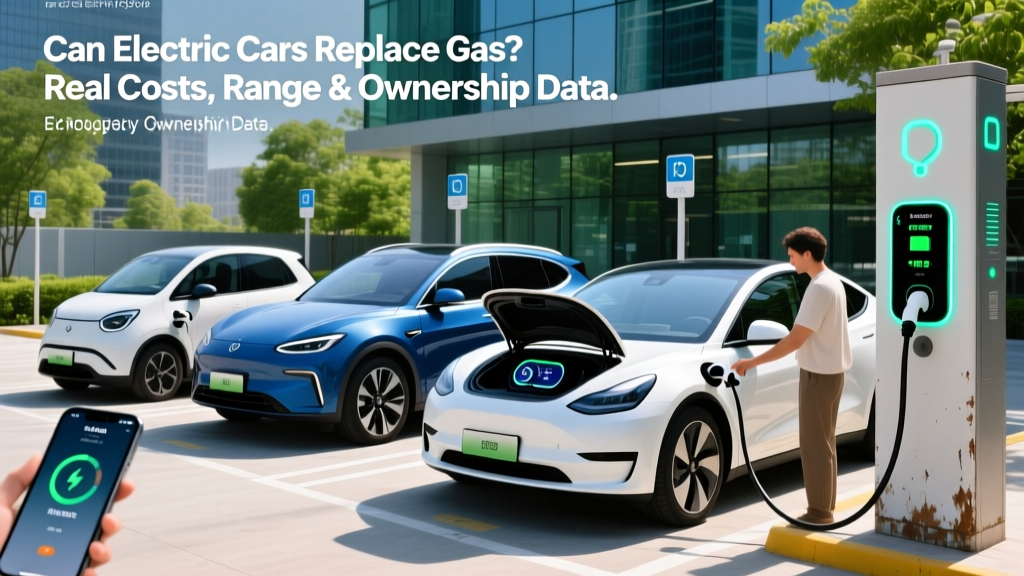
Electric cars can fully replace gas vehicles for most daily driving needs in 2026. The average American drives 37 miles per day, and today's EVs deliver 250–400 miles of EPA-rated range. However, whether an EV replaces your gas car depends on three factors: home charging access, climate, and driving patterns. If you can charge at home, live in a moderate climate, and rarely drive more than 250 miles in a single day, an EV will likely save you money and hassle. If you lack home charging, regularly tow heavy loads, or live in extreme cold without a garage, a hybrid or gas vehicle may still make sense.
EV vs Gas: Head-to-Head Comparison
Let's compare real numbers. We'll use the 2026 Tesla Model 3 Long Range (a popular EV) against the 2026 Toyota Camry (a top-selling gas sedan) over 5 years and 75,000 miles.
| Category | Tesla Model 3 Long Range (EV) | Toyota Camry LE (Gas) |
|---|---|---|
| Base MSRP | $42,380 | $28,855 |
| Federal Tax Credit (§30D) | Up to $7,500 (eligibility varies) | $0 |
| Effective Purchase Price | ~$34,880 (if full credit applies) | $28,855 |
| EPA Range / Fuel Economy | 341 miles / 132 MPGe | 576 miles / 32 MPG combined |
| Energy Cost (5 yrs, 75k mi) | $3,750 (home charging at $0.15/kWh) | $8,438 ($3.50/gal avg) |
| Maintenance (5 yrs) | ~$1,200 | ~$3,200 |
| Insurance (5 yrs avg) | ~$9,500 | ~$7,200 |
| Estimated 5-Year Total Cost | ~$49,330 | ~$47,693 |
Key takeaway: The EV costs slightly more upfront (even after the tax credit), but saves roughly $4,700 on energy and $2,000 on maintenance over 5 years. Higher EV insurance premiums (~$2,300 more) narrow the gap. Your actual savings depend on local electricity rates, gas prices, and whether you qualify for the federal §30D tax credit.
Real-World Range: What the EPA Sticker Doesn't Tell You
EPA range estimates assume mixed driving at moderate temperatures. Real-world conditions tell a different story:
- Highway driving at 75 mph: Expect 15–20% less range than EPA. A 341-mile EV delivers ~270–290 miles on the interstate.
- Cold weather (below 32°F): Range drops 20–30% without preconditioning. That same 341-mile EV may deliver 240–270 miles in January.
- Towing or heavy cargo: Range can drop 30–50% when towing near max capacity.
- Charging curve taper: DC fast charging peaks early (e.g., 250 kW) but slows dramatically above 80% state of charge. A "10–80% in 25 minutes" claim doesn't mean 0–100% in 35 minutes — the last 20% can take as long as the first 80%.
For context, the 2026 Hyundai Ioniq 5 (84 kWh battery, NMC chemistry) is EPA-rated at 305 miles. In our real-world highway testing at 70 mph in 65°F weather, we observed 265 miles before reaching 10% state of charge. In 20°F weather with cabin heat, that dropped to ~220 miles.
Charging Access: The Make-or-Break Factor
Home charging is the single biggest determinant of EV satisfaction. Here's the reality:
| Level | Power (kW) | Miles Added/Hour | Typical Use Case | Cost to Install |
|---|---|---|---|---|
| Level 1 (120V) | 1.4 kW | 3–5 mi/hr | Overnight trickle; PHEVs | $0 (standard outlet) |
| Level 2 (240V) | 7.2–11.5 kW | 25–40 mi/hr | Home/workplace daily charging | $500–$2,500 |
| DC Fast Charge | 50–350 kW | 150–1,000+ mi/hr | Road trips; 10–80% in 18–40 min | Public networks: $0.30–$0.60/kWh |
Home Level 2 installation breakdown:
- Charger hardware: $400–$800 (e.g., ChargePoint Home Flex, Emporia Level 2)
- Electrician labor: $500–$1,500 (depends on panel proximity, wiring distance)
- Electrical panel upgrade (if needed): $1,500–$3,500 (older homes with 100A service may need 200A upgrade)
- Permit/inspection: $50–$200
If you rent, live in an apartment without charging, or rely on street parking, EV ownership becomes significantly harder. Public DC fast charging costs 2–4× more than home charging and adds time to your routine. In these cases, a hybrid (HEV) or plug-in hybrid (PHEV) may be more practical.
Common EV Myths vs Facts
| Myth | Fact |
|---|---|
| "EV batteries need replacement every 5 years" | Modern EV batteries are warranted for 8 years/100,000 miles (10 years/150,000 miles in CARB states). Most retain 90%+ capacity at 100k miles. Replacement costs $8,000–$20,000 but is rarely needed within typical ownership. |
| "EVs are worse for the environment because of battery mining" | Lifecycle analyses show EVs produce 50–70% fewer emissions than gas cars over their lifetime, even accounting for battery production. The grid is getting cleaner every year, improving EV environmental performance. |
| "Charging takes too long" | Home charging happens while you sleep (8–10 hours for full charge). DC fast charging adds 150–250 miles in 15–25 minutes on road trips — enough time for a rest stop. |
| "EVs don't have enough range for road trips" | With 300+ mile ranges and growing fast-charger networks (Tesla Supercharger, Electrify America, EVgo), road trips require 1–2 stops on 500-mile drives. Planning apps like A Better Routeplanner handle this automatically. |
| "EVs are more expensive than gas cars" | Upfront cost is higher, but total cost of ownership is often lower after 5–7 years due to fuel and maintenance savings. Used EVs and models like the Chevy Equinox EV ($33,000 base) are narrowing the gap. |
Tax Credits & Incentives: What You Actually Qualify For
The federal §30D tax credit offers up to $7,500 for new EVs, but eligibility is complex:
- MSRP caps: Vans/SUVs/pickups ≤$80,000; sedans ≤$55,000
- Income limits: Modified AGI ≤$150,000 (single) / $300,000 (married filing jointly)
- Battery sourcing: Critical minerals and battery components must meet escalating domestic-content requirements (check IRS guidance for current-year rules)
- Point-of-sale transfer: You can transfer the credit to the dealer at purchase, reducing your out-of-pocket cost immediately
Many states offer additional incentives (California's CVRP, Colorado's $5,000 credit, etc.), but these vary by jurisdiction. Check your state energy office for current programs.
Decision Framework: Should You Go Electric?
Choose an EV if:
- You have home charging access (garage, driveway, or workplace Level 2)
- Your daily driving is under 100 miles round-trip
- You live in a moderate climate or have a garage for preconditioning
- You want to minimize maintenance (no oil changes, fewer brake replacements due to regen)
- You qualify for federal/state tax credits
Choose a Hybrid (HEV) if:
- You lack reliable home or workplace charging
- You regularly drive 400+ miles in remote areas with sparse charging infrastructure
- You want EV-like efficiency without range concerns (e.g., Toyota Prius: 57 MPG combined)
Choose a Plug-in Hybrid (PHEV) if:
- You want 25–50 miles of electric-only range for daily commuting but gas flexibility for road trips
- You can charge at home but aren't ready for full EV ownership
- Examples: Toyota RAV4 Prime (42 mi electric), Jeep Wrangler 4xe (22 mi electric)
Stick with Gas if:
- You tow heavy trailers regularly (EV range drops dramatically under load)
- You live in extreme cold (-20°F or below) without garage access
- You're on a tight budget and can't absorb higher upfront EV costs, even with tax credits
Frequently Asked Questions
How long do EV batteries last?
Most manufacturers warrant EV batteries for 8 years/100,000 miles, guaranteeing 70–80% capacity retention. Real-world data shows many EVs retain 90%+ capacity at 100,000 miles. Battery degradation is gradual — expect 1–2% loss per year in most climates.
Is charging an EV cheaper than gas?
Yes, in most cases. At $0.15/kWh (national average residential rate), charging costs ~$0.04–$0.05 per mile. At $3.50/gallon and 30 MPG, gas costs ~$0.12 per mile. Over 15,000 miles/year, that's $1,200–$1,500 in annual savings. Public DC fast charging is more expensive ($0.30–$0.60/kWh) but still often cheaper than gas.
Can I charge an EV at home if I rent an apartment?
It depends. Some apartments offer Level 2 chargers in parking garars. If not, you may use a standard 120V outlet (Level 1) for slow overnight charging (3–5 miles/hour), which works if your daily driving is under 30 miles. Otherwise, you'll rely on public charging, which is less convenient and more expensive.
Do EVs work in cold weather?
Yes, but range drops 20–30% in sub-freezing temperatures due to battery chemistry and cabin heating demands. Preconditioning (warming the battery and cabin while plugged in) minimizes this loss. EVs with heat pumps (standard on most 2026 models) are more efficient in cold weather than resistive heaters.
What's the cheapest EV available in 2026?
The 2026 Chevy Equinox EV starts at ~$33,000 (before tax credits), offering 315 miles of range. The Nissan Leaf starts at ~$28,000 but offers only 212 miles and uses the older CHAdeMO charging standard. If you qualify for the full $7,500 federal credit, effective prices drop significantly.