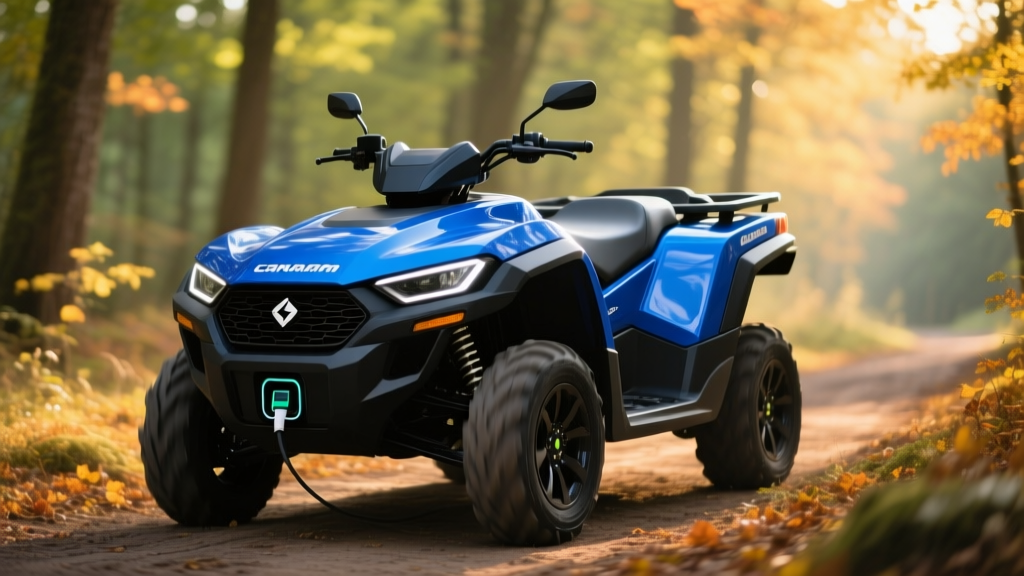
If you've been watching the off-road world inch toward electrification, the Can-Am Outlander Electric is the machine that's forcing the conversation. But before you put down a deposit, here's the practical reality: BRP has positioned this as an electric utility ATV aimed at trail riders, land managers, and outdoor professionals who value instant torque and near-silent operation. However, as of early 2026, BRP has released limited final production specifications, and full EPA-equivalent range certification for off-road vehicles remains a moving target. What we do know from BRP's announcements and industry analysis points to a machine that excels in specific use cases — low-speed technical trails, hunting, property management — while carrying real limitations around range under heavy load, charging infrastructure in remote areas, and a premium price point well above its gas-powered Outlander siblings.
Quick Answer: Is the Can-Am Outlander Electric Right for You?
Choose it if: You ride technical trails at moderate speeds, need silent operation (hunting, wildlife, noise-restricted areas), have reliable access to charging (home or property-based), and prioritize instant torque over all-day range.
Pass on it if: You regularly ride 80+ miles per day in backcountry without charging access, frequently tow heavy loads over long distances, or operate primarily in extreme cold where battery performance drops 20-35%.
What We Know About the Can-Am Outlander Electric (2026 Model Year)
BRP (Bombardier Recreational Products) confirmed the Can-Am Outlander Electric platform as part of its broader electrification push alongside the Can-Am Origin and Pulse electric motorcycles. The Outlander Electric targets the utility/recreation ATV segment — think property work, trail riding, and hunting — rather than high-performance sport riding. BRP has been deliberate in its rollout, and several key specifications remain preliminary for the 2026 model year.
Here's what has been confirmed or strongly indicated by BRP and industry reporting:
| Specification | Estimated / Confirmed Value | Notes |
|---|---|---|
| Battery Chemistry | LFP (Lithium Iron Phosphate) | Expected; LFP offers longer cycle life and thermal stability, ideal for off-road vibration/impact |
| Battery Capacity | ~8-12 kWh (estimated) | Final usable capacity unconfirmed by BRP as of early 2026 |
| Estimated Range | 40-70 miles (variable) | Highly dependent on terrain, speed, load, and temperature; no standardized EPA rating for off-road ATVs |
| Motor Output | ~40-60 HP equivalent (estimated) | Instant torque delivery; Rotax E-POWER platform |
| Charge Time (Level 1, 120V) | 6-10 hours (estimated) | Standard household outlet; suitable for overnight charging |
| Charge Time (Level 2, 240V) | 2-4 hours (estimated) | Requires 240V outlet or dedicated EV charger |
| Top Speed | ~55-65 mph (estimated) | Governed for utility use; not a sport machine |
| Towing Capacity | ~1,200-1,500 lbs (estimated) | Comparable to mid-range gas Outlander models |
| Base MSRP | $14,000-$18,000 (estimated) | Final pricing TBD; expect a significant premium over gas equivalents |
| Warranty | TBD | BRP typically offers 6-month to 1-year limited; battery warranty expected longer |
Critical caveat: Unlike highway-legal EVs rated by the EPA on fueleconomy.gov, off-road ATVs lack a standardized range-testing protocol. The "40-70 mile" estimate above is derived from comparable electric utility vehicles, BRP's own Rotax E-POWER platform disclosures, and typical ATV energy consumption of 150-300 Wh/mile depending on terrain. Your actual range will vary enormously based on riding style and conditions.
Electric ATV vs. Gas Outlander: The Real Comparison
The Can-Am Outlander has been a staple of the gas-powered ATV market for over two decades, with models ranging from the Outlander 500 to the Outlander MAX 6x6. So how does the electric version stack up against the internal combustion engine (ICE) lineup? The answer depends entirely on your use case.
| Factor | Outlander Electric (Est.) | Gas Outlander 700 (2025) |
|---|---|---|
| Base MSRP | $14,000-$18,000 | $8,500-$10,500 |
| Range / Tank | 40-70 miles (battery) | 120-180 miles (~5.3 gal tank, 25-35 mpg equiv.) |
| "Refuel" Time | 2-10 hours (charging) | 2 minutes (gas can or pump) |
| Noise Level | Near-silent (60-70 dB) | Loud (85-95 dB) |
| Instant Torque | Yes — full torque at 0 RPM | No — needs RPM build |
| Maintenance | Minimal (no oil, filters, spark plugs, CVT belt) | Regular (oil changes, air filter, belt, coolant) |
| Cold-Weather Performance | 20-35% range loss below 32°F | Minimal impact; engine heat aids performance |
| Remote Refueling | Impossible without portable generator/solar | Easy with extra fuel cans |
| Emissions | Zero tailpipe | EPA Tier emissions; ~15-25 lbs CO₂ per tank |
| Fuel/Energy Cost per 50 mi | ~$1.50-$3.00 (electricity) | ~$6.00-$10.00 (gasoline) |
The data reveals a clear pattern: the electric Outlander wins on operating cost, noise, and maintenance but loses decisively on range, refueling speed, and upfront price. For riders who cover 20-40 miles per outing and return to a property with charging access, the electric model's advantages compound over time. For backcountry explorers who ride 80+ miles from civilization, the gas Outlander remains the pragmatic choice.
Real Costs: Purchase, Charging, Maintenance & Insurance
The sticker price is only the beginning. Here's a realistic five-year cost breakdown comparing the electric Outlander to a gas equivalent, assuming 1,500 miles ridden per year (a moderate-to-heavy recreational schedule).
| Cost Category | Outlander Electric | Gas Outlander 700 |
|---|---|---|
| Purchase Price | $16,000 (est.) | $9,500 |
| Energy/Fuel (5 yrs, 7,500 mi) | $375 ($0.05/mi at $0.15/kWh) | $3,750 ($0.50/mi at 30 mpg equiv., $3.50/gal) |
| Maintenance (5 yrs) | $300 (brake pads, tire rotation, fluid top-off) | $2,500 (oil, filters, belts, coolant, plugs) |
| Insurance (5 yrs) | $3,000 ($600/yr est.) | $2,250 ($450/yr est.) |
| Home Charger Install (if needed) | $500-$1,500 (240V outlet) | $0 |
| 5-Year Total | $20,175-$21,175 | $18,000 |
| Cost Per Mile | $2.69-$2.82 | $2.40 |
At a 1,500-mile-per-year pace, the gas Outlander still holds a modest total-cost advantage over five years, primarily due to its lower purchase price. However, the gap narrows significantly if you ride more miles annually, if electricity rates are low in your area, or if gas prices spike. At 3,000 miles per year, the electric model approaches cost parity within five years — and surpasses it by year seven.
Federal tax credit note: Off-road ATVs do not qualify for the IRS §30D Clean Vehicle Credit, which applies to on-road vehicles meeting specific MSRP, income, and battery-sourcing requirements. Some states may offer off-road electrification incentives — check your state energy office — but do not count on a $7,500 federal credit for an ATV purchase.
Charging in the Real World: What Off-Road EV Owners Face
Charging an electric ATV is fundamentally different from charging a Tesla or a Ford F-150 Lightning. You won't be pulling up to an Electrify America station on a forest trail. Here's what the charging reality looks like:
Home and Property Charging (Your Primary Lifeline)
Most Outlander Electric owners will charge at home or on their property. A standard 120V household outlet (Level 1) delivers roughly 1.2-1.4 kW, meaning a full charge from empty could take 6-10 hours for a ~10 kWh battery. That's fine for overnight top-ups between weekend rides.
If you install a 240V outlet (Level 2) in your garage or barn — similar to a dryer outlet — charging time drops to 2-4 hours. A licensed electrician can typically install a 240V/20A circuit for $500-$1,500 depending on panel capacity and wiring distance. This is the single most impactful upgrade for electric ATV ownership.
Remote and Trailside Charging (The Hard Truth)
There is no public DC fast-charging network for ATVs. If you ride in remote areas and deplete the battery, your options are:
- Portable generator: A 2,000W inverter generator (like a Honda EU2200i, ~$1,200) can provide Level 1 charging in the field, but at 1.5 kW output, you're looking at 5-7 hours for a full charge. This defeats the purpose for most riders.
- Solar + battery bank: A 400W portable solar array paired with a portable power station (e.g., EcoFlow Delta Pro, ~$3,500) can trickle-charge an ATV over a full sunny day. Practical only for base-camp scenarios.
- Tow it out: The most realistic backup plan. Carry a tow strap and know your nearest road access.
This is the most significant ownership limitation of any electric off-road vehicle in 2026. If your riding regularly takes you beyond the battery's range from a charging point, a gas-powered ATV remains the safer choice.
Cold Weather, Terrain, and Load: What Destroys Your Range
Off-road energy consumption is far more variable than highway driving. Here are the factors that will slash your Outlander Electric's range below the already-modest estimates:
- Cold temperatures (below 32°F): LFP batteries lose 20-35% of usable capacity in freezing conditions. A 60-mile range in summer can drop to 40-45 miles in winter. Unlike a gas engine, there's no waste heat to warm the battery — though some EV platforms include battery preheating, BRP has not confirmed this for the Outlander Electric.
- Steep terrain and mud: Climbing hills and slogging through mud demand sustained high power draw. Energy consumption can spike to 300-400 Wh/mile in these conditions, cutting range by 40-50% compared to flat, hard-packed trails.
- Heavy towing and cargo: Towing a 1,000-lb trailer or carrying a heavy load increases rolling resistance and energy demand. Expect 15-25% range reduction under max load.
- High sustained speeds: ATVs aren't aerodynamic. Riding at 50+ mph on fire roads dramatically increases energy consumption compared to 15-25 mph technical trail riding.
The practical takeaway: plan your rides around 60-70% of the stated range estimate in moderate conditions, and 40-50% in cold, hilly, or loaded scenarios. Range planning is far more critical with an electric ATV than with any gas model.
Common Misconceptions About Electric ATVs
| Myth | Fact |
|---|---|
| "Electric ATVs have no power." | Electric motors deliver peak torque at 0 RPM. The Outlander Electric is expected to match or exceed mid-range gas models in low-speed pulling power and hill-climbing ability. |
| "You can charge it anywhere on the trail." | There is no public charging infrastructure for off-road vehicles. You must plan rides within range of a property-based charger or carry a generator. |
| "The battery will need replacing in 2-3 years." | LFP batteries are rated for 2,000-3,000+ charge cycles before degrading to 80% capacity. At one full cycle per week, that's 38-57 years of use. Real-world degradation depends on temperature and charge habits, but battery replacement is unlikely within a decade of normal use. |
| "Electric ATVs are completely silent, which is always better." | Near-silent operation is ideal for hunting and noise-restricted areas, but it can be a safety concern on shared trails where other riders rely on engine noise for awareness. Some riders add bells or warning devices. |
| "It qualifies for the $7,500 federal EV tax credit." | The IRS §30D credit applies to on-road vehicles only. Off-road ATVs are not eligible. Check state-level programs for possible incentives. |
Decision Framework: Should You Buy the Can-Am Outlander Electric?
If-Then Buyer's Guide
IF you ride 20-40 miles per outing on moderate terrain, return to a property with 240V charging, and value silent operation for hunting or noise-sensitive areas...
THEN the Outlander Electric is a strong fit. The operating cost savings, minimal maintenance, and instant torque make it a superior tool for this use case.
IF you regularly ride 60+ miles in backcountry, operate in extreme cold, or need to tow heavy loads over long distances...
THEN stick with a gas-powered Outlander (700 or 1000 series). The range and refueling flexibility are irreplaceable for these scenarios in 2026.
IF you're a land manager, park ranger, or farmer who uses an ATV daily for short property tasks (fence checks, livestock, trail maintenance)...
THEN the electric model is nearly ideal. Daily mileage is low, charging is always available, and the lack of exhaust fumes in barns or enclosed areas is a significant safety benefit.
IF you're a first-time ATV buyer on a tight budget...
THEN the gas Outlander remains the value play. The $6,000-$8,000 price gap is substantial, and you'll need several years of heavy use to recoup it through fuel and maintenance savings.
What First-Time EV ATV Buyers Must Know
If the Can-Am Outlander Electric would be your first electric off-road vehicle, here are the ownership realities that don't show up in marketing brochures:
- Install 240V charging before the ATV arrives. Relying on a 120V outlet means 6-10 hour charge times. A 240V circuit transforms the ownership experience and costs $500-$1,500 to install.
- Never plan rides to 100% battery depletion. Always keep a 20-30% buffer for unexpected terrain, headwinds, or detours. Off-road range is far less predictable than highway range.
- LFP batteries prefer partial charges. Unlike NMC batteries in some EVs, LFP chemistry tolerates — and even benefits from — regular charging to 100%. However, avoid leaving the battery at 0% for extended periods.
- Insurance costs more. Electric ATVs carry higher replacement costs and limited repair-network familiarity. Expect insurance premiums 20-40% higher than equivalent gas models. Get quotes before purchasing.
- Dealer support is still developing. Not all Can-Am dealers have technicians trained on high-voltage EV systems. Confirm your local dealer's EV service capability before buying.
- Resale value is uncertain. The electric ATV market is nascent. Long-term depreciation curves are unknown. Gas Outlanders have decades of established resale data.
Frequently Asked Questions
How fast does the Can-Am Outlander Electric charge?
On a standard 120V household outlet (Level 1), expect 6-10 hours for a full charge. On a 240V outlet (Level 2), charging time drops to approximately 2-4 hours. DC fast charging is not available for off-road ATVs, and there is no public charging network for trailside use.
Does the Can-Am Outlander Electric qualify for any tax credits?
No. The federal IRS §30D Clean Vehicle Credit applies only to on-road vehicles (cars, trucks, SUVs, motorcycles meeting specific criteria). Off-road ATVs are excluded. Some states or utility companies may offer off-road electrification rebates — check with your state energy office or local utility.
What happens if the battery runs out on the trail?
You'll need to tow the ATV out or bring a portable generator for emergency Level 1 charging (which takes many hours). This is the single biggest operational risk of an electric ATV. Always ride within your battery's realistic range from a charging point, and carry a tow strap.
Is the Can-Am Outlander Electric good for hunting?
Yes — this is one of its strongest use cases. Near-silent operation (60-70 dB vs. 85-95 dB for gas) means you won't spook game from a half-mile away. Zero exhaust odor is also an advantage. Just plan your hunt area within realistic battery range.
How long will the LFP battery last before needing replacement?
LFP (Lithium Iron Phosphate) batteries are rated for 2,000-3,000+ full charge cycles before degrading to 80% of original capacity. At one full charge cycle per week, that translates to 38-57 years. Real-world lifespan depends on temperature exposure and charge habits, but battery replacement within the first decade is unlikely under normal use.
Can I ride the Outlander Electric in winter?
Yes, but expect 20-35% range reduction in temperatures below 32°F due to LFP battery chemistry limitations in cold. Store and charge the ATV in a heated garage when possible, and plan shorter rides in winter conditions.