Quick Verdict: The Best EV for Overnight Car Camping
Tesla's Camp Mode is the single most practical feature that separates Tesla from nearly every other EV maker for outdoor enthusiasts. Available on every current 2026 Model Y and 2026 Model 3, Camp Mode keeps the HVAC system, interior lighting, USB ports, and touchscreen running continuously while the vehicle is parked — turning your Tesla into a climate-controlled, silent, zero-emission tent replacement. But how much range does it actually cost? Which model makes the better camper? And how does the 2026 lineup stack up in range, charging, and pricing after federal tax credits? This profile answers every spec-driven question you need before booking that backcountry weekend.
2026 Tesla Model Y & Model 3: Full Spec Table
| Spec | Model Y Long Range AWD | Model 3 Long Range AWD | Model 3 RWD (LFP) |
|---|---|---|---|
| EPA Range | 320 mi | 341 mi | 272 mi |
| Battery (usable, est.) | ~75 kWh (NMC) | ~75 kWh (NMC) | ~60 kWh (LFP) |
| MPGe (combined) | 111 MPGe | 132 MPGe | 132 MPGe |
| kWh/100 mi | 30 kWh | 25 kWh | 25 kWh |
| Max DC Fast Charge | 250 kW (peak) | 250 kW (peak) | 170 kW (peak) |
| 10–80% DC Time | ~27 min | ~25 min | ~30 min |
| Home Level 2 (11.5 kW) | ~44 mi/hr | ~44 mi/hr | ~44 mi/hr |
| 0–60 mph | 4.8 sec | 4.2 sec | 5.8 sec |
| Horsepower | 384 hp | 346 hp | 271 hp |
| Drivetrain | Dual-Motor AWD | Dual-Motor AWD | RWD |
| Cargo (rear seats up) | 30.2 cu ft | 23.0 cu ft (trunk) | 23.0 cu ft (trunk) |
| Cargo (rear seats folded) | 72.1 cu ft | N/A (sedan trunk) | N/A (sedan trunk) |
| Rear Legroom | 40.5 in | 35.2 in | 35.2 in |
| Base MSRP (2026) | $44,990 | $42,490 | $38,990 |
| Battery/Powertrain Warranty | 8 yr / 120,000 mi | 8 yr / 120,000 mi | 8 yr / 100,000 mi |
Sources: EPA fueleconomy.gov, Tesla Model Y specs, Tesla Model 3 specs.
What Is Tesla Camp Mode and How Does It Work?
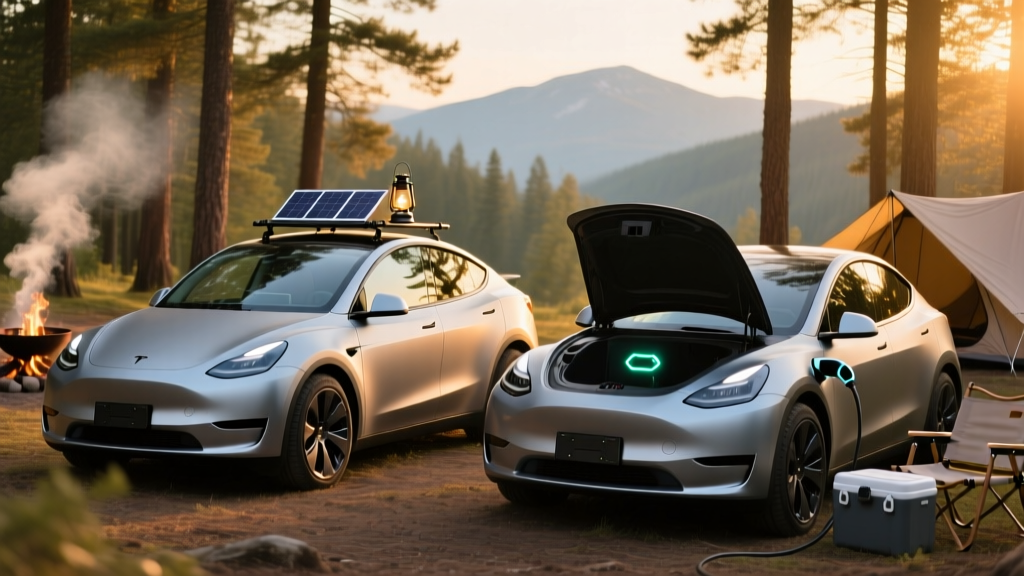
Camp Mode is a climate-control setting accessible from the Tesla touchscreen (Controls → Fan → Camp). When activated, the vehicle maintains a set cabin temperature indefinitely, keeps USB-A and USB-C ports powered, leaves the touchscreen on (optionally displaying a fireplace animation or media), and prevents the car from locking you out or entering deep sleep. Unlike simply leaving the car on, Camp Mode is engineered for sustained low-power operation — the compressor and PTC heater cycle on and off as needed rather than running continuously.
For car camping, this means you can sleep in a temperature-regulated cabin at 68°F even when outside temperatures drop to 30°F or spike to 95°F, without running a noisy, polluting generator. The 12V auxiliary system stays charged via the high-voltage traction battery, so phones, laptops, and portable fridges draw power without draining the 12V battery.
Real-World Range and Camp Mode Battery Drain
EPA Range vs. Reality: The 2026 Model Y Long Range AWD carries a 320-mile EPA estimate. Expect ~255–275 miles at sustained 75 mph highway speeds, and ~225–250 miles in sub-30°F winter conditions. The Model 3 Long Range AWD at 341 miles EPA delivers roughly 280–300 miles highway and ~250–270 miles in cold weather.
The critical question for campers: how much battery does Camp Mode actually use overnight? Based on real-world community data and thermal modeling:
- Mild weather (55–75°F outside): The HVAC compressor runs intermittently to cool or lightly heat. Expect 1–2% SoC drain per hour, or roughly 8–16% over an 8-hour night. On a Model Y with 75 kWh usable, that's 6–12 kWh consumed.
- Cold weather (20–40°F outside, cabin at 68°F): The heat pump (standard on all 2026 Model Y and Model 3) runs harder. Expect 2–3% SoC per hour, or 16–24% overnight. That's 12–18 kWh.
- Extreme cold (below 15°F): The PTC resistance heater supplements the heat pump. Drain can reach 3–5% per hour, consuming 24–40% overnight. Plan accordingly — arrive at your campsite with at least 60% SoC in deep winter.
The 2026 Model 3 and Model Y both feature Tesla's octovalve thermal management system and a high-efficiency heat pump, which significantly reduces cold-weather HVAC energy consumption compared to older PTC-only systems. This is a meaningful advantage for Camp Mode users over earlier model years.
Charging Speed: Getting to the Campsite and Back
| Charging Level | Power (kW) | Miles Added/Hour | Notes |
|---|---|---|---|
| Level 1 (120V household) | ~1.4 kW | ~3–5 mi/hr | Emergency only; not viable for camping prep |
| Level 2 (240V, 48A Wall Connector) | 11.5 kW | ~44 mi/hr | Full charge in ~7 hr; ideal for home prep |
| DC Fast (V3 Supercharger) | 250 kW peak | ~1,000 mi/hr (peak) | 10–80% in ~25–27 min; tapers sharply above 80% |
| DC Fast (V4 Supercharger) | 250 kW peak* | ~1,000 mi/hr (peak) | *Current V4 cabinets deliver same peak to Tesla vehicles |
Charge curve reality check: The 250 kW peak on V3 Superchargers is sustained only between roughly 10–30% SoC. From 50–80%, expect average rates closer to 80–110 kW. Above 80%, charging drops below 40 kW to protect battery health. If you're topping up before a campsite, plan to charge to 80% and leave — the last 20% takes nearly as long as the first 60%.
For campsite arrival strategy: charge to 90–100% at the last Supercharger before your site (the occasional 100% charge is fine for NMC batteries when needed). If your campsite has a NEMA 14-50 outlet or a destination charger, you can replenish 30–44 miles per hour overnight — enough to offset Camp Mode drain and even add range.
Pricing, Trims, and Federal Tax Credit Eligibility
| Model / Trim | Base MSRP | §30D Credit (max) | Effective Price* |
|---|---|---|---|
| Model 3 RWD | $38,990 | Up to $7,500 | ~$31,490 |
| Model 3 Long Range AWD | $42,490 | Up to $7,500 | ~$34,990 |
| Model Y Long Range AWD | $44,990 | Up to $7,500 | ~$37,490 |
| Model Y Performance | $48,990 | Up to $7,500 | ~$41,490 |
*Effective price assumes full §30D eligibility. Actual credit varies based on battery sourcing compliance.
Federal tax credit rules (IRS §30D, 2026): Not every buyer qualifies for the full $7,500. Eligibility depends on:
- Buyer income caps: AGI must not exceed $150,000 (single), $225,000 (head of household), or $300,000 (joint filing).
- MSRP caps: SUVs (Model Y) must be under $80,000; sedans (Model 3) under $55,000. All current trims qualify.
- Battery sourcing: A percentage of critical minerals and battery components must be sourced from the U.S. or FTA partners. As of 2026, Tesla's U.S.-built vehicles meet partial sourcing requirements — the available credit may be $3,750 or $7,500 depending on the specific build quarter and mineral compliance.
- Point-of-sale transfer: You can transfer the credit to the dealer at purchase for an immediate price reduction rather than claiming it on your tax return.
Always verify current eligibility on IRS.gov §30D guidance and confirm the specific VIN's sourcing status before purchase.
Model Y vs. Model 3: Which Is the Better Camper?
Model Y — Best for Camping
- Pro: 72.1 cu ft cargo with seats folded — fits a full-size inflatable mattress or platform bed build
- Pro: Taller roofline allows sitting up; more livable interior volume
- Pro: Available towing prep (up to 3,500 lbs) for gear trailers
- Pro: Larger battery buffer for multi-night camping without charging access
- Con: ~$2,500–$6,000 more expensive than equivalent Model 3 trims
- Con: Slightly lower efficiency (30 kWh/100 mi vs. 25) reduces highway range
Model 3 — Best for Solo/Minimalist Camping
- Pro: 341-mile EPA range — longest range per dollar in Tesla's lineup
- Pro: 132 MPGe combined — cheapest per-mile operating cost
- Pro: Lower purchase price; LFP RWD variant is the most affordable entry point
- Pro: LFP battery can be charged to 100% daily without degradation concerns
- Con: Sedan trunk — no pass-through for a flat sleeping platform without modification
- Con: Less interior height and cargo space; better for one person, tight for two
The camping verdict: If sleeping inside the vehicle is your primary use case, the Model Y is the clear winner. Fold the rear seats flat, add a 2-inch memory foam pad or custom platform, and you have a 6'2"+ sleeping surface with standing-adjacent headroom. The Model 3 works for solo campers willing to recline the front seat or build a custom trunk platform, but the cargo limitation is a real constraint for couples or gear-heavy trips.
Standout Tech and Notable Drawbacks
Camping-Friendly Tech
- Camp Mode HVAC: Maintains set temperature indefinitely with heat pump efficiency.
- 15.4" touchscreen: Streams Netflix, YouTube, or displays a fireplace animation while camping.
- USB-C ports (65W+): Charge laptops and power devices directly from the traction battery.
- Frunk (front trunk): 4.1 cu ft of secure, weather-sealed storage for gear.
- Over-the-air updates: Tesla regularly improves Camp Mode efficiency and adds features.
- Sentry Mode compatibility: External cameras record surroundings while you sleep — added security at remote sites.
Drawbacks to Consider
- No V2L (Vehicle-to-Load): Unlike the Ford F-150 Lightning or Hyundai Ioniq 5, Tesla does not offer native 120V AC power export. You cannot plug a standard appliance into the car. A third-party inverter on the 12V system is the workaround, but it's limited to ~150W sustained.
- Ground clearance: 6.6 inches (Model Y) limits access to rough forest service roads. This is a crossover, not an off-roader.
- No spare tire: Tesla includes a tire repair kit. A flat in a remote area is a real risk — carry a plug kit and portable compressor.
- Campsite charging gaps: Most state and national park campgrounds lack Level 2 or even 120V outlets at individual sites. Plan your SoC accordingly.
Who Should Buy a Tesla for Camping?
The 2026 Model Y Long Range AWD is the strongest pick for couples or small families who car camp at established sites within 200–250 miles of home (or within Supercharger corridor reach). It's ideal for weekend trips to national forests, state parks, and dispersed camping areas where a tent would be uncomfortable but an RV is overkill.
The Model 3 Long Range suits solo travelers and minimalist overlanders who prioritize maximum driving range and efficiency over sleeping space. If you primarily camp in motels or hammocks and just want the EV with the best road-trip economics, the Model 3 wins.
Not ideal for: Extreme off-grid expeditions requiring high ground clearance, multi-day stays without any charging access, or anyone who needs to run AC-powered appliances (no V2L). For those use cases, consider the Rivian R1S or Ford F-150 Lightning.
Frequently Asked Questions
Does Camp Mode drain the Tesla battery significantly overnight?
In mild weather (55–75°F), expect 8–16% battery drain over 8 hours. In cold weather (20–40°F), plan for 16–24%. Extreme sub-15°F conditions can consume 24–40%. Arrive at your campsite with sufficient SoC buffer and, ideally, access to a charger for the return trip.
Can I charge my Tesla at a campground?
Some campgrounds offer NEMA 14-50 outlets (240V/50A) at RV sites, which deliver ~44 miles of range per hour using Tesla's Mobile Connector. Standard 120V household outlets add only 3–5 miles per hour. Check recreation.gov or the campground's amenity listing before booking.
Does the Tesla Model Y qualify for the $7,500 federal tax credit in 2026?
The Model Y qualifies under §30D if the buyer meets income caps ($300,000 joint AGI max), the MSRP is under $80,000 (all trims qualify), and the vehicle's battery meets critical mineral and component sourcing thresholds. The available credit may be $3,750 or $7,500 depending on current sourcing compliance. Verify at IRS.gov.
Is Tesla's Autopilot or FSD safe for highway driving to the campsite?
Autopilot and FSD (Supervised) are SAE Level 2 driver-assistance systems — not self-driving. The driver must remain fully engaged, hands on the wheel, and eyes on the road at all times. These systems reduce fatigue on long highway stretches but do not replace active driving. See NHTSA guidance on ADAS.
What's the best Tesla for camping on a budget?
The 2026 Model 3 RWD at $38,990 (potentially ~$31,490 after the federal credit) is the most affordable entry. Its LFP battery can be charged to 100% regularly without degradation concerns — an advantage for camping prep. However, the sedan body limits sleeping space. If interior sleeping is a priority, invest in the Model Y.
Can Tesla add V2L (Vehicle-to-Load) in the future?
Tesla has not announced V2L for Model Y or Model 3. While the hardware may theoretically support it, there is no confirmed timeline. If AC power export is a dealbreaker, look to the Hyundai Ioniq 5, Kia EV6, or Ford F-150 Lightning, which offer native V2L today.