California's EV Incentive Landscape: What Actually Applies in 2026
California leads the nation in electric vehicle adoption, and the state's incentive ecosystem reflects that position. But when shoppers search for a "California electric vehicle tax credit," they're often conflating several distinct programs: the federal §30D tax credit, the state's Clean Vehicle Rebate Project (CVRP), utility company rebates, and local air district incentives. Understanding which programs stack—and which have strict eligibility gates—is the difference between saving $9,000 on a new EV purchase and saving $0.
This guide breaks down the complete California EV ownership cost picture for 2026, from purchase incentives through five-year total cost of ownership (TCO), including the higher insurance premiums and depreciation curves that many buyers overlook.
Federal EV Tax Credit: IRS §30D Rules for 2026
The federal electric vehicle tax credit remains the single largest purchase incentive available to California buyers, offering up to $7,500 for qualifying new EVs and up to $4,000 for qualifying used EVs (under §25E). But eligibility hinges on three simultaneous requirements: your income, the vehicle's MSRP, and the battery's critical mineral and component sourcing.
§30D Federal Tax Credit Eligibility Checklist (2026)
- Income caps (modified AGI): $150,000 single filer / $225,000 head of household / $300,000 joint filers
- MSRP caps: $80,000 for SUVs, vans, and pickup trucks / $55,000 for sedans and other passenger vehicles
- Critical minerals requirement: Battery minerals must meet escalating percentage thresholds sourced from US or FTA-partner countries ($3,750 credit component)
- Battery components requirement: Battery components must be manufactured or assembled in North America at escalating percentage thresholds ($3,750 credit component)
- Foreign Entity of Concern (FEOC) restriction: Vehicles with battery components from a FEOC are disqualified entirely
- Point-of-sale transfer: You can transfer the credit to the dealer at purchase, reducing the vehicle price immediately rather than waiting for tax filing
- Vehicle assembly: Final assembly must occur in North America
The critical minerals and battery component requirements have tightened significantly since the credit's restructuring under the Inflation Reduction Act. For 2026, the sourcing thresholds are higher than in prior years, meaning fewer vehicles qualify for the full $7,500. Many now qualify for only $3,750 (meeting one of the two requirements) or nothing at all. The IRS maintains the official qualifying vehicle list at irs.gov, and this list updates frequently—always verify before signing a purchase agreement.
California State and Local EV Incentives
Incentive Availability Varies by Region
California's EV incentive programs are fragmented across state agencies, local air districts, and investor-owned utilities. Your ZIP code determines which programs you can access. Always check current availability—funding pools deplete and programs get restructured.
California Clean Vehicle Rebate Project (CVRP): Historically offered up to $2,000 for eligible new EV purchases, though funding availability and income restrictions have fluctuated. Check the California Air Resources Board (CARB) for current status.
Clean Cars 4 All (CC4A): Targets lower-income Californians replacing older, high-polluting vehicles with new or used EVs, PHEVs, or hybrids. Rebates can reach $9,500 for income-qualified participants in certain air districts (Bay Area, South Coast, San Joaquin Valley).
Utility rebates: Major California utilities offer their own incentives:
- PG&E: Historically offered $1,000 residential EV rebates plus income-qualified programs up to $4,000
- SCE (Southern California Edison): Charge Ready program with rebates for home charging equipment and EV purchase incentives for income-qualified customers
- SDG&E: EV rebates and time-of-use rate optimization programs
- LADWP: Up to $1,500 in rebates for qualifying EV purchases plus used EV incentives
HOV lane access: California's Clean Air Vehicle (CAV) decal program grants single-occupant carpool lane access for qualifying EVs and PHEVs—a significant non-monetary benefit in metro areas. Decal availability has phase-out timelines tied to program sunset dates.
5-Year Total Cost of Ownership: EV vs Gas in California
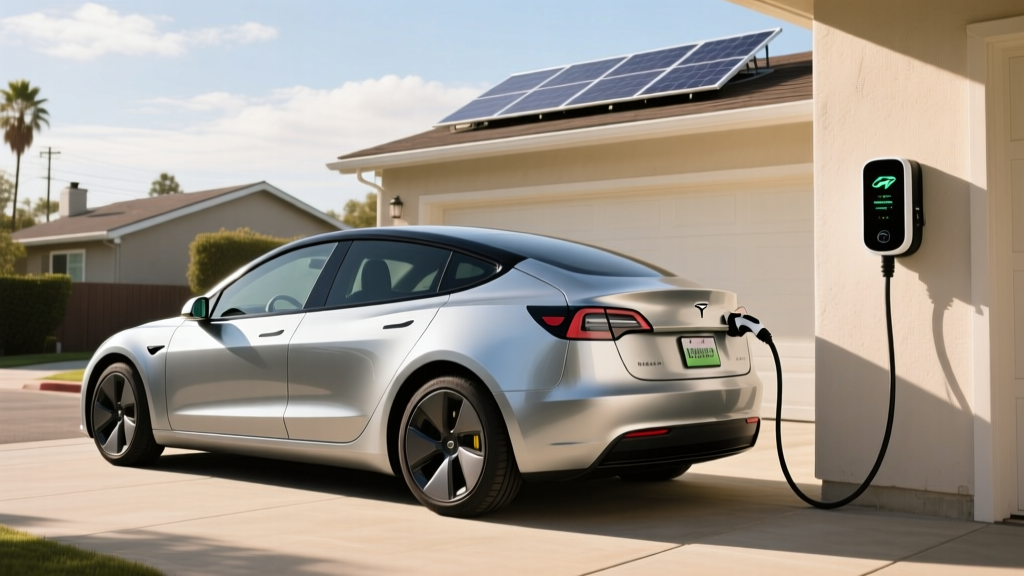
Let's model a realistic 5-year TCO comparing a popular EV against a comparable gasoline vehicle in California. We'll use the 2026 Tesla Model 3 Long Range RWD (EPA 363 miles, 75 kWh usable battery, $42,490 MSRP before incentives) against a 2026 Toyota Camry LE (EPA 32 MPG combined, ~$29,995 MSRP).
| Cost Category | Tesla Model 3 LR (EV) | Toyota Camry LE (Gas) | EV Advantage |
|---|---|---|---|
| Purchase price (MSRP) | $42,490 | $29,995 | -$12,495 |
| Federal tax credit (§30D) | -$3,750 to -$7,500 | $0 | +$3,750 to +$7,500 |
| CA/utility rebates (estimated) | -$1,000 | $0 | +$1,000 |
| Net purchase cost | ~$33,990 – $37,740 | $29,995 | -$3,995 to -$7,745 |
| Fuel/energy (5 yrs, 75,000 mi) | $5,625 (home L2 avg $0.15/kWh) | $14,766 ($4.25/gal, 32 MPG) | +$9,141 |
| Maintenance (5 yrs) | ~$1,500 | ~$3,250 | +$1,750 |
| Insurance (5 yrs) | ~$14,000 ($233/mo avg) | ~$10,500 ($175/mo avg) | -$3,500 |
| Depreciation (5 yrs) | ~$22,000 (est. 52%) | ~$14,000 (est. 47%) | -$8,000 |
| Total 5-Year Cost | ~$77,115 – $80,865 | ~$72,511 | -$4,604 to -$8,354 |
Key takeaway: The EV costs more over five years in this comparison, primarily due to higher depreciation and insurance. However, this changes significantly if (a) you qualify for the full $7,500 federal credit, (b) you drive more miles annually (fuel savings scale with mileage), or (c) you choose a less expensive EV. The math flips in the EV's favor at around 20,000+ miles per year or with a full-credit-eligible vehicle priced closer to $35,000.
Charging vs Gas: The Real $/Mile Math
| Scenario | Cost/kWh or Cost/Gallon | Efficiency | Cost Per Mile |
|---|---|---|---|
| Home Level 2 (off-peak TOU rate) | $0.12/kWh | 3.5 mi/kWh (Model 3 LR) | $0.034 |
| Home Level 2 (standard rate) | $0.25/kWh | 3.5 mi/kWh | $0.071 |
| Public DC fast charging (avg) | $0.45/kWh | 3.5 mi/kWh | $0.129 |
| Gasoline vehicle (32 MPG) | $4.25/gallon | 32 mi/gal | $0.133 |
| Gasoline vehicle (22 MPG truck/SUV) | $4.25/gallon | 22 mi/gal | $0.193 |
At home on off-peak rates, EV charging costs roughly $0.03–$0.07 per mile—a quarter to half the cost of gasoline at $4.25/gallon. But the advantage narrows sharply if you rely primarily on public DC fast charging at $0.40–$0.55/kWh, where costs approach or exceed gasoline per-mile rates. This is why home charging access is the single most important economic factor in EV ownership. California's average residential electricity rate hovers around $0.25–$0.30/kWh, but time-of-use (TOU) plans from PG&E, SCE, and SDG&E can drop off-peak rates to $0.10–$0.15/kWh if you charge overnight.
Maintenance Savings: Where EVs Genuinely Cost Less
| Service Item | EV (Model 3) | Gas Vehicle (Camry) |
|---|---|---|
| Oil changes | $0 (none required) | $600–$900 (every 5,000–10,000 mi) |
| Brake pads | $0–$200 (regen braking preserves pads) | $400–$800 (1–2 replacements) |
| Air filter | $50–$100 (cabin filter only) | $100–$200 (engine + cabin) |
| Transmission fluid | $0 (single-speed reduction gear) | $150–$300 |
| Coolant | $0–$100 (long-life battery coolant) | $100–$200 |
| Tire rotation | $200–$300 (EVs are heavier, tires wear faster) | $150–$250 |
| Tire replacement | $1,200–$1,800 (heavier vehicle, higher torque) | $800–$1,200 |
| Total estimated | ~$1,500 | ~$3,250 |
EVs eliminate oil changes, spark plugs, timing belts, and exhaust system repairs entirely. Regenerative braking dramatically extends brake pad life—many EV owners report original brake pads at 80,000+ miles. The main maintenance cost offset is tires: EVs are 300–600 lbs heavier than comparable gas vehicles and deliver instant torque, accelerating tire wear. Budget for tire replacement 10,000–15,000 miles sooner than you would on a gas car.
Insurance Costs: The Uncomfortable Reality
EV insurance premiums in California typically run 15–30% higher than equivalent gas vehicles. For a Model 3, expect $200–$280/month for full coverage depending on your driving record, ZIP code, and age—versus $150–$200/month for a Camry.
Why the premium?
- Higher repair costs: EV battery packs and powertrain components are expensive to replace after collision damage. A minor undercarriage impact that would dent a gas car's oil pan can total an EV if the battery enclosure is compromised.
- Specialized labor: High-voltage system repairs require certified technicians, and fewer shops have that certification.
- Vehicle price: EVs generally have higher MSRPs, increasing comprehensive and collision coverage costs.
- Parts availability: EV-specific body panels and structural components can have longer lead times, extending rental car coverage periods.
Shop around aggressively. Tesla Insurance (available in California) sometimes undercuts traditional carriers, and companies like Progressive and GEICO have narrowed the EV premium gap. Get quotes from at least three carriers before purchase.
EV Depreciation and Resale Value Trends
Depreciation is the largest ownership cost most buyers ignore—and for EVs in 2025–2026, it's been painful. Several factors have compressed EV resale values:
- Aggressive price cuts: Tesla's repeated Model 3/Y price reductions in 2023–2024 retroactively devalued every used Tesla on the market.
- Battery degradation concerns: While modern LFP and NMC batteries retain 85–92% capacity at 100,000 miles, buyer perception of battery risk suppresses used EV demand.
- Rapid technology advancement: Newer EVs with NACS charging, 350+ mile range, and faster charging make 3-year-old models feel dated.
- Lease return wave: A surge of off-lease EVs entering the used market in 2025–2026 increased supply and depressed prices.
According to iSeeCars data, the average EV depreciates approximately 49–55% over five years, compared to 38–45% for the average gasoline vehicle. The gap is narrowing as the used EV market matures, but buyers should model 50%+ depreciation in their TCO calculations to avoid unpleasant surprises at trade-in time.
The silver lining: if you plan to keep your EV for 8–10 years, depreciation matters less, and the cumulative fuel and maintenance savings increasingly offset the higher purchase price.
Frequently Asked Questions
How much does it really cost to own an EV over 5 years in California?
For a mid-range EV like the Tesla Model 3 Long Range at ~$42,490 MSRP, expect a 5-year total cost of approximately $77,000–$81,000 including purchase (after incentives), charging, insurance, maintenance, and depreciation. This is typically $4,000–$8,000 more than a comparable gas vehicle like the Toyota Camry, but the gap narrows or reverses if you qualify for the full $7,500 federal credit, drive 20,000+ miles annually, or choose a lower-priced EV.
Do I qualify for the federal EV tax credit?
Qualification requires meeting ALL of these: your modified AGI must be under $150K (single) / $300K (joint), the vehicle MSRP must be under $55K (sedans) or $80K (SUVs/trucks), the battery must meet critical mineral and component sourcing thresholds, and final assembly must be in North America. Many popular EVs in 2026 qualify for only $3,750 (half credit) because they meet one sourcing requirement but not both. Always check the current IRS qualifying vehicle list before purchasing.
How much do I save on fuel and maintenance?
Charging at home on off-peak California rates ($0.12–$0.15/kWh), you'll spend approximately $0.03–$0.05 per mile versus $0.13 per mile for a 32 MPG gas car at $4.25/gallon. Over 75,000 miles, that's roughly $7,500–$9,000 in fuel savings. Maintenance savings add another $1,500–$2,000 over five years from eliminated oil changes, fewer brake replacements, and no transmission or exhaust service.
Are EVs more expensive to insure in California?
Yes—typically 15–30% more than comparable gas vehicles. Expect to pay $200–$280/month for full coverage on a Model 3 versus $150–$200/month for a Camry. Higher repair costs, specialized labor requirements, and elevated vehicle prices drive the premium. Compare quotes from multiple insurers including Tesla Insurance, Progressive, and GEICO.
How well do EVs hold their value?
EVs currently depreciate faster than gas vehicles—approximately 49–55% over five years versus 38–45% for gas cars. Tesla price cuts, rapid technology advancement, and battery perception concerns have compressed resale values. However, the gap is narrowing as the used EV market matures, and long-term owners (8–10 years) are less affected since cumulative fuel savings offset depreciation.
Is there a California-specific EV tax credit?
California does not offer a direct state tax credit for EV purchases like the federal §30D credit. Instead, the state provides rebates through the Clean Vehicle Rebate Project (CVRP), the Clean Cars 4 All program (income-qualified), and various utility company incentives. These are cash rebates or point-of-sale discounts rather than tax credits. Check CARB's website and your local utility for current program availability and income requirements.
Can I stack federal, state, and utility incentives?
Yes—in most cases, the federal §30D tax credit stacks with California state rebates (CVRP, CC4A) and utility company incentives. However, some utility rebates have income qualifications or require participation in specific rate plans. The federal credit is non-refundable (or transferable at point-of-sale), while state and utility rebates are typically direct payments or purchase-price reductions.
Sources: IRS §30D qualifying vehicles, EPA Fuel Economy, California Air Resources Board. Tax credit rules and incentive amounts are current as of 2026 and subject to change. Consult a tax professional for eligibility guidance specific to your situation.