The Real Math Behind California EV Rebates and Incentives
California remains the most incentive-rich state for EV buyers in the US, but stacking federal, state, utility, and local rebates requires navigating a maze of income caps, MSRP ceilings, battery-sourcing rules, and utility-specific programs. The headline number — up to $7,500 federal plus thousands in California incentives — is achievable, but not for every buyer or every vehicle.
This guide breaks down every major EV rebate available to California residents in 2026, the exact eligibility requirements, and what your total cost of ownership actually looks like over five years when you factor in charging, insurance, maintenance, and depreciation alongside the purchase price.
Federal EV Tax Credit: IRS §30D Eligibility Rules for 2026
The federal Clean Vehicle Credit under IRS §30D offers up to $7,500 for qualifying new EVs and up to $4,000 for qualifying used EVs. However, "up to" is the operative phrase. The credit is split into two $3,750 halves — one tied to critical minerals sourcing, one to battery component manufacturing — and most vehicles assembled for the 2026 model year qualify for either $3,750 or $7,500 depending on their supply chain.
Since January 1, 2024, buyers can transfer the credit to the dealer at point of sale, reducing the purchase price directly rather than waiting to claim it on their tax return. This is a significant cash-flow advantage, but the dealer must be registered with the IRS Energy Credits Online system.
- Income caps: Modified AGI ≤ $150,000 (single), ≤ $225,000 (head of household), ≤ $300,000 (joint)
- MSRP caps: ≤ $80,000 for SUVs, pickups, vans; ≤ $55,000 for sedans and other body styles
- Assembly: Final assembly must occur in North America
- Battery sourcing: Critical minerals and battery components must meet escalating percentage thresholds from FEOC-compliant sources (China-exclusion rules tighten annually)
- Point-of-sale transfer: Available — dealer must be IRS-registered; credit reduces purchase price at signing
- Used EV credit: Up to $4,000 or 30% of sale price (whichever is lower); vehicle must be ≥ 2 model years old; buyer income caps are lower ($75k single / $150k joint)
For 2026, several popular models qualify for the full $7,500 — including the Tesla Model Y (Long Range and Performance trims), Ford F-150 Lightning, and Volkswagen ID.4 (US-assembled trims). Others, like certain Hyundai and Kia models assembled in Georgia, qualify for $3,750 or $7,500 depending on battery pack sourcing for that specific build month. Always check the fueleconomy.gov tax credit tracker for the specific trim and build date you're considering.
California State and Local EV Rebates
California layers several incentive programs on top of the federal credit. Here are the major ones available in 2026:
Clean Vehicle Rebate Project (CVRP)
The CVRP, administered by the California Air Resources Board (CARB), has undergone significant restructuring. As of 2026, the program focuses primarily on low-income buyers through the Clean Cars 4 All program and the Clean Vehicle Assistance Program (CVAP), which offers grants of up to $5,000 for income-qualified residents (at or below 400% of the federal poverty level) purchasing a new or used EV. Higher-income buyers should not count on a general CVRP rebate — those funds have largely been redirected to equity-focused programs.
Utility Rebates and Time-of-Use Rates
California's three major investor-owned utilities offer EV-specific incentives:
- PG&E: Offers rebates up to $1,000 for residential Level 2 charger installation and EV-specific time-of-use (TOU) rates that drop charging costs to roughly $0.12–$0.15/kWh during off-peak hours (midnight–3 PM on weekdays).
- Southern California Edison (SCE): The Charge Ready program provides up to $1,500 in residential charging infrastructure rebates for qualifying installations, plus TOU rates as low as $0.11/kWh off-peak.
- SDG&E: Offers the EV Time-of-Use plan with off-peak rates around $0.13/kWh and periodic charger rebates of $500–$1,000.
Air District Incentives
Local air quality management districts offer additional rebates, often stackable with state programs. The Bay Area Air Quality Management District (BAAQMD) and South Coast Air Quality Management District (SCAQMD) periodically offer $1,000–$2,500 rebates for EV purchases, with higher amounts for low-income residents replacing older gas vehicles. San Joaquin Valley's Drive Clean! program has historically offered up to $3,000. Availability rotates by funding cycle — check your district's website before committing to a purchase.
HOV Lane Access
California's Clean Air Vehicle (CAV) decal program grants solo carpool lane access to qualifying EVs. As of 2026, new EV purchases receive decals valid through approximately 3–4 years from issuance. This non-monetary benefit has real economic value for commuters in congested corridors like the 405, 101, and I-880.
5-Year Total Cost of Ownership: EV vs. Gas in California
Incentives reduce the purchase price, but the real financial story unfolds over years of operation. Below is a realistic 5-year / 75,000-mile TCO comparison between a 2026 Tesla Model Y Long Range (AWD, 310-mile EPA range, 75 kWh usable battery) and a comparably equipped 2026 Toyota RAV4 AWD (gas, 30 MPG combined), both purchased new in California.
| Category | Tesla Model Y LR | Toyota RAV4 AWD (Gas) |
|---|---|---|
| Base MSRP | $44,990 | $33,500 |
| Federal tax credit (§30D) | −$7,500 | $0 |
| CA/utility rebates (est.) | −$1,500 | $0 |
| Effective purchase price | $35,990 | $33,500 |
| Fuel/charging (75k mi) | $3,375 | $11,250 |
| Maintenance (5 years) | $1,200 | $3,500 |
| Insurance (5 years) | $12,500 | $9,500 |
| Depreciation (est.) | $18,000 | $13,500 |
| 5-Year Total Cost | $71,065 | $71,250 |
The numbers are remarkably close over five years, with the Model Y edging ahead by roughly $185 — essentially a wash. The EV's advantage comes from dramatically lower fuel and maintenance costs, which nearly offset its higher insurance premiums and steeper depreciation. Buyers who qualify for the full $7,500 federal credit plus income-based California programs (adding another $2,000–$5,000) will see the EV pull meaningfully ahead.
Charging vs. Gas: The $/Mile Reality in California
California has some of the highest electricity rates in the continental US, but also some of the highest gas prices. Here's how the per-mile math works out with real numbers:
EV (home charging, TOU off-peak): $0.14/kWh × 28 kWh/100 mi (Model Y real-world efficiency) = $0.039/mile
EV (DC fast charging, public): $0.40/kWh × 28 kWh/100 mi = $0.112/mile
Gas (RAV4, 30 MPG combined): $4.50/gal ÷ 30 MPG = $0.150/mile
At 15,000 miles/year, home-charged EV saves ~$1,665/year vs. gas. Exclusive DC fast charging narrows the gap to ~$570/year.
The takeaway: home charging is where the economics work. If you can install a Level 2 charger and use off-peak TOU rates, your per-mile fuel cost drops to roughly one-quarter of gasoline. Relying exclusively on public DC fast charging at $0.35–$0.48/kWh erodes most of the savings — a critical consideration for apartment dwellers without home charging access.
Maintenance Savings: Where EVs Genuinely Cost Less
EVs eliminate several recurring maintenance items that gas vehicles require. The savings are real but modest in absolute terms — typically $400–$600 per year for an average driver.
| Service Item | EV | Gas Vehicle | 5-Year EV Savings |
|---|---|---|---|
| Oil changes | None | 2×/year @ $60 | $600 |
| Brake pads | Replace at ~80k+ mi (regen braking) | Replace at ~35k mi | $400 |
| Transmission fluid | Sealed unit, rarely serviced | $150–$250 at 60k mi | $200 |
| Air filter, spark plugs | None | $100–$200 over 5 yr | $150 |
| Cabin filter, wipers, tires | Same as gas | Same as EV | $0 |
| Total 5-year savings | ~$1,350–$2,300 | ||
Note that EVs tend to wear tires faster due to higher curb weight and instant torque — budget for one extra set of tires over 75,000 miles compared to a lighter gas crossover. Tire costs partially offset the maintenance savings.
Insurance Costs: The Line Item That Catches Buyers Off Guard
EV insurance premiums in California typically run 15–30% higher than comparable gas vehicles. The reasons are structural, not arbitrary:
- Higher repair costs: EV battery packs, power electronics, and specialized body structures (aluminum, mixed-material) require certified technicians and OEM parts. A minor rear collision that totals a battery enclosure can push repair costs past the vehicle's actual cash value.
- Higher vehicle values: Even after incentives, the insured value of an EV is often higher than a comparable gas model, raising collision and comprehensive premiums.
- Limited repair network: Fewer body shops have EV-certified technicians, which drives up labor rates and rental car durations during claims.
For a 2026 Tesla Model Y in California, expect annual premiums of $2,200–$2,800 for a driver with a clean record and good credit, compared to $1,700–$2,100 for a RAV4. That $500–$700/year gap compounds to $2,500–$3,500 over five years. Some insurers (notably State Farm, GEICO, and Tesla Insurance in California) offer EV-specific policies that narrow this gap — always get quotes from at least three carriers before purchasing.
EV Depreciation and Resale Value Trends
Depreciation remains the largest ownership cost for any vehicle, and EVs have experienced more volatility than gas vehicles in recent years. Key dynamics as of 2026:
- Price war hangover: Tesla's aggressive price cuts in 2023–2024 reset the used EV market downward. A Model Y purchased at $52,000 in 2022 saw resale values collapse to $25,000–$28,000 by 2025 — a brutal 47–52% depreciation over three years. Buyers purchasing at 2025–2026 stabilized prices face a less severe trajectory.
- Battery health transparency: Used EV buyers increasingly demand battery State of Health (SoH) reports. Vehicles showing >90% SoH at 50,000 miles command a premium; those below 85% face steeper discounts.
- Technology obsolescence: Rapid advances in charging speed (350+ kW becoming standard), range (350+ miles), and battery chemistry (LFP longevity) make 2–3-year-old EVs feel dated faster than gas vehicles.
- Tax credit competition: The $7,500 point-of-sale credit on new EVs puts a ceiling on what buyers will pay for used models, compressing resale values.
Current projections suggest mainstream EVs (Model Y, ID.4, Ioniq 5) will retain roughly 40–48% of their incentive-adjusted purchase price after 5 years / 75,000 miles, compared to 55–60% for a RAV4 Hybrid. That gap has narrowed significantly from 2023–2024 levels, but EVs still depreciate faster in absolute dollar terms due to their higher starting prices.
Stacking Incentives: A Best-Case Scenario
Here's what a maximum-incentive scenario looks like for a moderate-income California buyer purchasing a 2026 Tesla Model Y Long Range:
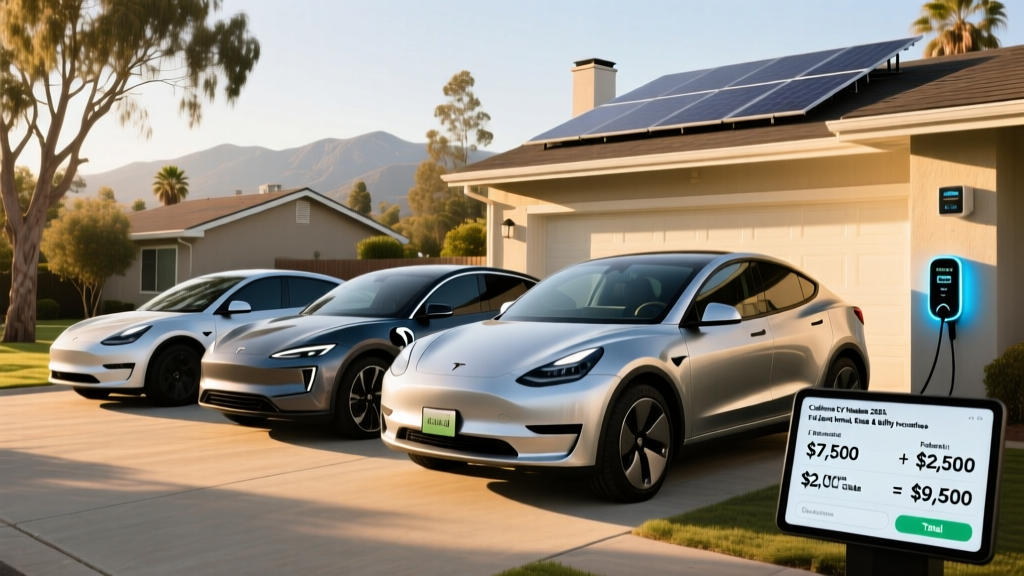
- Base MSRP: $44,990
- Federal §30D credit (point-of-sale): −$7,500
- Utility charger rebate (SCE Charge Ready): −$1,500
- Air district rebate (income-qualified, SCAQMD): −$2,500
- Clean Cars 4 All (if scrapping an older gas car, income-qualified): −$5,000
- Net effective price: $28,490
At that price, the 5-year TCO drops to approximately $63,565 — roughly $7,700 less than the RAV4 comparison. The catch: this scenario requires meeting income thresholds for multiple programs, scrapping an older vehicle, and purchasing in a specific air district during an open funding window. It's achievable but not automatic.
Frequently Asked Questions
How much does it really cost to own an EV over 5 years in California?
For a mainstream EV like the Tesla Model Y or Hyundai Ioniq 5, expect a 5-year total cost of $65,000–$75,000 including purchase (after incentives), charging, insurance, maintenance, and depreciation. This is roughly comparable to a gas crossover when you qualify for the full $7,500 federal credit. Without incentives, EVs cost $5,000–$10,000 more over five years due to higher purchase prices and insurance.
Do I qualify for the federal EV tax credit?
You qualify for up to $7,500 if your modified AGI is at or below $150,000 (single) or $300,000 (joint), the vehicle's MSRP is under $80,000 (SUVs/trucks) or $55,000 (sedans), it was assembled in North America, and its battery meets critical mineral and component sourcing thresholds. Check the specific vehicle on fueleconomy.gov — eligibility varies by trim and build date. The credit can be transferred to the dealer at point of sale to reduce your purchase price immediately.
How much do I save on fuel and maintenance?
With home charging on a TOU plan at ~$0.14/kWh, expect to spend about $0.04/mile on electricity — saving roughly $1,600–$1,800 per year vs. a 30 MPG gas vehicle at California's $4.50/gallon average. Maintenance savings add another $300–$500/year from eliminated oil changes, fewer brake replacements (regenerative braking extends pad life to 80,000+ miles), and no transmission or exhaust service. Combined annual savings: $1,900–$2,300.
Are EVs more expensive to insure in California?
Yes, typically 15–30% more than a comparable gas vehicle. For a Tesla Model Y, expect $2,200–$2,800/year vs. $1,700–$2,100 for a RAV4. Higher repair costs (specialized body shops, battery-related write-offs), higher vehicle values, and a smaller certified repair network drive the premium. Tesla Insurance, State Farm, and GEICO tend to offer more competitive EV rates — always compare at least three quotes.
How well do EVs hold their value?
EVs currently retain roughly 40–48% of their incentive-adjusted purchase price after 5 years / 75,000 miles — less than the 55–60% typical for popular gas crossovers. The gap has narrowed since the 2023–2024 used-EV price collapse, but faster technology cycles and new-vehicle incentive competition continue to pressure resale values. Buying at a competitive price (post-incentive) and maintaining battery health (avoiding repeated 100% charges on NMC batteries, minimizing DC fast charging) helps preserve resale value.
Can I stack California state rebates with the federal tax credit?
Yes — California incentives stack with the federal §30D credit. The federal credit is a federal income tax credit (or point-of-sale reduction), while California programs are separate state/utility/air-district rebates. There is no prohibition on combining them. However, some California programs have income limits that are lower than the federal caps, so eligibility for one doesn't guarantee eligibility for all.
What if I don't qualify for the federal credit due to income?
If your MAGI exceeds the §30D limits, you lose the $7,500 federal credit but can still benefit from California utility rebates ($500–$1,500 for charger installation), air district incentives (if income-qualified), HOV lane access, and the fuel/maintenance savings. The 5-year TCO gap vs. gas widens without the federal credit, but doesn't disappear — especially if you charge at home on TOU rates.
Bottom line: California EV rebates can meaningfully reduce your purchase price, but the savings are not automatic or universal. Run the numbers for your specific income, utility territory, vehicle choice, and charging situation. The buyers who come out furthest ahead are those who stack the full federal credit with income-qualified state programs, charge at home on off-peak rates, and plan to keep the vehicle long enough for fuel and maintenance savings to compound.