If you've scrolled through social media or automotive forums lately, you've likely encountered the claim that California is going to ban Tesla sales. The headline is alarming, especially if you're actively shopping for a Model Y, Model 3, or waiting on the Cybertruck. But before you panic-buy or abandon your Tesla plans entirely, let's separate regulatory fact from internet fiction — and look at what California's actual EV policies mean for Tesla buyers in 2026.
This article breaks down the origins of the "California ban" rumor, the real regulatory landscape Tesla faces in the Golden State, and a full profile of the vehicle most affected by any sales disruption: the 2026 Tesla Model Y, still the best-selling EV in America and the model most California buyers are cross-shopping.
Where the "California to Ban Tesla Sales" Rumor Comes From
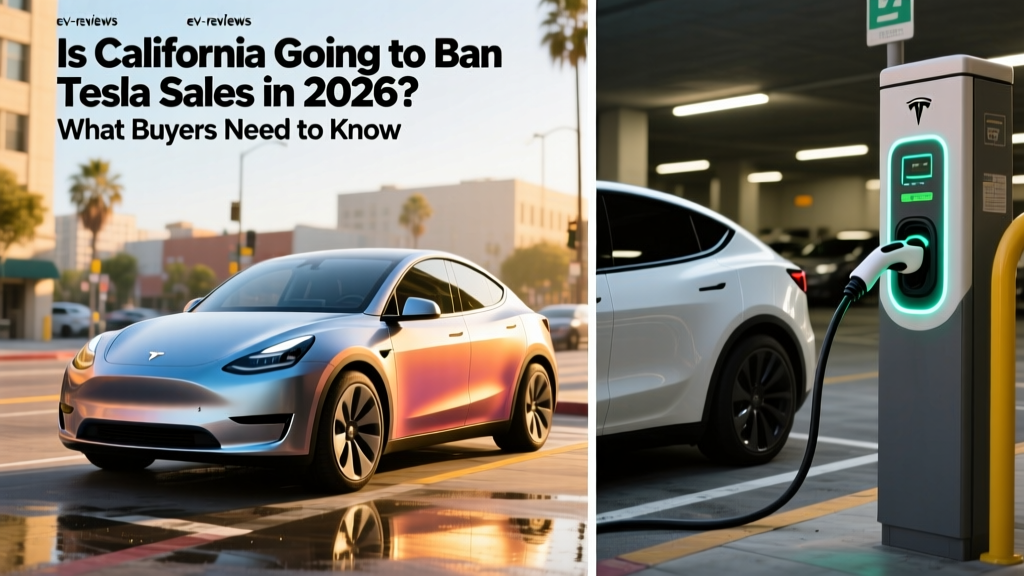
There is no legislation, ballot initiative, or regulatory action in California that bans Tesla from selling vehicles in the state as of 2026. Tesla remains fully operational in California, with active showrooms, service centers, and the Fremont factory producing Model 3 and Model Y vehicles.
The rumor appears to stem from a conflation of several real but distinct regulatory and legal issues:
- California's direct-sales ban (franchise law): California, like many states, has franchise laws that technically prohibit automakers from selling directly to consumers — the exact model Tesla uses. However, Tesla has operated under a special agreement with the California DMV since 2013, allowing limited direct sales. This agreement has been challenged periodically but remains in effect.
- Advanced Clean Cars II (ACC II) regulations: California's Air Resources Board (CARB) mandates that 100% of new vehicle sales be zero-emission by 2035. This mandates EV sales — it doesn't ban any specific manufacturer. In fact, this regulation benefits Tesla, which only sells EVs.
- Autopilot/FSD investigations: The NHTSA and California DMV have investigated Tesla's driver-assistance marketing. California's DMV briefly challenged Tesla's use of the term "Full Self-Driving" as potentially misleading, but this was a marketing language dispute, not a sales ban.
- Political friction: Tesla CEO Elon Musk's public political statements and relocation of Tesla's corporate headquarters to Texas have fueled speculation that California might retaliate against the company. No such retaliatory legislation has been introduced.
2026 Tesla Model Y: The California Buyer's Default Choice
With the sales-ban question settled, let's profile the vehicle most California EV shoppers are actually considering. The 2026 Tesla Model Y received a significant refresh (internally called "Juniper") that updated its styling, interior materials, suspension tuning, and noise insulation. It remains the benchmark compact electric SUV against which the Hyundai Ioniq 5, Ford Mustang Mach-E, and Chevrolet Equinox EV are measured.
| Spec | Long Range RWD | Long Range AWD | Performance |
|---|---|---|---|
| EPA Range | 320 miles | 305 miles | 280 miles |
| Battery (usable) | ~78 kWh (NMC) | ~78 kWh (NMC) | ~78 kWh (NMC) |
| Peak DC Charge Rate | 250 kW | 250 kW | 250 kW |
| 10–80% DC Charge Time | ~22 min | ~22 min | ~22 min |
| Level 2 Home Charging | 11.5 kW (~37 mi/hr) | 11.5 kW (~37 mi/hr) | 11.5 kW (~37 mi/hr) |
| 0–60 mph | 5.8 sec | 4.8 sec | 3.5 sec |
| Horsepower | ~346 hp | ~384 hp | ~456 hp |
| MPGe (combined) | 123 MPGe | 117 MPGe | 111 MPGe |
| Base MSRP | $44,990 | $47,990 | $52,490 |
Source: fueleconomy.gov and Tesla's official specifications. Verify trim-specific pricing at time of purchase, as Tesla adjusts MSRP frequently.
Real-World Range: What the EPA Sticker Doesn't Tell You
EPA estimated: 305 miles
Real-world highway (70–80 mph, 75°F): ~260–280 miles
Real-world cold weather (30°F, mixed driving): ~220–245 miles
California commute (stop-and-go, mild climate): ~290–310 miles
The Model Y's NMC battery and efficient heat pump give it an advantage in moderate climates like coastal California, where cold-weather range loss is minimal. However, if you regularly drive from Los Angeles to Lake Tahoe or the Sierras in winter, plan for a 20–25% range reduction at altitude and low temperatures. Tesla's trip planner in the navigation system accounts for elevation and temperature, which is one of the better onboard tools for managing range expectations.
The Long Range RWD variant's 320-mile EPA rating is among the highest in the compact EV SUV segment, and in temperate California conditions, hitting 300+ real-world miles on a charge is achievable with conservative driving.
Charging Speed: Supercharger Network vs. Public Alternatives
| Charging Level | Power | Speed (mi/hr) | Notes |
|---|---|---|---|
| Level 1 (120V household) | ~1.4 kW | ~4 mi/hr | Emergency/top-up only |
| Level 2 (240V home, 48A) | 11.5 kW | ~37 mi/hr | Full charge in ~8.5 hours |
| DC Fast (Tesla Supercharger V3) | 250 kW peak | ~1,000+ mi/hr (peak) | 10–80% in ~22 min |
| DC Fast (CCS adapter, non-Tesla) | Up to 250 kW | Variable | Depends on station; EA, EVgo compatible |
The Model Y's 250 kW peak DC charge rate is competitive but no longer class-leading — the Hyundai Ioniq 5 and Kia EV6 can accept up to 350 kW on 800V architectures. In practice, the Model Y sustains strong charging speeds between 10–50% SoC, then tapers progressively. Expect the 50–80% portion to add roughly 8–10 additional minutes beyond the 10–80% quoted time.
For California buyers, the Supercharger network remains the strongest charging ecosystem. With over 1,500 Supercharger stalls in California alone, long-distance travel along I-5, US-101, and I-15 is well-supported. Tesla now also offers a CCS adapter (included with new vehicles) for access to Electrify America and other networks, though native NACS Superchargers deliver the most consistent experience.
Interior, Cargo, and Daily Practicality
The Juniper refresh addressed some of the Model Y's longstanding interior criticisms. Materials are improved, the cabin is noticeably quieter at highway speeds, and the ventilated front seats are a welcome addition for California summers.
- Cargo volume (rear seats up): 30.2 cu ft
- Cargo volume (rear seats folded): 72.1 cu ft
- Front trunk (frunk): 4.1 cu ft
- Rear legroom: 41.6 inches
- Front headroom: 41.0 inches
- Seating: 5-passenger standard; 7-passenger option available on Long Range AWD ($3,000)
The 7-seat option adds two small rear-facing seats suitable for children under about 5'4". For families with older kids or adults who regularly need third-row space, the Kia EV9 or a PHEV SUV like the Toyota Grand Highlander Hybrid may serve better.
Pricing, Trims, and Federal Tax Credit Eligibility
| Trim | Base MSRP | §30D Credit Eligible? | Est. After Credit |
|---|---|---|---|
| Long Range RWD | $44,990 | Yes (under $80K SUV cap) | ~$37,490* |
| Long Range AWD | $47,990 | Yes (under $80K SUV cap) | ~$40,490* |
| Performance | $52,490 | Yes (under $80K SUV cap) | ~$44,990* |
*Effective price assumes full $7,500 IRS §30D federal tax credit. Eligibility requires:
- Buyer income cap: AGI ≤ $150,000 (single) / $300,000 (married filing jointly)
- MSRP cap: Vehicle must be under $80,000 for SUVs/vans/pickups (Model Y qualifies as an SUV)
- Battery sourcing: Critical minerals and battery components must meet phased-in domestic/FTEA sourcing thresholds — verify current-year compliance on Tesla's website and the IRS qualified vehicles list
- Point-of-sale transfer: As of 2024+, the $7,500 credit can be transferred to the dealer at purchase, reducing your out-of-pocket cost immediately rather than waiting for a tax refund
- VIN registration: You must register the vehicle for personal use in the U.S.
California-specific incentives: California's CVRP (Clean Vehicle Rebate Project) rebates vary by income and funding availability. Check energy.ca.gov for current rebate amounts. Some California air districts offer additional point-of-sale rebates for lower-income buyers.
Driver Assistance: Autopilot and FSD Supervised
The 2026 Model Y comes standard with Tesla's basic Autopilot (traffic-aware cruise control and lane centering). FSD (Supervised) remains an $8,000 option or $99/month subscription. FSD adds automatic lane changes, navigation-guided on/off-ramp handling, and traffic light/stop sign recognition. It's impressive in well-marked California highway conditions but requires constant driver supervision, particularly in construction zones and on poorly marked surface streets.
California DMV regulations require Tesla to report FSD disengagement data, and the company's autonomous vehicle reports are publicly available for review before you decide whether the FSD premium is justified.
Warranty and Long-Term Ownership
- Basic vehicle warranty: 4 years / 50,000 miles
- Battery & drive unit warranty: 8 years / 120,000 miles (Long Range) with minimum 70% capacity retention
- Expected battery degradation: Tesla's NMC packs typically lose 5–10% capacity over the first 100,000 miles, then plateau. Real-world fleet data suggests 85–90% state of health at 150,000 miles for properly maintained packs.
Tesla's battery warranty threshold (70% retention) is industry-standard. However, the 120,000-mile coverage on the Long Range trims exceeds the 100,000-mile coverage on the RWD Standard Range variant (when available), so verify your specific trim's warranty terms.
Pros and Cons: Honest Assessment
- Best-in-class Supercharger network access (native NACS)
- 320-mile max EPA range (RWD) is segment-leading
- Strong efficiency (123 MPGe combined RWD)
- Over-the-air updates continuously add features
- Excellent cargo space (72.1 cu ft max)
- Qualifies for full $7,500 federal credit (verify sourcing)
- Strong resale value relative to EV segment average
- 250 kW peak charge rate trails 800V competitors (Ioniq 5, EV6 at 350 kW)
- FSD ($8,000) remains Level 2 — expensive for supervised driving
- No Apple CarPlay or Android Auto
- Service center wait times in California can stretch weeks
- Panel gap and build quality inconsistency persists post-refresh
- Phantom braking reports in Autopilot mode still noted by NHTSA
- No physical instrument cluster — all info on center screen
Who Should Buy the 2026 Model Y in California?
- You want access to the Supercharger network for road trips along the Pacific Coast, to the Sierras, or across the Southwest
- You need 300+ miles of real-world range for a long California commute (e.g., Inland Empire to LA, Central Valley to Bay Area)
- You value over-the-air feature updates and a tech-forward cabin
- Cargo versatility matters (folding seats + frunk for gear, bikes, dogs)
- You need faster DC charging — consider the Hyundai Ioniq 5 (800V, 350 kW capable)
- You want Apple CarPlay — the Chevrolet Equinox EV or Ford Mustang Mach-E support it natively
- You need third-row seating for adults — look at the Kia EV9
- Service accessibility is a priority — BMW iX and Hyundai Ioniq 5 have broader dealer service networks in California
Frequently Asked Questions
Is California actually banning Tesla sales?
No. As of 2026, there is no legislation or regulation banning Tesla from selling vehicles in California. The company operates showrooms, service centers, and the Fremont manufacturing plant. The rumor conflates franchise-law debates, FSD marketing disputes, and California's 2035 ZEV mandate (which actually favors Tesla).
Does the 2026 Tesla Model Y qualify for the $7,500 federal tax credit?
All Model Y trims fall under the $80,000 SUV MSRP cap for §30D eligibility. However, the full credit depends on battery critical-mineral and component sourcing requirements that change annually. Verify the current IRS qualified vehicle list before purchase. Buyer income caps ($150K single / $300K joint) also apply.
What is the real-world range of the Model Y in California conditions?
In California's mild climate with mixed city/highway driving, expect 280–310 real-world miles from the Long Range AWD (EPA 305). Highway-only driving at 75+ mph reduces this to roughly 260–280 miles. Cold-weather trips to the mountains can drop range to 220–245 miles.
How does the Model Y's charging speed compare to competitors?
At 250 kW peak, the Model Y charges quickly but slower than 800V competitors like the Hyundai Ioniq 5 and Kia EV6 (350 kW peak, 10–80% in ~18 minutes). However, Tesla's Supercharger network delivers more consistent real-world speeds than third-party CCS stations, which can be congested or offline.
Is FSD (Full Self-Driving) worth the $8,000 cost?
FSD (Supervised) is a Level 2 driver-assist system, not autonomous driving. It handles highway lane changes and navigation-guided ramps well but requires constant driver engagement. For most California commuters, the included basic Autopilot is sufficient. Consider the $99/month subscription to test it before committing to the full purchase.
Can I still buy a Tesla in California if the headquarters moved to Texas?
Yes. Tesla's corporate headquarters relocation to Austin, Texas does not affect vehicle sales, manufacturing, or service operations in California. The Fremont factory continues to produce Model 3 and Model Y vehicles, and California remains Tesla's largest U.S. market by registration volume.