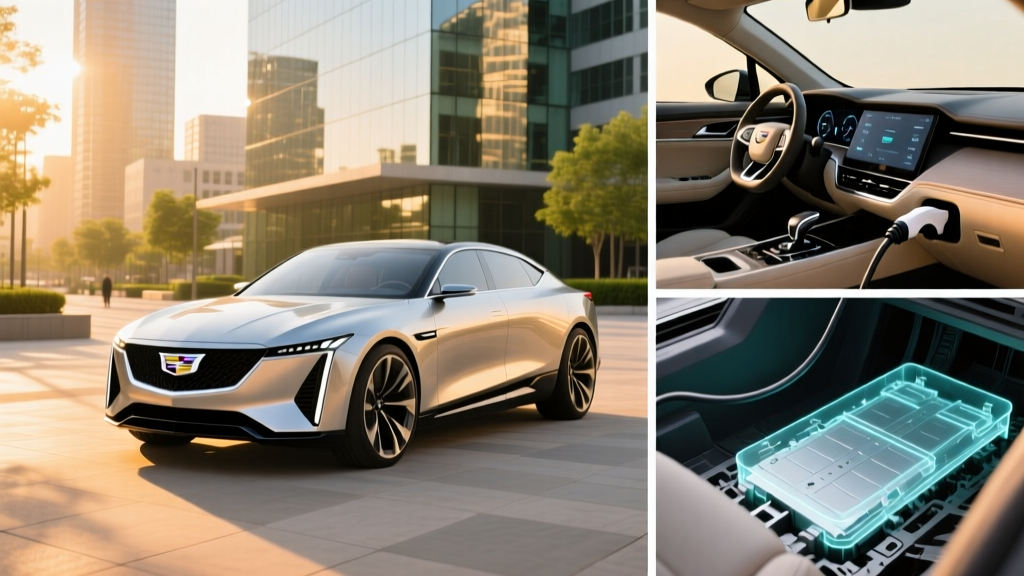
The 2026 Cadillac Optiq enters the luxury compact electric SUV segment as GM's premium answer to the Tesla Model Y, Genesis GV70 Electrified, and BMW iX3. Built on the Ultium platform and assembled at the Lansing Delta Township plant in Michigan, the Optiq slots between the Lyriq and the larger Escalade IQ in Cadillac's rapidly expanding EV lineup. We've compiled every confirmed spec, cross-referenced EPA data, and applied real-world driving adjustments so you know exactly what to expect before stepping into a dealership.
Range Reality Check
EPA Estimated: 305 miles (AWD Luxury trim, 20-inch wheels)
Real-World Expectation: ~260–280 miles in mixed highway driving; ~220–240 miles sustained at 75+ mph in cold weather (below 32°F). The Optiq's 102 kWh usable battery provides a generous buffer, but highway speeds and winter temperatures will reduce range by 15–25%, consistent with most dual-motor AWD crossovers in this class.
2026 Cadillac Optiq Spec Sheet at a Glance
| Specification | Detail |
|---|---|
| EPA Range | 305 miles (est., AWD Luxury) |
| Battery (Usable) | 102 kWh, NMC (nickel manganese cobalt) |
| Drivetrain | Dual-motor AWD |
| Horsepower | 350 hp (est.) |
| 0–60 mph | ~5.0 seconds (est.) |
| Max DC Fast Charge | 150 kW peak |
| 10–80% DC Charge Time | ~30 minutes |
| Level 2 Home Charge | 11.5 kW (~34 miles/hr) |
| Efficiency | ~95 MPGe / ~35 kWh/100mi (est.) |
| Cargo Volume | 26 cu ft (behind rear seats), ~60 cu ft (seats folded) |
| Base MSRP | $54,300 (Luxury AWD, est.) |
| Federal Tax Credit | Up to $7,500 (subject to §30D rules) |
| Battery/Powertrain Warranty | 8 years / 100,000 miles |
Battery, Chemistry, and What 102 kWh Actually Means
The Optiq uses a 12-module Ultium battery pack with NMC (nickel manganese cobalt) chemistry. GM has standardized NMC across its Ultium lineup for its higher energy density compared to LFP (lithium iron phosphate), which translates to more range in a physically smaller pack. The trade-off is that NMC cells are more sensitive to sustained high states of charge; GM recommends daily charging to 80–90% and reserving 100% fills for road trips.
With 102 kWh of usable capacity, the Optiq carries slightly less energy than the Lyriq's 102 kWh pack (the Lyriq uses a similar architecture but in a larger, heavier body). For context, the Tesla Model Y Long Range carries approximately 75 kWh usable, while the Genesis GV70 Electrified holds 72.6 kWh. The Optiq's larger battery gives it a range advantage in the luxury compact segment, though efficiency (kWh per mile) will ultimately determine how far that energy goes in real driving.
The 8-year/100,000-mile battery warranty covers capacity degradation below 60% of original capacity — a threshold that is less generous than Hyundai/Kia's 70% retention guarantee but standard for GM's EV lineup. In practice, Ultium packs have demonstrated roughly 5–8% degradation over the first 50,000 miles based on early Lyriq owner data, suggesting the Optiq should retain well above 90% capacity through the warranty period under normal use.
Charging Speed: DC Fast, Level 2, and the Curve Reality
The Optiq supports up to 150 kW peak DC fast charging via its CCS1 connector (with NACS adapter compatibility for Tesla Supercharger access expected to be included at launch, following GM's network transition). Here's what charging looks like across levels:
| Charging Level | Power | Speed | Use Case |
|---|---|---|---|
| Level 1 (120V) | 1.4 kW | ~4 miles/hr | Emergency / overnight trickle |
| Level 2 (240V, 48A) | 11.5 kW | ~34 miles/hr | Home daily charging (full in ~9 hrs) |
| DC Fast Charge | 150 kW peak | ~180 miles in 30 min | Road trips; 10–80% in ~30 min |
Charging curve reality: The 150 kW peak rate is available from roughly 10–40% state of charge. Above 50%, the rate tapers to approximately 100 kW, and above 80%, it drops to under 50 kW to protect battery health. This means the advertised 10–80% time of ~30 minutes is achievable at a properly rated 150+ kW station (Electrify America, EVgo, or Tesla Supercharger via adapter), but you'll rarely see 150 kW sustained for the entire session. Plan road-trip stops around the 10–80% sweet spot for maximum efficiency.
For home charging, the 11.5 kW onboard charger requires a 240V/48A circuit (hardwired Level 2 station recommended). A full 0–100% charge takes approximately 9 hours — easily accomplished overnight. Home installation typically costs $800–$2,000 depending on panel capacity and run length; budget for a potential panel upgrade if your home has a 100A service.
Performance and Driving Dynamics
The dual-motor AWD powertrain produces an estimated 350 horsepower and is expected to deliver a 0–60 mph time around 5.0 seconds. That's brisk for a luxury-oriented compact SUV, though it trails the Tesla Model Y Performance (3.5 seconds) and sits closer to the Genesis GV70 Electrified (4.2 seconds with boost). Cadillac has tuned the Optiq for refined acceleration rather than track-focused aggression — the torque delivery is linear and well-suited to highway merging and confident passing.
Regenerative braking offers multiple levels, including a one-pedal driving mode that can bring the Optiq to a complete stop without touching the brake pedal. A steering-wheel paddle allows on-the-fly regen adjustment — a feature carried over from the Lyriq that owners consistently praise for its intuitive operation.
Ride quality benefits from a five-link rear suspension and available Continuous Damping Control on higher trims. The Optiq's curb weight (estimated ~4,900 lbs) is managed well, with body roll controlled through corners and a composed ride over highway expansion joints. This is a touring-tuned luxury SUV, not a sport crossover, and the driving experience reflects that priority.
Interior, Tech, and Cargo Practicality
The Optiq's cabin centers on a 33-inch diagonal LED display that spans the driver cluster and infotainment touchscreen — the same curved panel architecture found in the Lyriq. Google Built-in provides native access to Google Maps, Google Assistant, and the Play Store, with wireless Apple CarPlay and Android Auto as standard. Over-the-air updates are supported across all vehicle modules.
Super Cruise, GM's hands-free Level 2 driver-assistance system, is available on mapped divided highways (over 750,000 miles of compatible roads in the US and Canada as of 2026). It remains a Level 2 system requiring driver attention — eye monitoring ensures engagement. This is not autonomous driving; it is an advanced cruise-and-lane-centering feature that reduces fatigue on long trips.
Cargo space is estimated at 26 cubic feet behind the rear seats and approximately 60 cubic feet with the 60/40 split rear seats folded. Rear legroom should accommodate adults comfortably at around 38–39 inches. A small front trunk (frunk) is not expected — the Ultium platform's front-mounted drive components limit under-hood storage, consistent with the Lyriq.
Pricing, Trims, and Federal Tax Credit Eligibility
| Trim | Est. MSRP | After $7,500 Credit |
|---|---|---|
| Luxury AWD | $54,300 | $46,800 |
| Premium Luxury AWD | $59,800 | $52,300 |
| Sport AWD | $62,300 | $54,800 |
The Optiq's base MSRP places it squarely under the IRS §30D SUV MSRP cap of $80,000, making it potentially eligible for the full $7,500 federal tax credit — provided the buyer and vehicle meet all requirements. Here's the current eligibility checklist:
- MSRP Cap: Vehicle base price must be ≤ $80,000 (SUV classification) — Optiq qualifies across all trims.
- Buyer Income Cap: Modified AGI must not exceed $150,000 (single), $225,000 (head of household), or $300,000 (joint filers).
- Battery Sourcing: Critical minerals and battery components must meet phased percentage thresholds from US or FTA-partner countries. GM has worked to localize Ultium cell production (Lansing, MI, and Spring Hill, TN plants), but exact qualification varies by model year and production batch.
- Point-of-Sale Transfer: As of 2024+, the credit can be transferred to the dealer at purchase, reducing the purchase price directly rather than waiting for a tax refund.
- New Vehicle: Must be purchased new; used EV credits are a separate program (§25E, up to $4,000).
Always verify current eligibility at IRS.gov and confirm with your tax professional before purchase. Sourcing requirements tighten annually, and specific build dates may affect qualification.
How the Optiq Stacks Up Against Key Competitors
| Spec | 2026 Cadillac Optiq | Tesla Model Y LR | Genesis GV70 Electrified | BMW iX xDrive50 |
|---|---|---|---|---|
| EPA Range | 305 mi (est.) | 320 mi | 236 mi | 324 mi |
| Battery (usable) | 102 kWh | ~75 kWh | 72.6 kWh | 105.2 kWh |
| DC Fast Charge Peak | 150 kW | 250 kW | 240 kW | 200 kW |
| 10–80% Time | ~30 min | ~20 min | ~18 min | ~31 min |
| Base MSRP | ~$54,300 | ~$48,990 | ~$68,000 | ~$87,000 |
| 0–60 mph | ~5.0 sec | 4.8 sec | 4.2 sec | 4.4 sec |
| Federal Credit | Up to $7,500 | Up to $7,500 | Likely ineligible | Likely ineligible |
The Optiq's closest rival is the Tesla Model Y Long Range, which offers slightly more range and significantly faster DC charging at a lower base price. However, the Optiq counters with a more traditional luxury interior, Google Built-in infotainment, Super Cruise, and a quieter, more composed ride. Against the Genesis GV70 Electrified, the Optiq wins decisively on range and pricing, though the GV70 charges faster and offers a more distinctive interior design. The BMW iX is larger and more powerful but starts well above the Optiq's range and typically exceeds the MSRP cap for tax credit eligibility.
Who Should Buy the Cadillac Optiq?
Choose the Optiq if:
- You want a luxury-branded EV with 300+ miles of range under $60k (after credits)
- You value a refined, quiet ride over sporty handling
- Super Cruise hands-free highway driving is a priority for your commute or road trips
- You prefer Google-native infotainment and OTA updates over Tesla's ecosystem
- You want an American-assembled EV that qualifies for the full federal tax credit
Look elsewhere if:
- Maximum DC charging speed is critical (Tesla Model Y or GV70 Electrified charge faster)
- You need three rows of seating (consider the Kia EV9 or Rivian R1S)
- Track-ready performance is a priority (Tesla Model Y Performance or BMW iX M60)
- You want the absolute lowest entry price in the segment (Model Y starts ~$5k lower)
Pros and Cons
Pros
- 305-mile EPA range is competitive in the luxury compact segment
- 102 kWh battery provides a large usable buffer for real-world driving
- Super Cruise is one of the best Level 2 highway assist systems available
- Likely qualifies for full $7,500 federal tax credit across all trims
- Refined ride quality and quiet cabin tuning
- Google Built-in with native Maps and Assistant
- Assembled in Michigan — domestic production
Cons
- 150 kW peak DC charging trails Tesla (250 kW) and Genesis (240 kW)
- No front trunk (frunk) due to front motor packaging
- NMC chemistry requires more careful charge management than LFP
- Base price still higher than a comparably equipped Model Y
- Cargo space slightly below segment leaders
- Super Cruise requires annual subscription after trial period
Frequently Asked Questions
What is the real-world range of the 2026 Cadillac Optiq?
Expect approximately 260–280 miles in mixed driving at moderate temperatures. Sustained highway driving at 75+ mph reduces range to roughly 240–260 miles. In cold weather (below 32°F), plan for 220–240 miles due to battery heating demands and reduced regenerative braking efficiency.
How fast does the Optiq charge at home and on the road?
At home on a 240V/48A Level 2 charger, the Optiq adds approximately 34 miles of range per hour, reaching a full charge in about 9 hours. On DC fast chargers, it peaks at 150 kW and can add roughly 180 miles in 30 minutes (10–80% state of charge).
How much does the Optiq cost after federal tax credits?
With the full $7,500 §30D credit applied at point of sale, the Luxury AWD trim drops from approximately $54,300 to $46,800. Eligibility depends on buyer income, battery sourcing compliance, and MSRP caps — verify at IRS.gov before purchasing.
Is the Cadillac Optiq worth buying over a Tesla Model Y?
It depends on priorities. The Model Y offers faster charging, slightly more range, a lower base price, and access to the extensive Supercharger network natively. The Optiq counters with a more luxurious interior, Super Cruise, Google infotainment, and a quieter ride. If luxury brand cachet and refinement matter more than absolute efficiency, the Optiq is a strong choice.
Does the Optiq qualify for the $7,500 federal EV tax credit?
Based on its MSRP (under the $80,000 SUV cap), US assembly, and GM's localized Ultium battery production, the Optiq is expected to qualify. However, buyer income limits and annual battery-sourcing thresholds apply. Always confirm eligibility with your tax professional and the IRS before finalizing a purchase.
What is the Optiq's battery warranty?
GM covers the Ultium battery and electric powertrain for 8 years or 100,000 miles, whichever comes first. The warranty covers defects and capacity degradation below 60% of original capacity.
Does the Optiq have Super Cruise?
Yes, Super Cruise is available on the Optiq for hands-free driving on over 750,000 miles of mapped divided highways in the US and Canada. It is an SAE Level 2 system — the driver must remain attentive and keep eyes on the road at all times.
Sources: Cadillac Optiq Official Page, EPA Fuel Economy, IRS Clean Vehicle Credits