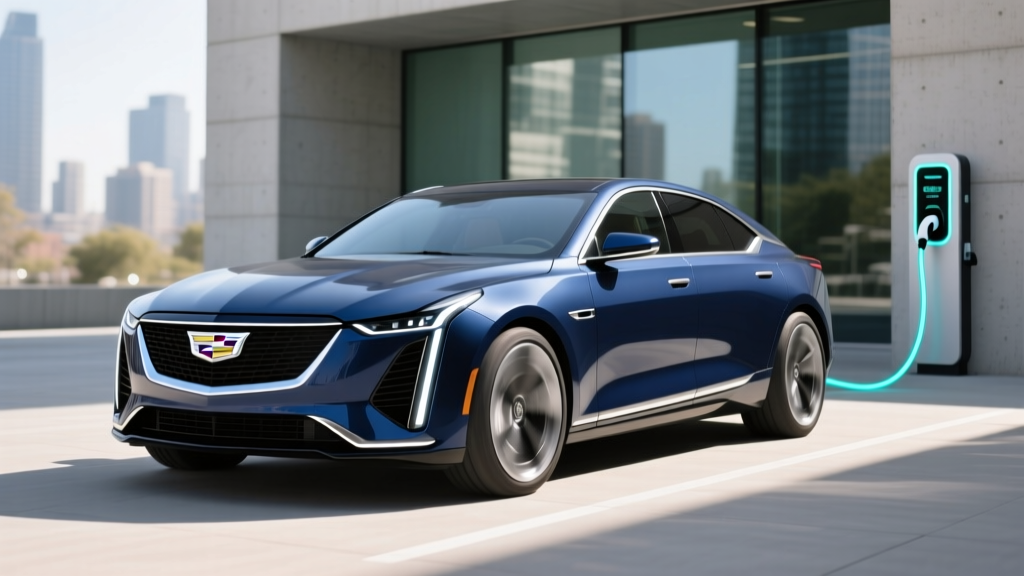
The Cadillac Optiq arrives as the brand's entry point into the electric luxury compact SUV segment — a segment dominated by the Tesla Model Y, BMW iX3, and Genesis GV60. Built on GM's Ultium platform and assembled at the Lansing Delta Township plant in Michigan, the Optiq aims to blend Cadillac's traditional comfort-oriented luxury with competitive EV specs. Below, we break down every number that matters for a purchase decision.
Range Reality Check
EPA Estimated Range: 303 miles (Luxury AWD trim, 20-inch wheels)
Real-World Expectation: Expect 260–280 miles on mixed highway driving at 70+ mph. In cold weather (below 30°F), plan for 210–240 miles due to battery heating demands and cabin climate load. City driving with regenerative braking can approach or slightly exceed the EPA sticker.
2026 Cadillac Optiq Specifications at a Glance
| Specification | Value |
|---|---|
| EPA Range | 303 miles (AWD, 20" wheels) |
| Battery Capacity | 85 kWh usable (NMC lithium-ion, Ultium platform) |
| Drivetrain | Dual-motor AWD (standard) |
| Horsepower | 340 hp (estimated) |
| 0–60 mph | ~5.0 seconds (estimated) |
| Max DC Fast Charge | 150 kW peak |
| 10–80% DC Charge Time | ~27 minutes |
| Level 2 Home Charging | 11.5 kW onboard charger (~31 mi/hr) |
| Efficiency | ~97 MPGe combined / ~35 kWh/100 mi |
| Cargo Volume | 26.0 cu ft (rear seats up) / 57.0 cu ft (rear seats folded) |
| Rear Legroom | 37.8 inches |
| Battery Warranty | 8 years / 100,000 miles |
| Base MSRP | $54,300 (Luxury AWD, incl. destination) |
Battery, Chemistry, and Efficiency
The Optiq uses GM's Ultium battery architecture with NMC (nickel manganese cobalt) chemistry across its modules. The 85 kWh usable capacity sits below the Lyriq's 102 kWh pack, reflecting the Optiq's smaller footprint and lighter curb weight. NMC chemistry offers strong energy density — important for packaging 300+ miles of range into a compact luxury SUV — though it sacrifices some cycle-life longevity compared to LFP (lithium iron phosphate) packs found in base Tesla Model Y trims.
Efficiency lands around 97 MPGe combined, or roughly 35 kWh per 100 miles. That puts the Optiq slightly behind the Tesla Model Y Long Range (~117 MPGe) but competitive with the Genesis GV60 (~95 MPGe). The difference translates to about $30–50 more per year in electricity costs for an average driver versus the most efficient competitors, based on the U.S. EPA's fueleconomy.gov national average electricity pricing.
Charging Speed: DC Fast, Level 2, and Real-World Curve
Charging is where buyers need to look past the peak number. The Optiq's 150 kW peak DC fast-charge rate is serviceable but not class-leading — the Hyundai Ioniq 5 peaks at 240 kW, and the Tesla Model Y at roughly 250 kW on V3 Superchargers.
| Charging Level | Power / Rate | Speed | Notes |
|---|---|---|---|
| Level 1 (120V household) | 1.4 kW | ~4 mi/hr | Emergency / trickle only |
| Level 2 (240V home) | 11.5 kW | ~31 mi/hr | Full charge in ~9 hours |
| DC Fast Charge | 150 kW peak | 10–80% in ~27 min | Tapers significantly above 80% SoC |
Charging curve reality: The Optiq will sustain close to its 150 kW peak between roughly 10% and 40% state of charge, then progressively taper. Expect average speeds of ~100–110 kW across the full 10–80% session. That 27-minute 10–80% time is respectable for road trips, but you'll spend 5–8 minutes longer at the charger than an Ioniq 5 owner on a comparable stop.
The Optiq ships with a NACS (North American Charging Standard) port, granting native access to Tesla's Supercharger network — a significant practical advantage over CCS-only vehicles as the Supercharger network remains the most reliable DC fast-charging infrastructure in the U.S. For home Level 2 charging, a 48-amp circuit on a 60-amp breaker will deliver the full 11.5 kW, adding roughly 31 miles of range per hour of charging.
Performance and Driving Dynamics
The dual-motor all-wheel-drive powertrain delivers an estimated 340 horsepower and approximately 325 lb-ft of torque. Cadillac tunes the Optiq for comfort rather than sportiness — the suspension absorbs road imperfections well, and the steering is weighted for relaxed cruising rather than aggressive cornering.
The estimated 5.0-second 0–60 mph time is adequate for merging and passing but won't impress anyone coming from a Tesla Model Y Performance (3.5 seconds) or even the BMW iX xDrive50 (4.4 seconds). The Optiq's mission is luxury isolation, not track capability, and it executes that well.
Regenerative braking offers multiple modes, including a one-pedal driving setting that provides strong deceleration when you lift off the accelerator. A heat pump comes standard, which helps preserve range in cold weather by efficiently managing cabin and battery thermal loads.
Interior Space, Technology, and Driver Assistance
The cabin centers around a sweeping 33-inch LED display that spans the dashboard, combining the instrument cluster and infotainment into one curved panel running Google Built-In. Wireless Apple CarPlay and Android Auto are standard, along with wireless phone charging and a 19-speaker AKG audio system on higher trims.
Cargo space measures 26.0 cubic feet behind the second row and 57.0 cubic feet with the rear seats folded — competitive with the Model Y (30.2 / 76.2 cu ft, though Tesla's numbers include the frunk). Rear legroom of 37.8 inches is generous for the segment, making the Optiq viable for families with older children or adults in the back seat regularly.
Cadillac's Super Cruise hands-free driving system is available on the Optiq, operating on over 750,000 miles of compatible divided highways in North America. Important: Super Cruise is an SAE Level 2 driver-assistance system — it handles steering, acceleration, and braking on compatible roads, but the driver must remain attentive. An infrared camera monitors driver eye position and will issue escalating alerts if attention lapses. This is not autonomous driving; it is supervised automation.
SAE Automation Level: Level 2 (partial automation). The driver must remain engaged and ready to take over at any time. Super Cruise does not navigate intersections, construction zones, or surface streets autonomously.
Pricing, Trims, and Federal Tax Credit Eligibility
The 2026 Optiq launches in a single Luxury AWD configuration at $54,300 including destination, with a Sport trim adding cosmetic and suspension tweaks at approximately $58,000. Fully optioned with premium packages (panoramic roof, upgraded leather, enhanced Super Cruise), expect as-tested pricing around $62,000–$65,000.
| Trim | MSRP | After Max §30D Credit | Notes |
|---|---|---|---|
| Luxury AWD | $54,300 | ~$46,800 | If buyer meets all §30D requirements |
| Sport AWD | $58,000 | ~$50,500 | If buyer meets all §30D requirements |
Federal Tax Credit (§30D) Eligibility
- MSRP Cap: The Optiq qualifies as an SUV under IRS rules, with an $80,000 MSRP ceiling — comfortably above even fully loaded pricing.
- Buyer Income Caps: Modified adjusted gross income must not exceed $150,000 (single), $225,000 (head of household), or $300,000 (joint filers).
- Battery Sourcing: The Optiq's Ultium battery is assembled in the U.S., but critical-mineral and battery-component sourcing requirements under §30D are stringent and subject to annual tightening. The full $7,500 credit requires meeting both the critical-minerals requirement ($3,750) and the battery-components requirement ($3,750). Check IRS.gov §30D guidance for the current model-year determination.
- Point-of-Sale Transfer: Eligible buyers can transfer the credit to the dealer at purchase, reducing the out-of-pocket price immediately rather than waiting for a tax refund.
Critical caveat: Battery-sourcing rules have tightened each year since 2023. By 2026, the critical-minerals requirement demands that an increasing percentage of minerals be sourced from the U.S. or FTA-partner countries. GM has aggressively localized Ultium supply chains, but confirm the Optiq's specific credit status at the time of purchase — it can change mid-year based on supply-chain shifts. Consult a tax professional for your specific situation.
Competitive Positioning: Optiq vs. the Field
The Optiq competes directly with the Tesla Model Y Long Range (~$48,000, 320 mi EPA, 117 MPGe), the BMW iX3 (~$56,000, 280 mi EPA), and the Genesis GV60 (~$53,000, 248 mi EPA). Here's how it stacks up where it matters:
Range Winner: Tesla Model Y
320 miles EPA vs. the Optiq's 303 — plus superior efficiency means less energy cost per mile.
Charging Speed Winner: Genesis GV60 / Hyundai Ioniq 5 Platform
800V architecture enables 240 kW peak charging, roughly 10 minutes faster for a 10–80% session.
Interior Luxury Winner: Cadillac Optiq
Material quality, sound insulation, and ride comfort exceed the Model Y and rival the best European offerings.
Driver-Assist Winner: Cadillac Optiq
Super Cruise's hands-free highway capability and driver-monitoring integration remain best-in-class for supervised Level 2 systems.
Who Should Buy the Cadillac Optiq?
Choose the Optiq if: You prioritize ride comfort and cabin quietness over outright range or charging speed, you value Super Cruise for highway commuting, and you want a luxury badge with U.S. assembly and strong tax-credit potential.
Look elsewhere if: Maximum range and charging speed are your top priorities (consider the Model Y or Ioniq 5), you need maximum cargo volume (the Model Y offers significantly more), or you want the sharpest handling in the segment (the BMW iX3 or GV60 are more engaging).
Pros and Cons
Pros
- 303-mile EPA range is competitive in the luxury compact SUV segment
- Super Cruise hands-free driving on 750,000+ miles of highways
- Standard NACS port for native Tesla Supercharger access
- Excellent ride quality and cabin isolation
- U.S.-assembled with strong §30D tax credit potential
- 11.5 kW Level 2 onboard charger enables fast home replenishment
Cons
- 150 kW peak DC charging lags behind 800V competitors (240+ kW)
- No front trunk (frunk) — cargo volume trails the Model Y
- Performance tuning favors comfort over engagement
- Pricing pushes above $54K base — value gap vs. Model Y
- NMC chemistry may degrade slightly faster than LFP over 10+ years
- Limited trim availability at launch (single Luxury configuration)
Warranty and Long-Term Ownership
GM backs the Optiq's battery and electric powertrain components with an 8-year / 100,000-mile warranty, covering defects and capacity loss below a guaranteed threshold (typically 60–70% of original capacity, though GM has not published an exact retention guarantee for the Optiq specifically). The bumper-to-bumper limited warranty runs 4 years / 50,000 miles.
For long-term ownership, NMC chemistry typically shows 8–12% degradation over 100,000 miles in real-world fleet data, though thermal management quality is the biggest variable. GM's Ultium platform uses an active liquid thermal management system that preconditions the battery during navigation to a charger and maintains optimal temperatures during fast charging — a key factor in longevity.
Frequently Asked Questions
What is the real-world range of the 2026 Cadillac Optiq?
The EPA rates the Optiq at 303 miles, but real-world highway driving at 70+ mph typically yields 260–280 miles. In cold weather below 30°F, expect 210–240 miles due to battery heating and cabin climate demands. City driving with regenerative braking can approach or slightly exceed the EPA figure.
How fast does the Cadillac Optiq charge at home and on the road?
On a Level 2 home charger (240V, 48A), the Optiq charges at 11.5 kW, adding about 31 miles of range per hour — a full charge takes roughly 9 hours. On DC fast chargers, it peaks at 150 kW and reaches 10–80% in approximately 27 minutes, though charging speed tapers significantly above 80% state of charge.
Does the Cadillac Optiq qualify for the $7,500 federal EV tax credit?
The Optiq meets the MSRP cap ($80,000 for SUVs) and is assembled in the U.S., but full $7,500 credit eligibility depends on the buyer's income (under $150K single / $300K joint), the battery's critical-mineral sourcing, and component-origin requirements under IRS §30D. These rules tighten annually — verify eligibility at IRS.gov before purchasing. The credit can be transferred to the dealer at point of sale.
Is the Cadillac Optiq worth buying over the Tesla Model Y?
It depends on priorities. The Model Y offers more range (320 vs. 303 mi), faster charging, more cargo space, and a lower base price. The Optiq counters with superior ride comfort, a quieter cabin, Super Cruise hands-free driving, and a more traditional luxury dealership experience. If comfort and driver-assist quality matter more than raw efficiency, the Optiq is a strong choice.
What is the biggest drawback of the Cadillac Optiq?
The 150 kW peak DC charging speed is the most significant limitation. On road trips, you'll spend 5–8 extra minutes per charging stop compared to 800V competitors like the Hyundai Ioniq 5 or Kia EV6, which peak at 240 kW. Over a long trip with multiple stops, that adds up. The lack of a frunk also limits total cargo versatility.
Does the Optiq have a NACS or CCS charging port?
The 2026 Optiq comes with a native NACS (Tesla-style) charging port, meaning it can plug directly into Tesla Superchargers without an adapter. This is a significant practical advantage as the Supercharger network offers the most reliable and widespread DC fast-charging coverage in the U.S.
Sources: EPA fueleconomy.gov for efficiency and range data; GM/Cadillac official specifications; IRS.gov for §30D clean vehicle credit rules. Specifications reflect announced 2026 model-year data and are subject to change. Always confirm final figures with your dealer at time of purchase.