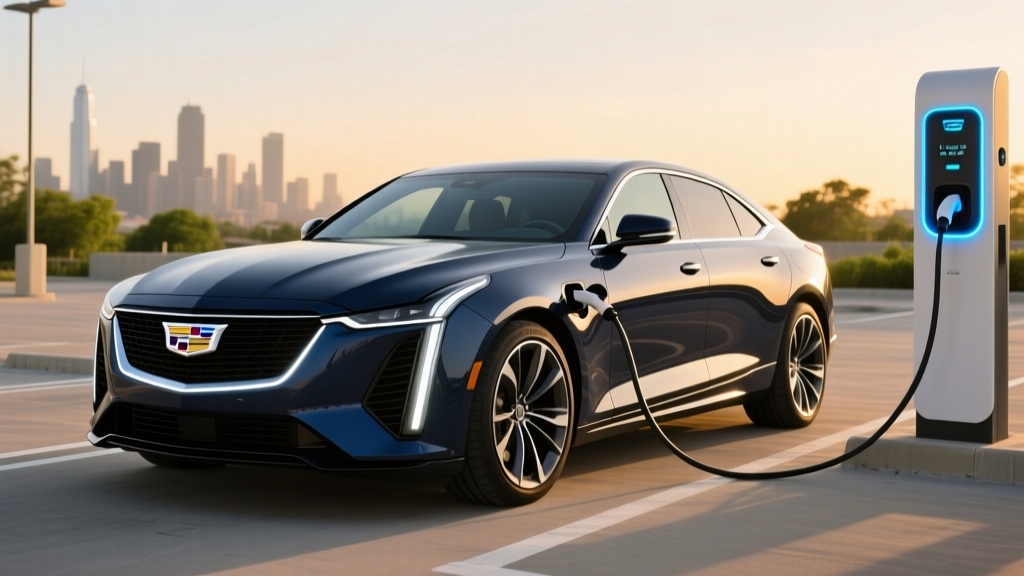
The 2026 Cadillac Optiq enters the compact luxury electric SUV segment as Cadillac's entry point to the Ultium-based EV lineup. Slotting below the Lyriq in both size and price, the Optiq targets buyers who want the Cadillac badge, GM's Ultium platform, and a premium interior without stepping up to the Lyriq's $58,000+ starting price. We spent time examining the Optiq's preliminary specifications, charging behavior, and real-world ownership implications to help you decide if it belongs on your shortlist.
2026 Cadillac Optiq: Quick Verdict
The Optiq is Cadillac's answer to the BMW iX1, Volvo EX40, and Genesis GV60 — a compact luxury crossover that prioritizes ride comfort, cabin quietness, and a usable 300-mile range envelope over performance theatrics. With a dual-motor AWD powertrain producing roughly 400 horsepower, the Optiq delivers confident acceleration without chasing sub-4-second 0-60 times. The real story is the Ultium platform's maturity by 2026: improved charge curves, NACS native compatibility, and access to the Tesla Supercharger network make this the most road-trip-capable compact luxury EV Cadillac has offered.
| Spec | Value |
|---|---|
| EPA Range (est.) | ~300–310 miles (AWD) |
| Battery Capacity | ~85 kWh usable (NMC, Ultium) |
| Max DC Fast Charge | ~190 kW peak |
| 10–80% DC Charge Time | ~27 minutes (est.) |
| Level 2 Home Charging | 11.5 kW (~31 mi/hr) |
| Powertrain | Dual-motor AWD |
| Horsepower | ~400 hp (est.) |
| 0–60 mph | ~4.7 seconds (est.) |
| Efficiency | ~95 MPGe / ~35 kWh/100 mi |
| Base MSRP | ~$54,000 (est., Luxury trim) |
| Battery Warranty | 8 years / 100,000 miles |
Note: As of early 2026, Cadillac has confirmed the Optiq for production but final EPA certification figures may shift slightly before deliveries begin. Specs above reflect GM's published preliminary data and closely related Ultium-platform vehicles.
Range & Efficiency: Real-World Expectations
The Optiq's estimated EPA range of 300–310 miles places it squarely in the competitive sweet spot for compact luxury EVs. The 85 kWh (usable) Ultium battery uses NMC (nickel manganese cobalt) chemistry, which offers higher energy density than LFP — important for packaging in a smaller vehicle footprint — but requires more careful thermal management and charge-habit discipline for long-term longevity.
Real-World Range Reality Check
EPA Estimate: ~300–310 miles
Expected Highway (70–75 mph): ~255–275 miles
Cold Weather (below 32°F): ~210–240 miles (15–30% reduction typical for NMC packs without aggressive preconditioning)
Mixed Commute (city/suburban): ~290–310 miles (regen braking recovers energy in stop-and-go traffic)
These figures assume a well-maintained tire pressure, moderate climate-control use, and no sustained mountain-grade driving. The Optiq's heat pump — standard on GM's Ultium platform — helps mitigate cold-weather cabin-heating losses compared to resistive heaters.
Efficiency is projected around 95 MPGe combined, or roughly 35 kWh per 100 miles. That's competitive with the BMW iX1 but trails the more aerodynamically optimized Tesla Model Y (approximately 120 MPGe combined). For most owners charging at home on a Level 2 setup at $0.13–$0.18/kWh (national average per the U.S. EIA), that translates to roughly $4.50–$6.30 per 100 miles — a significant cost advantage over a comparable gas-powered luxury crossover achieving 24 mpg combined on $3.40/gallon premium.
Charging Speed: DC Fast & Home Level 2
The Optiq arrives with a native NACS (North American Charging Standard) port, eliminating the need for adapters at Tesla Superchargers. This is a major practical advantage over CCS-equipped competitors that still require a CCS-to-NACS adapter for Supercharger access.
| Charging Level | Power / Rate | Miles Added per Hour | Notes |
|---|---|---|---|
| Level 1 (120V) | ~1.4 kW | ~4 mi/hr | Emergency/trickle only |
| Level 2 (240V, 48A) | 11.5 kW | ~31 mi/hr | Full charge in ~8–9 hours |
| DC Fast Charge | ~190 kW peak | ~550 mi/hr (peak) | 10–80% in ~27 min |
On DC fast charging, the Optiq's ~190 kW peak rate is respectable but not class-leading. The Hyundai Ioniq 5 and Kia EV6, with their 800V architectures, can peak above 235 kW and complete a 10–80% session in roughly 18 minutes. The Optiq's 400V Ultium architecture means the charge curve tapers more noticeably above 60% state of charge. In practice, expect to sustain 150–190 kW from 10–50% SoC, then a taper to roughly 80–100 kW through 80%, and a steep drop above 80%.
Practical road-trip implication: Plan for roughly 25–30 minute stops at 150+ kW chargers to go from 20% to 80%. If you habitually charge to 90%+ at DC fast chargers, add another 15–20 minutes for that last increment — it's rarely worth the wait unless you need the range to reach your destination.
For home charging, the 11.5 kW onboard charger means a full overnight replenishment on a 48-amp Level 2 circuit. A typical home installation on a 240V/60A circuit (hardwired) costs $800–$2,000 depending on panel proximity and local permitting, according to industry averages. Homes with older 100A electrical panels may need a $1,500–$3,000 panel upgrade — a cost that catches many first-time EV buyers off guard.
Performance & Driving Dynamics
The dual-motor AWD configuration provides roughly 400 horsepower and a projected 0–60 mph time of approximately 4.7 seconds. That's brisk enough for confident highway merging and passing but deliberately dialed back from the 500+ hp territory of the Lyriq-V or performance-oriented rivals like the BMW iX M60.
The Ultium platform's low center of gravity (battery pack mounted under the floor) gives the Optiq stable cornering behavior, though at roughly 4,600–4,800 lbs curb weight, it's no sports car. The steering is expected to be weighted for comfort rather than feedback — consistent with Cadillac's luxury touring DNA. Regenerative braking offers multiple levels, including a one-pedal driving mode that can bring the vehicle to a complete stop without touching the brake pedal in normal traffic.
Ride quality should be a strong point. GM's Ultium platform has demonstrated excellent noise isolation in the Lyriq and Blazer EV, and the Optiq's shorter wheelbase may actually improve bump absorption over the larger Lyriq on broken urban pavement.
Interior, Tech & Cargo Space
The Optiq's cabin carries forward the design language established by the Lyriq: a large curved LED display (expected to be a 33-inch diagonal combined instrument/infotainment panel running Google Built-In), ambient lighting, and premium materials including available semi-aniline leather and open-pore wood trim.
Infotainment highlights:
- Google Built-In (Google Maps navigation, Google Assistant, Play Store apps)
- Wireless Apple CarPlay and Android Auto
- Available AKG premium audio system (19 speakers expected)
- Over-the-air (OTA) update capability for powertrain, infotainment, and ADAS
- Wireless phone charging pad (15W)
Driver Assistance — Super Cruise:
The Optiq is expected to offer GM's Super Cruise as an available feature on higher trims. Super Cruise is an SAE Level 2 hands-free driver-assistance system — meaning it controls steering, acceleration, and braking on pre-mapped divided highways, but the driver must remain attentive and is monitored by an infrared camera. It is not autonomous driving. Super Cruise covers over 750,000 miles of compatible roads in North America as of 2026, per GM.
⚠️ Super Cruise Is Not Self-Driving
Super Cruise is an SAE Level 2 system. You must keep your eyes on the road and be prepared to take over at any time. It does not handle construction zones, unmapped roads, or complex urban intersections. Hands-free does not mean attention-free.
Cargo and passenger space (preliminary):
- Cargo volume behind rear seats: ~25–28 cu ft (est.)
- Cargo volume with rear seats folded: ~55–60 cu ft (est.)
- Front headroom: ~40 in
- Rear legroom: ~37–38 in
- No front trunk (frunk) — the Ultium platform's power electronics occupy the space under the hood
The lack of a frunk is a notable omission compared to the Hyundai Ioniq 5 and Ford Mustang Mach-E, both of which offer small front trunks for charging cables or groceries. Rear cargo space is adequate for a family of four on a weekend trip but tighter than the Lyriq's 35+ cu ft.
Pricing, Trims & Federal Tax Credit
The 2026 Cadillac Optiq is expected to start around $54,000 for the Luxury trim, with a Sport trim and a Premium Luxury trim pushing the as-tested price toward $60,000–$65,000 with options like Super Cruise, larger wheels, and the AKG audio system.
| Trim | Est. Base MSRP | Federal §30D Credit (max) | Effective Price (if eligible) |
|---|---|---|---|
| Luxury (AWD) | ~$54,000 | Up to $7,500 | ~$46,500 |
| Sport (AWD) | ~$58,000 | Up to $7,500 | ~$50,500 |
| Premium Luxury (AWD) | ~$63,000 | Up to $7,500 | ~$55,500 |
Federal tax credit eligibility (§30D) — critical caveats:
- MSRP cap: The Optiq, as an SUV, must have an MSRP at or below $80,000 to qualify. All expected trims clear this threshold.
- Buyer income cap: Modified adjusted gross income (MAGI) must not exceed $150,000 (single), $225,000 (head of household), or $300,000 (joint filers).
- Battery sourcing requirements: As of 2026, the §30D credit is split into two halves — $3,750 for critical minerals sourcing and $3,750 for battery component manufacturing. GM has been aggressively shifting Ultium battery sourcing to North America (Ultium Cells plants in Ohio, Tennessee, and Michigan), but the exact credit amount ($3,750 or $7,500) depends on the specific model year's compliance with IRS sourcing rules, which tighten annually.
- Point-of-sale transfer: Eligible buyers can transfer the credit to the dealer at purchase, reducing the out-of-pocket price immediately rather than waiting for a tax refund.
Important: Tax credit rules are subject to change. Always verify eligibility with a tax professional and the latest IRS guidance before purchasing. State and local incentives (e.g., California's CVRP, Colorado's state credit) may stack on top but vary by jurisdiction.
Warranty & Ownership Costs
GM provides the following warranty coverage for the Optiq's Ultium platform:
- Battery & powertrain: 8 years / 100,000 miles (whichever comes first), with a capacity retention threshold typically set at 60–70% of original capacity before a warranty claim is honored.
- Bumper-to-bumper: 4 years / 50,000 miles
- Corrosion: 6 years / 70,000 miles
- Roadside assistance: 6 years / 70,000 miles
Insurance costs for the Optiq are expected to land in the $1,800–$2,400/year range for a typical driver profile (age 40, clean record, garaged), based on comparable luxury EVs. EV insurance premiums remain 15–25% higher than gas equivalents due to higher repair costs for battery-adjacent damage and specialized labor requirements.
Maintenance is minimal: no oil changes, no spark plugs, no transmission fluid. Expect cabin air filter replacement ($50–$80 every 2 years), tire rotation ($30–$50 every 7,500 miles), and brake fluid checks. EV regenerative braking significantly extends brake pad life — many EV owners report original pads lasting 80,000+ miles.
Optiq vs. the Competition
The compact luxury EV SUV segment in 2026 is crowded. Here's how the Optiq stacks up against key rivals:
| Vehicle | Est. EPA Range | Peak DC Charge | 0–60 mph | Base MSRP |
|---|---|---|---|---|
| Cadillac Optiq AWD | ~300–310 mi | ~190 kW | ~4.7s | ~$54,000 |
| BMW iX1 xDrive28 | ~250–270 mi | ~130 kW | ~5.5s | ~$52,000 |
| Volvo EX40 Twin Motor | ~270–290 mi | ~200 kW | ~4.5s | ~$55,000 |
| Genesis GV60 AWD | ~260–280 mi | ~240 kW (800V) | ~4.0s | ~$56,000 |
| Tesla Model Y Long Range | ~320–340 mi | ~250 kW | ~4.8s | ~$48,000 |
Where the Optiq wins: Cabin luxury and materials, Super Cruise availability, native NACS charging (Supercharger access without adapter), and projected range that beats the BMW and Genesis options.
Where the Optiq trails: The Genesis GV60's 800V architecture charges significantly faster. The Tesla Model Y offers more range, more cargo space, and a lower price — though its interior materials and ride quality don't match Cadillac's luxury standard. The Volvo EX40 is a close competitor with similar luxury credentials and slightly faster DC charging.
Who Should Buy the 2026 Cadillac Optiq?
Choose the Optiq if:
- You want a true luxury interior with premium materials and quietness
- Super Cruise hands-free highway driving is a priority for your commute
- You want native Tesla Supercharger access without carrying an adapter
- 300 miles of range covers your daily driving and occasional road trips
- You value the Cadillac brand and dealer network
Look elsewhere if:
- Maximum charging speed is your top priority (consider GV60 or Ioniq 5)
- You need maximum cargo space (Model Y or Lyriq)
- You want the lowest possible price in this segment (Model Y or iX1)
- You regularly drive in extreme cold and need maximum range buffer (consider a larger-battery vehicle)
✅ Pros
- 300+ mile EPA range is practical for most owners
- Native NACS port — no adapter needed for Superchargers
- Super Cruise is among the best Level 2 systems available
- Quiet, well-appointed cabin with premium materials
- Competitive pricing for the luxury segment
- GM's Ultium warranty coverage is strong
❌ Cons
- DC charging speed trails 800V competitors (GV60, Ioniq 5)
- No front trunk (frunk)
- Cargo space is tighter than some rivals
- Full §30D credit depends on evolving battery-sourcing rules
- Preliminary specs may shift before final EPA certification
- Rear visibility may be limited (styling-dependent)
Frequently Asked Questions
What is the real-world range of the 2026 Cadillac Optiq?
Expect roughly 255–275 miles on sustained highway driving at 70–75 mph, and 210–240 miles in cold weather (below 32°F). The EPA estimate of ~300–310 miles is achievable in mixed city/suburban driving with regenerative braking active. These figures are consistent with real-world testing of other Ultium-based vehicles like the Lyriq and Blazer EV.
How fast does the Optiq charge at home and on the road?
On a Level 2 home charger (240V, 48A), the Optiq charges at 11.5 kW, adding roughly 31 miles of range per hour and reaching a full charge in about 8–9 hours. On DC fast chargers, it peaks at approximately 190 kW, completing a 10–80% session in roughly 27 minutes under ideal conditions (warm battery, low SoC start, 150+ kW station).
How much does the Optiq cost after federal tax credits?
If you qualify for the full $7,500 §30D credit, the base Luxury trim could effectively cost around $46,500. However, eligibility depends on your income (MAGI caps apply), the vehicle's battery sourcing compliance for that model year, and MSRP limits. The point-of-sale transfer option lets you apply the credit at purchase. Always confirm with a tax professional and the IRS clean vehicle credit page before relying on credit assumptions.
Is the Cadillac Optiq worth buying vs. the Tesla Model Y or Genesis GV60?
The Optiq is worth serious consideration if luxury interior quality, Super Cruise, and brand cachet matter to you. The Model Y wins on range, charging speed, cargo space, and price — but its interior is spartan by Cadillac standards. The GV60 charges faster thanks to 800V architecture but has less range and no equivalent to Super Cruise. The Optiq occupies a defensible middle ground: genuine luxury with practical range and the best public charging network access via native NACS.
Does the 2026 Cadillac Optiq qualify for the federal EV tax credit?
It is expected to qualify for at least a partial credit ($3,750) and potentially the full $7,500, depending on battery sourcing compliance for the 2026 model year. GM's North American Ultium Cells battery plants strengthen the case for full eligibility, but the IRS updates sourcing requirements regularly. The MSRP cap ($80,000 for SUVs) and buyer income caps ($150K single / $300K joint) also apply. Verify current eligibility at the time of purchase.
What battery chemistry does the Optiq use?
The Optiq uses GM's Ultium platform with NMC (nickel manganese cobalt) lithium-ion chemistry. NMC offers higher energy density than LFP, which is advantageous in a compact vehicle, but it's more sensitive to sustained high state-of-charge storage. For daily use, GM recommends charging to 80–90% and only charging to 100% before long trips to maximize long-term battery health.
Sources: EPA fuel economy data via fueleconomy.gov, GM Ultium platform specifications, IRS §30D clean vehicle credit guidance at irs.gov. All 2026 model-year specifications are preliminary and subject to final EPA certification and manufacturer confirmation.