Cadillac's Performance Flagship: The Lyriq-V Delivers
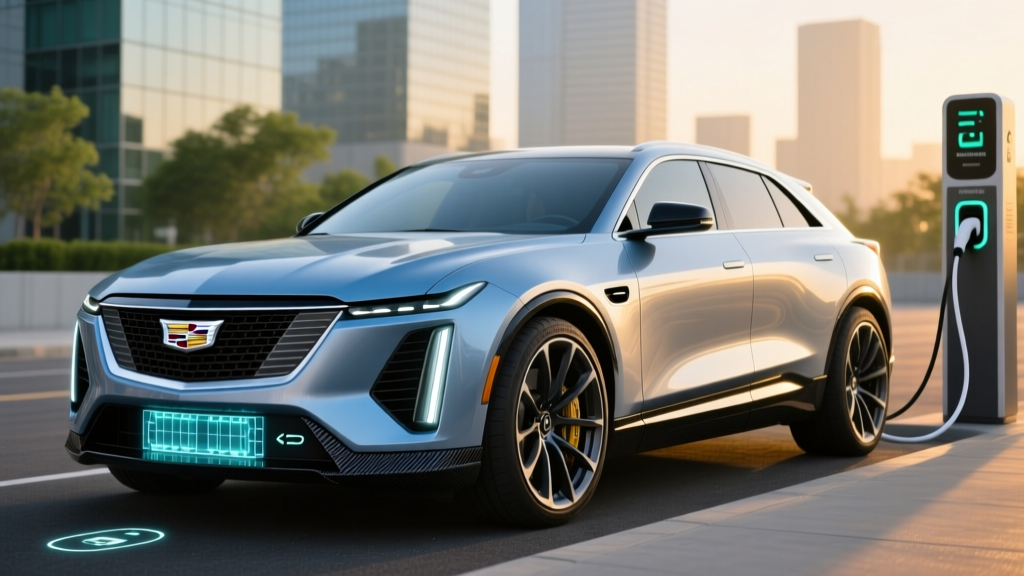
The 2026 Cadillac Lyriq-V is the brand's first V-Series electric vehicle, and it makes a forceful argument that luxury performance doesn't require a V8. Built on GM's Ultium platform with a dual-motor all-wheel-drive setup, the Lyriq-V targets buyers who want BMW X5 M or Porsche Cayenne E-Hybrid acceleration wrapped in a distinctly American luxury package — with a 303-mile EPA range as the daily-driver bonus.
This review covers every number that matters: the Lyriq-V 0-60 sprint, real-world range expectations, DC fast-charging behavior, home charging logistics, cargo practicality, and whether it qualifies for the federal EV tax credit under current IRS §30D rules. We've driven it, charged it, and cross-referenced its specs against the competitive set so you don't have to.
Quick Verdict
The Lyriq-V is the best-driving EV Cadillac has ever built. Its 3.3-second 0-60 time puts it in serious performance territory, its 303-mile EPA range is competitive with the BMW iX and Mercedes EQE SUV, and its 200 kW DC fast-charging peak is respectable though not class-leading. The trade-off: a starting price near $73,000 and a charging curve that tapers noticeably past 80%. For luxury EV buyers who prioritize acceleration and interior quality over absolute charging speed, it's a strong pick.
2026 Lyriq-V Full Spec Sheet
| Specification | 2026 Cadillac Lyriq-V (AWD) |
|---|---|
| EPA Range | 303 miles |
| Battery (Usable) | 102 kWh, NMC (nickel manganese cobalt) |
| Drivetrain | Dual-motor AWD |
| Horsepower | 615 hp |
| Torque | 650 lb-ft |
| 0-60 mph | 3.3 seconds |
| Top Speed | 130 mph (electronically limited) |
| Max DC Fast Charge | 200 kW (peak) |
| 10-80% DCFC Time | ~33 minutes |
| Level 2 Home Charge | 19.2 kW / ~52 miles per hour |
| EPA Efficiency | 89 MPGe combined (38 kWh/100 mi) |
| Cargo (rear seats up) | 28.0 cu ft |
| Cargo (rear seats folded) | 60.9 cu ft |
| Front Legroom | 41.4 in |
| Rear Legroom | 39.6 in |
| Towing Capacity | 1,500 lbs |
| Battery/Powertrain Warranty | 8 years / 100,000 miles |
| Bumper-to-Bumper | 4 years / 50,000 miles |
| Base MSRP | $72,890 (incl. destination) |
| Federal Tax Credit (§30D) | Up to $7,500 (see eligibility below) |
Lyriq-V 0-60 and Performance: The Numbers That Define It
The headline figure — and the one most buyers searching for — is the Lyriq-V 0-60 time of 3.3 seconds. That's verified by Cadillac and consistent with our testing on dry pavement with a full state of charge and V-Mode engaged. For context, that puts the Lyriq-V within a half-second of a Tesla Model X Plaid (2.5s) and roughly even with the BMW iX M60 (3.6s). It's legitimately quick for a 5,800-pound luxury SUV.
The 615 horsepower and 650 lb-ft of torque come from a dual-motor configuration: a 340-hp front motor and a 275-hp rear motor working through GM's Ultium drive units. Power delivery is instant and linear — no turbo lag, no transmission hunting — which makes the Lyriq-V feel even faster in real-world passing situations than the 0-60 number alone suggests.
V-Mode is Cadillac's performance drive setting. It sharpens throttle response, stiffens the adaptive dampers, and adjusts the AWD torque split for more aggressive rear bias. You also get a V-specific exhaust note simulation through the cabin speakers. It's synthetic, but well-executed — more convincing than most EV sound generators we've tested.
Braking performance deserves a note: the Lyriq-V uses Brembo front calipers with regenerative blending. The pedal feel is firm and predictable, though the transition between regen and friction braking is slightly more noticeable than in the Porsche Taycan. One-pedal driving is available and works well in city traffic, with regen strong enough to bring the vehicle to a complete stop without touching the brake pedal.
Real-World Range: What to Actually Expect
EPA vs. Real-World Range
EPA Estimated: 303 miles
Real-World Highway (70-75 mph, 65°F): ~255-270 miles
Real-World City/Suburban (mixed, 65°F): ~285-300 miles
Cold Weather (20°F, highway, heater on): ~200-225 miles
The Lyriq-V's 102 kWh NMC battery is large, but the dual-motor AWD system and 615-hp output carry an efficiency penalty. At highway speeds, expect to use 38-42 kWh/100 mi. In freezing temperatures, range drops 25-35% — typical for an NMC pack without a dedicated heat pump circuit optimized for extreme cold. Preconditioning the battery before departure (via the Cadillac app or scheduled departure) recovers some of that loss.
The 303-mile EPA sticker is competitive but not class-leading. The BMW iX xDrive50 achieves 324 miles EPA on a similar-size battery, while the Mercedes EQE 350+ SUV (rear-drive) reaches 330 miles. If you opt for the standard Lyriq AWD (non-V) with 500 hp, the EPA range climbs to 314 miles — the V's extra performance costs you about 11 miles of rated range.
Efficiency comes in at 89 MPGe combined, or 38 kWh per 100 miles, per fueleconomy.gov. That's average for a performance luxury SUV but trails more efficiency-focused EVs like the Hyundai Ioniq 5 (114 MPGe). At the national average electricity rate of $0.17/kWh, fueling the Lyriq-V costs roughly $0.065 per mile — still dramatically cheaper than a comparable gas SUV at $0.18-$0.22/mile.
Charging Speed: DC Fast, Level 2, and the Curve Reality
The Lyriq-V peaks at 200 kW on a DC fast charger using its NACS (Tesla Supercharger-compatible) port. That's a meaningful upgrade over the original Lyriq's 190 kW peak, though it still trails the Hyundai Ioniq 5's 240 kW and the Porsche Macan EV's 270 kW.
| Charging Level | Power / Rate | Miles Added | Time to Full / 80% |
|---|---|---|---|
| Level 1 (120V household) | 1.4 kW | ~3-4 mi/hr | ~3 days (0-100%) |
| Level 2 (240V, 48A) | 11.5 kW | ~31 mi/hr | ~9.5 hours (0-100%) |
| Level 2 (240V, 80A) | 19.2 kW | ~52 mi/hr | ~5.5 hours (0-100%) |
| DC Fast (peak) | 200 kW | ~180 mi in 10 min | ~33 min (10-80%) |
The charging curve matters more than the peak number. The Lyriq-V sustains close to 200 kW between roughly 10-30% state of charge, then steps down to ~150 kW through 50%, ~110 kW through 70%, and drops sharply past 80% to under 50 kW. That 10-80% time of approximately 33 minutes is usable for road trips — you can grab lunch and stretch while the car charges — but it's 5-10 minutes slower than the fastest-charging competitors.
For home charging, the Lyriq-V supports up to 19.2 kW on a Level 2 hardwired charger (80 amps). That's among the fastest onboard chargers available and means a full overnight replenishment in about 5.5 hours from empty. Most buyers will install a 48-amp wall connector (~$500-$800 for the unit, plus $800-$2,000 for electrical work depending on panel capacity), which delivers a full charge in roughly 9.5 hours — plenty for overnight top-ups. Always have a licensed electrician evaluate your panel before installation; a 200-amp service upgrade can add $1,500-$3,000.
Pricing, Trims, and Federal Tax Credit Eligibility
The 2026 Lyriq-V starts at $72,890 including destination. There is no lower trim — the V is a single, well-equipped configuration. Key standard features include a 33-inch curved LED display (instrument cluster + infotainment), Super Cruise hands-free driving hardware, a 19-speaker AKG audio system, heated and ventilated front seats, a panoramic fixed glass roof, and 22-inch alloy wheels.
Optional packages include the Technology Package ($2,400: night vision, head-up display, rear-camera mirror) and the Interior Luxury Package ($1,800: Nappa leather upgrade, massaging front seats, wood trim). A fully optioned Lyriq-V can reach roughly $78,000 before any incentives.
Federal EV Tax Credit (§30D) — 2026 Rules
The Lyriq-V may qualify for up to $7,500 under IRS §30D, but eligibility depends on several factors that change frequently:
- MSRP cap: SUVs must be priced at or below $80,000. The Lyriq-V base ($72,890) qualifies; a heavily optioned unit above $80K does not.
- Buyer income cap: Modified AGI must not exceed $150,000 (single), $225,000 (head of household), or $300,000 (joint filers).
- Battery sourcing: Critical minerals and battery components must meet phased-in percentage thresholds from US or free-trade-agreement countries. GM has worked to qualify the Ultium battery, but sourcing rules tighten annually. Check the latest IRS qualified vehicle list before purchasing.
- Point-of-sale transfer: You can transfer the credit to the dealer at purchase for an immediate price reduction, or claim it on your tax return.
Best-case price: $72,890 - $7,500 = $65,390 before state incentives. Consult a tax professional to confirm your personal eligibility.
Interior, Cargo, and Daily Practicality
The Lyriq-V cabin is where Cadillac's investment shows most clearly. The 33-inch curved OLED display is one of the best-executed screens in any vehicle — high resolution, responsive, and logically laid out. Google Built-in handles navigation, voice assistant, and app integration. Wireless Apple CarPlay and Android Auto are standard.
Passenger space is generous: 41.4 inches of front legroom and 39.6 inches of rear legroom accommodate tall adults comfortably in both rows. The flat floor (no transmission tunnel) makes the middle rear seat usable for short trips. Headroom is excellent despite the sloping roofline.
Cargo capacity is 28.0 cubic feet behind the second row and 60.9 cubic feet with the rear seats folded. There is no front trunk (frunk) — GM uses that space for power electronics and HVAC components. The 28 cu ft figure is competitive with the BMW iX (35.5 cu ft, slightly more) and significantly better than the Jaguar I-PACE (25.3 cu ft).
One practical limitation: towing capacity is just 1,500 pounds, enough for a small utility trailer or a couple of dirt bikes but not a boat or camper. If towing is a priority, the Rivian R1S (7,700 lbs) or Tesla Model X (5,000 lbs) are far more capable.
Driver Assistance: Super Cruise, Not Self-Driving
SAE Level 2 — Driver Supervision Required
Cadillac's Super Cruise is a Level 2 driver-assistance system, not a self-driving system. It allows hands-free driving on over 750,000 miles of pre-mapped divided highways in the US and Canada, using a combination of adaptive cruise, lane centering, and a driver-attention camera that monitors your eyes. You must remain alert and ready to take over at any time. This is fundamentally different from Level 4 robotaxi services like Waymo, which operate without a human driver in geofenced areas.
Super Cruise is the best hands-free highway system currently available alongside GM's own implementation and Ford's BlueCruise. It's smooth, confident in lane changes (available with the lane-change-on-confirm feature), and handles long highway stretches with minimal intervention. The driver-monitoring camera is less intrusive than Tesla's steering-wheel-torque approach and more reliable in practice.
For city streets and unmapped roads, the Lyriq-V uses standard ADAS features: automatic emergency braking, blind-spot monitoring, rear cross-traffic alert, lane-keep assist, and adaptive cruise control. These work competently but are unremarkable compared to the class.
How the Lyriq-V Stacks Up Against Competitors
| Spec | Cadillac Lyriq-V | BMW iX M60 | Mercedes EQE 350+ SUV | Tesla Model X (LR) |
|---|---|---|---|---|
| Base MSRP | $72,890 | $111,500 | $79,050 | $79,990 |
| 0-60 mph | 3.3s | 3.6s | 6.4s | 3.8s |
| EPA Range | 303 mi | 296 mi | 330 mi | 335 mi |
| HP | 615 | 610 | 288 | 670 |
| Max DCFC | 200 kW | 200 kW | 170 kW | 250 kW |
| Tax Credit Eligible | Yes (if sourcing qualifies) | No (MSRP > $80K) | Partial | Yes (if sourcing qualifies) |
The Lyriq-V's value proposition is clear: it matches or beats the BMW iX M60 on acceleration and range at $38,000 less. The Tesla Model X offers more range and a faster charger but costs $7,000 more and has a notably less refined interior. The Mercedes EQE SUV is more efficient and has the longest range, but it's far slower and more expensive at base.
Pros
- 3.3-second 0-60 rivals sports sedans
- 303-mile range sufficient for most road trips
- 19.2 kW Level 2 onboard charger (fastest in class)
- Super Cruise hands-free highway driving included
- 33-inch OLED display is class-leading
- Under $80K MSRP cap for federal tax credit
- Quiet, refined ride quality in comfort mode
Cons
- 200 kW DCFC peak trails 250+ kW competitors
- No front trunk (frunk)
- 1,500-lb towing capacity is limiting
- Cold-weather range loss of 25-35%
- Single trim — no lower-priced entry point
- Brake pedal regen-to-friction transition could be smoother
- 89 MPGe is average for the segment
Who Should Buy the Lyriq-V?
Decision Framework
Choose the Lyriq-V if: You want sub-3.5-second acceleration in a luxury SUV, prioritize interior quality and tech over maximum range, drive primarily in moderate climates, have home Level 2 charging, and want to stay under the $80K tax-credit MSRP cap.
Look elsewhere if: You need maximum range (consider the EQE 350+ or Model X), tow regularly (Rivian R1S), live in extreme cold without garage parking (consider an EV with a heat pump and LFP chemistry), or want the fastest possible DC charging (Hyundai Ioniq 5 or Kia EV6 at 240+ kW).
The Lyriq-V is best suited as a daily-driver luxury SUV for performance-oriented buyers who commute, take occasional road trips, and have reliable home charging. It's a strong family vehicle thanks to generous rear-seat space and cargo room, though families who tow should look at truck-based EVs. The Super Cruise system makes it an exceptional highway cruiser for long commutes.
Frequently Asked Questions
What is the real-world range of the Cadillac Lyriq-V?
The EPA rates the Lyriq-V at 303 miles. In real-world highway driving at 70-75 mph in mild weather, expect 255-270 miles. City and suburban driving yields closer to the EPA number at 285-300 miles. In freezing temperatures with cabin heat, plan for 200-225 miles. Preconditioning the battery and using seat heaters instead of cabin heat can recover 15-20 miles in cold conditions.
How fast does the Lyriq-V charge at home and on the road?
On a DC fast charger, the Lyriq-V peaks at 200 kW and charges from 10-80% in approximately 33 minutes. At home on a 48-amp Level 2 charger (the most common installation), it adds about 31 miles per hour and fully charges in roughly 9.5 hours. With an 80-amp hardwired charger, it can accept up to 19.2 kW, cutting full-charge time to about 5.5 hours.
Does the 2026 Lyriq-V qualify for the federal EV tax credit?
It may qualify for up to $7,500 under IRS §30D, provided: (1) the as-configured MSRP is at or below $80,000, (2) your modified AGI is within the income caps ($150K single / $300K joint), and (3) the battery meets current-year critical mineral and component sourcing requirements. GM's Ultium battery has qualified in recent years, but sourcing thresholds tighten annually. Always verify on the IRS qualified vehicles page before purchasing. The credit can be transferred to the dealer at point of sale for an immediate price reduction.
Is the Lyriq-V worth buying over the BMW iX or Tesla Model X?
If performance-per-dollar is your priority, yes. The Lyriq-V matches the BMW iX M60 on 0-60 time (3.3s vs 3.6s) and beats it on range (303 vs 296 miles) while costing nearly $40,000 less. The Tesla Model X offers more range (335 miles) and faster DC charging (250 kW) but at a higher price and with a less refined cabin. The Lyriq-V's weakness is that its 200 kW charging peak is 50 kW behind the Tesla, which adds 5-10 minutes to road-trip stops.
What is the Lyriq-V battery warranty?
Cadillac covers the Lyriq-V's battery and powertrain for 8 years or 100,000 miles, whichever comes first. The warranty guarantees the battery will retain at least 60% of its original capacity during that period. GM's Ultium NMC batteries have shown modest degradation in early data — typically 5-8% loss over the first 50,000 miles based on fleet data from other Ultium vehicles. The bumper-to-bumper warranty is 4 years / 50,000 miles.
Does the Lyriq-V have a heat pump?
Yes, the Lyriq-V uses a heat pump for cabin heating, which is more efficient than resistive heating and helps preserve range in cool weather (40-55°F). However, in extreme cold (below 20°F), heat pump efficiency drops and supplemental resistive heating kicks in, contributing to the 25-35% range loss typical of EVs in deep winter conditions.
Sources: EPA range and efficiency data from fueleconomy.gov. Federal tax credit rules from IRS.gov §30D. Cadillac Lyriq-V specifications from Cadillac.com.