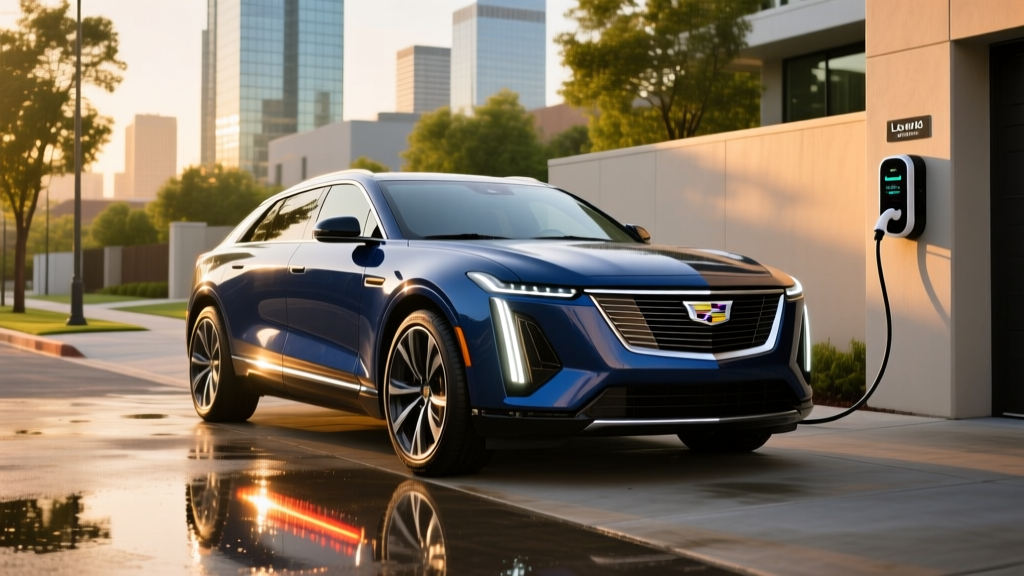
The Cadillac Lyriq remains General Motors' flagship electric luxury crossover and the brand's most convincing argument that legacy automakers can compete with Tesla, Rivian, and the German establishment on battery-electric turf. Built on GM's Ultium platform, the Lyriq pairs a 102 kWh usable battery with one of the best Level 2 home-charging speeds in its class. But luxury EV buyers need more than a glowing hood ornament — they need real-world range honesty, charging practicality, and clear tax-credit math. Here is our data-driven 2026 breakdown.
Quick Verdict: Who the Lyriq Is For
The 2026 Cadillac Lyriq is best suited for luxury-crossover shoppers who prioritize ride comfort, cabin refinement, and home-charging convenience over track performance or cutting-edge autonomy. It is a commuter and road-trip cruiser, not a performance SUV. Buyers who need three rows, serious towing, or hands-free-everywhere driving should look at the Rivian R1S, BMW iX, or Tesla Model X instead. For two-row luxury with an outstanding Level 2 charge rate and a compliant ride, the Lyriq holds its ground.
Range, Efficiency, and the Real-World Reality Check
The EPA rates the rear-wheel-drive (RWD) Lyriq at 314 miles of range, while the all-wheel-drive (AWD) variant drops to 307 miles. On the efficiency side, the RWD model achieves approximately 89 MPGe combined (roughly 37 kWh/100 mi), which trails the BMW iX xDrive50 and Tesla Model X but is competitive with the Genesis Electrified GV70.
- EPA sticker: 314 mi (RWD) / 307 mi (AWD)
- Mixed highway driving (70-75 mph, moderate climate): expect ~265-285 mi
- Cold weather (below 30°F, cabin heat on): expect ~220-250 mi — a 20-30% reduction typical of NMC chemistry without aggressive heat-pump preconditioning
- City/regenerative driving: can approach or slightly exceed EPA figures thanks to regen recapture
The Lyriq uses an NMC (nickel manganese cobalt) battery chemistry, which offers higher energy density than LFP but is more susceptible to cold-weather range loss. GM's thermal management system is competent but not class-leading; precondition the cabin while plugged in to mitigate winter losses. According to fueleconomy.gov, the Lyriq's combined efficiency is respectable but not exceptional for a vehicle of its mass (~5,700 lbs curb weight).
Charging Speed: The Lyriq's Sleeper Advantage
This is where the Lyriq quietly outperforms most rivals. Its onboard AC charger supports 19.2 kW on Level 2 — a rate that adds roughly 52 miles of range per hour of charging at home. Most competitors (BMW iX, Audi Q8 e-tron, Genesis GV70 Electrified) cap out between 7.2 kW and 11.5 kW. If you install a hardwired Level 2 station on a 100-amp circuit, the Lyriq can replenish its entire 102 kWh battery overnight in approximately 5.5 hours.
| Charge Level | Power (kW) | Connector | Speed / Time |
|---|---|---|---|
| Level 1 (120V household) | ~1.4 kW | J1772 / NACS | ~4 mi/hr — emergency use only |
| Level 2 (240V home) | 19.2 kW (max) | NACS (native) | ~52 mi/hr; 0-100% in ~5.5 hrs |
| DC Fast Charge | 190 kW (peak) | NACS (native) | 10-80% in ~30 min; tapers sharply above 80% |
On DC fast charging, the Lyriq peaks at 190 kW and sustains strong throughput between 10-50% SoC before tapering. A 10-80% session takes approximately 30 minutes at a capable 350 kW station. That is slower than the Hyundai Ioniq 5 or Porsche Macan Electric (which hit 10-80% in 18-21 minutes) but adequate for highway rest stops. The Lyriq uses the NACS (North American Charging Standard) connector natively, giving it seamless access to Tesla Superchargers and the growing NACS-equipped public network without an adapter.
One ownership note: to unlock the full 19.2 kW Level 2 rate, you need a hardwired wall connector on a dedicated 100A circuit. Many homes have 100A or 150A main panels, and adding a 100A sub-circuit may require a panel upgrade ($1,500-$3,500). Budget for this during purchase planning.
Performance and Drivetrain
| Spec | RWD (Luxury / Sport) | AWD (Sport / V-Series) |
|---|---|---|
| Powertrain | Single rear motor | Dual motor AWD |
| Horsepower | 340 hp | 500 hp |
| Torque | 325 lb-ft | 450 lb-ft |
| 0-60 mph | 6.0 sec | 4.6 sec |
| Top Speed | 118 mph | 130 mph |
| Towing Capacity | 1,500 lbs (braked) | |
The RWD Lyriq delivers smooth, linear acceleration appropriate for a luxury cruiser — not exhilarating, but never strained. The AWD variant's 500 hp and 4.6-second sprint make it genuinely quick, though it still trails the BMW iX M60 and Tesla Model X Plaid. Ride quality is a highlight: the Lyriq's five-link rear suspension and passive damping absorb highway imperfections with a composure that outshines the firmer-riding iX. Steering is light and isolated — some enthusiasts will find it numb, but it suits the luxury brief.
Towing is limited to 1,500 lbs, ruling out most travel trailers and boat setups. If towing is a priority, the Rivian R1S (7,700 lbs) or even the Hyundai Ioniq 5 (2,300 lbs) offer more utility.
Interior, Cargo, and Technology
The cabin centers on a 33-inch LED curved display that spans the instrument cluster and infotainment touchscreen into a single pane of glass. Google Built-In powers navigation, voice assistant, and app integration. Wireless Apple CarPlay and Android Auto are standard. A 19-speaker AKG Studio audio system is included on most trims.
| Dimension | Measurement |
|---|---|
| Front headroom | 39.7 in |
| Front legroom | 44.3 in |
| Rear headroom | 38.4 in |
| Rear legroom | 39.6 in |
| Cargo (rear seats up) | 28.0 cu ft |
| Cargo (rear seats folded) | 60.9 cu ft |
| Frunk | None |
Cargo space is adequate but not generous for the segment — the BMW iX offers 35.5/77.9 cu ft, and the Tesla Model X dwarfs it with its frunk and available third row. The Lyriq has no front trunk (frunk), a missed opportunity given the Ultium platform's packaging flexibility. Rear legroom is comfortable for adults on long trips.
On the driver-assistance front, Super Cruise is available on mapped divided highways, offering genuine hands-free driving with eye monitoring. This is a SAE Level 2 system — the driver must remain attentive and ready to resume control. Super Cruise coverage has expanded to over 750,000 miles of compatible roads in North America, and it remains one of the most refined Level 2 implementations on the market. However, it does not function on unmapped surface streets or in construction zones, and it will not handle intersections or autonomous parking.
Super Cruise is an SAE Level 2 driver-assist system. It is not self-driving. The driver must keep eyes on the road (monitored via infrared camera) and hands available to resume the wheel. It operates only on pre-mapped limited-access highways. It will not navigate roundabouts, traffic lights, or unmapped roads.
Pricing, Trims, and Federal Tax Credit Eligibility
| Trim | Drivetrain | Base MSRP | Est. After §30D Credit* |
|---|---|---|---|
| Luxury RWD | RWD | $58,590 | ~$51,090 |
| Sport RWD | RWD | $60,290 | ~$52,790 |
| Sport AWD | AWD | $63,790 | ~$56,290 |
| V-Series AWD | AWD | $74,990 | ~$67,490 |
*Tax credit estimates assume full $7,500 eligibility under IRS §30D. Actual eligibility depends on buyer income, battery sourcing, and MSRP caps. See checklist below.
The Lyriq's MSRP falls under the $80,000 SUV cap for the federal §30D clean vehicle credit, making most trims potentially eligible for up to $7,500 — either as a point-of-sale reduction at the dealer or as a tax credit claimed on your return. However, eligibility is not automatic. Per IRS guidelines, buyers must meet all of the following:
- Income caps: Modified AGI ≤ $150,000 (single), $225,000 (head of household), or $300,000 (joint)
- MSRP cap: Vehicle MSRP ≤ $80,000 (SUV classification — Lyriq qualifies)
- Battery sourcing: Critical minerals and battery components must meet phased-in domestic/FTEA sourcing thresholds (verify with dealer for specific VIN)
- Assembly: Final assembly must occur in North America (Lyriq is built in Spring Hill, Tennessee — qualifies)
- Transfer election: Buyers may transfer the credit to the dealer for a point-of-sale price reduction starting in 2024
Always confirm eligibility with your tax professional before committing to a purchase, as sourcing rules tighten annually and specific VINs may qualify for the full $7,500, a partial $3,750, or nothing at all depending on battery-component origin.
Warranty and Long-Term Ownership
GM backs the Lyriq with competitive warranty coverage:
- Battery & powertrain: 8 years / 100,000 miles (whichever comes first)
- Bumper-to-bumper: 4 years / 50,000 miles
- Battery capacity retention: GM warrants the Ultium battery against falling below ~70% of original capacity during the warranty period
NMC batteries in liquid-cooled packs like the Lyriq's typically degrade 8-12% over the first 100,000 miles based on industry data from similar GM Ultium and Hyundai E-GMP vehicles. Keeping daily charge between 20-80% SoC and avoiding repeated DC fast-charging sessions will extend long-term State of Health (SoH). GM's Ultium platform has not yet accumulated enough real-world mileage data (the Lyriq launched for MY2023) to confirm 200,000-mile degradation curves, but early owner reports and third-party telematics data suggest normal wear patterns.
Lyriq vs. Key Competitors
| Spec | Cadillac Lyriq AWD | BMW iX xDrive50 | Genesis Electrified GV70 | Tesla Model X LR |
|---|---|---|---|---|
| EPA Range | 307 mi | 324 mi | 236 mi | 335 mi |
| Battery (usable) | 102 kWh (NMC) | 105.2 kWh (NMC) | 77.4 kWh (NMC) | 100 kWh (est.) |
| DC Fast Peak | 190 kW | 200 kW | 240 kW | 250 kW |
| Level 2 Max | 19.2 kW | 11.0 kW | 10.9 kW | 11.5 kW |
| 0-60 mph | 4.6 sec | 4.4 sec | 4.2 sec | 3.8 sec |
| Base MSRP | $63,790 | $87,250 | $68,450 | $79,990 |
| §30D Eligible | Yes (most trims) | No (MSRP cap) | No (non-NA assembly) | Partial (sourcing) |
| Super Cruise / L2+ | Yes | No (Highway Assistant) | No | Autopilot / FSD Supervised |
- You want the fastest home Level 2 charging in the luxury segment
- Ride comfort and cabin quietness matter more than corner-carving dynamics
- Super Cruise hands-free highway driving appeals to you
- You want a sub-$65K luxury EV SUV that qualifies for the full §30D credit
- You need three rows or significant towing capacity → Rivian R1S, Tesla Model X
- You prioritize maximum DC fast-charging speed → Hyundai Ioniq 5, Porsche Macan Electric
- You want a sportier driving experience → BMW iX, Porsche Macan Electric
- Range is your top priority → Tesla Model X, BMW iX
Pros and Cons
- Class-leading 19.2 kW Level 2 home charging
- Smooth, quiet ride quality befitting the Cadillac name
- Super Cruise hands-free highway driving (SAE Level 2)
- Federal §30D tax credit eligible on most trims
- NACS connector — native Supercharger access
- Striking design with premium materials
- No front trunk (frunk) — wasted packaging opportunity
- Cargo space trails BMW iX and Tesla Model X
- 1,500-lb towing limit is restrictive
- DC fast charging at 190 kW lags segment leaders
- Infotainment learning curve with the 33-inch curved display
- Cold-weather range loss typical of NMC without best-in-class heat pump
Frequently Asked Questions
What is the real-world range of the Cadillac Lyriq?
The EPA rates the RWD Lyriq at 314 miles and the AWD at 307 miles. In real-world mixed highway driving at 70-75 mph, expect 265-285 miles. In cold weather below 30°F, plan for 220-250 miles. City driving with regenerative braking can approach or slightly exceed EPA estimates.
How fast does the Lyriq charge at home and on the road?
At home on a Level 2 (240V) hardwired station, the Lyriq charges at up to 19.2 kW — adding about 52 miles of range per hour and fully replenishing in roughly 5.5 hours. On DC fast chargers, it peaks at 190 kW and reaches 10-80% in approximately 30 minutes. Note that charging slows significantly above 80% SoC to protect battery health.
Does the Cadillac Lyriq qualify for the $7,500 federal EV tax credit?
Most trims qualify for the full $7,500 under IRS §30D because the Lyriq is assembled in Tennessee (North America), falls under the $80,000 SUV MSRP cap, and meets current battery-sourcing requirements. However, buyer income must not exceed $150K (single) / $300K (joint) modified AGI. Always verify with the dealer for the specific VIN and consult a tax professional. The credit can be transferred to the dealer for a point-of-sale price reduction.
How much does the Lyriq cost after tax credits?
The base Luxury RWD trim starts at $58,590. With the full $7,500 §30D credit applied, the effective price drops to approximately $51,090 — competitive with non-luxury EVs like the Ford Mustang Mach-E Premium. The V-Series AWD at $74,990 drops to roughly $67,490 after the credit.
Is the Lyriq worth buying vs. the BMW iX or Tesla Model X?
The Lyriq wins on value (significantly lower MSRP, tax credit eligibility), home-charging speed (19.2 kW vs. 11 kW), and ride comfort. The BMW iX offers more range (324 mi), more cargo room, and sharper handling but costs $20K+ more and doesn't qualify for the federal credit due to MSRP caps. The Tesla Model X offers more range, a frunk, optional third row, and faster DC charging, but its interior quality and ride refinement don't match the Cadillac. Choose based on your priorities: luxury value (Lyriq), driving dynamics (iX), or utility and tech (Model X).
Is Super Cruise actually self-driving?
No. Super Cruise is an SAE Level 2 driver-assistance system. It provides hands-free steering, acceleration, and braking on pre-mapped limited-access highways, but the driver must remain attentive (monitored by an infrared eye-tracking camera) and be ready to take over at any time. It does not handle surface streets, intersections, or construction zones autonomously. Only Level 4 services like Waymo operate without a human driver in the loop.
What is the battery warranty on the Lyriq?
GM provides an 8-year / 100,000-mile warranty on the Ultium battery pack and electric powertrain components. The battery is warranted against capacity loss below approximately 70% of its original state of health during the warranty period. The bumper-to-bumper warranty covers 4 years / 50,000 miles.
For official EPA efficiency data, visit fueleconomy.gov. For current §30D tax credit rules, consult the IRS Clean Vehicle Credit page. Safety ratings are available through NHTSA and IIHS.