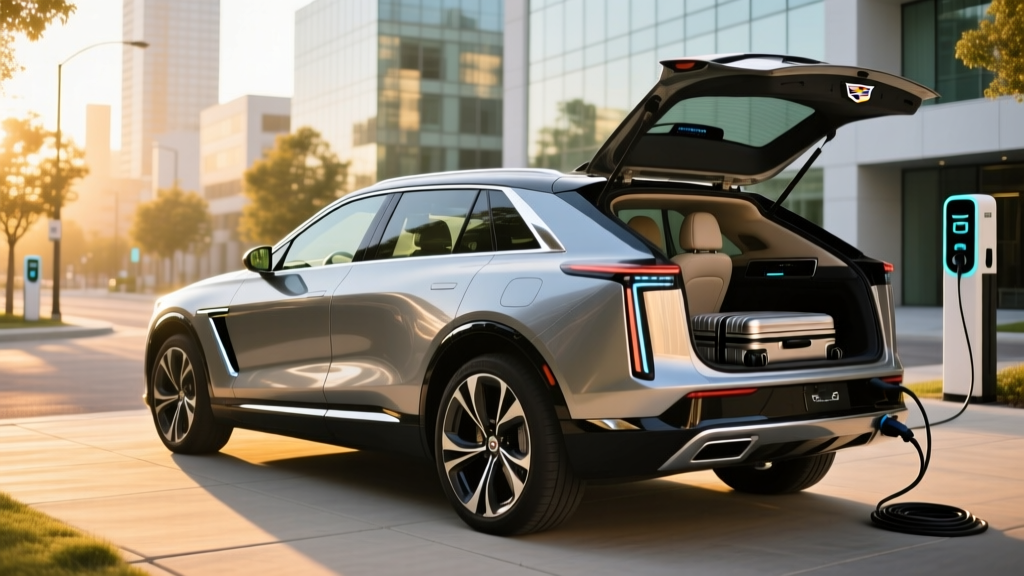
The Cadillac Lyriq has carved out a distinct niche as a luxury electric SUV that doesn't try to be a Tesla clone. But for buyers eyeing this vehicle for family road trips, cargo hauling, or towing light loads, weight ratings matter just as much as horsepower and infotainment screens. Understanding the Cadillac Lyriq GVWR (Gross Vehicle Weight Rating) tells you exactly how much weight the vehicle is engineered to safely carry — passengers, cargo, and accessories combined — before you exceed its structural and braking limits.
In this deep-dive review, we cover the Lyriq's weight ratings, real-world range, charging performance, pricing, and how it stacks up against rivals like the BMW iX, Genesis Electrified GV70, and Tesla Model X.
What Is the Cadillac Lyriq GVWR and Why It Matters
The GVWR is the maximum allowable total weight of a fully loaded vehicle — including the vehicle itself, all passengers, cargo, and any accessories. For the 2026 Cadillac Lyriq, the GVWR sits at approximately 6,210 lbs (2,817 kg) for the rear-wheel-drive (RWD) model and 6,415 lbs (2,910 kg) for the all-wheel-drive (AWD) variant.
With a curb weight of roughly 5,730 lbs for RWD and 5,870 lbs for AWD, that leaves a practical payload capacity of about 480 lbs (RWD) and 545 lbs (AWD). In real terms, that's four adults and a weekend's worth of luggage — but not much more. If you're loading up a family of four (averaging 170 lbs each), you've consumed 680 lbs, which already pushes past the RWD payload limit. This is a common EV reality: heavy battery packs eat into payload headroom.
| Specification | RWD | AWD |
|---|---|---|
| Curb Weight | ~5,730 lbs | ~5,870 lbs |
| GVWR | ~6,210 lbs | ~6,415 lbs |
| Max Payload Capacity | ~480 lbs | ~545 lbs |
| Max Towing Capacity | 3,500 lbs (w/ trailering pkg) | 3,500 lbs (w/ trailering pkg) |
| GCWR (Gross Combined Weight Rating) | ~9,710 lbs | ~9,915 lbs |
Owner insight: If you regularly carry four or five adults plus gear, the AWD model's slightly higher payload is worth noting. And if you plan to use the optional trailering package (3,500-lb rating), remember that tongue weight counts against your payload — a 350-lb tongue weight on a loaded trailer leaves very little room for passengers and cargo inside the Lyriq.
Range, Efficiency, and Real-World Expectations
The 2026 Cadillac Lyriq uses GM's Ultium platform with a 102 kWh usable battery pack (12-module, NMC lithium-ion chemistry). Here's what the EPA says — and what you should actually expect.
- RWD: 314 miles (EPA combined)
- AWD: 307 miles (EPA combined)
- City/suburban driving (mild weather): ~290–320 mi (RWD) — regen braking in stop-and-go helps
- Highway (70–80 mph, mild weather): ~245–270 mi (RWD) — aerodynamic drag dominates at speed
- Cold weather (below 32°F, mixed driving): ~210–250 mi (RWD) — expect 20–30% range loss without preconditioning
Efficiency ratings from fueleconomy.gov put the RWD Lyriq at 89 MPGe combined (37 kWh/100 mi) and the AWD at 87 MPGe (39 kWh/100 mi). These are midpack numbers for the luxury EV SUV segment — the BMW iX xDrive50 achieves 87 MPGe, while the Tesla Model X Long Range hits 102 MPGe thanks to superior aerodynamics and a lighter chassis.
The Lyriq's heavy curb weight (a consequence of the Ultium battery and steel-intensive body structure) is the primary efficiency limiter. If range-per-kWh is your top priority, this isn't the class leader. But if ride quality, cabin quietness, and luxury feel rank higher, the tradeoff is reasonable.
Charging Speed: DC Fast Charging and Home Level 2
Charging performance is where the Lyriq has improved incrementally through software updates. Here's the current picture for the 2026 model year:
| Charging Level | Power / Rate | Speed / Time | Connector |
|---|---|---|---|
| Level 1 (120V household) | ~1.4 kW | ~4 mi/hr added | J1772 / NACS adapter |
| Level 2 (240V home, 48A) | 11.5 kW | ~31 mi/hr added; full charge ~10 hrs | J1772 / NACS |
| DC Fast Charge (peak) | 190 kW | 10–80% in ~33 min | CCS1 (or NACS via adapter) |
| DC Fast Charge (sustained avg.) | ~120–140 kW | Average across 10–80% session | CCS1 / NACS |
Charging curve reality check: The Lyriq peaks at 190 kW only between roughly 10–35% state of charge (SoC), then tapers progressively. From 60–80%, you'll see rates drop to 80–100 kW. That 33-minute 10–80% claim assumes ideal battery temperature (preconditioned) and a functioning 350 kW CCS charger. In practice at Electrify America or EVgo stations, expect 35–45 minutes for a 10–80% session.
For home charging, the Lyriq's 11.5 kW onboard charger is a strong point. A properly installed 60-amp circuit with a 48-amp Level 2 charger (like the ChargePoint Home Flex or Emporia Vue) will replenish about 31 miles of range per hour — easily enough to go from 20% to 100% overnight. Installation costs typically run $800–$2,000 depending on your panel capacity and run length, per licensed electrician estimates.
One notable development: GM's adoption of the NACS (Tesla) charging standard means the 2026 Lyriq ships with a NACS port, granting native access to Tesla Supercharger stations (V3 and V4) without an adapter. This significantly expands the reliable fast-charging network available to Lyriq owners.
Performance and Drivetrain
The Lyriq is tuned for effortless luxury cruising, not track performance. Here are the numbers:
| Spec | RWD | AWD |
|---|---|---|
| Horsepower | 340 hp | 500 hp |
| Torque | 325 lb-ft | 450 lb-ft |
| 0–60 mph | 6.0 sec | |
| Drivetrain | Rear motor (RWD) | Dual motor (AWD) |
| Top Speed | 118 mph (electronically limited) | 130 mph (electronically limited) |
The AWD model's 500 hp and 4.6-second 0–60 time provide genuine punch for highway merging and passing. The RWD model is more than adequate for daily driving — 340 hp in an EV delivers smooth, linear torque with no gear-shift lag. The Lyriq's adaptive air suspension (available on upper trims) soaks up rough pavement and delivers the floaty, isolated ride Cadillac buyers expect.
Regenerative braking offers multiple levels via paddle shifters behind the steering wheel, including a one-pedal driving mode that can bring the Lyriq to a full stop without touching the brake pedal. This is particularly useful in stop-and-go traffic and helps recapture energy that would otherwise be lost.
Pricing, Trims, and Federal Tax Credit Eligibility
The 2026 Cadillac Lyriq is offered in four trims. Pricing has shifted modestly from the 2025 model year:
| Trim | Drivetrain | Base MSRP | Est. As-Tested (loaded) |
|---|---|---|---|
| Tech (base) | RWD | $58,590 | $62,000–$64,000 |
| Luxury | RWD or AWD | $62,590 (RWD) / $66,090 (AWD) | $68,000–$72,000 |
| Sport | AWD | $66,090 | $70,000–$75,000 |
| V-Series (performance) | AWD | $73,590 | $78,000–$82,000 |
Does the Cadillac Lyriq Qualify for the Federal EV Tax Credit?
This is where the Lyriq's GVWR becomes directly relevant to your wallet. Under IRS §30D rules, the federal EV tax credit has different MSRP caps based on vehicle classification:
- SUVs, vans, and trucks: MSRP cap of $80,000
- Sedans and other passenger vehicles: MSRP cap of $55,000
The Lyriq is classified as an SUV (its GVWR exceeds 6,000 lbs, which is one factor the IRS uses), meaning all Lyriq trims fall under the $80,000 MSRP cap. This is critical — if the Lyriq were classified as a sedan, only the base Tech trim would qualify, and barely.
- ✓ Vehicle MSRP below $80,000 (SUV classification) — All Lyriq trims qualify
- ⚠ Buyer modified adjusted gross income (MAGI): ≤ $150,000 (single), ≤ $225,000 (head of household), ≤ $300,000 (joint)
- ⚠ Battery critical minerals and component sourcing requirements must be met (GM has been working to comply, but verify current-year eligibility on IRS.gov)
- ✓ Point-of-sale transfer available — you can apply the credit as a down payment reduction at the dealer
- ⚠ Credit amount: up to $7,500, split between critical minerals ($3,750) and battery components ($3,750) — partial credit possible
Bottom line: Many Lyriq buyers will qualify for the full or partial $7,500 credit, but eligibility depends on your income and the current battery-sourcing compliance status. Always verify on the IRS website before purchasing, and consult a tax professional for your specific situation.
Interior Space, Technology, and Drawbacks
The Lyriq's cabin is where Cadillac makes its strongest luxury argument. The centerpiece is a 33-inch LED display that stretches across the dashboard, combining the instrument cluster and infotainment screen into a single curved panel running Google Built-In (Google Maps, Google Assistant, Play Store).
| Dimension | Measurement |
|---|---|
| Front Headroom | 38.6 in |
| Front Legroom | 44.3 in |
| Rear Headroom | 37.7 in |
| Rear Legroom | 39.6 in |
| Cargo Volume (behind 2nd row) | 28.0 cu ft |
| Cargo Volume (2nd row folded) | 60.9 cu ft |
| Frunk | None (no front trunk) |
Standout tech features:
- Super Cruise (available on Luxury and above): GM's Level 2 hands-free driver-assist system, operational on over 750,000 miles of mapped highways in North America. This is not autonomous driving — you must remain attentive and the system monitors your eyes via a driver-facing camera.
- AKG 19-speaker audio system with headrest speakers on upper trims
- Wireless Apple CarPlay and Android Auto
- Remote parking assist and 360-degree camera system
- Over-the-air (OTA) updates for powertrain calibration, infotainment, and ADAS improvements
- No frunk: Unlike the Tesla Model X, Rivian R1S, or Ford Mustang Mach-E, the Lyriq has no front trunk. All cargo must go in the rear.
- Touch-sensitive climate controls: The haptic-touch slider for temperature and fan speed is less intuitive than physical knobs — a common complaint among owners.
- DC charging speed trails rivals: At 190 kW peak, the Lyriq charges slower than the Hyundai Ioniq 5 (240 kW), Kia EV9 (236 kW), or Porsche Macan Electric (270 kW).
- Heavy weight impacts tire wear: At nearly 6,000 lbs, expect tire replacement intervals of 25,000–35,000 miles depending on driving style.
Warranty Coverage
GM backs the Lyriq with competitive warranty terms:
- Battery & Propulsion System: 8 years / 100,000 miles (whichever comes first), with a minimum 70% capacity retention guarantee
- Bumper-to-Bumper (Limited): 4 years / 50,000 miles
- Powertrain (non-electric components): 6 years / 70,000 miles
- Corrosion Protection: 6 years / unlimited miles
- Roadside Assistance: 6 years / 70,000 miles
The 8-year/100,000-mile battery warranty is standard for the segment and matches what BMW, Tesla, and Ford offer. The 70% retention threshold means GM will repair or replace the battery if it degrades below 70% of original capacity within the warranty period — based on current Ultium battery data, most owners should see 85–92% retention at 100,000 miles under normal use.
Lyriq vs. Key Competitors
| Spec | Cadillac Lyriq (AWD) | BMW iX xDrive50 | Tesla Model X LR | Genesis Electrified GV70 |
|---|---|---|---|---|
| EPA Range | 307 mi | 324 mi | 335 mi | 236 mi |
| Battery (kWh) | 102 | 111.5 | 100 | 77.4 |
| Peak DC Charge (kW) | 190 | 200 | 250 | 350* |
| 0–60 mph | 4.6 sec | 4.6 sec | 3.8 sec | 4.2 sec |
| Base MSRP | $66,090 | $87,100 | $79,990 | $68,850 |
| GVWR | ~6,415 lbs | ~6,834 lbs | ~5,732 lbs | ~5,843 lbs |
| Cargo (rear seats up) | 28.0 cu ft | 35.5 cu ft | 37.1 cu ft (+ frunk) | 28.3 cu ft |
| Tax Credit Eligible | Yes (SUV cap) | Partial/Limited | Partial (sourcing) | No (MSRP >$80K as SUV, sourcing) |
*Genesis Electrified GV70 350 kW peak requires 800V-capable charger; most US DC stations deliver 150–250 kW.
- You prioritize ride comfort, cabin quietness, and traditional luxury over sporty dynamics
- Super Cruise hands-free driving on mapped highways is important to you
- You want a luxury EV that qualifies for the federal tax credit under the SUV MSRP cap
- Your daily driving is under 250 miles and you charge at home
- Maximum range is your top priority (consider the Tesla Model X or BMW iX)
- You need the fastest DC charging speeds in the segment (Hyundai Ioniq 5, Kia EV9, or Porsche Macan Electric charge faster)
- You need a frunk or maximum cargo space
- You want third-row seating (check the Kia EV9 or Rivian R1S)
Who the Lyriq Suits Best
The 2026 Cadillac Lyriq is best suited for luxury-oriented commuters and couples who value refinement over raw performance. It excels as a daily driver for professionals with home charging access, offering a serene ride, excellent Super Cruise highway assist, and enough range for most commutes and weekend trips within a 200-mile radius.
For families with small children, the rear seat space is generous and the ride quality is soothing on long drives. However, the lack of a frunk and the modest 28 cu ft cargo area behind the second row means stroller-plus-grocery runs require some packing strategy.
For road trippers, the Lyriq is viable but not optimal. The 190 kW peak charge rate means 30–40 minute stops every 200–250 highway miles, and the growing NACS/Supercharger network helps. But rivals like the Hyundai Ioniq 5 (240 kW, 10–80% in 18 minutes) make road-trip charging noticeably faster.
For towing, the 3,500-lb rating (with the optional trailering package) handles a small boat trailer or lightweight camping trailer. Just remember: towing cuts range by 30–50%, and the tongue weight counts against your already-modest payload.
Frequently Asked Questions
What is the real-world range of the Cadillac Lyriq?
In mixed real-world driving at moderate temperatures (50–80°F), expect 270–300 miles from the RWD model and 260–290 from AWD. Highway-only driving at 75+ mph drops this to 245–270 miles (RWD). In freezing temperatures (below 32°F), range can fall to 210–250 miles without battery preconditioning. Always plan road trips around 200–220 mile segments between charging stops for a comfortable buffer.
How fast does the Cadillac Lyriq charge?
On a DC fast charger, the Lyriq peaks at 190 kW and charges from 10–80% in approximately 33 minutes under ideal conditions (preconditioned battery, functioning high-power CCS/NACS station). Sustained average rates across a full session are closer to 120–140 kW. At home on a 48-amp Level 2 charger (11.5 kW), you'll add about 31 miles of range per hour, with a full charge taking roughly 10 hours.
How much does the Lyriq cost after tax credits?
If you qualify for the full $7,500 federal credit under §30D (income limits met, battery sourcing compliant), the base RWD Tech trim drops from $58,590 to an effective $51,090. The AWD Luxury at $66,090 becomes roughly $58,590. Keep in mind that state and local incentives may stack on top — check your state's EV rebate programs and your utility's off-peak charging rebates for additional savings.
Does the Cadillac Lyriq qualify for the federal EV tax credit?
Yes — the Lyriq is classified as an SUV, so the MSRP cap is $80,000 (all trims qualify). However, you must also meet income limits ($300,000 joint / $150,000 single MAGI), and the vehicle's battery must meet critical-mineral and component-sourcing requirements as defined by the IRS. The credit can be up to $7,500 and may be applied at the point of sale as a down payment reduction. Always verify current eligibility on IRS.gov before purchasing.
Is the Cadillac Lyriq worth buying vs. key competitors?
The Lyriq offers the best value proposition in the luxury EV SUV segment if you prioritize ride quality, Super Cruise, and tax credit eligibility. It undercuts the BMW iX by nearly $20,000 while delivering comparable performance. Against the Tesla Model X, it trades range and charging speed for a more traditional luxury interior and better build quality. The Genesis Electrified GV70 is sportier but has significantly less range (236 mi EPA) and may not qualify for the federal credit. If luxury comfort and a smooth ownership experience matter most, the Lyriq is a strong pick.
What are the biggest pros and cons of the Lyriq?
- Exceptionally quiet, comfortable ride with available air suspension
- Super Cruise hands-free driving on 750,000+ miles of mapped roads
- All trims qualify for the $80,000 SUV MSRP tax credit cap
- NACS native charging — direct Tesla Supercharger access
- Strong 11.5 kW Level 2 home charging rate
- 33-inch curved LED display is visually impressive
- 190 kW peak DC charging is slower than several rivals
- No frunk — cargo space limited to rear only
- Heavy GVWR limits payload capacity (~480–545 lbs)
- Touch-sensitive climate controls are frustrating to use while driving
- Efficiency (89 MPGe RWD) trails lighter, more aero-efficient competitors
- No third-row seating option
What is the Lyriq's towing capacity?
With the optional trailering package, the 2026 Lyriq is rated to tow up to 3,500 lbs. This covers small utility trailers, light boat trailers, and compact camping trailers. Expect a 30–50% range reduction while towing, and remember that trailer tongue weight (typically 10–15% of trailer weight) counts against your payload capacity.
Sources: EPA fuel economy data via fueleconomy.gov; Cadillac official specifications; IRS §30D clean vehicle credit guidelines via irs.gov. Specifications reflect 2026 model year data available at time of publication. Always confirm final specs and pricing with your local Cadillac dealer.