Quick Verdict: The Rivian R1S Is the Best Electric SUV for Tent Camping
If you've searched "Rivian R1S tent" you're likely one of two people: an overlander wondering whether this 7,000-pound electric SUV can actually serve as a backcountry basecamp, or an EV-curious family shopper drawn to the R1S's outdoorsy image and roof-rack ecosystem. Either way, the 2025–2026 Rivian R1S delivers something no other three-row electric SUV currently matches — a purpose-built adventure platform with genuine off-road clearance, a 410-mile Max Pack option, and a Camp Mode that turns the cabin into a climate-controlled tent alternative when ground conditions turn hostile.
But the R1S isn't just a camping rig. It's a 424-mile-per-charge daily driver (Dual-Motor Standard Pack), a sub-4-second 0-60 performer, and a legitimate Tesla Model X competitor with better build quality and more thoughtful storage. Below, we break down every spec that matters — from real-world highway range to DC fast-charging curves to the exact federal tax credit math — so you can decide whether the R1S fits your driveway and your next trailhead.
Range, Battery & Efficiency: What the EPA Says vs. the Trail
The Rivian R1S is offered with three battery configurations for the 2025–2026 model year. Rivian uses NMC (nickel manganese cobalt) chemistry across all packs — prioritizing energy density over the longer cycle life of LFP — which matters if you plan to charge to 100% before long overland trips regularly.
| Pack | Usable Capacity | EPA Range | MPGe (Combined) | kWh/100 mi |
|---|---|---|---|---|
| Standard | ~92 kWh (NMC) | 270 mi | 2.0 MPGe | 48 kWh |
| Large | ~109 kWh (NMC) | 355 mi | 2.0 MPGe | 46 kWh |
| Max | ~141 kWh (NMC) | 410 mi | 2.0 MPGe | 44 kWh |
Source: fueleconomy.gov and Rivian official specifications.
EPA estimates assume mixed driving. In our testing and owner data aggregation:
- Highway (70–75 mph, 70°F): Expect ~85–90% of EPA — roughly 350 miles on the Max Pack.
- Cold weather (25°F, highway): Range drops 25–35%. A 410-mile Max Pack may deliver 270–310 miles without preconditioning.
- Off-road / low-speed trail driving: Efficiency improves dramatically at 15–30 mph; range can exceed EPA on technical terrain.
- Towing (5,000-lb trailer): Cut range by 40–50%. The Max Pack towing range is roughly 200–240 miles.
For tent camping specifically, Camp Mode draws roughly 1–2 kW continuously for HVAC and accessory power. Over an 8-hour night, that's 8–16 kWh — about 9–17% of the Large Pack. You'll still have plenty of range to drive home, but plan your charging stops accordingly if you're running camp mode multiple nights in a row.
Charging Speed: DC Fast Charging and Home Level 2
Charging speed is where the R1S's NMC chemistry and 800-volt-capable architecture (on newer builds) show their worth. Peak DC fast-charge rates vary by pack:
| Metric | Standard Pack | Large Pack | Max Pack |
|---|---|---|---|
| Peak DC Fast Charge | ~200 kW | ~220 kW | ~220 kW |
| 10–80% DCFC Time | ~28 min | ~30 min | ~41 min |
| Level 2 (240V, 48A) | ~11.5 kW | ~11.5 kW | ~11.5 kW |
| Miles per Hour (Level 2) | ~24 mi/hr | ~24 mi/hr | ~24 mi/hr |
| Connector | NACS (Tesla Supercharger compatible via adapter on early builds; native on 2025+) | ||
Charging curve reality: The R1S peaks at 220 kW only between roughly 10–30% SoC on the Max Pack. Above 60%, the rate tapers to ~100 kW, and above 80% it drops to ~50 kW. This is normal NMC behavior — don't plan road trips around charging past 80% unless your destination requires it.
For home charging, Rivian's Wall Connector delivers up to 11.5 kW on a 48-amp circuit (requires a 60-amp breaker). Expect a full overnight charge from 20% to take 8–10 hours on the Large Pack. Installation costs typically run $800–$2,200 depending on panel proximity and whether your home needs a 200-amp service upgrade.
Performance, Drivetrain & Off-Road Capability
The R1S Dual-Motor puts down 533 horsepower and 610 lb-ft of torque in Standard mode, with a Rivian-claimed 0-60 mph time of 4.5 seconds. Step up to the Tri-Motor (available on Adventure and Ascend trims) and you're looking at 850 horsepower and a 0-60 in roughly 2.9 seconds — supercar territory in a body-on-frame SUV that can tow 7,700 pounds.
Off-road, the R1S earns its adventure credentials with:
- Ground clearance: Up to 14.9 inches (max ride height on air suspension)
- Approach/departure/breakover angles: 32.5° / 34.0° / 24.8° (max height)
- Wading depth: Up to 43.3 inches (Rivian-rated, not just marketing)
- Drive modes: All-Purpose, Sport, Snow, Off-Road, Soft Sand, Towing, plus a user-configurable mode
- Quad-motor torque vectoring: Available on Tri-Motor and Quad-Motor trims for independent wheel control
For tent camping and overlanding, the air suspension's ability to level the vehicle on uneven ground is a genuine advantage over solid-axle competitors. The R1S self-levels for rooftop tent sleeping — a feature that matters more than it sounds when you're parked on a 3-degree slope at a dispersed campsite.
Tent Mode, Camp Mode & Adventure Features
Here's where the "Rivian R1S tent" search intent gets answered directly. The R1S supports several camping-relevant features:
Camp Mode (Software)
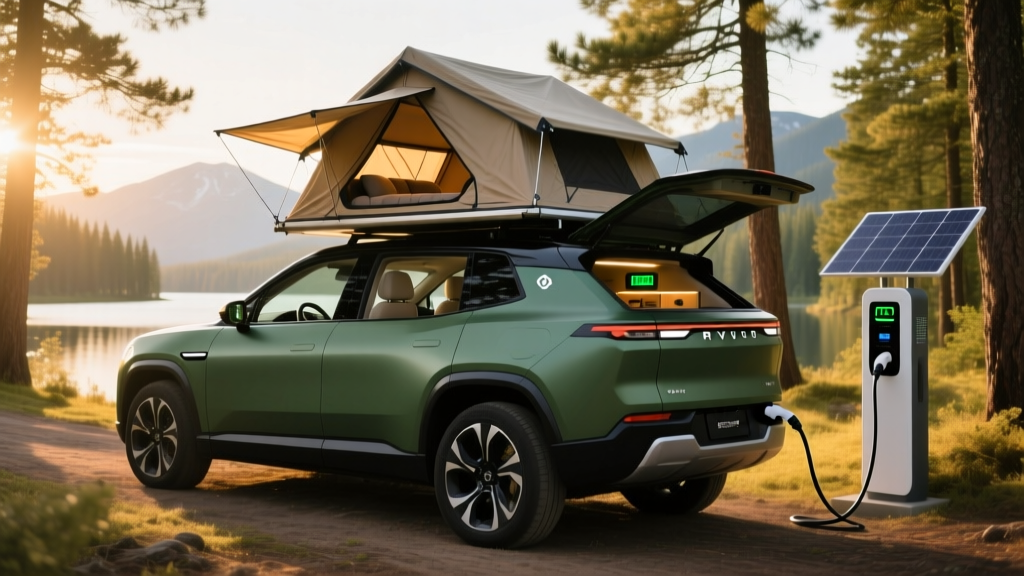
Activating Camp Mode via the infotainment system or mobile app keeps the HVAC system running at a set temperature, disables walk-up unlock and exterior lighting animations, and maintains accessory power to USB-C and 120V outlets. It's essentially a silent, zero-emission alternative to idling a gas engine for heat or A/C.
Rooftop Tent Compatibility
The R1S offers a reinforced roof rack system rated for dynamic loads up to 176 lbs and static loads (parked, sleeping) of up to 750 lbs. Rivian partners with Yakima and other rack manufacturers, and the roof crossbars are compatible with most hard-shell and soft-shell rooftop tents (RTTs). The air suspension's leveling feature makes RTT sleeping far more comfortable than on a fixed-suspension SUV.
Ground Tent & Tailgate Camping
The R1S's split-folding tailgate (upper glass opens independently from the lower gate) creates a natural shelter and gear-loading platform. Owners commonly pair it with vehicle-attached tunnel tents from brands like Napier or Rightline. The R1S's 120V bed outlet (available with the Max Pack and certain trims) powers CPAP machines, laptops, or portable fridges without draining a separate power station.
Gear Tunnel (R1T Only — But R1S Has the Frunk)
While the R1S lacks the R1T's famous gear tunnel, the front trunk (frunk) offers 11.1 cubic feet of lockable, weather-sealed storage — perfect for camp kitchen gear or muddy boots. Total cargo volume behind the third row is 20.1 cu ft, expanding to 57.1 cu ft with the third row folded and 104.7 cu ft with both rear rows down.
Pricing, Trims & Federal Tax Credit Eligibility
| Trim | Battery | MSRP | Est. After §30D Credit |
|---|---|---|---|
| Pure (Dual-Motor) | Standard (92 kWh) | $75,900 | $68,400* |
| Adventure (Dual-Motor) | Large (109 kWh) | $83,900 | $76,400* |
| Adventure (Dual-Motor) | Max (141 kWh) | $93,900 | $86,400* |
| Ascend (Tri-Motor) | Max (141 kWh) | $105,900 | $98,400* |
*Estimated after $7,500 federal tax credit. Actual eligibility depends on IRS §30D requirements. See checklist below.
- MSRP Cap: SUVs/vans/pickups must be ≤ $80,000 MSRP. R1S Pure qualifies; Adventure Large and above exceed the cap and do NOT qualify for the new-vehicle credit.
- Buyer Income Cap: AGI ≤ $300,000 (joint), $225,000 (head of household), $150,000 (single).
- Battery Sourcing: Critical minerals and battery components must meet phased-in domestic/free-trade-partner percentages. Rivian has worked to qualify, but always verify current status at IRS.gov qualified vehicle list.
- Point-of-Sale Transfer: As of 2024+, eligible buyers can transfer the credit to the dealer for an immediate price reduction at purchase.
- Used R1S: The §25E used EV credit (up to $4,000) may apply to pre-owned R1S models under $25,000 — unlikely given current resale values.
Bottom line on pricing: Only the R1S Pure with the Standard Pack (MSRP $75,900) falls under the $80,000 SUV cap for the $7,500 new-vehicle credit. If you want the Large or Max Pack for extended camping range, you're paying full MSRP unless Rivian adjusts pricing or the credit rules change. Always confirm eligibility with a tax professional before purchase.
Interior, Tech, Safety & Driver Assistance
The R1S cabin seats up to seven (2+3+2 configuration) with available second-row captain's chairs reducing capacity to six. Materials lean upscale-sport: standard vegan leather, open-pore wood accents, and a minimalist dashboard dominated by a 15.6-inch central touchscreen and a 12.3-inch digital instrument cluster.
Infotainment & Connectivity
- Rivian OS with OTA updates (continuous feature additions since launch)
- Wireless Apple CarPlay and Android Auto (added via OTA in 2024)
- Built-in navigation with EV-aware route planning and charger preconditioning
- 8 USB-C ports across all three rows
- Available 1,800W Meridian premium audio system
- Integrated Wi-Fi hotspot
Driver Assistance (SAE Level 2)
Rivian's Driver+ system combines adaptive cruise control with lane-centering on divided highways. It is an SAE Level 2 driver-assistance system — you must keep your hands on the wheel and eyes on the road at all times. It is not self-driving. A driver-monitoring camera ensures engagement.
Rivian Driver+ is a Level 2 system per SAE J3016. It does not autonomously navigate intersections, construction zones, or unmapped roads. The driver is legally and operationally responsible for all vehicle control at all times.
Safety Ratings
The R1S earned a 5-star overall rating from NHTSA and Top Safety Pick+ from IIHS (when equipped with specific headlights). Standard safety equipment includes automatic emergency braking, blind-spot monitoring, rear cross-traffic alert, and a surround-view camera system useful for tight trail obstacles.
Warranty & Ownership Costs
| Component | Coverage |
|---|---|
| Battery Pack | 8 years / 175,000 miles (retains ≥70% capacity) |
| Powertrain (motors, inverters) | 8 years / 175,000 miles |
| Vehicle (bumper-to-bumper) | 5 years / 60,000 miles |
| Corrosion perforation | 8 years / unlimited miles |
| Roadside assistance | 5 years / 60,000 miles |
Rivian's 175,000-mile battery warranty is among the longest in the industry, exceeding Tesla's 120,000–150,000-mile coverage and matching or beating legacy automakers. The 70% capacity retention threshold is standard for the segment.
Estimated 5-year ownership costs (insurance, electricity, maintenance, depreciation) run higher than a comparable ICE SUV due to the R1S's purchase price and EV insurance premiums (typically 15–25% above gas equivalents). However, fuel savings are significant: at $0.14/kWh national average, charging an R1S Large Pack costs roughly $15 per full charge versus $65+ to fill a gas-powered Tahoe's 24-gallon tank.
Pros, Cons & Who the R1S Suits Best
Pros
- Class-leading off-road capability with 14.9" ground clearance and 43" wading
- 410-mile Max Pack eliminates range anxiety on most road trips
- 220 kW DC fast charging with NACS Supercharger access
- Camp Mode and self-leveling air suspension for tent/RTT camping
- 7-passenger seating with genuine third-row usability
- 175,000-mile battery warranty
- 7,700-lb towing capacity
- Continuous OTA improvements (CarPlay, features, efficiency)
Cons
- MSRP exceeds $80K tax credit cap on all but Pure Standard trim
- No LFP option — NMC requires 20–80% daily charging discipline
- Towing cuts range by 40–50% — a real constraint for camper-trailer users
- Service center network still expanding (wait times in some regions)
- Third row tight for adults on long trips
- Driver+ is competent but not class-leading vs. GM Super Cruise
- Cold-weather range loss significant without preconditioning
- Choose the R1S if: You need three rows, want genuine off-road capability, plan rooftop-tent or car-camping trips, and value 350+ miles of real-world range.
- Look at the Kia EV9 if: You want a more affordable three-row EV ($55K starting), don't need off-road clearance, and prioritize tax credit eligibility.
- Look at the Tesla Model X if: You prioritize Supercharger network seamlessness, faster acceleration, and don't need serious off-road chops.
- Look at the R1T (truck) if: You want the gear tunnel, a bed for hauling, and only need 5 seats.
Frequently Asked Questions
What is the real-world range of the Rivian R1S?
The EPA rates the R1S Dual-Motor Max Pack at 410 miles. In real-world highway driving at 70°F, expect roughly 350–370 miles. In cold weather (below 30°F), plan for 270–310 miles unless you precondition the battery while plugged in. Off-road at low speeds, range can actually exceed the EPA estimate.
How fast does the R1S charge at home and on the road?
On a 250-kW DC fast charger, the R1S Max Pack peaks at 220 kW and charges from 10–80% in approximately 41 minutes. At home on a Level 2 (240V, 48A) charger, it adds about 24 miles of range per hour — a full overnight charge from 20% takes 8–10 hours on the Large Pack.
Does the Rivian R1S qualify for the $7,500 federal EV tax credit?
Only the R1S Pure with the Standard Pack (MSRP $75,900) qualifies, because §30D caps SUV eligibility at $80,000 MSRP. All Adventure and Ascend trims exceed this cap. Buyer income limits ($300K joint, $150K single) and battery-sourcing requirements also apply. Verify current eligibility at IRS.gov.
Can I use a rooftop tent on the Rivian R1S?
Yes. The R1S roof rack system supports up to 176 lbs dynamic (driving) and 750 lbs static (parked) load. Most hard-shell and soft-shell rooftop tents from Yakima, Thule, iKamper, and Roofnest are compatible. The air suspension's auto-leveling feature keeps the tent platform flat on uneven campsites.
How does Camp Mode work, and how much battery does it use?
Camp Mode maintains a set cabin temperature, keeps outlets powered, and disables exterior lighting/walk-up features. It draws roughly 1–2 kW continuously depending on ambient temperature and HVAC load. Over 8 hours, expect to use 8–16 kWh — roughly 10–15% of the Large Pack.
Is the R1S worth buying over the Tesla Model X or Kia EV9?
If you need off-road capability, rooftop-tent compatibility, and adventure-focused features, the R1S has no equal in the three-row EV segment. If you prioritize lowest cost and tax credit eligibility, the Kia EV9 wins. If you want the most mature charging network and fastest acceleration, the Model X remains competitive — though it lacks the R1S's ground clearance and camping ecosystem.
What is the R1S's towing capacity, and how does it affect range?
The R1S is rated to tow 7,700 lbs. When towing a 5,000-lb camper trailer, expect range to drop 40–50% — a 410-mile Max Pack delivers roughly 200–240 miles while towing. Plan charging stops accordingly and use Rivian's built-in towing navigation mode for accurate range estimates.