The Cadillac Lyriq occupies a specific niche in the luxury EV SUV market: it's a rear-wheel-drive-biased, comfort-oriented cruiser that prioritizes cabin serenity and cargo utility over Nürburgring lap times. With GM's Ultium platform underpinning it, the Lyriq brings a usable 102 kWh battery pack, a massive 33-inch LED dashboard display, and one of the more practical cargo areas in its class. But how does it actually perform when you load it up for a road trip, plug into a DC fast charger, or navigate the federal tax credit landscape? We break down every spec that matters.
Cadillac Lyriq Cargo Space and Interior Dimensions
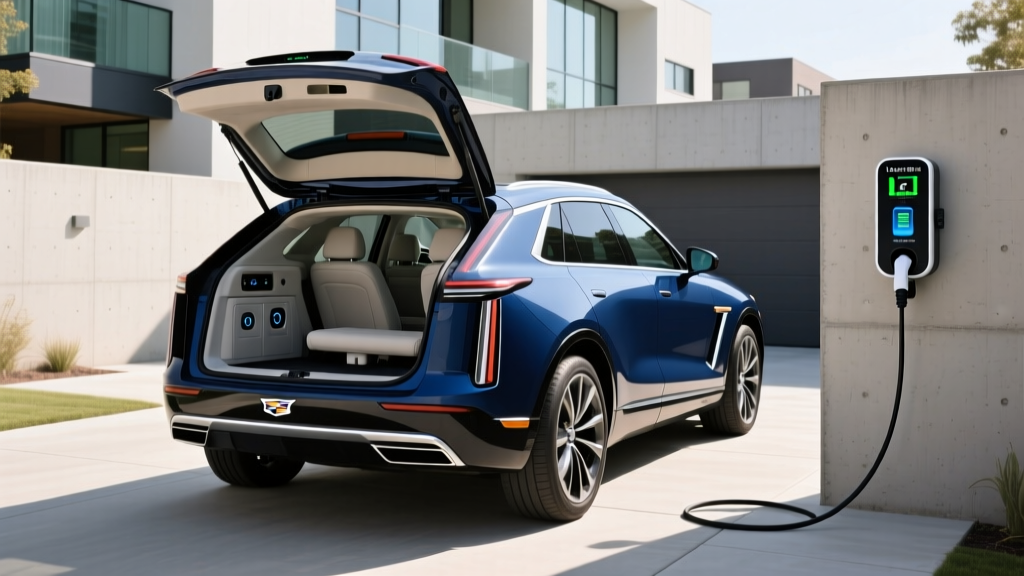
The headline reason many shoppers search for this vehicle is practicality. The Lyriq's cargo area is genuinely competitive with midsize luxury SUVs, gas or electric.
| Measurement | Specification |
|---|---|
| Cargo volume (rear seats up) | 28.0 cu ft |
| Cargo volume (rear seats folded) | 60.8 cu ft |
| Front headroom | 39.6 in |
| Rear headroom | 38.5 in |
| Front legroom | 44.3 in |
| Rear legroom | 39.6 in |
| Frunk (front trunk) | None — space used for HVAC/electronics |
The 28.0 cu ft behind the second row is a strong figure — it edges out the Genesis GV60 (24.0 cu ft) and competes closely with the BMW iX (35.5 cu ft). The load floor is flat and wide enough for two large suitcases side by side with a stroller on top. The 60/40 split-folding rear seats expand that to 60.8 cu ft, which handles furniture-box-scale hauling.
One notable omission: there is no frunk. GM uses the space between the front wheels for thermal management hardware and auxiliary electronics. If you're accustomed to Tesla Model Y's front trunk for charging cables and groceries, you'll need to rely on a cargo organizer in the rear or the under-floor storage compartment.
EPA Range vs. Real-World Driving
The Lyriq uses a 102 kWh Ultium battery pack (NMC chemistry — nickel manganese cobalt), of which roughly 100 kWh is usable. The EPA rates the RWD Lyriq at 97 MPGe combined, translating to roughly 34 kWh per 100 miles. That's mid-pack efficiency — the BMW iX xDrive50 achieves similar numbers, while the Tesla Model X is slightly less efficient due to its heavier curb weight and falcon-wing door mechanisms.
In real-world testing, the Lyriq's range holds up reasonably well in city and suburban driving where regenerative braking recovers energy. Highway efficiency suffers more than some competitors because the Lyriq's aerodynamic profile, while sleek, carries a boxy SUV frontal area. Cold-weather range loss is typical for NMC chemistry — expect a 15–25% reduction when temperatures drop below freezing, mitigated somewhat by the standard heat pump that preconditions the battery and cabin more efficiently than resistive heating.
Charging Speed: DC Fast and Home Level 2
| Charging Level | Power / Rate | Time / Miles Added |
|---|---|---|
| Level 1 (120V household) | ~1.4 kW | ~4 miles per hour |
| Level 2 (240V home, 48A) | 11.5 kW | ~31 miles per hour; full charge in ~10 hours |
| DC Fast Charge (peak) | 190 kW | 10–80% in ~34 minutes |
| DC Fast Charge (sustained avg.) | ~130–150 kW | Adds ~150 miles in 20 minutes |
The Lyriq's onboard charger supports up to 11.5 kW on Level 2, which is a strong spec — it means a full overnight charge from near-empty on a properly installed 48-amp home charger. This is faster than the Genesis GV60's 10.9 kW and matches most competitors in this segment.
DC fast charging peaks at 190 kW on compatible CCS stations (or NACS with the adapter GM began including for 2025+ models). That peak rate holds roughly between 10–40% state of charge before tapering. The charge curve flattens noticeably above 60%, and charging from 80–100% on DC is slow enough that you should plan to unplug at 80% during road trips. The 10–80% time of approximately 34 minutes is competitive but not class-leading — Hyundai/Kia's E-GMP platform at 350 kW chargers still holds the speed crown at roughly 18 minutes.
For home charging, budget $800–$2,200 for a quality Level 2 station (ChargePoint Home Flex, Emporia Vue, or similar) plus $500–$2,000 for electrician installation depending on panel capacity and run distance. A 200-amp electrical panel is typically sufficient, but older homes may need a panel upgrade ($1,500–$3,500).
Performance, Drivetrain, and Ride Quality
| Spec | RWD (Luxury/Sport) | AWD (Luxury/Sport) |
|---|---|---|
| Horsepower | 340 hp | 500 hp |
| Torque | 325 lb-ft | 450 lb-ft |
| 0–60 mph | 6.0 sec | 4.6 sec |
| Drivetrain | Rear single motor | Dual motor AWD |
| Towing capacity | 1,500 lbs | 1,500 lbs |
The RWD Lyriq is tuned for comfort, not aggression. The 6.0-second 0–60 time is adequate for highway merging and passing but won't pin you to the seat. The AWD variant's 4.6 seconds is meaningfully quicker and adds all-weather confidence, though it costs you roughly 7 miles of EPA range.
Ride quality is where the Lyriq earns its luxury badge. The five-link rear suspension and standard passive damping deliver a compliant, quiet ride that absorbs expansion joints and potholes with minimal cabin intrusion. Steering is light and precise but offers minimal road feedback — this is a GT cruiser, not a sports SUV. If you want performance handling, the BMW iX M60 or Tesla Model X Plaid serve that buyer; the Lyriq serves the one who wants to arrive relaxed.
Pricing, Trims, and Federal Tax Credit Eligibility
| Trim | Base MSRP | Est. After §30D Credit |
|---|---|---|
| Luxury RWD | $58,590 | ~$51,090* |
| Sport RWD | $59,790 | ~$52,290* |
| Luxury AWD | $62,090 | ~$54,590* |
| Sport AWD | $63,290 | ~$55,790* |
*Tax credit estimates assume full §30D eligibility. Actual credit varies based on battery sourcing compliance, buyer income, and tax liability.
The Lyriq's MSRP falls under the IRS §30D SUV cap of $80,000, which is the first requirement. However, federal tax credit eligibility depends on several factors that change annually:
- Buyer income cap: Modified adjusted gross income (MAGI) must not exceed $300,000 (married filing jointly), $225,000 (head of household), or $150,000 (single).
- Battery sourcing: The credit is split into two $3,750 halves — one for critical minerals sourcing and one for battery component manufacturing. GM has been progressively shifting Ultium battery supply chains to North America, but the exact credit amount ($3,750 or $7,500) can vary by model year and production batch.
- Point-of-sale transfer: As of 2024, eligible buyers can transfer the credit to the dealer at purchase, reducing the out-of-pocket price immediately rather than waiting for a tax refund.
Because sourcing rules tighten each year, confirm current eligibility with your dealer and a tax professional before purchase. Do not assume the full $7,500 — many Lyriq buyers in recent model years have qualified for $3,750 (the critical-minerals half only).
Technology, Driver Assistance, and Cabin Features
The Lyriq's cabin centerpiece is a 33-inch diagonal LED display that stretches across the driver's instrument cluster and center infotainment screen in a single curved pane. It runs GM's latest Android-based infotainment OS with Google Built-In (Maps, Assistant, Play Store). Wireless Apple CarPlay and Android Auto are standard.
Standard driver assistance includes Super Cruise availability on compatible mapped highways — GM's hands-free Level 2 system. To be explicit: this is SAE Level 2, meaning the driver must remain attentive and ready to take over. Super Cruise uses a driver-monitoring camera to ensure eyes are on the road. It covers over 750,000 miles of divided highways in North America and is one of the most capable Level 2 systems available, but it is not autonomous driving.
Additional tech highlights include a 19-speaker AKG audio system (standard on most trims), ambient lighting with 26 color options, a panoramic fixed glass roof with a power shade, and GM's EV-specific route planning that factors in charging stops and battery preconditioning when a DC fast charger is set as your navigation destination.
Notable drawbacks: the Lyriq lacks a frunk, the rear visibility is compromised by the sloping roofline (relying heavily on the digital rearview camera mirror), and the touch-capacitive climate controls on the center stack can be finicky while driving. Some owners report that the regenerative braking feel in one-pedal mode is less intuitive than competitors, requiring an adaptation period.
Battery Warranty, Longevity, and Ownership Costs
GM backs the Lyriq's Ultium battery and electric drive components with an 8-year / 100,000-mile warranty, which is standard for the segment. The warranty covers defects and capacity loss below a specified threshold (typically 60–70% of original capacity, though GM's exact retention guarantee should be confirmed in your purchase documentation).
The NMC chemistry in the Ultium pack offers high energy density but is more sensitive to prolonged high-state-of-charge storage than LFP batteries. Best practices for longevity: charge to 80% for daily use, use the vehicle's scheduled departure preconditioning feature, and avoid leaving the car at 100% SoC for extended periods in hot weather.
For total cost of ownership, the Lyriq's electricity cost averages roughly $0.12–$0.15 per mile at home (national average of ~$0.16/kWh) versus $0.14–$0.18 per mile for a comparably sized gas SUV at $3.50/gallon. Insurance premiums for the Lyriq run 10–20% higher than equivalent gas Cadillacs due to repair cost data on EVs — expect $2,200–$3,000 annually depending on your profile. Depreciation remains a wildcard as the luxury EV segment matures, though GM's brand cachet and the Lyriq's strong cargo utility provide some floor.
Who Should Buy the Cadillac Lyriq?
Pros and Cons
- Class-competitive cargo space (28.0 / 60.8 cu ft)
- Super Cruise hands-free driving on 750K+ miles of highways
- Excellent ride comfort and cabin isolation
- 11.5 kW Level 2 onboard charger for fast home charging
- Standard heat pump for cold-weather efficiency
- 33-inch curved LED display is visually impressive
- No frunk — front space used for HVAC hardware
- 190 kW peak DC charging trails Hyundai/Kia E-GMP rivals
- 1,500-lb towing capacity is limited for an SUV this size
- Touch-capacitive climate controls are distracting while driving
- Rear visibility compromised by roofline design
- Tax credit may be $3,750 rather than full $7,500 depending on sourcing
Frequently Asked Questions
What is the real-world range of the Cadillac Lyriq?
The EPA rates the RWD Lyriq at 314 miles. In real-world highway driving at 70–75 mph, expect 265–285 miles. In freezing temperatures with heat on, plan for 230–255 miles. The AWD model drops to approximately 307 miles EPA.
How fast does the Lyriq charge at home and on DC fast chargers?
At home on a 48-amp Level 2 charger (240V), the Lyriq charges at 11.5 kW, adding about 31 miles per hour and reaching a full charge in roughly 10 hours. On DC fast chargers, it peaks at 190 kW and charges from 10–80% in approximately 34 minutes.
Does the Cadillac Lyriq qualify for the $7,500 federal EV tax credit?
It can, but eligibility depends on current IRS §30D battery-sourcing rules, your income (must be under $300K married filing jointly / $150K single), and your tax liability. The MSRP is under the $80,000 SUV cap. Many Lyriq buyers have qualified for $3,750 rather than the full $7,500 due to partial sourcing compliance. Verify with IRS guidelines and a tax professional.
Is the Cadillac Lyriq worth buying over the BMW iX or Tesla Model X?
The Lyriq wins on ride comfort, cabin serenity, and Super Cruise. The BMW iX offers more cargo space (35.5 cu ft) and a more engaging drive. The Tesla Model X provides longer range, faster Supercharger access, and a frunk. Choose the Lyriq if traditional luxury comfort and hands-free highway cruising are your top priorities.
Does the Lyriq have a frunk?
No. The front compartment houses thermal management and electrical systems. All cargo must go in the rear cargo area (28.0 cu ft behind the second row).
What is the Lyriq's towing capacity?
1,500 pounds for both RWD and AWD trims. This is sufficient for a small utility trailer or a pair of dirt bikes but not for a boat or camper. If you need serious towing, the Rivian R1S (up to 7,700 lbs) or Ford F-150 Lightning are better choices.