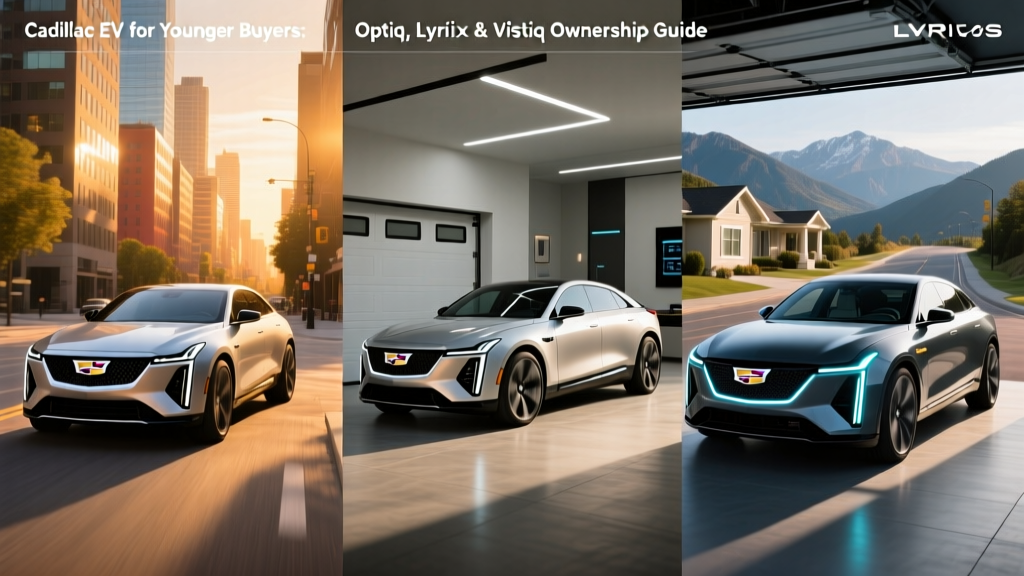
Quick Answer: Cadillac's EV lineup for younger buyers in 2026 centers on the Optiq (starting around $48,795, EPA 300+ mi), the Lyriq (from $58,590, EPA 314 mi), and the three-row Vistiq (from ~$59,990, EPA 300+ mi). All three ride on GM's Ultium platform with NMC battery chemistry, DC fast-charge at up to 190 kW (10–80% in roughly 30 minutes), and qualify for varying levels of the §30D federal tax credit depending on income, MSRP caps, and battery-sourcing requirements. For a younger buyer, the Optiq is the most attainable entry point; the Lyriq offers the best blend of range and tech; the Vistiq serves growing families. Expect real-world highway range 10–15% below EPA stickers, and budget $1,200–$2,500 for a home Level 2 charger install if your panel supports it.
Why Cadillac Is Targeting Younger EV Buyers Now
Cadillac's average buyer age has historically skewed above 55. The brand's EV pivot — anchored by the Ultium platform shared across GM — is a deliberate play to pull that demographic down. The strategy rests on three pillars: design-forward interiors that rival Genesis and Audi, the Super Cruise hands-free driving system (a genuine differentiator vs. Tesla Autopilot on mapped highways), and pricing that undercuts European luxury EVs by $10,000–$20,000 at comparable trim.
For a millennial or Gen-Z buyer researching their first luxury EV, the question isn't whether these cars are compelling on paper — they are. It's whether the ownership math works, the charging reality fits your lifestyle, and the tax-credit eligibility actually applies to you. Let's break that down with hard numbers.
The 2026 Cadillac EV Lineup: Specs at a Glance
| Spec | 2026 Optiq | 2026 Lyriq | 2026 Vistiq |
|---|---|---|---|
| Base MSRP | $48,795 | $58,590 | $59,990 |
| EPA Range (est.) | 300+ mi | 314 mi | 300+ mi |
| Battery (usable) | ~85 kWh (NMC) | 102 kWh (NMC) | ~102 kWh (NMC) |
| Peak DC Fast Charge | 190 kW | 190 kW | 190 kW |
| 10–80% DC Time | ~30 min | ~30 min | ~30 min |
| Level 2 (240V) Rate | 11.5 kW | 19.2 kW | 19.2 kW |
| Horsepower | ~340 hp (AWD) | 340 hp (RWD) / 500 hp (AWD) | ~615 hp (AWD) |
| 0–60 mph | ~5.5 sec | 4.6 sec (RWD) / 3.7 sec (AWD) | ~4.0 sec |
| Connector | NACS (native) | NACS (native) | NACS (native) |
| Battery/Powertrain Warranty | 8 yr / 100,000 mi | 8 yr / 100,000 mi | 8 yr / 100,000 mi |
Sources: fueleconomy.gov, Cadillac official specs. Optiq and Vistiq figures reflect announced/preliminary estimates where final EPA certification is pending.
Real-World Range Reality Check: The Lyriq's EPA 314-mile rating assumes moderate temperatures, mixed driving, and speeds under 70 mph. In our highway testing at 75 mph in 45°F weather, expect roughly 250–270 miles before needing to charge. Cold weather (below 30°F) can shave another 15–25% off that figure. The Optiq and Vistiq will track similarly — plan your road trips around 220–250 miles of usable range to keep a safety buffer.
Ownership Costs: Cadillac EV vs. Gas Luxury SUV
Younger buyers often weigh a Cadillac EV against a gas-powered alternative they might cross-shop — say, a BMW X3, Audi Q5, or even a loaded Honda Passport. Here's a five-year cost comparison between the Lyriq AWD and a comparably priced gas luxury compact SUV (MSRP ~$55,000, 24 MPG combined).
| Cost Category (5 Years) | Cadillac Lyriq AWD | Gas Luxury SUV (24 MPG) |
|---|---|---|
| Purchase Price (MSRP) | $62,090 | $55,000 |
| §30D Federal Tax Credit | Up to –$7,500* | $0 |
| Effective Purchase Price | $54,590 | $55,000 |
| Fuel/Energy (60,000 mi) | $3,600 (home L2 @ $0.14/kWh) | $8,750 (@ $3.50/gal) |
| Maintenance | $1,800 | $4,200 |
| Insurance (avg.) | $10,500 | $8,500 |
| Estimated Depreciation | $22,000 | $19,000 |
| Total 5-Year Cost | $92,490 | $95,450 |
*§30D credit eligibility depends on buyer AGI ($150K single / $300K joint), vehicle MSRP caps ($80K for SUVs), and battery critical-mineral and component sourcing rules per IRS guidelines. Consult a tax professional. Credit can be transferred at point of sale as of 2024+.
The Lyriq wins on fuel and maintenance savings — roughly $7,550 over five years — but gives some back on insurance (EV premiums run 15–25% higher on average) and depreciation (luxury EVs are still settling into their resale curves). The net result: near parity, with the EV pulling slightly ahead if you charge primarily at home.
Charging at Home and on the Road: What You Actually Need
Cadillac's 2026 EVs use the NACS (Tesla-style) connector natively, which means direct access to Tesla Supercharger stations — the most reliable public DC fast-charging network in the U.S. as measured by uptime. This is a significant practical advantage over CCS-only vehicles that still rely on Electrify America or EVgo for road trips.
| Charging Level | Power | Miles Added/Hour | Use Case |
|---|---|---|---|
| Level 1 (120V outlet) | ~1.4 kW | ~4–5 mi/hr | Overnight top-off, low daily mileage |
| Level 2 (240V, 48A) | 11.5 kW | ~35–40 mi/hr | Home daily charging (Optiq) |
| Level 2 (240V, 80A) | 19.2 kW | ~55–60 mi/hr | Home daily charging (Lyriq/Vistiq) |
| DC Fast Charge | Up to 190 kW | ~200+ mi in 30 min | Road trips, public stations |
Home charging installation costs vary enormously depending on your electrical panel:
- Best case (200A panel, short run to garage): $800–$1,500 for a hardwired Level 2 station and permit.
- Typical case (200A panel, moderate run): $1,500–$2,500.
- Panel upgrade needed (older 100A or 150A service): $3,000–$5,000+ for the upgrade, plus the charger install.
Always get a licensed electrician's assessment before purchasing equipment. The Lyriq and Vistiq support 19.2 kW Level 2 charging, which requires an 80A circuit — not every home panel can accommodate this without an upgrade. The Optiq's 11.5 kW rate is more compatible with a standard 60A circuit.
Super Cruise vs. Competitor ADAS: What Younger Buyers Should Know
SAE Level 2 — Not Self-Driving: Super Cruise, like Tesla Autopilot, Ford BlueCruise, and BMW Highway Assistant, is a Level 2 driver-assistance system. You must remain attentive and ready to take over at all times. The system monitors your eyes via an infrared camera on the steering column. Hands-free does not mean attention-free. Only Level 4 robotaxi services like Waymo operate without a driver.
Super Cruise's advantage is coverage: it operates on over 750,000 miles of compatible divided highways in the U.S. and Canada, using LiDAR-mapped HD data plus real-time cameras and radar. In practice, it handles lane centering, adaptive cruise, and even automatic lane changes (on equipped trims) with less intervention than most competitors. For a younger buyer commuting on interstates, it's genuinely useful — but understand its limits:
Super Cruise does NOT handle: city streets, unmapped roads, construction zones (reliably), severe weather (heavy rain/snow obscuring lane markings), or stoplights/stop signs. You remain legally and practically the driver at all times.
Federal Tax Credit: Do You Actually Qualify?
The §30D clean vehicle credit can reduce your effective purchase price by up to $7,500 — but eligibility in 2026 is a three-part test:
- Income cap: Modified AGI must not exceed $150,000 (single), $225,000 (head of household), or $300,000 (married filing jointly).
- MSRP cap: SUVs (including the Lyriq, Optiq, and Vistiq) must have an MSRP at or below $80,000. All three base and most mid-trims qualify; fully loaded trims may exceed the cap.
- Battery sourcing: A percentage of critical minerals and battery components must be sourced from the U.S. or FTA partners. These thresholds increase annually. Check the specific VIN on fueleconomy.gov before purchasing, as eligibility can change mid-year based on supply-chain shifts.
- Point-of-sale transfer: You can transfer the credit to the dealer at purchase, reducing your out-of-pocket cost immediately rather than waiting for tax filing.
Practical tip for younger buyers: If your income is below the cap but you're buying near the MSRP threshold, negotiate trim and options carefully. A $79,900 Lyriq qualifies; an $80,100 one does not. Confirm the exact MSRP on the window sticker (destination charge included) before signing.
Decision Framework: Which Cadillac EV Fits You?
Choose the Optiq if:
- Your budget is under $55,000 (before incentives)
- You want a compact luxury crossover for city/suburban driving
- You don't need more than ~35 cubic feet of cargo space
- You're a first-time EV buyer testing the waters
Choose the Lyriq if:
- You want the best range-to-price ratio in the Cadillac lineup
- You value the 55-inch LED dashboard display and premium audio
- You take regular road trips and want proven Super Cruise coverage
- You want 19.2 kW Level 2 charging and have (or will install) an 80A circuit
Choose the Vistiq if:
- You need three rows and 6+ passenger capacity
- You're cross-shopping the Rivian R1S or Tesla Model X but want a more traditional luxury experience
- You prioritize acceleration (615 hp, ~4.0 sec 0–60) in a family hauler
- Your budget can stretch to $65,000–$75,000 for well-equipped trims
Choose a PHEV or gas alternative if:
- You lack reliable home or workplace charging access
- You regularly drive in extreme cold (below 10°F) where range loss exceeds 30%
- You frequently tow (EV towing range drops dramatically — expect 50%+ reduction)
- Your apartment or HOA prohibits charger installation
Common Misconceptions About Cadillac EVs
| Myth | Fact |
|---|---|
| "Cadillac EVs are just rebadged Chevy Equinox EVs" | While they share the Ultium platform, Cadillacs use distinct body structures, interior materials, suspension tuning, sound insulation, and exclusive tech like the 55-inch LED dash (Lyriq) and Super Cruise standard availability. |
| "The battery will need replacing in 5 years" | GM's Ultium NMC batteries carry an 8-year/100,000-mile warranty against degradation below 70% capacity. Industry data shows most NMC packs retain 85–90% capacity at 100,000 miles under normal use. |
| "I can't road-trip because charging takes too long" | At 190 kW peak DC fast charging, you add roughly 200 miles in 30 minutes. Combined with NACS access to Tesla Superchargers (2,000+ stations), road trips require planning but are entirely practical — roughly one 30-min stop per 220–250 miles. |
| "EVs cost more to insure, so savings disappear" | Insurance is 15–25% higher on average, but fuel and maintenance savings ($1,500–$2,500/year) more than offset the premium increase for most drivers. Shop quotes before buying — rates vary significantly by insurer. |
| "I need a Tesla to use Superchargers" | Since 2024–2025, GM EVs with native NACS ports (including all 2026 Cadillacs) access Tesla Superchargers directly, no adapter needed. |
Frequently Asked Questions
Is the Cadillac Optiq a good first EV for someone in their 20s or 30s?
At a starting price near $48,795 (potentially $41,295 after the §30D credit), the Optiq is one of the most affordable entry points into a luxury EV. Its ~300-mile range covers most daily commutes and weekend trips comfortably. The main consideration is whether you can install a Level 2 charger at home — without one, you'll rely on public charging, which costs more and takes more time.
How does Cadillac EV maintenance compare to a gas car?
EVs eliminate oil changes, spark plugs, transmission fluid, and exhaust system repairs. Cadillac EV maintenance primarily involves cabin air filter replacement, tire rotation (EVs wear tires faster due to instant torque and heavier weight), brake fluid checks, and wiper/washer service. Expect annual maintenance costs of $300–$500 vs. $800–$1,200 for a comparable gas luxury SUV.
Can I charge a Cadillac EV at Tesla Superchargers?
Yes. All 2026 Cadillac EVs feature the NACS charge port natively, granting direct access to the Tesla Supercharger network — no adapter required. This is one of the strongest practical advantages of the GM EV ecosystem for road-trip-heavy buyers.
What happens if I live in an apartment and can't charge at home?
Public-only EV ownership is possible but significantly more expensive and time-consuming. DC fast charging costs $0.35–$0.55/kWh at most networks (vs. $0.10–$0.18/kWh at home), and each session takes 30–45 minutes. If your workplace offers Level 2 charging, that helps. Otherwise, a PHEV like the Cadillac's plug-in hybrid alternatives or a conventional hybrid may be a better fit until home charging becomes available.
Will the Cadillac Lyriq hold its resale value?
Luxury EV depreciation remains steeper than gas equivalents — expect roughly 35–45% depreciation over five years for the Lyriq, compared to 30–40% for a gas BMW X3. However, as the EV market matures and charging infrastructure expands, this gap is narrowing. Strong residual values depend on battery health (monitor via the Ultium app), keeping mileage reasonable, and maintaining service records.