Quick Verdict: The Electric Flagship Arrives
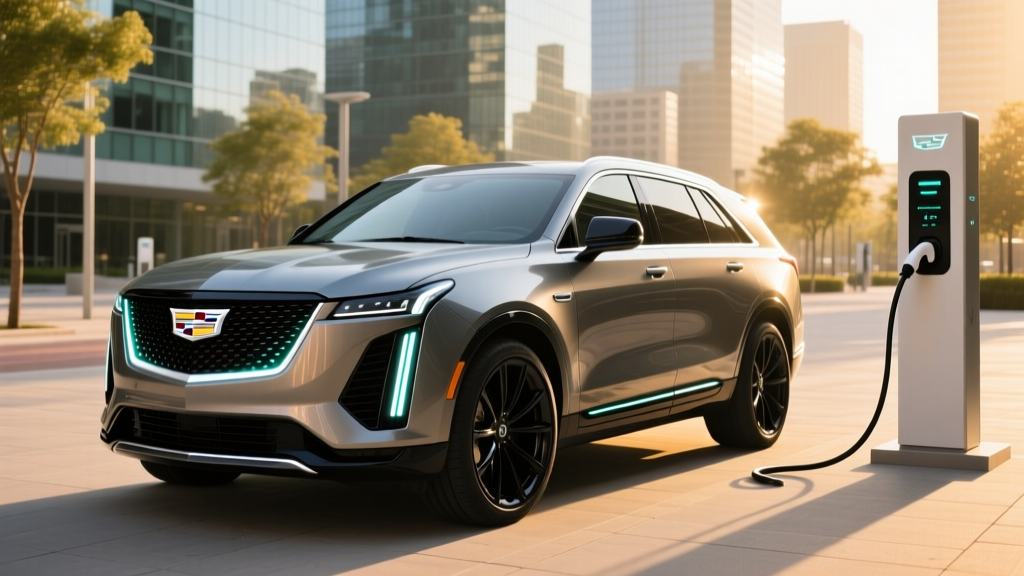
The Cadillac Escalade IQ SUV is GM's most ambitious electric vehicle to date — a full-size, three-row luxury hauler built on the Ultium platform that attempts to replace the internal-combustion Escalade without compromise. With an EPA-estimated 460 miles of range, a massive battery, and a cabin loaded with up to 55 inches of combined display real estate, it targets buyers who want the Escalade experience with zero tailpipe emissions. But at a starting price near $130,000 and with real-world efficiency that reflects its 8,000-pound curb weight, the IQ demands careful consideration before you sign the order sheet.
This review breaks down every spec that matters — from sustained DC fast-charging speeds to cold-weather range loss — so you can decide whether the Escalade IQ earns a spot in your garage.
Range, Battery, and Real-World Efficiency
| Spec | Figure |
|---|---|
| EPA Range (Luxury 2 AWD) | 460 miles |
| Battery Capacity (usable) | ~200 kWh (NCMA, Ultium) |
| Battery Chemistry | NCMA (nickel-cobalt-manganese-aluminum) |
| EPA Efficiency (combined) | ~43 MPGe / ~78 kWh/100 mi |
| Drivetrain | Dual-motor eAWD |
| Horsepower | 680 hp (750 hp w/ Velocity Max) |
| 0–60 mph | ~4.7 seconds (Velocity Max) |
Real-World Range vs. EPA Sticker
EPA estimate: 460 miles (Luxury 2 trim, AWD, standard 24-inch wheels).
Expect in practice: Roughly 380–410 miles on mixed highway driving at 70–75 mph. In cold weather (below 32°F), plan for 320–360 miles due to cabin heating demands and reduced battery efficiency. The Escalade IQ's enormous frontal area and ~8,000-lb curb weight work against highway efficiency — the EPA cycle includes substantial city/regen driving that flatters large EVs.
Bottom line: The 460-mile figure is legitimate for suburban and city-heavy use. For interstate road trips, budget conservatively around 380 miles before you need a charger.
The Ultium battery pack uses GM's NCMA (nickel-cobalt-manganese-aluminum) pouch cells — not LFP. This chemistry prioritizes energy density, which is essential for fitting over 200 kWh of usable capacity into a vehicle chassis. The trade-off is that NCMA batteries typically benefit from staying between 20–80% state of charge for daily use, reserving 100% charges for road trips. GM's battery management system includes a substantial buffer to protect long-term health, and active thermal management keeps cells in their optimal temperature window during fast charging and extreme weather.
Charging Speed: DC Fast, Level 2, and Home Setup
| Charging Level | Power | Speed / Time |
|---|---|---|
| DC Fast Charge (peak) | Up to 350 kW | 10–80% in ~25 minutes (est.) |
| DC Fast Charge (sustained avg) | ~200–250 kW | 10–80% realistic ~30–35 min |
| Level 2 (240V, 48A) | 11.5 kW | ~17 miles of range per hour |
| Level 2 (240V, 80A) | 19.2 kW | ~28 miles of range per hour |
| Level 1 (120V) | ~1.4 kW | ~2 miles per hour (emergency only) |
The Escalade IQ supports up to 350 kW on DC fast chargers via the CCS1 connector (GM has confirmed NACS adapter availability for Tesla Supercharger access). However, as with all large-battery EVs, the peak rate is not sustained across the entire charge curve. Expect the battery to pull peak power through roughly 30–40% state of charge, then taper progressively. On a 350 kW-capable station like an Electrify America or EVgo unit, a 10–80% session will take roughly 30–35 minutes in real-world conditions with battery preconditioning active.
Preconditioning matters here. Navigate to a DC fast charger using the IQ's built-in navigation, and the thermal management system will warm or cool the pack to the optimal temperature before you arrive. Skip preconditioning in cold weather, and your peak charge rate could drop by 30–50%, extending your stop significantly.
For home charging, the IQ's 19.2 kW onboard charger is a standout feature. Most EVs top out at 11.5 kW (48 amps), meaning an overnight charge from 20% to 80% takes roughly 10–12 hours. With a 19.2 kW (80-amp) Level 2 home charger — which requires a dedicated 100-amp circuit and professional installation — that same session drops to roughly 6–7 hours. Given the IQ's enormous battery, investing in a high-amperage home charger is nearly mandatory unless you're comfortable multi-day top-ups. Expect a professional 80-amp installation to cost $1,500–$3,500 depending on panel capacity and conduit runs, according to U.S. Department of Energy guidance.
Performance and Driving Dynamics
The dual-motor eAWD powertrain delivers 680 horsepower in standard driving mode. Engaging Velocity Max mode (available on Sport trims) unlocks 750 horsepower and drops the 0–60 mph time to approximately 4.7 seconds — remarkable for a vehicle that weighs over four tons. Torque is instantaneous, and the IQ pulls with authority at any speed. The low center of gravity from the floor-mounted battery pack keeps body roll surprisingly controlled, though physics ultimately limits cornering enthusiasm. This is a luxury cruiser, not a sport ute, and the adaptive air suspension prioritizes ride isolation over aggressive handling.
The regenerative braking system offers multiple levels, including a one-pedal driving mode that can bring the IQ to a complete stop without touching the friction brakes. The brake pedal feel is well-calibrated — a common issue in heavy EVs where the transition from regen to friction braking can feel abrupt. Steering is light and precise at parking speeds but lacks feedback at highway speeds, which is typical for this segment.
Interior, Cargo, and Technology
The Escalade IQ cabin seats up to seven passengers across three rows. Second-row captain's chairs are standard on most trims, with an available bench for six-passenger seating. Key interior dimensions:
- Front headroom: ~40.0 inches
- Second-row legroom: ~42.5 inches
- Third-row legroom: ~34.0 inches (usable for adults on shorter trips)
- Cargo behind 3rd row: ~25.0 cu ft
- Cargo behind 2nd row (3rd row folded): ~72.0 cu ft
- Max cargo (all rear seats folded): ~120.0 cu ft
- Front trunk (frunk): ~12.0 cu ft (weather-sealed, drainable)
The dashboard is dominated by a pillar-to-pillar 55-inch total diagonal display surface — a 35-inch curved LED driver display paired with a passenger-side information screen. Rear passengers get available 12.6-inch diagonal screens mounted on the front seatbacks. The infotainment system runs GM's latest Ultifi software platform with Google Built-In (Maps, Assistant, Play Store), wireless Apple CarPlay and Android Auto, and over-the-air update capability.
Driver assistance: The IQ comes equipped with Super Cruise, GM's Level 2 hands-free driving system. Super Cruise operates on over 750,000 miles of compatible roads in North America, using a combination of LiDAR-mapped data, GPS, cameras, and radar. The driver monitoring system tracks eye attention and requires the driver to remain engaged. This is not autonomous driving — it is SAE Level 2 automation, meaning the driver is always responsible for the vehicle. Super Cruise excels on highways and reduces fatigue substantially on long trips, but it does not handle construction zones, unmapped roads, or complex urban environments without driver takeover.
Pricing, Trims, and Federal Tax Credit Eligibility
| Trim | Base MSRP | Est. As-Tested |
|---|---|---|
| Luxury 2 (AWD) | $129,990 | $135,000–$145,000 |
| Sport 2 (AWD) | $130,990 | $140,000–$155,000 |
| Premium Luxury 2 (AWD) | $149,990 | $155,000–$170,000 |
| Premium Sport 2 (AWD) | $150,990 | $160,000–$175,000 |
Federal EV Tax Credit (§30D) — Escalade IQ Eligibility
- MSRP cap: The §30D credit caps at $80,000 for SUVs. The Escalade IQ starts at $129,990 — it does NOT qualify for the federal purchase credit.
- Buyer income cap: Even if it qualified on price, AGI limits are $300K (married filing jointly), $225K (head of household), $150K (single).
- Battery sourcing: Critical mineral and battery component requirements must be met (sourced from U.S. or FTA partners).
- Point-of-sale transfer: Available for qualifying vehicles — but moot here due to MSRP cap.
- Commercial clean vehicle credit (§45W): Businesses and fleet operators may be eligible for up to $7,500 under the commercial vehicle credit, which has no MSRP cap. Consult a tax professional — see IRS guidance on clean vehicle credits.
The Escalade IQ is priced firmly in ultra-luxury territory. With no federal purchase credit available to individual buyers, your total cost rests entirely on the MSRP plus destination, options, and applicable state incentives. Some states offer their own rebates or HOV lane access regardless of price — check your local DMV or energy office for details.
Warranty and Long-Term Ownership
GM backs the Escalade IQ with a competitive warranty package:
- Battery & drive unit warranty: 8 years / 100,000 miles (whichever comes first), with a minimum 70% capacity retention guarantee
- Bumper-to-bumper: 4 years / 50,000 miles
- Powertrain (non-battery): 6 years / 70,000 miles
- Corrosion: 6 years / unlimited miles
- Roadside assistance: 6 years / 70,000 miles
The 70% retention threshold is standard for the industry. In practice, GM's Ultium packs with active thermal management have shown modest degradation in early real-world data from other Ultium vehicles (Lyriq, Blazer EV) — typically 5–8% loss over the first 50,000 miles. The Escalade IQ's large pack has a built-in buffer that should keep usable range above 400 miles for the warranty period under normal use. Full battery replacement out of warranty is estimated at $25,000–$35,000 based on pack size, though this figure is expected to decrease as Ultium production scales.
Escalade IQ vs. the Competition
The IQ's direct rivals are thin but growing:
- Tesla Model X Plaid: Faster (0–60 in 2.5 sec), more Supercharger access, but smaller third row, lower build quality, and a starting price around $95K. Range is lower at ~326 miles EPA.
- Mercedes-Benz EQS SUV: More refined ride, ~305-mile range, starts around $105K. Smaller battery (~108 kWh usable) and slower DC charging (~200 kW peak).
- BMW iX M60: Sportier handling, ~324-mile range, starts around $112K. Two-row only — not a true three-row competitor.
- Rivian R1S (Tri Motor): More off-road capable, ~352-mile range (Max Pack), starts around $100K. More adventure-oriented, less traditional luxury.
The Escalade IQ wins on raw range, battery capacity, and three-row practicality. It loses on price and federal tax credit eligibility. If you need the maximum electric range in a full-size luxury SUV and budget is secondary, the IQ is currently unrivaled. If you want a more affordable option with two rows or don't need 460 miles, the competitors above deserve test drives.
Pros
- Class-leading 460-mile EPA range
- 350 kW DC fast-charging capability
- 19.2 kW Level 2 onboard charger (faster home charging than rivals)
- Super Cruise hands-free highway driving
- Massive battery with strong degradation buffer
- True three-row seating with usable cargo space
- 55-inch display surface with Google Built-In
- 750 hp in Velocity Max mode
Cons
- $129,990+ starting price — no federal tax credit
- Real-world highway range drops to ~380 miles
- Cold-weather range loss significant (~320–360 miles)
- 8,000+ lb curb weight affects tire wear and efficiency
- Requires 100-amp circuit for optimal 19.2 kW home charging
- Third-row space is adequate but not generous for tall adults
- CCS1 native — NACS Supercharger access requires adapter
Who Should Buy the Escalade IQ?
Choose the Escalade IQ if: You need a three-row luxury SUV with maximum electric range, you have reliable home charging (ideally 19.2 kW), you regularly drive long highway routes where Super Cruise shines, and the $130K+ price point fits your budget without needing a tax credit.
Look elsewhere if: You need the federal $7,500 credit to justify the purchase, you primarily drive short commutes (the massive battery is overkill), you want a sporty driving experience (the Rivian R1S or BMW iX handle better), or you need guaranteed 400+ mile real-world highway range in winter (no full-size EV delivers that yet).
Frequently Asked Questions
What is the real-world range of the Cadillac Escalade IQ?
The EPA estimates 460 miles for the Luxury 2 AWD trim. In real-world highway driving at 70–75 mph, expect roughly 380–410 miles. In cold weather below freezing, plan for 320–360 miles. The large battery gives a strong buffer, but the IQ's weight and aerodynamic profile reduce highway efficiency compared to the EPA mixed cycle.
How fast does the Escalade IQ charge?
On a 350 kW DC fast charger, Cadillac estimates a 10–80% charge in roughly 25 minutes under ideal conditions. Realistically, with charge-curve tapering, expect 30–35 minutes. At home on a 19.2 kW (80-amp) Level 2 charger, you'll add about 28 miles of range per hour — enough to fully replenish overnight. On a standard 11.5 kW (48-amp) Level 2, expect about 17 miles per hour.
Does the Escalade IQ qualify for the federal EV tax credit?
No. The IRS §30D credit caps the vehicle MSRP at $80,000 for SUVs. The Escalade IQ starts at $129,990, making it ineligible for individual buyers. Business and fleet purchasers may qualify under the §45W commercial clean vehicle credit — consult a tax professional for details.
How much does it cost to own vs. a gas Escalade?
The gas Escalade (6.2L V8, ~16 MPG combined) costs roughly $3,800–$4,500 per year in fuel at 15,000 miles and $3.50/gallon. The IQ, at ~78 kWh/100 mi and a national average electricity rate of $0.16/kWh, costs roughly $1,870 per year to charge — saving $2,000–$2,600 annually in energy. However, the IQ's higher purchase price and potentially higher insurance premiums offset some savings. Over five years, energy savings may total $10,000–$13,000, but the IQ's $50,000+ price premium over a base gas Escalade means the financial case rests on intangibles: silence, instant torque, Super Cruise, and emissions reduction.
Is the Escalade IQ worth buying vs. key competitors?
If you prioritize maximum range, three-row seating, and traditional American luxury, the IQ has no direct equal. The Tesla Model X is faster and cheaper but less refined. The Mercedes EQS SUV is quieter but has roughly 150 fewer miles of range. The Rivian R1S is more versatile off-road but less opulent. For buyers who specifically want an electric Escalade — the presence, the size, the brand cachet — the IQ is the only answer.
What charger do I need at home for the Escalade IQ?
To take advantage of the IQ's 19.2 kW onboard charger, you'll need a hardwired 80-amp Level 2 EVSE on a dedicated 100-amp circuit. This typically requires a 200-amp (minimum) electrical panel, and many homes will need a panel upgrade ($2,000–$4,000). A 48-amp Level 2 charger on a 60-amp circuit will still work but charges at 11.5 kW — adding about 17 miles per hour instead of 28. Consult a licensed electrician to assess your panel capacity before ordering equipment.