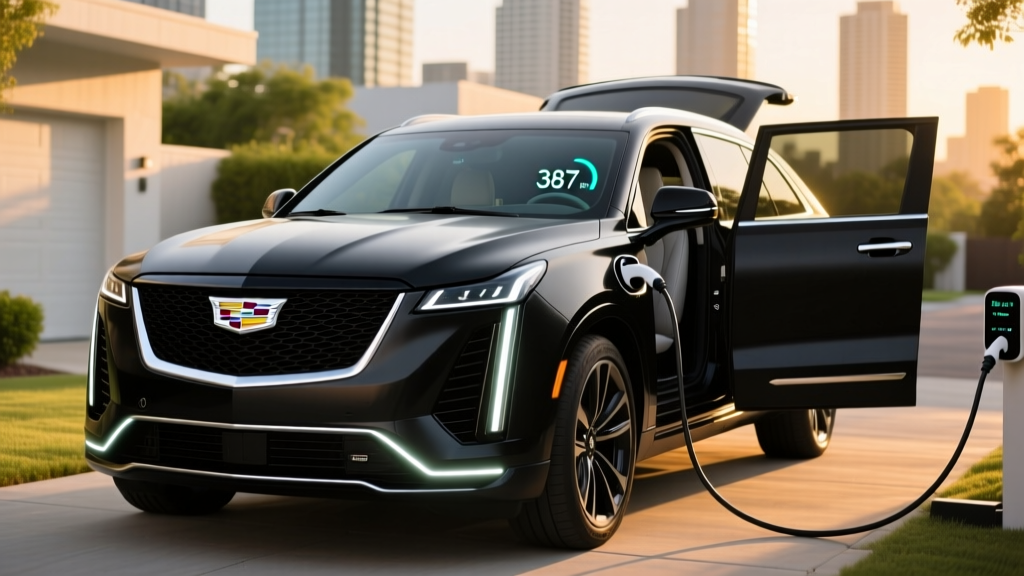
The 2026 Cadillac Escalade IQ Sport 2 arrives as the performance-oriented, second-tier trim in General Motors' all-electric flagship SUV lineup. Built on GM's BT1 electric platform shared with the Chevrolet Silverado EV and GMC Sierra EV, the Escalade IQ attempts to translate six-figure American luxury into a zero-tailpipe-emissions package. But with a curb weight pushing past 9,000 pounds and a battery pack exceeding 200 kWh, the real question for buyers is how the physics of moving this much mass translates into range, charging practicality, and daily ownership. We break down every number that matters.
Range, Battery, and the Real-World Reality Check
The Escalade IQ Sport 2 carries a massive Ultium battery pack rated at approximately 200 kWh usable capacity, utilizing GM's NMC (nickel manganese cobalt) pouch-cell chemistry. This is one of the largest battery packs in any production passenger vehicle, and it's necessary: moving 9,000+ pounds requires enormous energy reserves.
EPA Estimated Range: ~460 miles (Sport 2 AWD trim)
Real-World Highway (70-80 mph): Expect approximately 350–390 miles
Cold Weather (below 30°F): Plan for 280–330 miles depending on cabin heating load and preconditioning
City/Stop-and-Go: Can approach or slightly exceed EPA figure thanks to regenerative braking
The gap between the EPA sticker and real-world highway range is significant here — more pronounced than in lighter EVs like the Tesla Model Y or Hyundai IONIQ 5. The Escalade IQ's aerodynamic profile (a tall, broad SUV) and immense mass mean highway efficiency drops sharply above 70 mph. Cold weather compounds the loss: NMC chemistry is more susceptible to low-temperature range reduction than LFP, and heating a cabin this large draws substantial energy. Preconditioning the battery while plugged in is essential to minimize losses.
Efficiency is rated at approximately 58 MPGe combined, or roughly 58 kWh per 100 miles — far thirstier than a mid-size electric sedan but expected for a full-size luxury SUV with three rows of seating.
Charging Speed: DC Fast, Level 2, and What to Expect
GM equipped the Escalade IQ with an 800-volt battery architecture, enabling DC fast-charge rates that partially offset the enormous battery size. Here's the charging breakdown:
| Charge Level | Power / Rate | Speed / Time |
|---|---|---|
| DC Fast Charge (Peak) | Up to 350 kW | ~100 miles of range in ~10 minutes |
| DC Fast Charge 10–80% | Sustained avg. ~200 kW | ~35–45 minutes |
| Level 2 Home (240V, 48A) | 11.5 kW | ~21 miles of range per hour |
| Level 2 Full Charge (0–100%) | 11.5 kW | ~18–20 hours |
| Level 1 (120V, 12A) | 1.4 kW | ~2.5 miles per hour |
The 350 kW peak rate is achievable only at capable chargers (Electrify America 350 kW stalls, select EVgo stations) and only while the battery is between roughly 10–30% state of charge. As with all EVs, the charge curve tapers significantly above 80% — topping off from 80–100% on DC fast charge can add another 25–35 minutes. For a 200 kWh pack, that taper is especially long.
At home on a Level 2 wall connector, you'll recover about 21 miles of range per hour. A full overnight charge from near-empty to full takes roughly 18–20 hours, meaning most owners will charge incrementally — plugging in nightly and maintaining a 20–80% daily window, which also preserves long-term battery health. Level 1 is essentially useless for this vehicle except as an emergency trickle.
The Escalade IQ ships with a NACS (North American Charging Standard) connector, granting access to Tesla Supercharger stations via GM's agreement with Tesla. This significantly expands the available DC fast-charging network for road trips, though not all Supercharger stalls deliver the 350 kW peak — many V3 stalls cap at 250 kW.
Performance and Powertrain
The Sport 2 trim comes standard with a dual-motor all-wheel-drive (eAWD) configuration. The Sport trims are tuned for more aggressive throttle mapping and slightly firmer suspension calibration compared to the Luxury trims, though this is still a comfort-first luxury cruiser at its core.
| Spec | Value |
|---|---|
| Drivetrain | Dual-Motor AWD (eAWD) |
| Horsepower | ~680 hp (estimated, GM final certification pending) |
| Torque | ~615 lb-ft |
| 0–60 mph | ~4.7 seconds (estimated) |
| Top Speed | Electronically limited ~120 mph |
| Towing Capacity | ~8,000 lbs (estimated, when properly equipped) |
| Adaptive Air Suspension | Standard |
Sub-5-second 0–60 times in a three-row luxury SUV that weighs over four tons is genuinely impressive — the instant torque of dual electric motors makes the Escalade IQ feel far lighter than it is in around-town driving. The adaptive air suspension with Magnetic Ride Control manages body roll competently, though physics ultimately wins in tight corners. This is a highway cruiser and boulevard statement, not a canyon carver.
Towing capacity is estimated at approximately 8,000 lbs, competitive with the gas Escalade. However, towing will slash range dramatically — expect a 40–55% reduction when pulling a heavy trailer at highway speeds, bringing effective range down to 200 miles or less between charges.
Pricing, Trims, and Federal Tax Credit Eligibility
The Escalade IQ lineup is positioned firmly in six-figure territory. The Sport 2 sits as the second trim level in the Sport series, above the Sport 1 and below the Sport 2 with optional equipment packages.
| Trim | Estimated Base MSRP | As-Tested (with options) |
|---|---|---|
| Luxury 1 | ~$129,990 | ~$135,000–$145,000 |
| Luxury 2 | ~$139,990 | ~$148,000–$160,000 |
| Sport 1 | ~$129,990 | ~$135,000–$145,000 |
| Sport 2 | ~$139,990 | ~$148,000–$160,000 |
Federal Tax Credit (§30D) — Does the Escalade IQ Qualify?
Under current IRS rules for the §30D Clean Vehicle Credit, the Escalade IQ faces multiple hurdles:
- MSRP Cap: SUVs must have an MSRP at or below $80,000. The Escalade IQ Sport 2 at ~$139,990 far exceeds this cap and does NOT qualify for the $7,500 federal purchase credit.
- Income Cap: Even if it met the price cap, buyers must fall under AGI limits ($150K single / $300K joint).
- Battery Sourcing: Critical minerals and battery component requirements must be met (likely met given GM's Ultium domestic production, but moot due to MSRP cap).
Bottom line: The Escalade IQ does not qualify for the federal EV tax credit due to its MSRP. Buyers should consult a tax professional regarding potential state-level incentives, which vary by jurisdiction.
Interior, Tech, and Cargo Space
Cadillac has loaded the Escalade IQ with a technology-forward cabin centered around a massive 55-inch total LED display spanning the dashboard — combining a digital instrument cluster, central infotainment touchscreen, and passenger-facing display into one curved glass panel. Google Built-In handles navigation, voice assistant, and app integration.
Key tech and interior features include:
- Super Cruise hands-free driver assistance (SAE Level 2 — driver must remain attentive) on compatible mapped highways
- AKG Studio Reference 36-speaker audio system
- Power-folding third row with executive second-row seating
- Head-up display with augmented reality navigation
- Hands-free power liftgate with gesture control
- Vehicle-to-load (V2L) capability for powering external devices
| Measurement | Value |
|---|---|
| Cargo (behind 3rd row) | ~22 cu ft |
| Cargo (3rd row folded) | ~70 cu ft |
| Cargo (all rows folded) | ~115 cu ft |
| Front Legroom | ~43.5 inches |
| 2nd-Row Legroom | ~41.5 inches |
| 3rd-Row Legroom | ~32 inches |
| Seating Capacity | 7 passengers (standard) |
| Front Trunk (Frunk) | ~10 cu ft (e-trunk) |
The frunk (e-trunk) adds useful sealed storage for charging cables or gear you want to keep separate from the main cabin. Third-row space remains tight for adults on long trips, consistent with the gas Escalade — this is a children's or occasional-use third row.
Warranty, Battery Longevity, and Ownership Costs
GM backs the Escalade IQ with its standard EV warranty package:
- Battery Pack: 8 years / 100,000 miles (whichever comes first), covering defects and capacity loss below ~70% of original capacity
- Powertrain (motors, power electronics): 8 years / 100,000 miles
- Bumper-to-Bumper: 4 years / 50,000 miles
- Corrosion: 6 years / 100,000 miles
The 200 kWh NMC pack will inevitably degrade over time, but GM's Ultium battery management system includes active liquid thermal management to mitigate accelerated wear. Real-world degradation data for the Ultium platform is still limited given its recent introduction — owners should monitor State of Health (SoH) through the vehicle's diagnostics and follow best practices: avoid routinely charging to 100%, minimize DC fast-charging frequency, and precondition in extreme temperatures.
A full battery replacement out of warranty would be extraordinarily expensive — industry estimates for packs of this size range from $25,000 to $40,000+ for parts and labor. However, catastrophic pack failure within the warranty period is rare, and partial module replacement may be possible rather than a full swap.
Insurance premiums for the Escalade IQ will be substantial. Expect quotes in the $3,500–$5,500+ annual range depending on location, driving record, and coverage levels. Always obtain insurance quotes before purchase.
Competition and Verdict: Who Should Buy the Escalade IQ Sport 2?
The Escalade IQ occupies a narrow lane. Direct competitors include the Mercedes-Benz EQS SUV (smaller, less range, lower starting price), the BMW iX (much smaller, sportier, significantly cheaper), and the upcoming Lincoln Navigator EV (not yet on sale). Within GM's own family, the GMC Hummer EV SUV shares the Ultium platform but targets a different buyer persona.
Choose the Escalade IQ Sport 2 If:
- You need three rows of seating and want an electric powertrain with no compromise on presence or luxury
- You have reliable home Level 2 charging and a daily commute under 100 miles
- You value the Super Cruise network for hands-free highway travel
- Price is not a primary constraint and you want the largest, most opulent American electric SUV available
Look Elsewhere If:
- You need federal tax credit eligibility (MSRP cap disqualifies the Escalade IQ)
- You regularly drive 350+ miles between charging stops and don't want to plan around DC fast-charger locations
- You want sporty handling dynamics — the BMW iX or Rivian R1S are more engaging to drive
- Towing is a primary use case — range while towing will be a serious limitation
Pros
- Class-leading ~460-mile EPA range for a full-size luxury SUV
- 800V architecture with up to 350 kW DC fast charging
- Massive 55-inch display and premium cabin materials
- Super Cruise hands-free driving on mapped highways
- Frunk adds practical cargo flexibility
- Dual-motor AWD with sub-5-second 0–60
Cons
- Does NOT qualify for $7,500 federal tax credit (MSRP cap)
- Real-world highway range significantly below EPA estimate
- 18–20 hour Level 2 full charge requires disciplined overnight routine
- Towing cuts range by 40–55%
- $140K+ starting price limits buyer pool
- Third-row legroom is tight for adults
- Insurance costs are high
Frequently Asked Questions
What is the real-world range of the 2026 Cadillac Escalade IQ Sport 2?
The EPA estimates approximately 460 miles for the Sport 2 AWD trim. In real-world highway driving at 70–80 mph, expect 350–390 miles. Cold weather (below 30°F) can reduce that further to 280–330 miles. City driving with regenerative braking may approach or slightly exceed the EPA figure.
How fast does the Escalade IQ charge at home and on the road?
On DC fast chargers, the Escalade IQ peaks at up to 350 kW, adding roughly 100 miles of range in 10 minutes. A 10–80% charge takes approximately 35–45 minutes at a capable station. At home on Level 2 (240V, 48A, 11.5 kW), it recovers about 21 miles per hour, with a full charge taking 18–20 hours.
Does the Escalade IQ qualify for the federal EV tax credit?
No. Under current IRS §30D rules, SUVs must have an MSRP of $80,000 or less to qualify. The Escalade IQ Sport 2 starts at approximately $139,990, far exceeding this cap. State-level incentives may apply — check your local DMV or energy office for details.
Is the Escalade IQ worth buying versus a gas Escalade or competitors?
If you have home charging and want silent, smooth electric propulsion with the Escalade's signature presence, the IQ delivers a genuinely different luxury experience. Operating costs per mile are lower than the gas Escalade's 14–17 MPG. However, the higher upfront cost, no federal credit, and range limitations when towing or road-tripping are real trade-offs. The Mercedes EQS SUV is smaller but more affordable; the Rivian R1S is more capable off-road with a smaller footprint.
What battery chemistry does the Escalade IQ use?
The Escalade IQ uses GM's Ultium NMC (nickel manganese cobalt) pouch-cell chemistry in a ~200 kWh usable pack. NMC offers high energy density suited to this heavy vehicle but is more sensitive to cold-weather range loss than LFP chemistry.
Is Super Cruise actually self-driving?
No. Super Cruise is an SAE Level 2 driver-assistance system. It allows hands-free driving on pre-mapped divided highways, but the driver must remain attentive, keep eyes on the road (monitored by a driver-facing camera), and be ready to take over at any time. It does not handle unmapped roads, construction zones, or complex urban environments autonomously.
Specs and pricing in this review are based on manufacturer-published preliminary data and industry analysis as of the 2026 model year. Final EPA certification figures, official MSRP, and feature availability should be confirmed with a Cadillac dealer before purchase. Tax credit rules are subject to change — consult irs.gov and a qualified tax professional for current eligibility.