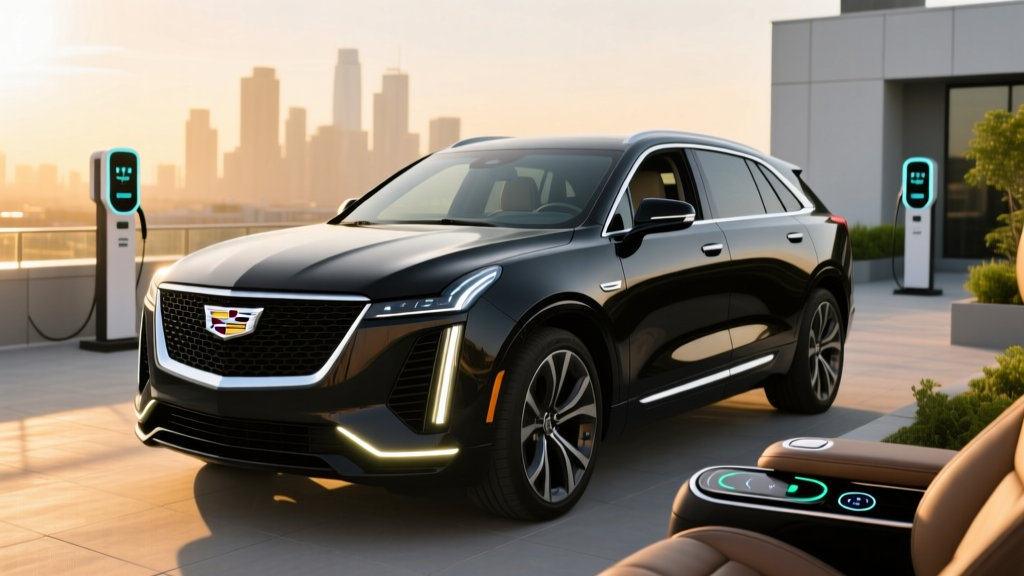
If you're researching the electric Cadillac truck, you're almost certainly looking at the 2026 Cadillac Escalade IQ — General Motors' flagship full-size electric SUV built on the Ultium platform. Here's the quick answer most buyers need before anything else:
Quick Verdict: The 2026 Escalade IQ delivers an EPA-estimated 450+ miles of range (with the available 200+ kWh Ultium battery), DC fast-charges at up to 350 kW (adding ~100 miles in roughly 10 minutes), and starts around $130,000. It qualifies as a luxury SUV under §30D tax-credit MSRP caps, but buyer income limits and battery-sourcing rules apply. It's best suited for buyers with reliable home Level 2 charging, daily commutes under 150 miles, and a desire for three-row luxury without fuel stops. If you frequently tow heavy loads over 300 miles or live in a charging desert, the gas Escalade ESV remains the pragmatic choice.
2026 Escalade IQ: Core Specs at a Glance
Before we get into ownership costs and comparisons, here are the numbers that matter. Cadillac has positioned the Escalade IQ as a direct electric rival to its own gas Escalade and to luxury competitors like the Rivian R1S and Mercedes EQS SUV.
| Specification | 2026 Escalade IQ (Luxury 1) | 2026 Escalade IQ (Sport 2) |
|---|---|---|
| EPA Range (est.) | ~450 miles | ~440 miles |
| Battery (usable) | ~200+ kWh (NMC, Ultium) | ~200+ kWh (NMC, Ultium) |
| Horsepower | ~680 hp (dual motor AWD) | ~750 hp (Velocity trim) |
| 0–60 mph | ~4.8 seconds | ~3.5 seconds (Velocity) |
| DC Fast Charge (peak) | Up to 350 kW | Up to 350 kW |
| 10–80% DC Charge | ~25–30 minutes | ~25–30 minutes |
| Level 2 Charge Rate | ~19.2 kW (AC) | ~19.2 kW (AC) |
| Towing Capacity | ~8,000 lbs (est.) | ~8,000 lbs (est.) |
| Starting MSRP | ~$130,000 | ~$150,000+ |
| Battery/Powertrain Warranty | 8 years / 100,000 miles | 8 years / 100,000 miles |
Note: Cadillac has confirmed the Ultium platform specs broadly; final EPA certifications for the Escalade IQ were pending as of early 2026. Check fueleconomy.gov for the latest certified figures.
Real-World Range vs. EPA: What to Actually Expect
The EPA sticker is a starting point, not a guarantee. In a vehicle with the Escalade IQ's mass (likely 9,000+ lbs curb weight), aerodynamic profile, and battery size, real-world conditions significantly shift your usable range.
EPA Estimate: ~450 miles
Real-World Highway (70–80 mph, mild weather): ~350–380 miles
Cold Weather (below 30°F, highway + cabin heat): ~280–330 miles
Towing (5,000+ lb trailer, flat terrain): ~200–250 miles
Cold weather hits large-battery EVs hard. The Escalade IQ's Ultium pack uses a liquid thermal management system with a heat pump, which mitigates some loss compared to resistive heating — but expect a 25–35% range reduction in sustained sub-freezing driving. If your daily round-trip commute is 100 miles or less, even cold-weather range is more than sufficient with nightly Level 2 top-ups.
Highway efficiency in a boxy, three-row SUV is inherently lower than in a sedan. At 75 mph, the Escalade IQ will consume roughly 50–55 kWh/100 mi — translating to about 1.8–2.0 mi/kWh. That's the physics of moving 9,000+ pounds through air.
Charging at Home and on the Road: Speeds, Costs, and Setup
Charging is the single biggest ownership variable for any EV. The Escalade IQ supports the full spectrum, but your experience depends entirely on your setup.
| Charging Level | Power (kW) | Connector | Miles Added Per Hour | Typical Use Case |
|---|---|---|---|---|
| Level 1 (120V) | ~1.4 kW | NACS / J1772 adapter | ~3–4 miles | Emergency / overnight trickle |
| Level 2 (240V, 48A) | ~11.5 kW | NACS | ~28–32 miles | Standard home overnight |
| Level 2 (240V, 80A) | ~19.2 kW | NACS | ~45–50 miles | High-power home / depot |
| DC Fast Charge | Up to 350 kW | NACS | ~600+ mi/hr (peak) | Road trips, 10–80% in ~25 min |
Home Charging Installation Costs
For a vehicle this size with a 200+ kWh battery, a robust Level 2 setup is essential. Charging from 10% to 80% on a standard 48-amp Level 2 (11.5 kW) takes roughly 12–14 hours — fine for overnight. An 80-amp circuit cuts that to ~7–8 hours.
| Item | Cost Range | Notes |
|---|---|---|
| Level 2 Charger (hardwired, 48–80A) | $500–$1,200 | ChargePoint Home Flex, WallConnector, etc. |
| Electrician (240V circuit install) | $800–$2,500 | Depends on panel proximity, conduit run |
| Electrical Panel Upgrade (if needed) | $1,500–$4,000 | Required if existing panel is 100A or maxed |
| Permit & Inspection | $100–$400 | Varies by municipality |
| Total (typical install) | $1,400–$4,000 | Without panel upgrade |
| Total (with panel upgrade) | $3,000–$8,000 | Older homes may need 200A service |
Always have a licensed electrician evaluate your panel capacity before purchasing equipment. An 80-amp circuit requires a 100-amp breaker and significant panel headroom.
DC Fast Charging on the Road
The Escalade IQ's 350 kW peak rate is impressive, but understand the charge curve: peak speed only holds between roughly 10–40% State of Charge. From 40–80%, the rate tapers to ~150–200 kW, and above 80% it drops sharply to protect the battery. A realistic 10–80% session at a 350 kW station takes ~25–30 minutes.
GM vehicles with NACS connectors now have access to Tesla Supercharger stations (V4 stalls with CCS/NACS support), significantly expanding the road-trip network beyond Electrify America and EVgo. Cadillac also includes limited complimentary charging through partner networks — confirm current terms with your dealer.
Escalade IQ vs. Gas Escalade: 5-Year Cost Comparison
The electric Cadillac truck carries a higher sticker price, but the operating-cost story is where the math gets interesting — or doesn't, depending on your situation.
| Cost Factor | 2026 Escalade IQ (Electric) | 2026 Escalade ESV (Gas, 6.2L V8) |
|---|---|---|
| Base MSRP | ~$130,000 | ~$88,000 |
| Federal Tax Credit (§30D) | Up to $7,500 (if eligible) | $0 |
| Effective Purchase Price | ~$122,500 | ~$88,000 |
| Fuel/Energy (15,000 mi/yr, 5 yr) | ~$6,500–$9,000 | ~$18,000–$22,000 |
| Maintenance (5 yr) | ~$1,500–$2,500 | ~$4,500–$6,000 |
| Insurance (5 yr avg.) | ~$18,000–$24,000 | ~$14,000–$18,000 |
| Home Charger Install | $2,000–$4,000 | $0 |
| Est. 5-Year Total Cost | ~$150,500–$162,000 | ~$124,500–$134,000 |
Key takeaway: The Escalade IQ saves roughly $12,000–$16,000 in fuel and maintenance over five years, but the $34,000–$42,000 price premium (after tax credit) means you won't break even on operating costs alone within typical ownership. The value proposition here is the driving experience, instant torque, silent cabin, reduced emissions, and tech — not pure economics.
If your gas Escalade ESV gets 16 MPG combined and you drive 15,000 miles per year at $3.80/gallon, you're spending roughly $3,560/year on fuel. Charging the IQ at home at the national average of $0.16/kWh and consuming ~52 kWh/100 mi costs roughly $1,250/year — a savings of about $2,300 annually. Public DC fast charging at $0.40–$0.60/kWh erodes this advantage quickly, which is why home charging access is critical.
Federal Tax Credit Eligibility: §30D Rules for 2026
The Escalade IQ falls under the SUV MSRP cap of $80,000 — wait. Cadillac's starting price is ~$130,000. That means the Escalade IQ exceeds the §30D MSRP cap for SUVs and does not qualify for the new-vehicle federal tax credit based on current IRS guidelines.
Common Misconceptions — Corrected
| Myth | Fact |
|---|---|
| "Every EV gets the $7,500 credit" | No. MSRP caps ($55K sedans, $80K SUVs/trucks), income caps ($150K single / $300K joint), and battery-sourcing rules all apply. The Escalade IQ exceeds the SUV cap. |
| "I can charge in any standard outlet quickly" | Level 1 (120V) adds only ~3–4 miles per hour. A 200+ kWh battery would take days on a wall outlet. Level 2 is mandatory for practical ownership. |
| "Electric means zero maintenance" | Tires (heavy EVs wear them faster), cabin air filters, brake fluid, wiper blades, and suspension components still need service. But no oil changes, spark plugs, or transmission fluid. |
| "The battery will need replacing in 5 years" | GM warrants the Ultium battery for 8 years / 100,000 miles with a capacity-retention threshold (typically 70%). Real-world degradation data from Bolt EV/EUV owners shows ~10–12% loss over 100K miles. |
| "Super Cruise means I don't need to pay attention" | Super Cruise is SAE Level 2 — the driver must remain engaged and eyes on the road. It is not self-driving. It operates on mapped divided highways only. |
Who Should Buy the Electric Cadillac Truck — And Who Shouldn't
Not every luxury-SUV buyer is a good candidate for the Escalade IQ. Here's a practical decision framework based on real ownership variables:
Choose the Escalade IQ (Electric) If:
- You have garage or driveway access for a Level 2 charger (240V, 48A minimum)
- Your daily driving is under 200 miles round-trip, with road trips 4–6 times per year
- You value instant torque, a silent cabin, and one-pedal driving in traffic
- You want to reduce (not eliminate) your carbon footprint — especially with clean-grid electricity
- You're comfortable with a $130K+ purchase price knowing the tax credit won't apply
- You want access to HOV lanes in states that offer EV exemptions (varies by state)
Stick With the Gas Escalade ESV If:
- You cannot install a Level 2 charger at home or work (apartment, street parking, no electrical capacity)
- You regularly tow 6,000+ lbs over long distances (towing cuts EV range roughly in half)
- You live in a rural area with sparse DC fast-charging infrastructure
- You take frequent 500+ mile road trips and can't afford 30-minute charge stops every 2.5 hours
- Budget is a primary concern — the gas Escalade is $40K+ cheaper upfront
Consider a Plug-in Hybrid Alternative If:
- You want electric commuting (30–40 miles) but gas flexibility for road trips
- You're not ready for full EV ownership but want reduced fuel consumption
- Your home electrical panel can't support a high-amperage Level 2 circuit without costly upgrades
First-Time EV Buyer Checklist: What to Know Before You Sign
If the Escalade IQ is your first electric vehicle, these are the non-obvious realities that no brochure will tell you:
- Preconditioning matters. The Escalade IQ will warm or cool its battery before a scheduled DC fast-charge session (set via navigation). Skipping this means slower charging in cold weather — sometimes 40–50% slower.
- Tire costs are real. A 9,000-lb EV with instant torque wears tires 20–30% faster than a comparable gas vehicle. Budget $1,800–$2,500 for a set of premium all-season tires every 25,000–35,000 miles.
- Insurance premiums are higher. EV repair costs (specialized labor, battery protection) push premiums 15–30% above gas equivalents. Get quotes before purchasing.
- Regenerative braking changes your driving. One-pedal driving takes about a week to adapt to, then most owners prefer it. It also extends brake-pad life significantly.
- Plan road trips around chargers, not gas stations. Use apps like PlugShare, A Better Routeplanner, and the in-dash navigation to pre-plan DC fast-charge stops. V4 Superchargers and Electrify America 350 kW stalls are your best options.
- Depreciation is steeper (for now). EVs have historically depreciated faster than gas luxury SUVs, partly due to rapid tech advancement and Tesla price cuts resetting the market. Factor this into lease-vs-buy decisions.
Super Cruise and Driver Assistance: SAE Level 2, Not Self-Driving
SAE Automation Level: 2 (Partial Driving Automation)
Cadillac's Super Cruise — standard or available on the Escalade IQ — provides hands-free driving on pre-mapped divided highways (over 750,000 miles of compatible roads in North America). The system handles steering, acceleration, and braking, but the driver must keep eyes on the road, monitored by an infrared camera on the steering column. This is not autonomous driving. You are legally and practically responsible for the vehicle at all times.
For 2026, Cadillac has expanded Super Cruise coverage and added lane-change-on-confirm functionality. It remains one of the most capable and well-regarded Level 2 systems available — particularly on long highway stretches — but it does not handle city streets, construction zones, or unmapped roads. NHTSA continues to monitor Level 2 system safety data; always verify current capabilities with your dealer.
Frequently Asked Questions
Does the electric Cadillac Escalade IQ qualify for the federal tax credit?
No. Under current IRS §30D rules, new electric SUVs must have an MSRP at or below $80,000 to qualify. The Escalade IQ starts around $130,000, exceeding this cap. Some state-level incentives may still apply — check your state's energy office for details.
How long does it take to fully charge the Escalade IQ at home?
On a 48-amp Level 2 charger (11.5 kW), a full 0–100% charge of the ~200 kWh battery takes approximately 17–18 hours. On an 80-amp circuit (19.2 kW), it's roughly 10–11 hours. In practice, most owners charge from 20–80% overnight, which takes 6–9 hours on a standard Level 2.
What happens to range when towing with the Escalade IQ?
Expect a 40–55% range reduction when towing a 5,000–7,000 lb trailer at highway speeds. That drops the ~450-mile range to roughly 200–260 miles. Plan charging stops accordingly and confirm trailer compatibility with the dealer.
How does the Escalade IQ compare to the Rivian R1S?
The R1S is smaller (two-row, with optional third row), starts around $80,000–$100,000, and may qualify for partial tax credits on certain trims. The Escalade IQ is larger, more luxurious, and offers more range, but at a significantly higher price. The R1S is the better value pick; the IQ is the luxury flagship.
Will the Ultium battery need replacement during ownership?
Unlikely under normal use. GM warranties the battery for 8 years / 100,000 miles against defects and excessive capacity loss (below ~70% State of Health). Based on Ultium-platform data and predecessor Bolt EV/EUV longevity, most owners will see 10–15% degradation over 150,000 miles — leaving plenty of usable range. Full battery replacement, if ever needed out of warranty, is estimated at $18,000–$28,000 for a pack this size.
Can I use Tesla Superchargers with the Escalade IQ?
Yes. GM vehicles equipped with the NACS charge port (standard on the 2026 Escalade IQ) can access compatible Tesla Supercharger V3 and V4 stalls via the GM Energy app. This adds roughly 17,000+ additional fast-charging locations across North America.