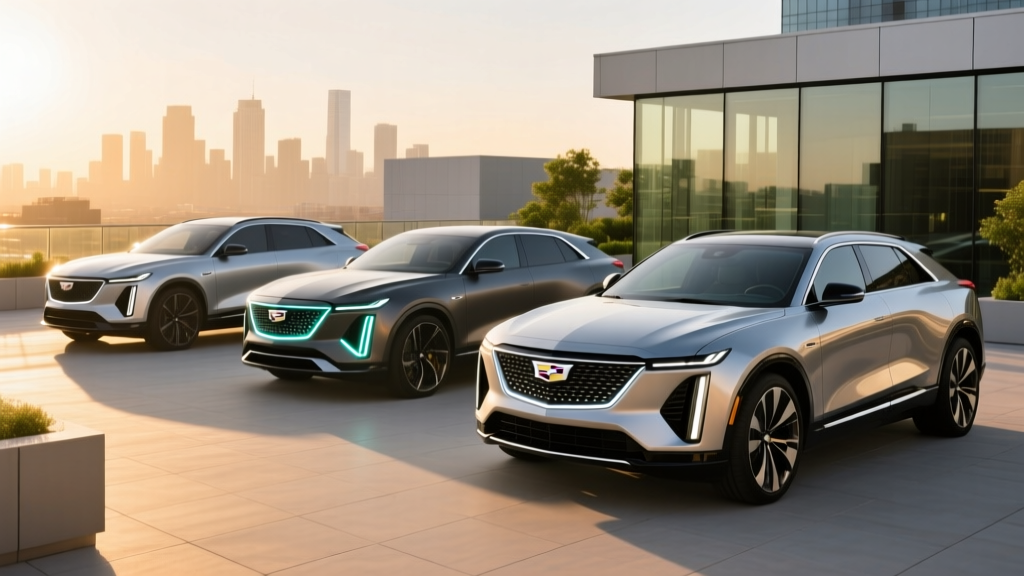
Quick Answer: Which 2026 Cadillac Electric SUV Fits You?
Cadillac offers three electric SUVs for the 2026 model year: the Lyriq (midsize, ~314 mi EPA range, starting ~$58,590), the Optiq (compact, ~300 mi estimated range, starting ~$53,990), and the Vistiq (three-row flagship, ~300 mi estimated range, starting ~$79,990). All ride on GM's Ultium platform with NMC battery chemistry, support DC fast charging up to 190 kW (Lyriq), and qualify for varying degrees of the federal §30D tax credit depending on battery-sourcing compliance and buyer income. If you need two rows and maximum range, pick the Lyriq. If you want a smaller footprint and lower price, the Optiq is the entry point. If you need three rows and towing capacity, the Vistiq is the only option — but expect a higher price and slightly lower efficiency.
2026 Cadillac Electric SUV Lineup at a Glance
Cadillac's EV offensive has matured from a single model into a full three-SUV battery-electric portfolio. Unlike legacy luxury brands still leaning on mild hybrids, every model here is a dedicated BEV (battery electric vehicle) built on GM's modular Ultium architecture. That means shared battery cell formats, common powertrain components, and an electrical system designed from the ground up for electrification — not a converted gas platform.
| Spec | 2026 Lyriq | 2026 Optiq | 2026 Vistiq |
|---|---|---|---|
| Class | Midsize 2-row SUV | Compact 2-row SUV | Full-size 3-row SUV |
| Battery (usable, est.) | 102 kWh (NMC) | ~85 kWh (NMC) | ~102 kWh (NMC) |
| EPA Range | ~314 mi (RWD) | ~300 mi (est.) | ~300 mi (est.) |
| Drivetrain | RWD or AWD | AWD | AWD |
| Horsepower | 340 (RWD) / 500 (AWD) | ~400 (est.) | ~615 (est.) |
| 0–60 mph | 6.0s (RWD) / 4.6s (AWD) | ~5.5s (est.) | ~4.5s (est.) |
| Max DC Fast Charge | 190 kW | ~150 kW (est.) | ~190 kW |
| 10–80% DCFC Time | ~33 min | ~30 min (est.) | ~33 min |
| Level 2 Charge Rate | 19.2 kW (AC) | 11.5 kW (AC) | 19.2 kW (AC) |
| Base MSRP | $58,590 | $53,990 | $79,990 |
| Battery Warranty | 8 yr / 100,000 mi | 8 yr / 100,000 mi | 8 yr / 100,000 mi |
Sources: fueleconomy.gov, Cadillac official specifications. Estimated figures reflect preliminary manufacturer data for 2026 model-year trims and may shift before delivery.
Real-World Range: What the EPA Sticker Doesn't Tell You
EPA vs. Reality: The Lyriq RWD carries a 314-mile EPA estimate. In real-world highway driving at 70–75 mph in mild conditions, expect ~265–280 miles. In cold weather (below 30°F), range can drop 20–30%, bringing usable range down to ~220–250 miles before you need a charger. The AWD trims sacrifice roughly 15–25 miles of EPA range due to the second motor's weight and parasitic drag.
This gap between sticker and reality isn't unique to Cadillac — it's physics. EV efficiency drops at sustained highway speeds because aerodynamic drag increases with the square of velocity, and there's no multi-speed transmission to optimize the powertrain's operating range like an ICE vehicle. Cold weather compounds the problem: battery chemistry slows, cabin heating draws significant energy (Cadillac uses a heat pump on the Lyriq and Vistiq, which helps, but resistance heating is still a load), and regenerative braking is limited until the battery warms.
For the Optiq and Vistiq, with estimated EPA ranges around 300 miles, plan for ~240–260 miles of comfortable real-world highway range in fair weather, and ~200–220 miles in deep winter. If your commute is under 50 miles round-trip, this is a non-issue — you'll charge at home nightly and never think about it. If you regularly drive 200+ miles one-way, you'll need to plan DC fast-charging stops.
Charging Speed, Connectors, and the NACS Transition
All 2026 Cadillac electric SUVs use the NACS (North American Charging Standard) connector natively. This is a significant practical advantage: it means direct access to Tesla's Supercharger network — the most reliable and widespread DC fast-charging infrastructure in the U.S. — without an adapter. GM completed the transition to NACS for its 2025+ model-year EVs, so 2026 Cadillacs ship with the Tesla-style port from the factory.
| Charging Level | Power (kW) | Connector | Miles of Range Added per Hour | Best For |
|---|---|---|---|---|
| Level 1 (120V outlet) | ~1.4 kW | NACS | ~4–5 mi/hr | Overnight trickle, emergencies |
| Level 2 (240V home) | 11.5–19.2 kW | NACS | ~35–60 mi/hr | Daily home charging |
| DC Fast Charge | 150–190 kW peak | NACS | ~600+ mi/hr (peak) | Road trips, rapid top-ups |
Understanding the charge curve: The Lyriq's advertised 190 kW peak DC fast-charge rate is not sustained for the entire session. Like all lithium-ion batteries, the Ultium cells accept maximum power only at lower states of charge (roughly 10–40% SoC). As the battery fills, the charge management system tapers power to protect cell longevity. A typical 10–80% session takes about 33 minutes, but an 80–100% top-off can take nearly as long as the 10–80% portion. For road trips, plan to charge to 80% and move on — it's faster overall than waiting for a full battery.
At home on a Level 2 charger, the Lyriq and Vistiq can accept up to 19.2 kW (requiring a 100-amp circuit and hardwired EVSE), which fully replenishes the ~102 kWh battery in roughly 6 hours. The Optiq's 11.5 kW onboard charger is more modest but still provides a full overnight charge on a standard 48-amp Level 2 circuit. Most EV owners install a 48-amp or 60-amp Level 2 wallbox, which costs $500–$1,200 for equipment plus $800–$2,500 for professional installation depending on your electrical panel's capacity and distance from the panel to the garage.
Cost Breakdown: Purchase Price, Tax Credits, and Operating Expenses
Purchase Price and the §30D Federal Tax Credit
The 2026 Lyriq starts at $58,590 (Luxury RWD), with the AWD Sport trim climbing to roughly $65,000+ depending on options. The Optiq opens at $53,990, making it Cadillac's most affordable EV. The Vistiq, as a three-row premium SUV, commands $79,990 and up.
Federal tax credit eligibility under IRS §30D is complex and model-specific. Key rules for 2026:
- MSRP cap: SUVs must be priced at or below $80,000 to qualify. This puts the base Vistiq right at the limit — higher trims exceed it and lose eligibility entirely.
- Buyer income cap: Modified AGI must not exceed $150,000 (single), $225,000 (head of household), or $300,000 (joint).
- Battery sourcing: A percentage of critical minerals and battery components must be sourced from the U.S. or free-trade-agreement countries. The exact qualifying credit amount ($3,750 for minerals + $3,750 for components = up to $7,500 total) depends on whether each threshold is met for the specific model year.
- Point-of-sale transfer: As of 2024, you can transfer the credit to the dealer at purchase, reducing your out-of-pocket cost immediately rather than waiting for a tax refund.
Important: Credit eligibility changes as battery supply chains evolve. Always verify current status on fueleconomy.gov and consult a tax professional before relying on the credit in your purchase decision.
Operating Costs: EV vs. Gas Comparison
| Annual Cost (15,000 mi/yr) | Cadillac Lyriq (EV) | Cadillac XT5 (Gas AWD) |
|---|---|---|
| Fuel / Electricity | $650–$950 (home charging at $0.14/kWh) | $2,400–$2,800 (gas at $3.40/gal, 23 MPG combined) |
| Maintenance | $200–$400 (no oil, fewer brake jobs due to regen) | $800–$1,200 (oil, filters, brakes, spark plugs) |
| Insurance (avg.) | $1,800–$2,400 | $1,500–$2,000 |
| Estimated Annual Total | $2,650–$3,750 | $4,700–$6,000 |
The Lyriq's electricity cost assumes predominantly home Level 2 charging at the U.S. average residential rate of ~$0.14/kWh and an efficiency of roughly 3.0 mi/kWh. If you rely heavily on public DC fast chargers (at $0.35–$0.50/kWh), your annual fuel cost could rise to $1,400–$1,800 — still below gasoline, but the savings gap narrows. Insurance tends to run 15–25% higher for EVs due to higher repair costs and replacement parts pricing, though this varies by state, driver profile, and insurer.
Over five years and 75,000 miles, a Lyriq owner charging primarily at home could save $8,000–$12,000 in fuel and maintenance compared to a similarly priced gas SUV like the XT5. Factor in the federal tax credit (if eligible), and the total cost of ownership can undercut a gas equivalent despite the higher sticker price.
First-Time EV Buyer Considerations: What to Know Before You Sign
Buying your first EV involves more than picking a trim. Here are the practical realities that spec sheets don't emphasize:
Home charging is the single biggest ownership variable. If you can install a Level 2 charger at home (garage or driveway with a 240V circuit), daily EV ownership is effortless — you wake up with a "full tank" every morning. If you live in an apartment, condo, or street-parking situation without charging access, public charging becomes your primary refueling method, which is more expensive, less convenient, and less reliable than home charging. Before purchasing any EV, confirm your charging plan.
Your electrical panel may need an upgrade. A 48-amp Level 2 charger requires a dedicated 60-amp circuit. If your home's main panel is already near capacity (common in older homes with 100-amp service), you may need a panel upgrade to 200 amps, which costs $1,500–$3,500 on top of the charger installation. Get a licensed electrician to assess your panel before committing to a purchase.
Cold weather is manageable but real. If you live in a climate with sustained sub-freezing winters, budget 20–30% range loss into your planning. The Lyriq's heat pump helps, but preconditioning the battery while plugged in (a feature Cadillac supports via the app) is the most effective way to preserve range and enable faster DC charging in cold weather.
Super Cruise is impressive but not self-driving. Cadillac's hands-free driver-assistance system works on over 400,000 miles of mapped highways in the U.S. and Canada. It's classified as SAE Level 2 — meaning you must remain attentive, keep your eyes on the road (monitored by a driver-facing camera), and be ready to take over instantly. It is not autonomous driving. It reduces fatigue on long highway stretches significantly, but it does not navigate unmapped roads, handle construction zones reliably, or replace an engaged driver.
SAE Level 2 — Driver Assistance, Not Self-Driving: Super Cruise, like Tesla Autopilot and Ford BlueCruise, is a Level 2 system. The driver is always responsible for vehicle operation. Only Level 4 services like Waymo operate without a human driver — and those are limited to specific geofenced urban areas, not available in a consumer SUV.
Common Misconceptions About Cadillac's EVs
| Myth | Fact |
|---|---|
| "EV batteries need replacing every few years and cost a fortune." | GM's Ultium batteries carry an 8-year/100,000-mile warranty against capacity loss below 70%. Industry data shows typical degradation of ~10–15% over 8 years. Full replacement (rarely needed) runs $12,000–$18,000 but is covered under warranty for defects. |
| "You can't road-trip an EV — charging takes too long." | A Lyriq adds ~190 miles of range in 20 minutes at a 190 kW NACS Supercharger. On a 600-mile trip, plan two 25-minute stops. It's more time than a gas stop, but most drivers use it for food/restroom breaks. The bigger constraint is charger availability in rural corridors. |
| "All Cadillacs qualify for the full $7,500 tax credit." | Credit eligibility depends on battery mineral/component sourcing, buyer income, and MSRP caps. The Vistiq's higher trims exceed the $80,000 SUV cap. Verify on fueleconomy.gov before purchasing. |
| "EVs are worse in the winter — they can't handle cold." | Range drops 20–30% in deep cold, but EVs start instantly (no cold cranking), the cabin heats quickly with a heat pump, and AWD traction is excellent due to instant torque and low center of gravity. Preconditioning while plugged in mitigates most range loss. |
Decision Framework: Which 2026 Cadillac Electric SUV Should You Buy?
Choose the Lyriq if: You want the best balance of range (314 mi EPA), charging speed (190 kW), interior space for five, and a starting price that stays within the §30D MSRP cap. It's the most proven model in the lineup with the longest track record and the widest charging compatibility. Best for couples, small families, and commuters with road-trip ambitions.
Choose the Optiq if: You want Cadillac's EV experience at the lowest entry price (~$53,990), prefer a smaller vehicle for urban driving, and don't need maximum cargo space. It's the best pick if you're transitioning from a compact crossover like the XT4 and want to minimize upfront cost while still accessing the Supercharger network via NACS.
Choose the Vistiq if: You need three rows of seating for six or seven passengers, value flagship luxury appointments, and your budget accommodates a ~$80,000+ starting price. Be aware that higher trims may exceed the §30D MSRP cap, eliminating federal tax credit eligibility. Best for larger families replacing an Escalade or XT6 who want to eliminate fuel costs.
Stick with gas or a PHEV if: You cannot install a home charger, regularly drive in areas with sparse DC fast-charging infrastructure (rural routes, remote regions), or frequently tow heavy loads over long distances. A Cadillac PHEV (if available in your market) or a conventional XT5/XT6 may still be the pragmatic choice until charging access improves in your area.
Frequently Asked Questions
Do 2026 Cadillac EVs use the Tesla Supercharger network?
Yes. All 2026 Cadillac electric SUVs come with a native NACS charge port, which is the same connector used by Tesla Superchargers. You can pull up to any V3 or V4 Supercharger stall and plug in directly — no adapter needed. You'll use the Cadillac app or in-vehicle navigation to initiate sessions and handle billing.
How long does it take to charge a Cadillac Lyriq at home?
On a 19.2 kW Level 2 home charger (hardwired, 100-amp circuit), a fully depleted Lyriq battery recharges in approximately 6 hours. On a more common 48-amp / 11.5 kW Level 2 circuit, expect about 9–10 hours from empty to full. Most owners charge nightly from 30–80% SoC, which takes roughly 3 hours on a 48-amp circuit — more than enough for daily driving.
What is the battery degradation warranty on Cadillac EVs?
GM provides an 8-year / 100,000-mile battery warranty that covers defects and excessive capacity loss. The warranty typically guarantees the battery will retain at least 70% of its original capacity during the coverage period. Real-world data from earlier Ultium vehicles suggests typical degradation of 8–12% over the first 5 years under normal use.
Can I tow with a Cadillac electric SUV?
Yes, but with range trade-offs. The Lyriq AWD is rated to tow up to 3,500 lbs, and the Vistiq is expected to tow up to 4,000–5,000 lbs (final rating pending EPA certification). Towing at or near capacity can reduce range by 40–50% due to the massive increase in aerodynamic drag and rolling resistance. If you tow frequently over long distances, plan charging stops accordingly.
Is Super Cruise included or does it cost extra?
Super Cruise availability and pricing vary by trim. On higher Lyriq and Vistiq trims, it's often included or available as part of a premium package. Expect a subscription fee after an initial complimentary period (typically 3 years), estimated at $25–$30/month or $250/year. Check the specific trim's equipment list before purchasing.