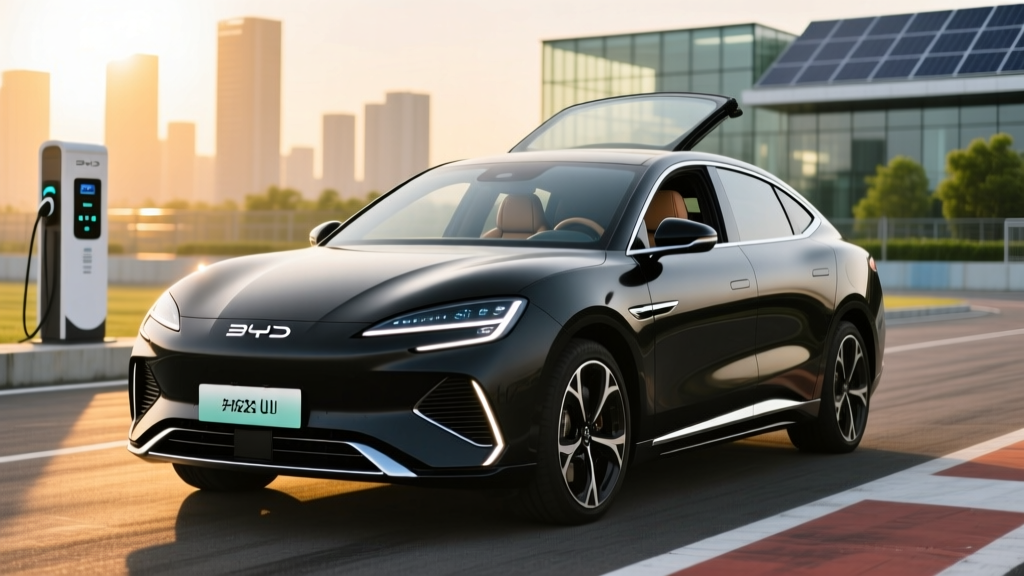
The BYD YangWang U9 is the Chinese automaker's flagship electric supercar — a 1,287-horsepower, four-motor halo car that made headlines with its ability to drive on three wheels, jump off the ground, and dance via its DiSus-X active suspension. But beyond the viral stunts, the U9 is a serious (and seriously expensive) electric grand tourer aimed squarely at the Rimac Nevera and Lotus Evija. For the 2026 model year, BYD has confirmed limited global availability, though U.S. buyers face steep tariffs, no federal tax credit eligibility, and a sparse service network. Here's the full data-driven breakdown.
BYD YangWang U9: Key Specs at a Glance
| Specification | 2026 YangWang U9 |
|---|---|
| EPA Range (est.) | 282 miles (CLTC: 450 km / 280 mi) |
| Battery Capacity | 128.7 kWh (usable ~120 kWh), LFP Blade |
| Drivetrain | Quad-motor AWD (e4 platform) |
| Horsepower | 1,287 hp (960 kW) combined |
| 0-60 mph | 2.36 seconds (manufacturer) |
| Top Speed | 190 mph (electronically limited) |
| Max DC Fast Charge | 500 kW (dual-gun) |
| 10-80% DC Charge Time | ~15 minutes (at 500 kW capable station) |
| Level 2 Home Charge | 11 kW (~28 mi/hr) |
| Efficiency | ~85 MPGe / 40 kWh/100 mi (est.) |
| Cargo Volume | 5.3 cu ft (rear trunk only, no frunk) |
| Seating | 2 passengers |
| Base MSRP (China) | ¥1,680,000 (~$232,000 USD) |
| U.S. Import MSRP (est.) | $280,000+ (incl. 100% EV tariff) |
| Battery Warranty | 8 years / 150,000 km (~93,000 mi) — China market |
| Federal Tax Credit (§30D) | Not eligible |
Real-World Range: What to Actually Expect
- City / moderate driving: 250–270 miles
- Highway (70+ mph sustained): 190–220 miles
- Cold weather (below 32°F): 170–200 miles (LFP packs lose 25-35% in extreme cold without preconditioning)
The 128.7 kWh LFP Blade battery is BYD's in-house cell-to-body (CTB) architecture, where cells are integrated directly into the chassis structure. This provides excellent torsional rigidity (critical for a supercar) but complicates battery replacement. LFP chemistry offers superior thermal stability and cycle life (3,000+ cycles to 80% capacity) compared to NMC, though at the cost of lower energy density and worse cold-weather performance. For a $230K+ supercar that most owners will garage and drive sparingly, the LFP trade-off is reasonable — longevity over energy density.
Charging Speed: 500 kW Dual-Gun and Real Charge Curves
The U9 supports BYD's dual-gun DC fast-charging system, which can pull up to 500 kW by using two CCS2 connectors simultaneously. This is the same architecture found in the Denza N7 and BYD Seal, and it requires compatible high-power stations — currently rare outside China.
| Charging Method | Power (kW) | Speed / Time | Availability Notes |
|---|---|---|---|
| DC Fast Charge (dual-gun) | Up to 500 kW | 10-80% in ~15 min | Requires 500 kW station; very limited outside China |
| DC Fast Charge (single-gun) | Up to 250 kW | 10-80% in ~28 min | Standard CCS2 stations (Electrify America, EVgo) |
| Level 2 (home / public AC) | 11 kW | ~28 mi/hr; 0-100% in ~11 hrs | Requires 48A / 60A circuit; 240V |
| Level 1 (120V household) | 1.4 kW | ~3.5 mi/hr | Emergency use only |
Charging curve reality: The 500 kW peak rate is only sustained between roughly 10-40% State of Charge. Above 60%, the charge rate tapers to approximately 200 kW, and above 80% it drops further to under 80 kW to protect the LFP cells. On a single CCS2 gun (250 kW max), expect a more linear curve but a longer overall session. U.S. buyers should plan around 250 kW single-gun charging, which still delivers a usable 10-80% time of under 30 minutes — adequate for road-trip stops if you can find a functioning 350 kW charger.
One critical note: the U9 uses CCS2 (the European/Chinese standard), not NACS. U.S. buyers importing the car would need a CCS2-to-NACS adapter for Tesla Supercharger access, and even then, Superchargers max out at 250 kW (V3) or 350 kW (V4) — meaning the dual-gun 500 kW capability is unusable in the U.S.
Performance: 1,287 HP and the e4 Quad-Motor Platform
The YangWang U9's e4 ("e Four") platform uses four independent electric motors — one per wheel — each producing approximately 322 hp. The combined system output is 1,287 hp and an estimated 1,254 lb-ft of torque. BYD claims a 0-60 mph time of 2.36 seconds, which would place it in Rimac Nevera territory (1.85s for the Nevera, but at nearly double the price).
The independent motor control enables torque vectoring at a resolution no mechanical differential can match. Each wheel's torque is adjusted thousands of times per second, enabling the U9 to corner with uncanny neutrality for a 5,467-lb vehicle. The DiSus-X active suspension adds another layer: it can raise the car for speed bumps, lower it for highway stability, and even perform a "jump" function (primarily a demonstration feature, not practical for driving).
Notable performance limitation: The U9's massive weight is its physics enemy. While straight-line acceleration is brutal, sustained track use will tax the battery and thermal management system. BYD has not published lap times at major circuits, and the LFP pack's lower energy density means track sessions will drain the battery faster than an NMC-based competitor like the Lotus Evija. This is a grand-touring supercar, not a track weapon.
Pricing, Tax Credits, and U.S. Availability Reality
| Cost Factor | Amount |
|---|---|
| Base MSRP (China) | ¥1,680,000 (~$232,000 USD) |
| Estimated U.S. Import Price | $280,000–$320,000 (incl. tariffs, homologation) |
| Federal §30D Tax Credit | $0 — not eligible |
| State/Local Incentives | Varies; most require EPA certification and U.S. MSRP listing |
| Estimated Annual Insurance | $8,000–$14,000 (supercar tier, limited U.S. data) |
The BYD YangWang U9 does not qualify for the U.S. federal EV tax credit under IRS §30D. The reasons are threefold:
- MSRP cap: §30D limits the credit to vehicles with an MSRP of $80,000 or less for sedans/sedans, and $80,000 for SUVs/trucks. The U9 far exceeds this.
- Manufacturer eligibility: The credit requires the vehicle to be manufactured by an automaker with a U.S. dealer network and EPA-certified fuel economy data. BYD does not sell passenger vehicles in the U.S. as of 2026.
- Battery sourcing: §30D requires critical minerals and battery components to meet U.S. free-trade-agreement sourcing thresholds. BYD's vertically integrated LFP supply chain is entirely China-based.
Additionally, the U.S. imposed a 100% tariff on Chinese EVs in 2024, effectively doubling the import cost. Any U.S. buyer would be looking at a $280,000+ total price through a grey-market importer, with no warranty support, no U.S. service centers, and no NHTSA crash-test data. This is a vehicle for collectors and enthusiasts who can absorb those risks.
Interior, Tech, and Daily Livability
The U9's cabin is a two-seat layout with a driver-focused digital cockpit. Key tech features include:
- 12.8-inch rotating center display with BYD's DiLink infotainment (Android-based, Chinese app ecosystem)
- Digital instrument cluster with real-time torque vectoring visualization
- Nappa leather and Alcantara with carbon-fiber trim
- DiSus-X suspension controls accessible via touchscreen (raise/lower, dance mode, jump mode)
- Level 2 ADAS: adaptive cruise, lane-keep, 360-degree cameras — but no hands-free or eyes-off capability
Cargo and space: With only 5.3 cu ft of rear trunk space and no front trunk (the e4 motors and electronics occupy the frunk area), the U9 is impractical for anything beyond a weekend bag. Legroom is adequate for adults up to 6'2", but the low-slung roofline makes ingress and egress a deliberate affair. Ground clearance is 4.7 inches in standard mode, though DiSus-X can raise it to approximately 6.3 inches for driveways and speed bumps.
Pros
- 1,287 hp with independent torque vectoring per wheel
- LFP Blade battery — exceptional thermal safety and longevity
- 500 kW dual-gun charging (where infrastructure exists)
- DiSus-X active suspension is genuinely innovative
- 3,000+ charge cycle life (LFP chemistry)
- Sub-2.4-second 0-60 mph
Cons
- No U.S. sales network, no warranty support, no NHTSA data
- 100% U.S. tariff makes import cost prohibitive (~$280K+)
- Heavy at 5,467 lbs — limits track endurance and efficiency
- CCS2 connector — requires adapter for U.S. NACS chargers
- Real-world highway range drops to ~200 miles
- Minimal cargo space (5.3 cu ft, no frunk)
Who Should Consider the YangWang U9?
This is a niche vehicle even within the supercar niche. The U9 makes sense for:
- Collectors and enthusiasts outside the U.S. (China, Middle East, Europe) who want a cutting-edge EV supercar with unique active-suspension technology
- BYD brand loyalists upgrading from a Seal or Han who want the halo experience
- Technology demonstrators — the e4 platform and DiSus-X are engineering showcases that preview future BYD/Denza/YangWang vehicles
It does not make sense for U.S. buyers in 2026. The tariff wall, lack of service infrastructure, CCS2 connector incompatibility, and zero tax-credit eligibility make it a financial and logistical dead end stateside. U.S. buyers seeking a comparable electric supercar experience should look at the Rimac Nevera (if budget allows at $2.2M), the Lotus Evija (limited availability), or wait for domestic options like the upcoming Cadillac Celestiq performance variants.
BYD YangWang U9 vs. Key Competitors
| Spec | BYD YangWang U9 | Rimac Nevera | Lotus Evija |
|---|---|---|---|
| Price | ~$232K (China) | $2,200,000 | $2,100,000 |
| Horsepower | 1,287 hp | 1,914 hp | 1,972 hp |
| 0-60 mph | 2.36 sec | 1.85 sec | ~2.0 sec |
| Battery | 128.7 kWh LFP | 120 kWh NMC | 70 kWh NMC |
| Range (est.) | ~282 mi EPA | ~340 mi WLTP | ~250 mi WLTP |
| Max DC Charge | 500 kW (dual) | 500 kW | 800 kW |
| Weight | 5,467 lbs | 4,740 lbs | 4,160 lbs |
| U.S. Available? | No | Limited | Limited |
The U9's value proposition is clear: roughly one-tenth the price of a Nevera or Evija, with 65-70% of the performance. But value only matters if you can actually buy, service, and insure the car in your market. For non-U.S. buyers in BYD's export markets, the U9 is arguably the best value in electric supercars. For everyone else, it remains a fascinating engineering exercise that highlights BYD's rapid ascent upmarket.
Frequently Asked Questions
What is the real-world range of the BYD YangWang U9?
Expect approximately 250-270 miles in city and moderate driving, 190-220 miles on the highway, and as low as 170-200 miles in cold weather (below 32°F). The heavy 5,467-lb curb weight and four-motor energy draw significantly reduce highway efficiency compared to lighter dual-motor EVs.
How fast does the YangWang U9 charge?
Using dual-gun DC fast charging at a 500 kW station, the U9 can go from 10-80% in approximately 15 minutes. On a standard single-gun 250 kW CCS2 charger (the U.S. norm), expect 10-80% in about 28 minutes. Home Level 2 charging at 11 kW adds roughly 28 miles per hour, requiring about 11 hours for a full charge.
Does the BYD YangWang U9 qualify for the U.S. federal EV tax credit?
No. The U9 does not qualify for the IRS §30D federal tax credit. It exceeds the $80,000 MSRP cap, BYD does not have a U.S. passenger vehicle sales network, and its battery sourcing does not meet critical-mineral requirements. No state incentives are likely available either.
Is the YangWang U9 worth buying over a Rimac Nevera or Lotus Evija?
On pure value, the U9 offers 65-70% of the performance at roughly 10% of the price. However, it is heavier, less track-capable, and unavailable in most Western markets. If you're in China or the Middle East, the U9 is a compelling supercar bargain. In the U.S., import costs and lack of support make the Nevera or Evija (if you can get one) more practical choices despite their higher prices.
What is the DiSus-X suspension and why does it matter?
DiSus-X is BYD's fully active hydraulic-electric suspension system. It can independently raise or lower each wheel, enabling the U9 to clear obstacles, perform a controlled "jump" (all four wheels leave the ground), and even drive on three wheels if one tire is damaged. It's primarily a technology demonstration, but the real-world benefit is adjustable ride height (4.7 to 6.3 inches) and exceptional body control during cornering.
Can I import a BYD YangWang U9 to the United States?
Technically yes, through a registered importer who can handle NHTSA import compliance modifications. However, the 100% tariff on Chinese EVs, lack of U.S. crash-test data, CCS2 connector incompatibility, and absence of any BYD service network make it impractical and extremely expensive. Total landed cost would likely exceed $300,000 with no warranty protection.