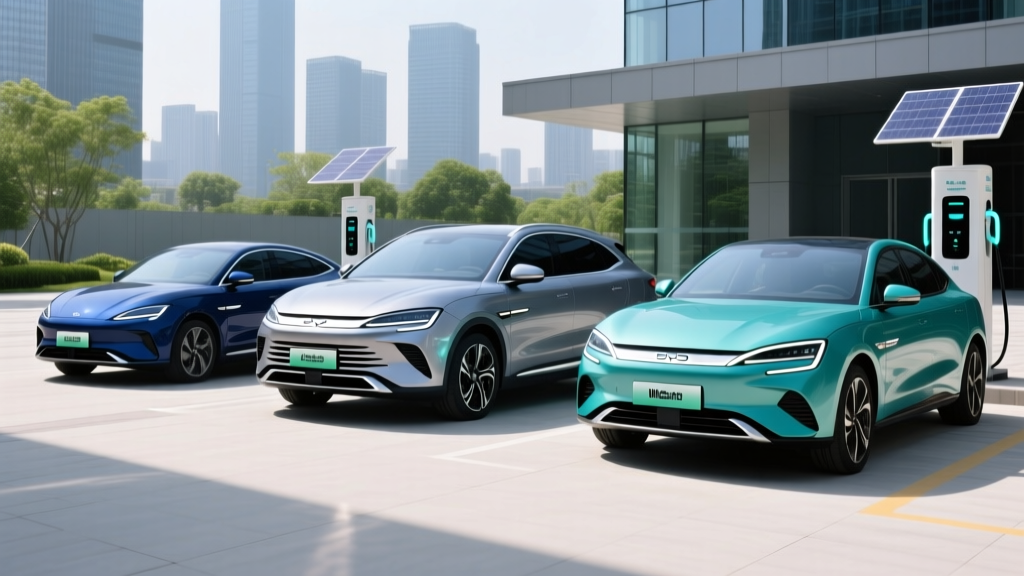
Chinese battery-electric vehicles (BEVs) have reshaped global EV markets, and BYD — the world's largest plug-in vehicle manufacturer — is the most prominent name in the BEV China export wave. After dominating in Europe, Southeast Asia, and Latin America, BYD's passenger vehicles are now drawing intense scrutiny from US buyers wondering whether affordable, long-range Chinese EVs will ever reach American driveways. This profile examines BYD's global BEV lineup from a US-market perspective: what these vehicles offer on paper, how they compare to established rivals, and what tariff and tax-credit realities mean for potential buyers in 2026.
BYD's Global BEV Lineup at a Glance
BYD produces both plug-in hybrids (PHEVs, branded as DM-i/DM-p) and pure battery-electric vehicles. For this review, we focus exclusively on the BEV models most likely to interest US shoppers based on global availability, segment relevance, and import discussions. Below are the headline specifications based on BYD's published global figures and WLTP-to-EPA adjusted estimates where US certification is pending.
| Model | Segment | Battery (kWh) | Chemistry | WLTP Range | Est. EPA Range | 0–60 mph | HP |
|---|---|---|---|---|---|---|---|
| Dolphin | Subcompact hatch | 60.4 | LFP (Blade) | 265 mi | ~225 mi | 7.0 s | 201 |
| Atto 3 (Yuan Plus) | Compact SUV | 60.4 | LFP (Blade) | 260 mi | ~220 mi | 7.3 s | 201 |
| Seal | Midsize sedan | 82.5 | LFP (Blade) | 354 mi | ~300 mi | 5.9 s (RWD) / 3.8 s (AWD) | 313 (RWD) / 530 (AWD) |
| Seal U | Midsize SUV | 87.0 | LFP (Blade) | 310 mi | ~265 mi | 6.7 s | 313 |
| Han EV | Full-size sedan | 85.4 | LFP (Blade) | 325 mi | ~275 mi | 7.9 s (FWD) / 3.9 s (AWD) | 244 (FWD) / 516 (AWD) |
Note: EPA estimates are approximated from WLTP figures using a typical 85% conversion factor. Official EPA certification is required before US sale. Source: BYD Global.
Range & Efficiency: Real-World Expectations
BYD's entire passenger BEV lineup uses its proprietary Blade Battery, a lithium iron phosphate (LFP) cell in a cell-to-pack configuration. LFP chemistry sacrifices some energy density versus the nickel-manganese-cobalt (NMC) packs used in many Hyundai, Kia, and Tesla models, but gains in thermal stability, cycle life, and cost. For US buyers, that means slightly less range per kWh but potentially better long-term degradation behavior and the ability to charge to 100% daily without accelerated wear.
EPA range stickers for BYD models sold in Europe and Australia suggest the following US-adjusted expectations. Real-world results depend heavily on conditions:
- BYD Seal (RWD, est. EPA 300 mi): Expect ~250–270 mi on highway trips at 70 mph; ~210–230 mi in sub-40°F winter conditions without consistent preconditioning.
- BYD Atto 3 (est. EPA 220 mi): Expect ~180–195 mi highway; ~155–170 mi in cold weather.
- BYD Dolphin (est. EPA 225 mi): Expect ~185–200 mi highway; ~150–170 mi in cold weather.
LFP batteries tend to show more voltage sag in extreme cold than NMC, making battery preconditioning and garage parking important for winter range retention. WLTP figures published in Europe overstate range by roughly 15–20% compared to EPA methodology. Source: fueleconomy.gov (EPA testing methodology reference).
In terms of efficiency, the BYD Seal RWD achieves roughly 14–15 kWh/100 km (WLTP), translating to an estimated 120–130 MPGe combined under EPA testing. The Atto 3 sits around 115–120 MPGe combined. These figures trail the Hyundai Ioniq 6 (140 MPGe) and Tesla Model 3 (132 MPGe) but remain competitive for the class.
Charging Speed: DC Fast & Level 2 Breakdown
Charging speed has historically been a weak spot for BYD's global BEVs compared to Hyundai/Kia's E-GMP platform or Tesla's architecture. BYD has improved with its newer e-Platform 3.0 models, but peak DC fast-charge rates remain modest.
| Model | Max DC Fast Charge | 10–80% DC Time | Level 2 AC Rate | Level 2 Miles/Hr |
|---|---|---|---|---|
| Dolphin | 88 kW | ~29 min | 11 kW | ~35 mi/hr |
| Atto 3 | 88 kW | ~29 min | 11 kW | ~33 mi/hr |
| Seal (RWD) | 150 kW | ~26 min | 11 kW | ~40 mi/hr |
| Seal (AWD) | 150 kW | ~26 min | 11 kW | ~40 mi/hr |
| Seal U | 140 kW | ~28 min | 11 kW | ~38 mi/hr |
| Han EV | 120 kW | ~30 min | 7.4 kW | ~25 mi/hr |
Charge curve reality: BYD's LFP packs sustain peak charge rates for a shorter window than NMC competitors. The Seal, for example, may peak at 150 kW between 10–40% SoC, then taper to ~90 kW through 60%, and drop sharply above 80%. If you regularly road-trip and charge to 90%+, add 10–15 minutes to the published 10–80% time. For comparison, a Hyundai Ioniq 5 with its 800V architecture sustains 230+ kW longer, achieving 10–80% in ~18 minutes.
For home charging, BYD models accept 11 kW AC (three-phase, common in Europe/Australia). On a standard US single-phase 48A Level 2 circuit (11.5 kW), expect similar charge rates. A full overnight charge from 20% to 100% takes roughly 7–9 hours depending on pack size — adequate for daily use.
Performance & Drivetrain
BYD positions its BEVs as comfort-oriented rather than performance-first. The Seal AWD Performance is the exception, with 530 hp and a 3.8-second 0–60 mph time that challenges the Tesla Model 3 Performance. Most other models prioritize smooth acceleration over outright speed.
- Dolphin: 201 hp single motor, FWD. Adequate for city driving; highway passing requires planning.
- Atto 3: 201 hp single motor, FWD. Competent daily driver; not sporty.
- Seal RWD: 313 hp, rear-wheel drive. Confident acceleration, balanced chassis.
- Seal AWD: 530 hp dual motor. Genuinely quick; torque-vectoring AWD provides confident all-weather traction.
- Han EV AWD: 516 hp dual motor. Straight-line speed is strong, but handling favors comfort over agility.
Ride quality across the lineup is tuned for compliance. NVH (noise, vibration, harshness) levels are respectable, though wind noise at highway speeds is more noticeable than in a Tesla Model 3 or BMW i4.
Interior, Cargo & Technology
BYD interiors emphasize material quality and screen technology. The signature feature is a 15.6-inch rotating center display that pivots between landscape (navigation, media) and portrait (climate, app menus) orientation. Software runs BYD's DiLink OS, which supports over-the-air updates, wireless Apple CarPlay/Android Auto, and a built-in app store.
| Model | Rear Legroom | Cargo (rear seats up) | Cargo (rear seats folded) | Frunk |
|---|---|---|---|---|
| Dolphin | 34.3 in | 12.2 cu ft | 36.6 cu ft | None |
| Atto 3 | 36.2 in | 15.7 cu ft | 47.3 cu ft | None |
| Seal | 35.4 in | 14.1 cu ft | N/A (sedan) | 1.8 cu ft |
| Seal U | 37.0 in | 19.4 cu ft | 52.5 cu ft | None |
| Han EV | 37.4 in | 14.5 cu ft | N/A (sedan) | None |
Driver assistance: BYD equips most global models with its DiPilot suite — adaptive cruise control, lane-keeping assist, blind-spot monitoring, and a 360° camera. This is an SAE Level 2 driver-assistance system requiring constant driver supervision. It is not autonomous driving. In global reviews, DiPilot is competent but less refined than Tesla Autopilot, Ford BlueCruise, or GM Super Cruise in lane-centering smoothness and hands-free capability.
Notable drawbacks: The Han EV and older-platform models use a torsion-beam rear suspension (cost-saving), resulting in less composed ride on rough pavement. Touchscreen-dependent climate controls lack physical buttons, frustrating some drivers. European-spec models use CCS2 connectors; US-spec models would require CCS1 (or NACS, depending on BYD's eventual US strategy).
Pricing, Tax Credits & Ownership Costs
Here is where the BEV China conversation becomes complicated for US buyers. BYD does not currently sell passenger vehicles in the United States, and significant trade barriers make near-term entry uncertain.
| Model | Global Price (USD equiv.) | US Competitor | US MSRP |
|---|---|---|---|
| Dolphin | ~$30,000 | Chevy Bolt EV | $28,785 |
| Atto 3 | ~$35,000 | Hyundai Kona Electric | $34,050 |
| Seal (RWD) | ~$42,000 | Tesla Model 3 RWD | $39,990 |
| Seal (AWD) | ~$50,000 | Tesla Model 3 LR AWD | $47,990 |
| Han EV | ~$48,000 | BMW i4 eDrive40 | $57,900 |
Federal Tax Credit Eligibility (§30D)
Under current IRS rules (IRS §30D), the federal EV tax credit provides up to $7,500 for qualifying new clean vehicles. However, several provisions directly affect Chinese-manufactured BEVs:
- Battery component sourcing: Vehicles with battery components manufactured by a "foreign entity of concern" (FEOC) — which includes Chinese companies — are disqualified from the $3,750 battery-component portion of the credit. Since BYD vertically manufactures its own Blade Battery in China, any BYD imported directly would likely fail this requirement.
- Critical minerals: The $3,750 critical-minerals portion requires sourcing from the US or free-trade-agreement partners. Chinese-processed minerals may disqualify this half as well.
- MSRP caps: Sedans must be under $55,000 MSRP; SUVs/pickups/vans under $80,000.
- Income caps: AGI limits of $150K single / $300K joint filers.
- Assembly: The credit does not require US assembly, but the sourcing rules effectively exclude most China-built BEVs.
Bottom line: Even if BYD began US sales, its current China-manufactured vehicles would likely qualify for $0 of the $7,500 federal credit under 2026 FEOC and critical-mineral rules. This erases a key price advantage versus US-assembled competitors like the Tesla Model 3, Chevy Equinox EV, and Hyundai Ioniq 5 (all of which may qualify for partial or full credit depending on battery sourcing).
Tariff Reality
The US imposes a 100% tariff on Chinese-manufactured EVs (raised from 25% in 2024 under Section 301 trade actions). This means a BYD Seal with a $42,000 factory cost would carry roughly $84,000 in landed cost before dealer markup — making it uncompetitive against a US-built Tesla Model 3 at ~$40,000. BYD has acknowledged this barrier and has not announced US passenger vehicle sales plans as of early 2026.
Pros, Cons & Verdict
Pros
- LFP Blade Battery offers excellent thermal safety and cycle life
- Competitive global pricing undercuts most Western rivals by 15–25%
- Seal AWD Performance delivers genuine sports-sedan acceleration (3.8s 0–60)
- Generous standard equipment: rotating display, 360° camera, V2L
- Strong build quality observed in Euro NCAP 5-star tested models
Cons
- DC fast-charge speeds lag behind Hyundai/Kia 800V and Tesla platforms
- LFP chemistry means greater cold-weather range loss than NMC competitors
- 100% US tariff on Chinese EVs makes import economically unviable
- No federal tax credit eligibility due to FEOC battery-sourcing rules
- DiPilot ADAS refinement trails Tesla Autopilot and GM Super Cruise
- No US service/parts network or confirmed sales timeline
Who Should Consider BYD (and Who Shouldn't)
This BEV lineup suits: International buyers in markets without Chinese EV tariffs (Europe, Australia, Southeast Asia, Latin America) who want affordable, well-equipped electric vehicles with LFP battery longevity. The Seal and Atto 3 are particularly compelling for value-conscious EV adopters in those regions.
US buyers should wait or look elsewhere: Unless BYD establishes local manufacturing (potentially in Mexico or through a partnership) that circumvents tariffs and satisfies §30D sourcing rules, these vehicles are not purchasable in the US. American shoppers are better served by the Tesla Model 3, Hyundai Ioniq 5/6, Chevy Equinox EV, or Ford Mustang Mach-E — all available now with US service networks and potential tax-credit eligibility.
Frequently Asked Questions
What is the real-world range of BYD's BEVs?
The BYD Seal RWD achieves an estimated ~300 miles EPA-equivalent, but expect 250–270 miles on highway road trips and 210–230 miles in freezing temperatures. The Atto 3 delivers roughly 180–195 highway miles. LFP batteries lose more range in cold weather than NMC packs, so preconditioning is essential.
How fast do BYD BEVs charge at home and on the road?
DC fast charging peaks at 88–150 kW depending on model, with 10–80% taking 26–30 minutes. Home Level 2 charging at 11 kW adds roughly 33–40 miles per hour. These speeds are adequate but trail the 18-minute 10–80% times of 800V competitors like the Hyundai Ioniq 5.
Can I buy a BYD in the United States in 2026?
No. BYD has not launched US passenger vehicle sales, and a 100% tariff on Chinese-manufactured EVs makes direct import economically impractical. BYD sells commercial electric trucks and buses in the US, but not consumer cars.
Does BYD qualify for the $7,500 federal EV tax credit?
Under current §30D rules, almost certainly not. BYD's vertically integrated Chinese battery production triggers the FEOC (foreign entity of concern) exclusion, disqualifying the $3,750 battery-component half. Chinese-processed critical minerals likely eliminate the remaining $3,750 as well. Always verify current eligibility at fueleconomy.gov.
Is BYD's Blade Battery better than NMC?
It depends on your priorities. LFP (Blade) offers superior thermal stability, longer cycle life (3,000+ cycles vs. ~1,500–2,000 for NMC), and the ability to charge to 100% regularly without degradation concerns. The trade-off is lower energy density (more weight for the same range) and greater cold-weather range loss. For daily commuters who charge at home, LFP is arguably the better long-term choice.
How does BYD compare to Tesla?
On price and equipment, BYD undercuts Tesla globally. On charging speed, software refinement, Supercharger network access, and ADAS capability, Tesla maintains advantages. In markets where both compete, BYD wins on value; Tesla wins on ecosystem and charging infrastructure.