Quick Verdict: An Impressive SUV — But Not (Yet) for US Buyers
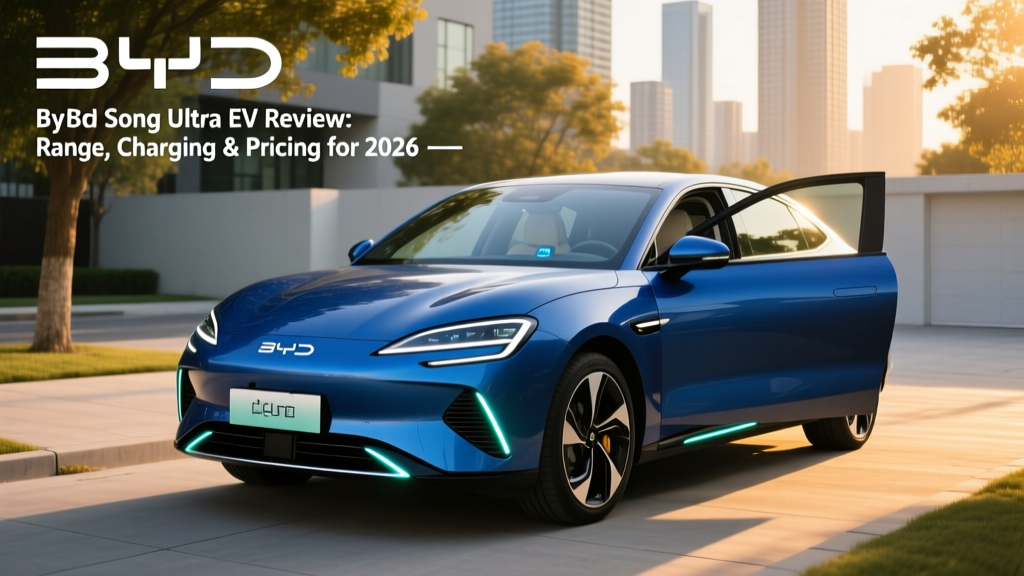
The BYD Song Ultra EV is one of the most compelling mid-size electric crossovers selling globally in 2026. With a Blade (LFP) battery, competitive range, and a price that undercuts rivals by thousands in international markets, it's easy to see why this model generates search interest from US-based EV shoppers. But here's the critical fact upfront: BYD does not currently sell passenger vehicles in the United States, and the Song Ultra EV is not available for purchase from any US dealership as of early 2026.
That said, the Song Ultra EV matters. It sets a benchmark for what a value-oriented electric crossover can deliver, and it pressures every competitor — from the Tesla Model Y to the Hyundai Ioniq 5 — to justify their pricing. If BYD ever enters the US market (or if you're reading from a market where it's available), here's exactly what this vehicle offers.
BYD Song Ultra EV: Full Specifications at a Glance
| Specification | Detail |
|---|---|
| Battery Capacity | 87.04 kWh (usable), LFP Blade chemistry |
| CLTC Range | ~373 mi (600 km) |
| Est. EPA-Equiv. Range | ~280–310 mi |
| Motor / Drivetrain | Single motor, FWD / Dual motor AWD available |
| Horsepower | 201 hp (FWD) / 402 hp (AWD) |
| 0–60 mph (est.) | ~7.9 sec (FWD) / ~4.4 sec (AWD) |
| DC Fast Charge (peak) | ~140 kW (peak) |
| 10–80% DC Charge Time | ~30 minutes |
| Level 2 AC Charge Rate | 7 kW (onboard charger) |
| Efficiency (est.) | ~105 MPGe / ~32 kWh/100 mi |
| Cargo Volume | ~20.1 cu ft (rear seats up) / ~50.5 cu ft (folded) |
| Rear Legroom | ~37.4 in |
| Warranty (Int'l) | 6 yr / 93,000 mi vehicle; 8 yr / 100,000 mi battery |
| Base Price (Int'l, est.) | ~¥189,800 CNY ≈ $26,200 USD (before tariffs) |
Battery and Platform: The Blade Advantage
The Song Ultra EV rides on BYD's e-Platform 3.0 and uses the company's signature Blade Battery — a lithium iron phosphate (LFP) cell arranged in a structural pack. The 87.04 kWh pack is one of the largest LFP batteries in the mid-size crossover segment.
Why LFP matters: Compared to nickel-manganese-cobalt (NMC) chemistry used in many competitors, LFP offers superior thermal stability (lower fire risk), longer cycle life (often 3,000+ full cycles before significant degradation), and no cobalt in the supply chain. The trade-off is lower energy density — LFP packs are heavier for the same kWh — and slightly worse cold-weather performance, though BYD's heat pump and battery preconditioning mitigate this.
BYD claims the Blade Battery retains over 80% of its original capacity after 5,000 charge cycles in lab testing. In real-world ownership, expect 5–8% degradation over the first 100,000 miles, which is consistent with industry-leading LFP data from CATL-supplied vehicles.
Charging Speed: Adequate, Not Class-Leading
| Charging Level | Power | Miles Added per Hour | Notes |
|---|---|---|---|
| Level 1 (120V) | ~1.4 kW | ~4–5 mi/hr | Emergency/trickle only |
| Level 2 (240V) | 7 kW | ~22–25 mi/hr | Full charge in ~12–13 hrs |
| DC Fast Charge | ~140 kW peak | ~150 mi in 30 min | 10–80% in ~30 min; tapers above 80% |
The Song Ultra EV's 140 kW peak DC charge rate is respectable but falls behind competitors like the Hyundai Ioniq 5 (peak 240 kW on 800V architecture) and the Tesla Model Y (peak ~250 kW on V3 Superchargers). The LFP chemistry contributes to a flatter charge curve — meaning the battery sustains a relatively steady charge rate through a wider state-of-charge window — but the peak rate itself is limited by the 400V platform.
Practical implication: On a road trip, you'll spend about 30 minutes at a DC fast charger to go from 10% to 80%. That's acceptable but noticeably slower than the 18-minute stops possible in 800V vehicles. If you charge mostly at home overnight on Level 2, this matters less — the 7 kW onboard charger fills the battery in roughly 12–13 hours, which covers most daily needs.
Performance and Driving Dynamics
The front-wheel-drive variant delivers 201 hp and 310 Nm (229 lb-ft) of torque, good for a 0–60 mph time around 7.9 seconds. That's adequate for merging and passing but won't win drag races. The AWD dual-motor variant is the performance option, with a combined 402 hp and a 0–60 time of approximately 4.4 seconds — genuinely quick for a family crossover.
BYD's e-Platform 3.0 uses a rear multi-link suspension that handles bumps competently. Steering is light and geared toward comfort rather than sportiness. Regenerative braking offers multiple levels, but unlike some competitors, the Song Ultra EV doesn't quite achieve true one-pedal driving at its strongest regen setting — you'll still need the friction brake for final stops.
Interior, Tech, and Cargo Space
The cabin is where the Song Ultra EV punches above its price class. A 15.6-inch rotating center touchscreen dominates the dash — it pivots between landscape and portrait orientation depending on the app. The digital instrument cluster is a 10.25-inch display behind a flat-bottom steering wheel.
Infotainment: BYD's DiLink system supports voice control, OTA updates, and a growing app ecosystem (in markets where it's sold). Apple CarPlay and Android Auto integration varies by market. The system is responsive but the UI has a learning curve compared to Tesla's minimalist approach or Hyundai's more conventional layout.
Driver Assistance: The Song Ultra EV includes BYD's DiPilot suite — adaptive cruise control, lane-keeping assist, automatic emergency braking, blind-spot monitoring, and a 360-degree camera. This is an SAE Level 2 system, meaning the driver must remain fully engaged with hands on the wheel and eyes on the road at all times. It is not autonomous driving.
Cargo practicality: With 20.1 cubic feet behind the second row and 50.5 cubic feet with seats folded, the Song Ultra EV is competitive with the Model Y (30.2/76.2 cu ft, though Tesla's figure includes the frunk). The BYD does not offer a front trunk (frunk), which is a missed opportunity given the e-Platform 3.0's packaging efficiency.
Pricing, Tax Credits, and US Availability
In China, the 2026 BYD Song Ultra EV starts at approximately ¥189,800 (roughly $26,200 USD at current exchange rates) for the FWD base trim, with the AWD variant climbing to around ¥239,800 (~$33,100 USD). These prices are remarkably aggressive — thousands below a comparably equipped Tesla Model Y or Ford Mustang Mach-E in their respective home markets.
However, for US buyers, pricing is academic. BYD has no announced plans to sell passenger vehicles in the United States as of 2026. Even if they did, the vehicle would face:
- 100% tariff on Chinese-made EVs (raised from 25% in 2024 under updated USTR trade policy), effectively doubling the import price
- No federal §30D tax credit eligibility — the $7,500 credit under IRS rules requires final assembly in North America, battery component sourcing from the US or FTA partners, and critical minerals from approved sources. A BYD built in China meets none of these criteria.
- No established US service network for warranty repairs or parts supply
If BYD were to build a North American factory (as they've done for buses in Lancaster, California), the equation could change. But no such passenger-vehicle plant has been announced.
How the Song Ultra EV Compares to US-Available Rivals
For US buyers cross-shopping the concept of the Song Ultra EV against vehicles they can actually purchase, here's how the numbers stack up:
| Metric | BYD Song Ultra (Int'l) | Tesla Model Y LR | Hyundai Ioniq 5 SEL |
|---|---|---|---|
| EPA Range | ~280–310 (est.) | 320 mi | 303 mi |
| Battery | 87 kWh LFP | 75 kWh NMC | 77.4 kWh NMC |
| DC Peak kW | ~140 kW | ~250 kW | ~240 kW |
| 10–80% Time | ~30 min | ~25 min | ~18 min |
| Base MSRP (US) | N/A (not sold) | $44,990 | $42,600 |
| Federal Tax Credit | Not eligible | Partial/variable | Eligible (check sourcing) |
Sources: fueleconomy.gov, manufacturer specifications.
✓ Pros
- Excellent value in international markets (~$26K base)
- Large 87 kWh LFP Blade Battery with long cycle life
- Competitive estimated range (~280–310 mi EPA-equiv.)
- Spacious cabin with generous rear legroom
- Strong safety reputation — BYD scored 5 stars in Euro NCAP for related models
- Heat pump standard for cold-climate efficiency
✗ Cons
- Not available in the United States
- DC fast-charge speed (140 kW peak) trails 800V rivals
- No front trunk (frunk)
- DiPilot ADAS is basic compared to Tesla Autopilot or GM Super Cruise
- Infotainment UI less polished than Western competitors
- Brand has no US service infrastructure
Who Is the BYD Song Ultra EV For?
If you live outside the US (Europe, Southeast Asia, Latin America, Australia) where BYD sells the Song Ultra EV, it's a strong pick for:
- Daily commuters who charge at home and want low running costs with a large battery buffer
- Families who prioritize cabin space and safety over sporty handling
- Value-driven buyers who want maximum range per dollar without paying luxury-EV premiums
If you're in the US, the Song Ultra EV is a benchmark to measure against, not a purchase option. Your best alternatives at similar price points (after tax credits) include the Hyundai Ioniq 5 (faster charging, eligible for §30D credit), Tesla Model Y (Supercharger network access, more range), and the Volkswagen ID.4 (US-built, credit-eligible, competitive cargo space).
Frequently Asked Questions
What is the real-world range of the BYD Song Ultra EV?
BYD rates it at ~373 miles on China's CLTC cycle, which is optimistic. The realistic EPA-equivalent figure is approximately 280–310 miles. In real-world highway driving at sustained speeds, expect 230–260 miles. In cold weather below freezing, budget 190–220 miles. LFP chemistry handles degradation well long-term but loses slightly more range in cold than NMC.
How fast does the BYD Song Ultra EV charge?
On a DC fast charger, it peaks at approximately 140 kW, reaching 10–80% in about 30 minutes. At home on a Level 2 (240V) charger, the 7 kW onboard charger adds roughly 22–25 miles per hour, requiring 12–13 hours for a full charge. This is adequate for overnight charging but slower than 800V competitors like the Ioniq 5 (18 minutes, 10–80%).
Does the BYD Song Ultra EV qualify for the US federal EV tax credit?
No. Under current IRS §30D rules, the $7,500 federal tax credit requires North American final assembly, battery components from US or FTA-partner countries, and critical minerals from approved sources. The Song Ultra EV is manufactured in China and meets none of these requirements. Additionally, 100% tariffs on Chinese-made EVs would effectively double the import price.
Is the BYD Song Ultra EV worth buying over a Tesla Model Y or Hyundai Ioniq 5?
In markets where all three are available, the Song Ultra EV wins on price — it costs significantly less than either rival. However, it loses on DC charging speed (140 kW vs. 240–250 kW), ADAS sophistication, and charging-network access. If you prioritize low purchase price and mostly charge at home, it's an excellent value. If you road-trip frequently and need fast public charging, the Ioniq 5 or Model Y are stronger choices.
What is BYD's Blade Battery and is it safe?
The Blade Battery is BYD's proprietary LFP cell design where long, thin cells are arranged structurally in the pack. LFP chemistry is inherently more thermally stable than NMC — it's far less prone to thermal runaway. BYD's nail-penetration test (a standard abuse test) showed no fire or smoke from the Blade cell. In real-world crash testing, BYD vehicles using the Blade platform have scored well in Euro NCAP and C-NCAP assessments.
Will BYD ever sell cars in the United States?
As of 2026, BYD has no announced timeline for US passenger-vehicle sales. The company operates a bus factory in Lancaster, California, but has indicated that 100% tariffs on Chinese EVs make passenger-car entry economically unfeasible under current trade policy. BYD is instead building factories in Thailand, Brazil, Hungary, Indonesia, and Turkey to serve those regional markets.
Note: Specifications and pricing in this review reflect international-market data for the 2025–2026 BYD Song Ultra EV (also known as Song Plus EV in some markets). US-equivalent figures are estimated based on CLTC-to-EPA conversion ratios and are not official EPA-certified values. Always verify current pricing and availability with BYD's official site for your region.